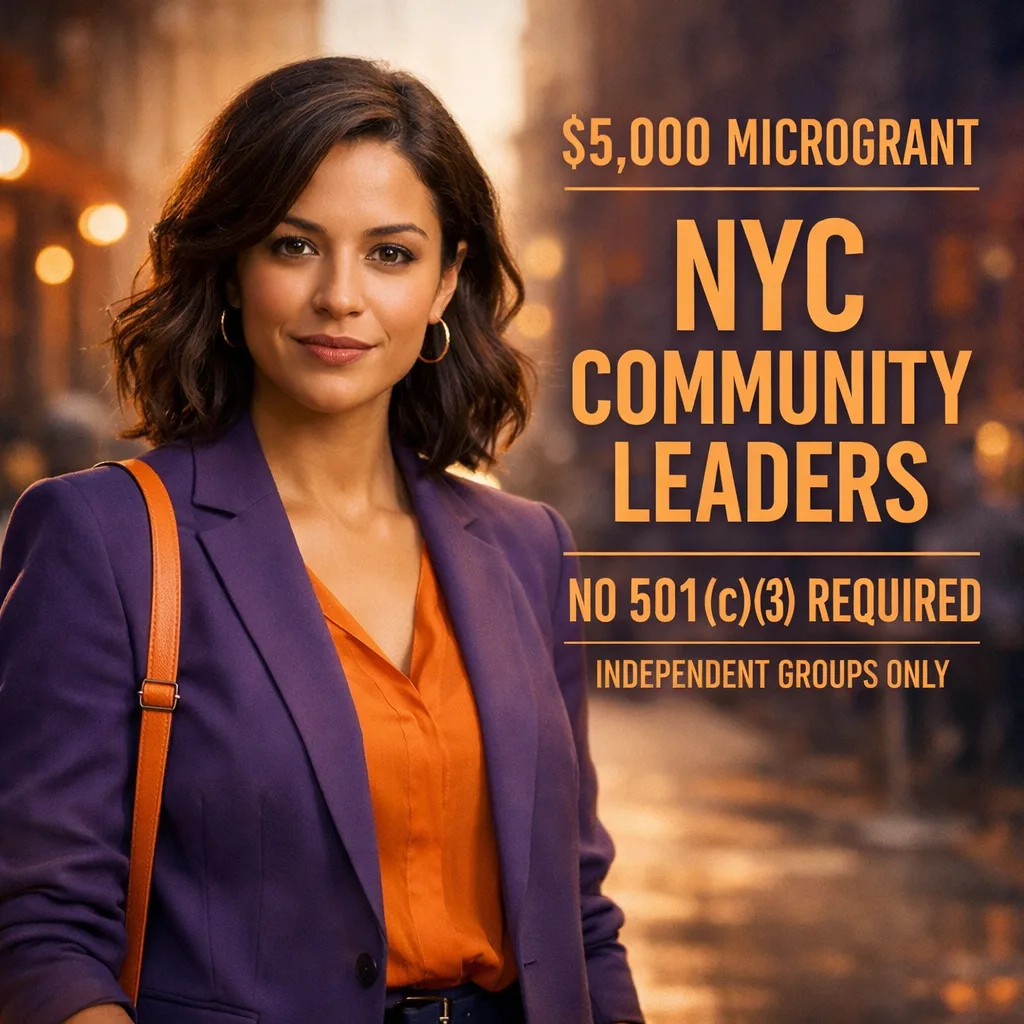
CitizensNYC's Community Leaders Grants accepts only independent, non-profit grassroots groups with zero ties to larger chapters. This $5,000 microgrant targets volunteer-led neighborhood projects in NYC's five boroughs. But independence matters more than impact. Being a chapter of a national nonprofit disqualifies you instantly. Running a church food pantry might too, depending on messaging.
The good news? You do not need 501(c)(3) status. Unincorporated groups qualify. Two volunteers minimum. Budget under $250,000. Simple, until it is not. This page untangles the specific constraints that eliminate most applicants before they type a word.
Who this grant is for: Resident-led nonprofit or volunteer groups, public schools, or youth councils in NYC with budgets under $250,000 and at least two volunteers.
Who should not apply: For-profit entities, chapters of larger organizations, groups with budgets ≥ $250,000 (unless a school), projects promoting ideology, or non-NYC applicants.
This fund is short, specific, and strict: only resident-led, non-profit or volunteer groups with modest budgets
qualify. The first thing you must check is whether your group is resident-based, non-profit (or grassroots),
not an affiliate, and under CitizensNYC’s budget ceiling. If any of those fail, this is not for you.
Who This Grant Is Actually For
Independent resident leaders who coordinate neighborhood projects without corporate backing. Think volunteer-run community gardens, unincorporated tenant associations, or parent groups organizing outside school systems. You qualify if you have zero affiliation with national nonprofits, no revenue-generating activities, and a specific project timeline between June 2026 and May 2027.
Expert Tip
Apply as if it is your first time even if you received funding before; past grantees must demonstrate new project angles to score competitively.
Who Should Skip This
Chapters of Habitat for Humanity. Church ministries promoting faith. Social enterprises selling products to fund missions. Groups with fiscal sponsors affiliated with national networks. If you pay rent for your workspace using project funds, look elsewhere. If your project started last month, you are ineligible. CitizensNYC strictly enforces the June 2026 start date.
Direct answers
Who this grant is actually for
Resident-led, non-profit or grassroots volunteer groups, public schools, or youth councils based in any of New
York City’s five boroughs, with projects scheduled between June 2026 and May 2027 and organizational budgets under $250,000.
Who should not apply
For-profit projects, chapters or affiliates of larger organizations, initiatives outside NYC, organizations with annual budgets at or above $250,000 (unless a school), or projects that promote religious or political ideology.
What makes it different
This is a resident-centered microgrant focused on neighborhood life and leadership; unlike small business grants,
it prioritizes volunteer-led civic projects and imposes a strict budget ceiling and non-affiliate rule.
What usually disqualifies applicants
Instant disqualifiers include non-residency, being an affiliate of a larger organization, having an organizational budget ≥ $250,000 (unless a school), or proposing explicitly ideological programming.
What this funding realistically supports
One-time community projects: arts events, youth programming, environmental or public safety activities, small equipment, outreach, and shortterm operations that fit a $1K–$5K microgrant model and a June 2026–May 2027 timeline.
Eligibility explained in plain language
First, verify your residency. CitizensNYC requires that applicants live in one of New York City’s five boroughs.
That means the primary contact listed on the form should have a NYC home address. If your leadership lives outside NYC,
plan to partner with an eligible local resident before applying.
Second, you must be a community-oriented group. CitizensNYC expects at least two volunteers connected to the project.
A single founder without additional volunteers will fail the volunteer threshold. Schools and youth councils are accepted,
and 501(c)(3) status is optional.
Third, your organization’s budget matters. If your group’s annual operating budget is equal to or above $250,000,
you will not be eligible—unless you are applying as a public school or school program, which is exempt from that ceiling.
Fourth, you cannot be an affiliate or chapter of a larger organization. Fiscal sponsorships, formal chapters,
or clear parent-organization relationships are likely disqualifying unless you can demonstrate independent governance.
If that relationship is unclear, treat it as an eligibility risk and contact grants@citizensnyc.org.
Finally, the program does not fund projects that promote religious or political ideology. Civic programming and
community education that do not push an ideological agenda are acceptable; explicitly partisan or sectarian projects are not.
Important Note
If any of the above rules are unclear for your group, respond with the precise situation and contact grants@citizensnyc.org before applying.
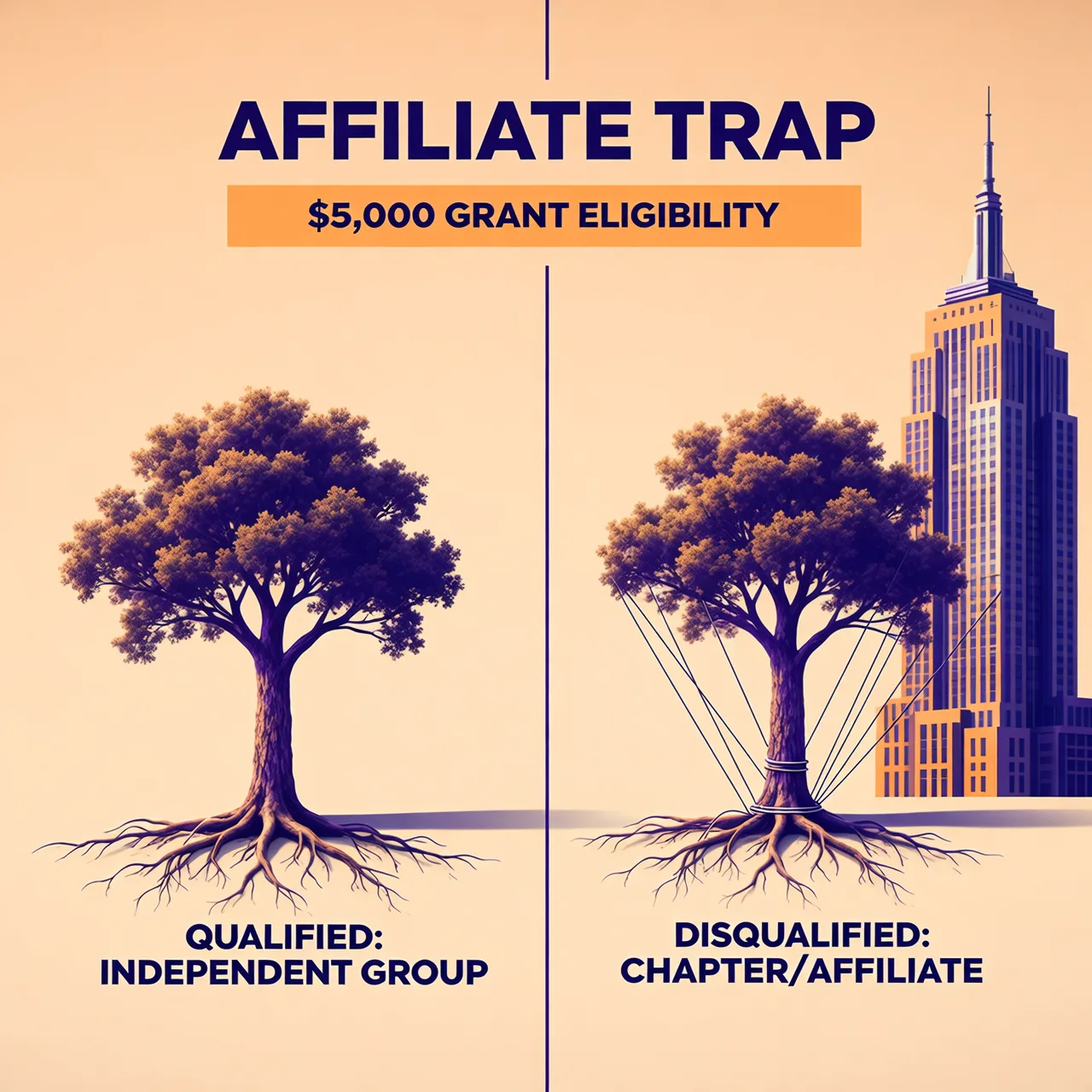
The Affiliate Trap
The fastest way to waste three hours on this application is misunderstanding "affiliate or chapter of a larger organization." CitizensNYC does not define this term publicly. However, the intent is clear. They fund hyper-local, autonomous groups. If your group shares a name, branding, or funding pipeline with a national entity, you likely fail this test.
Fiscal sponsorship creates ambiguity. Some interpret having a 501c3 fiscal sponsor as affiliation. Others argue it is merely financial management. CitizensNYC does not clarify in public documents. If your fiscal sponsor is a large regional or national organization, consider contacting grants@citizensnyc.org before applying.
Important Note
Groups that received awards in Cycle 1 (November to February) cannot apply in Cycle 2 (May to July) of the same fiscal year.
What You Can Actually Buy
This grant restricts spending heavily. You cannot pay salaries. You cannot cover rent. You cannot buy computers or projectors for personal use. The budget operates on caps.
Category
Allowable Amount
Restrictions
Stipends
Max $500 total ($250 per person)
Artists performers facilitators youth only
Space Rental
Max $500
Cannot be ongoing rent
Food
Max $500
Must serve project participants
Transportation
Max $500 public transit ($100 gas)
Personal vehicle use limited
Equipment
Case by case
Must stay in accessible community location not private homes
Garden Furniture
Max $500
Permanent installation preferred
Success hinges on framing expenses as community assets, not organizational support. A $400 purchase of t-shirts for volunteers works. Paying a coordinator $1,000 fails. Renting a generator for a one-day event works. Paying monthly office rent fails.
Community Leaders vs Neighborhood Business Grant
CitizensNYC runs two $5,000 programs simultaneously. Choosing wrong means instant rejection.
The Community Leaders Grant serves nonprofit and volunteer groups. The Neighborhood Business Grant serves for-profit businesses. That is the fundamental divide. If your group generates revenue, applies for 501c3 status eventually, or operates as a social enterprise, you likely need the Business Grant, not this one.
Other differences matter. The Business Grant requires two years operating history and maximum ten employees. This grant requires neither. The Business Grant targets business-led community initiatives. This grant targets pure community building. They share office hours and application platforms but use separate review criteria. Double-check your tax status before choosing.
The Religious Organization Question
CitizensNYC prohibits projects that "promote religious, political, or any other ideology." Yet they do not clarify whether religiously-affiliated groups running secular work qualify.
A church running a vacation Bible school faces obvious rejection. A church basement hosting a secular food pantry enters gray territory. The prohibition targets promotion, not location. However, without published guidance on this distinction, applicants meeting in religious spaces risk disqualification. If your project serves general community needs without religious requirements for participation, you might qualify. Emphasize secular outcomes in your application.
What Success Looks Like
Scoring happens across four areas: Need, Quality of Life Impact, Community Engagement, and Clarity. High-scoring applications demonstrate major improvements lasting over one year with daily community benefit. Minor improvements lasting weeks score lower.
Examples help. Transforming an abandoned lot into a permanent community garden where residents grow food scores as major impact. Adding mulch to an existing garden scores as minor. Creating a new internship program where youth train next year's cohort scores major. Continuing last year's internship scores minor.
Do's
Demonstrate lasting infrastructure or skill transfer
Show daily community benefit beyond event days
Include specific timelines with responsible parties named
Don'ts
Request salary support or ongoing rent payments
Submit projects completed before June 2026
Apply as a chapter of national nonprofits
Application Reality Check
The form requires two distinct contacts with separate phone numbers and emails. Both must participate actively in the project. CitizensNYC calls applicants for clarification, so use real numbers you answer.
Demographic data collection is mandatory but not scored. They collect race, ethnicity, LGBTQ+ status, gender, immigrant generation, age, and disability for both contacts. This data goes to city and state agencies for equity tracking. It does not influence selection.
Budget realism matters more than ambition. Requesting $5,000 for a $50,000 project suggests poor planning. Requesting $5,000 for a $4,200 project shows precision. The review committee may award less than requested based on budget line items.
Must Do
Confirm independence from national organizations
Verify June 2026 start date for projects
Prepare detailed budget with capped expenses
Name two distinct contacts with phone access
Draft 150-word minimum responses for four narrative sections
Eligibility Verification
Use our interactive tool below to check your specific situation against current CitizensNYC requirements. This tool processes the complex affiliation and budget rules instantly.
Eligibility Check
Eligibility for Community Leaders Grants CitizensNYC
Answer a few guided questions. Your responses are matched to this grant's criteria in real time.
Ready to check your eligibility?
We'll guide you through a short, structured flow and instantly evaluate fit for this opportunity.
Eligible
You Appear Eligible
Based on your answers, you meet the core requirements for this grant.
Recommended Next Step
Protect Your Application Before You Submit
You look eligible — but eligibility alone doesn't win grants. Most rejections happen on the application itself: missed language, wrong framing, weak impact statement. A Grantaura Expert Review takes 24–48 hours and flags every gap before the funder sees it.
✓Expert reviews your draft⏱Results in 24–48 h💰Avg. grant value $12,000+
⚠ Grant committees reject 7 in 10 applications that meet eligibility. One overlooked line can cost you thousands.
🔒 Satisfaction-backed — if our review finds nothing actionable, you pay nothing more.
This Grant Isn’t the Right Fit. Your Best One Might Be Two Clicks Away.
Missing one criterion for Community Leaders Grants CitizensNYC doesn’t mean you’re out of options — it means this grant wasn’t designed for your profile. Our expert research team identifies the grants built specifically for businesses like yours, across 500+ active opportunities.
Basic Match
$125
One-time research
A list of 5 grants only
Basic eligibility matching based on industry & location
Standard funding amount range verification
Primary criteria alignment check
Most Popular
Advanced Match
$145
One-time research
A list of 7 grants only
Advanced eligibility matching with business model analysis
Deep competitive advantage assessment
Innovation & impact potential matching
Market fit & growth trajectory alignment
Premium Match
$175
One-time research
A list of 10 grants only
AI-powered deep-match algorithm analysis
Historical success pattern matching
Priority sector & focus area alignment
Advanced sustainability impact matching
Strategic vision & long-term goals alignment
Preparing secure checkout…
✓
Order Confirmed
Your grant research order is placed. Our team will deliver your personalised report within 3–5 business days. Check your email for confirmation.
Auto-advances after each answer. Use Back to revise.
More Community Leaders Grants
CitizensNYC Neighborhood Business Grant: For-profit businesses in NYC seeking $5,000 microgrants for community impact projects. Unlike the Community Leaders Grant, this requires profit-generating status and two years operating history.
- Donor: Citizens Committee for New York City
- Focus: small business funding, community development, NYC entrepreneurship
- Deadline: Varies by cycle
EmpowerHer Fund NYC: Microgrants supporting women-led community initiatives in New York City. Targets grassroots leaders similar to CitizensNYC but specifically for female residents with projects under $1,000.
- Donor: EmpowerHer Initiative
- Focus: women leadership, NYC grassroots funding, gender equity
- Deadline: Rolling
New York City Grants: Comprehensive directory of NYC-specific funding opportunities across all five boroughs. Filter by borough-specific eligibility including Bronx, Brooklyn, Manhattan, Queens, and Staten Island programs.
- Donor: Various
- Focus: NYC nonprofit funding, five boroughs, local community grants
- Deadline: Varies for each grant in New York City
Grantaura indexes over 200 funding opportunities for NYC community leaders. Our platform updates daily with new microgrants, capacity building awards, and grassroots funding sources. Create a free account to save searches for independent volunteer groups and unincorporated organizations.
Terms
Affiliate or Chapter: A local group formally connected to a larger regional or national organization sharing branding, funding, or governance structures. CitizensNYC rejects these groups to ensure funding reaches truly independent local leaders rather than existing network nodes.
Community-Oriented Group: An organization or informal collective focused on neighborhood improvement with at least two volunteers. The term encompasses nonprofits, schools, youth councils, and unincorporated volunteer associations working for public benefit rather than private profit.
Fiscal Sponsor: A tax-exempt nonprofit that manages funds and administrative tasks for groups lacking 501c3 status. The relationship creates ambiguity for CitizensNYC eligibility because large fiscal sponsors might be interpreted as "larger organizations" under affiliate rules.
Grassroots Volunteer Group: An unincorporated collective of residents organizing projects without formal nonprofit status, paid staff, or corporate structure. These groups qualify for Community Leaders Grants specifically because CitizensNYC does not require 501c3 incorporation.
Major Quality of Life Impact: Project improvements lasting longer than one year with benefits noticeable daily or almost daily. Examples include permanent infrastructure like community gardens or skill transfer programs creating lasting leadership pipelines.
Microgrant: Small funding awards, typically under $10,000, designed for specific projects rather than general operating support. CitizensNYC's $5,000 maximum fits this category, emphasizing accessible funding for small volunteer groups.
Minor Quality of Life Impact: Temporary improvements lasting weeks or less, such as one-time events or maintenance of existing programs. These score lower in CitizensNYC review criteria compared to major impact projects.
Nonprofit Status: Tax-exempt status under IRS 501c3 code. While many grants require this, CitizensNYC explicitly accepts groups without 501c3 status, including pending applications and unincorporated groups, provided they meet other eligibility criteria.
Profit-Generating: Organizations earning revenue through sales, services, or commercial activities. CitizensNYC Community Leaders Grants prohibit profit-generating entities, redirecting them to the Neighborhood Business Grant instead.
Project Period: The mandatory implementation window between June 2026 and May 2027. Projects starting before June 2026 or ending after May 2027 are ineligible regardless of merit or community need.
Resident-Led: Projects designed and implemented by local community members rather than outside institutions or professional organizations. CitizensNYC prioritizes authentic local leadership over external expertise.
Stipend: Fixed payment to individuals for specific services like facilitation or performance, distinct from salary or wages. CitizensNYC allows stipends up to $250 per person ($500 total) but prohibits regular employment compensation.
Two-Cycle System: CitizensNYC's biannual grantmaking schedule with applications opening November and May. Winners of Cycle 1 cannot apply in Cycle 2, creating strategic timing considerations for applicants.
Volunteer Requirement: The mandatory minimum of two volunteers associated with the project. CitizensNYC accepts groups that "will have" volunteers, allowing recruitment post-application but before implementation.
Youth Council: Formal or informal groups of young people organizing community projects. These entities qualify for Community Leaders Grants and receive exemptions from the $250,000 budget cap applied to other applicant types.
Author
Imran Ahmad writes about funding and practical grant decisions for Grantaura. With a background in marketing and mass communication,
Imran focuses on translating eligibility rules into quick decisions for neighborhood leaders and small volunteer teams.
He builds clear, decision-first listings so local applicants spend less time guessing and more time applying.
We are your trusted grant application partners. You can navigate the entire grant application process with our expert guidance through this simple 5-step process.
300+ Projects
4.9/5 Rating
Expert Team
Step 1: Application Form
Fill out the "Apply for this grant" form with your information and grant requirements.
Step 2: Eligibility Assessment
Our grant experts will assess your eligibility and notify you via email.
Step 3: Expert Consultation
A dedicated grant expert will be assigned to discuss next steps for your application.
Step 4: Application Submission
Our expert will help you complete and submit your application with all required materials.
Step 5: Final Decision
The grant committee will make their decision and notify successful applicants.
As the founder of Grantaura, I've dedicated myself to demystifying the grant funding process. My goal is simple: to empower entrepreneurs, non-profits, and innovators like you to secure the capital needed to make a real impact. Let's build your funding strategy together.
Profile data is saved in your browser and synced to secure storage when available.
Context
Grants selected0
SLA tierNot selected yet
Billing modelNot selected yet
Due today--
Total project value--
Selection preview
No grants selected yet.
Soft estimate
Estimate only. Final pricing appears in Quote step.
Quote expiry
Quote timer starts after pricing is generated.
Verification
Verification status appears here once quote is confirmed.
Success snapshot
Success milestones appear here after confirmation.
What happens next
After quote confirmation, verify your email and complete secure payment.
ProfileReviewPayment
Choose your service
Select how you want to proceed. You will review pricing before checkout.
Next stepReview pricing, then checkout
Recommended
Full service
Full Application Submission
From USD 41.40
We prepare and submit your grant application on your behalf, with priority or rush handling applied when the deadline makes faster service necessary.
No funding guarantee. If Grantaura cannot complete due to our operational failure, refund policy applies.
Assessment
Quick review
Eligibility Assessment
USD 5.99 one-time
Find out if you qualify. Results typically within 24 hours.
FreeNo card needed
Share & Submit Free
Share this grant with your network. We will assess your application at no cost.
Why does Grantaura charge a fee?
The donor does not charge you. This fee covers Grantaura's hands-on work: expert review time, eligibility checks, application drafting, and submission handling.
You will see the exact quote before checkout. Nothing is charged just for opening this screen.
Keep your post public. Our team will verify the link before processing your assessment. If the post is deleted or made private after submission, your free assessment will be void.