IMLS Inspire Grants for Small Museums
Federal project grants for small museums supporting collections care, education, and capacity building. No match required under $25K.
Key Takeaways
Small projects $5K-$25K need NO match
Large projects $25K-$75K need 1:1 match
Deadline March 13 2026 no exceptions
SAM registration takes several weeks
Grant Overview
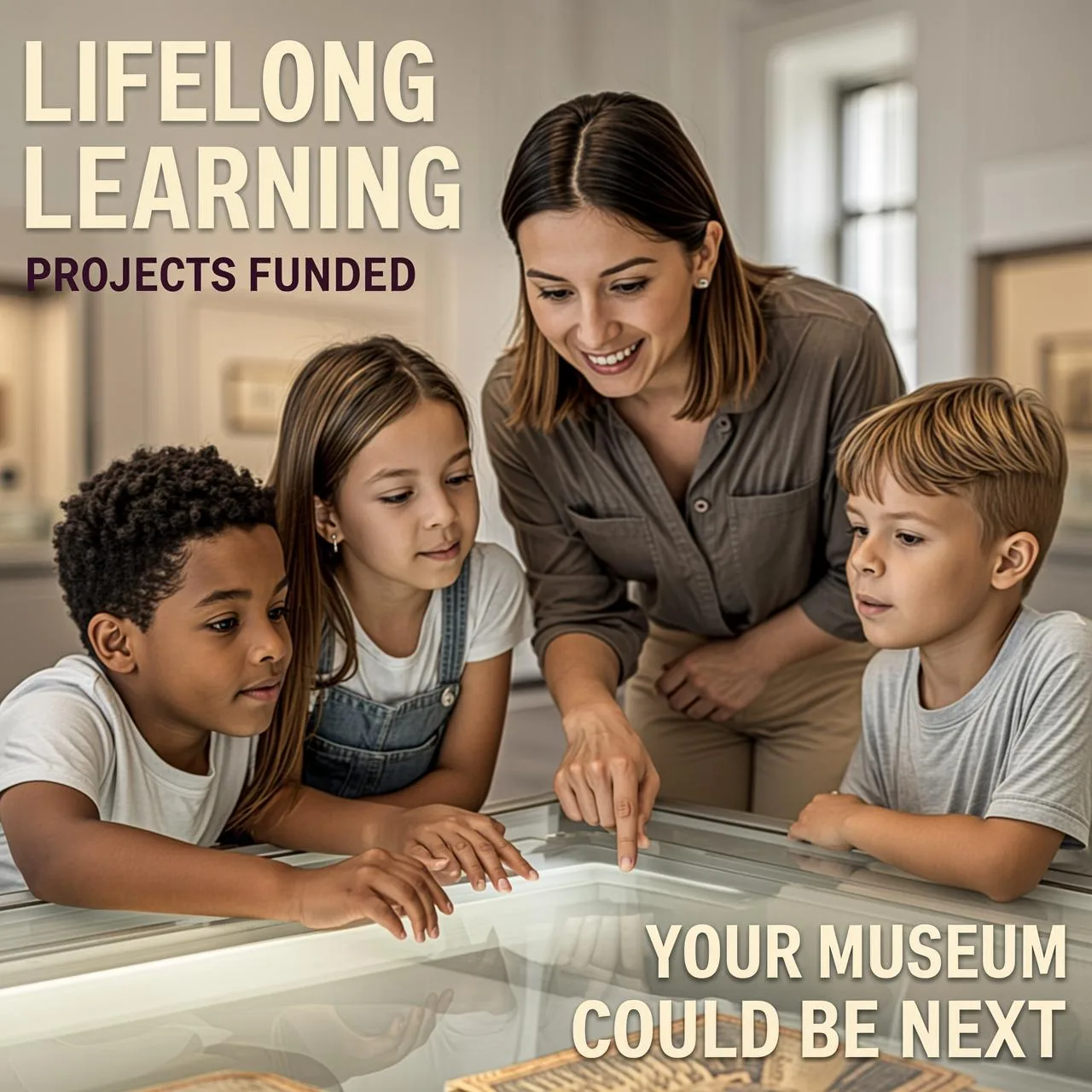
Small museums face a peculiar catch-22: you need funding to build capacity, but many grants assume you already have it. The Inspire! Grants for Small Museums program gets this. IMLS designed this specifically for museums with limited staff, tight budgets, and structural constraints that make competing for larger grants nearly impossible. For FY26, the program has two distinct tiers. Small projects ($5,000–$25,000) require zero matching funds. Large projects ($25,001 - $75,000) need a 1:1 match from non-federal sources.
If you have been putting off applying because matching funds felt out of reach, the small project tier might be your opening. The deadline is March 13, 2026, but there is a hidden timeline trap most people miss: SAM.gov registration alone can take several weeks. If you are not already registered, you need to start today.
Inspire! Grants for Small Museums
- Grant Award
- $75,000
- Application Deadline
- March 13, 2026
- Eligible Region
- United States, District of Columbia, Puerto Rico, US Virgin Islands, Guam, American Samoa, Northern Mariana Islands, Marshall Islands, Federated States of Micronesia, Republic of Palau
- 501(c)(3) nonprofit organization OR unit of state/local/tribal government
- Located in the United States or eligible territories
- At least one professional staff member (paid OR unpaid) primarily handling collections
- Own or use tangible objects exhibited to the public for minimum 120 days per year
- Active SAM.gov registration with current UEI
- Active Grants.gov registration with approved AOR
- Current IMLS grantees cannot apply for renewal/supplementation
- $75,000
- Small Projects ($5,000-$25,000): NO cost share required
- Large Projects ($25,001-$75,000): 1:1 cost share from non-federal sources required
- Project period: 1-3 years (September 1, 2026 – August 31, 2029)
- Approximately 75 awards anticipated from $3,000,000 total funding
- Average award in previous years: $43,147
Check Your Eligibility for Inspire! Grants
IMLS does not use a bright-line test for "small." Instead, you self-assess based on organizational constraints: staff size, operating budget, collection scope, facility limitations, and capacity relative to similar institutions in your region. The Eligibility Checker below walks you through the key questions IMLS reviewers will evaluate. It takes about one minute and gives you an immediate read on whether you should apply.
If the tool shows you qualify, start your SAM.gov registration immediately if it is not active. That is the longest lead-time requirement. If you do not qualify, consider whether you could partner with an eligible institution as a subcontractor. If you are unsure about your professional staff designation or public access calculation, we recommend speaking with a program officer before proceeding.
Not sure if you qualify as "small"? Our experts specialize in eligibility assessments. We will review your organizational structure and help you determine the strongest positioning for your application according to the IMLS. Book a free consultation and we will do the analysis for you.
Small Projects vs Large Projects: Which Tier Fits You?
The program operates in two tiers. Choose carefully. Your tier determines your matching requirement and your competition pool.
Small Projects are ideal if you need to digitize a specific collection, produce a small exhibition, or send one staff member to professional training. Large Projects suit multi-year initiatives like comprehensive collections rehousing, major exhibition development, or institutional strategic planning processes.
Cost share is an eligibility criterion for Large Projects, not a scored factor. You either have it or you do not. But you must document it thoroughly. Acceptable sources include cash reserves, donated professional services, volunteer hours valued at fair market rate, or existing staff time reallocated to the project.
Q: Can I include the value of volunteer time as part of my match for a Large Project?
A: Yes. Volunteers' time counts as in-kind cost share if you can document hours worked and calculate the value using prevailing wage rates for comparable professional positions in your area. You must keep detailed records during the project period.
Q: What if I start with a Small Project but realize mid-application that I need more funding?
A: You cannot change tiers after submission. Choose carefully at the start. If your project legitimately requires more than $25,000, you need to secure matching funds before applying.
How IMLS Actually Defines "Small" (And How to Make Your Case)
This is where most applicants stumble. IMLS does not publish a staff number cutoff or budget threshold. Instead, the NOFO lists attributes you must address in your Organizational Profile: number of staff and volunteers, total person-hours worked per week, operating budget and revenue sources, collection size and type, facility square footage, audiences served, and size relative to peer institutions in your discipline or region.
Reviewers want to see constraints, not just numbers. A museum with three paid staff and a $200,000 operating budget might be "small" in a major metropolitan area where peer institutions have 30-person teams and multimillion-dollar budgets. That same museum might be considered mid-size in a rural region where most museums are entirely volunteer-run with budgets under $50,000.
Q: Our museum is part of a university. Does that disqualify us as "small"?
A: Not automatically. Museums within parent organizations can apply independently if they function as discrete units with segregated budgets and independent application authority. You will need to document this clearly in your Organizational Profile.
Q: We have one paid director and everyone else is a volunteer. Are we too small to manage a federal grant?
A: Small staff size doesn't disqualify you, but you do need to show you can manage federal compliance requirements: reporting, budget tracking, record-keeping. If your director has grant management experience or you plan to bring in a fiscal consultant (allowable cost), that strengthens your case.
Lifelong Learning vs Collections Stewardship: Picking Your Objective
Inspire has two objectives and you must choose one. Your project Narrative must align clearly with the objective you select. Different IMLS program officers review applications based on objective, so choosing the wrong one can land your project in front of a reviewer who is not the best match for your work.
Objective 1: Lifelong Learning
This supports experiential learning and discovery programs. Think educational exhibits, interpretive programs, digital learning resources, community engagement activities, visitor experience improvements, youth programs, or teacher professional development. Contact Reagan Moore (rmoore@imls.gov) for counseling on Lifelong Learning projects.
Objective 2: Collections Stewardship and Access
This supports management and care of collections. Examples include conservation assessments, environmental monitoring, treatment of objects or specimens, rehousing projects, catalog improvements, digitization for access, metadata enhancement, or collections management system implementation. Contact Mark Feitl (mfeitl@imls.gov) for guidance on Collections projects.
If you are on the fence between tiers, default to the Small Project track unless you have documented matching funds already committed. Securing cost share mid-application is nearly impossible.
The Strategic Plan Requirement Most Applicants Underestimate
IMLS requires a Strategic Plan Summary and you must indicate who approved the plan and when. This is not optional. Reviewers explicitly evaluate how well your project advances your institutional strategic goals.
If you do not have a formal strategic plan, you need one before applying. A one-page vision statement will not cut it. IMLS expects a document that articulates organizational priorities, identifies goals and objectives, and shows governance approval (board resolution, director signature, stakeholder endorsement).
The good news: your plan does not need to be elaborate. A three-year strategic plan with clear priorities, measurable objectives, and documented approval is sufficient. What matters is that your proposed project demonstrably connects to a specific strategic objective.
Q: Our strategic plan expired two years ago. Can we still use it?
A: Technically yes, but it weakens your application. An expired plan signals organizational drift. If you are still working from that plan and it is current in practice, explain that in your Strategic Plan Summary. Better option: have your board quickly reaffirm the plan's continued relevance.
Strategic plan missing or outdated? Grantaura's experts can facilitate rapid strategic planning processes designed for small institutions. We will help you develop a board-approved plan that meets IMLS requirements and actually serves your museum's needs beyond this grant. Schedule a planning session.
SAM.gov and Grants.gov: The Registration Bottleneck You Cannot Rush
The NOFO explicitly warns that SAM.gov registration "can take several weeks." This is not an exaggeration. You need a Unique Entity Identifier (UEI), an active SAM.gov registration, and a Grants.gov account with an Authorized Organization Representative (AOR) before you can submit. Each step depends on the previous one.
Create a Login.gov account immediately if you do not have one Start SAM.gov registration today - do not wait Designate multiple AORs in Grants.gov to avoid single-point-of-failure risk Verify your organization's bank account information in SAM matches current records Check that your organization's legal name in SAM exactly matches your IRS determination letter
Q: We registered in SAM.gov five years ago for a different grant. Are we still good?
A: Check immediately. SAM registrations must be renewed at least every 12 months. If yours lapsed, you will need to reactivate it and that can take as long as initial registration. Log into SAM.gov now and verify your status shows as Active.
What the Application Actually Requires
The NOFO lists required documents that typically slow applicants down: the Narrative (5 pages maximum, strictly enforced), the IMLS Budget Form (requires JavaScript-enabled PDF software), and the Performance Measurement Plan.
The 5-Page Narrative (Where Most Applications Succeed or Fail)
You have five pages to address three sections: Project Justification, Project Work Plan, and Project Results. IMLS will remove any additional pages. Use 11-point font minimum and 0.5-inch margins minimum.
Project Justification must explain which Inspire objective you are addressing, how the project advances your strategic plan, what need or problem you are solving, who your primary audience is, and who the ultimate beneficiaries are.
Project Work Plan needs to detail specific activities and their sequence, risks and mitigation strategies, who will manage the project, what resources you need, and how you will track progress.
Project Results should articulate intended outcomes, how knowledge or skills or behaviors will change, what products you will create, how you will sustain benefits beyond the grant period, and how collection care or access will improve.
Allowable Costs
Q: Can we use grant funds for marketing the project?
A: Yes, reasonable costs for publicizing the project's results are generally allowable if directly tied to project objectives. However, these should not be general institutional marketing expenses.
Timeline and What to Expect
Applications are due March 13, 2026 by 11:59 p.m. U.S. Eastern Time. IMLS anticipates notifying successful applicants in August 2026. Projects must begin September 1, 2026 and can run one to three years.
The review process involves peer panels of museum professionals. They score based on four criteria: Project Justification (35%), Work Plan (25%), Evaluation (20%), and Organizational Capacity (20%). For Inspire! grants, reviewers specifically consider your institutional constraints when scoring capacity.
Cost share is an eligibility criterion and is NOT considered in peer review. Reviewers do not see whether you provided the minimum match or significantly exceeded it. What matters is project quality.
Key Terms for Museum Grant Seekers
- Cost Share: The non-federal portion of project costs you must provide for Large Projects. Can be cash or in-kind contributions including volunteer time valued at fair market rates. Proper documentation is essential for eligibility.
- IMLS: The Institute of Museum and Library Services is the federal agency administering this grant. It is distinct from the National Endowment for the Arts (NEA) and National Endowment for the Humanities (NEH) though all three support cultural projects.
- Lifelong Learning: One of two project objectives covering educational programs, workshops, and experiences that serve diverse audiences including K-12 students, adults, and families. Contact Reagan Moore for this track.
- Collections Stewardship and Access: The project objective covering preservation, conservation, digitization, rehousing, and improved public access to collections. Contact Mark Feitl for this track.
- Organizational Profile: A required section where you describe your museum's size, budget, staff, collection scope, and regional context. This helps reviewers evaluate your proposal relative to similar institutions.
- Professional Staff: At least one person paid or unpaid who spends most of their time on acquisition, care, or exhibition of objects. This can be a volunteer curator or director.
- SAM.gov: The System for Award Management. All federal grant applicants must have active registration with a current Unique Entity Identifier (UEI). Registration can take several weeks.
- Grants.gov: The federal portal for submitting grant applications. Requires registration and an approved Authorized Organization Representative (AOR).
- Project Period: The duration of your grant activity. Inspire! grants can run one to three years within the period September 1, 2026 through August 31, 2029.
- Cost Share Threshold: The $25,000 dividing line between Small Projects (no match required) and Large Projects (1:1 match required). Choose your request amount strategically.
- UEI: Unique Entity Identifier. Replaced the DUNS number in 2022. You get this automatically through SAM.gov registration. Required for all federal grant applications.
- AOR: Authorized Organization Representative. The person in your organization approved to submit federal grant applications through Grants.gov.
- NOFO: Notice of Funding Opportunity. The official federal document announcing the grant competition. Contains all rules, requirements, and evaluation criteria.
- Strategic Plan Summary: Required document explaining how your proposed project advances specific institutional strategic objectives. Must indicate approval date and governing body.
- Performance Measurement Plan: Required explanation of how you will monitor and assess project performance using four measures: Effectiveness, Efficiency, Quality, and Timeliness.
- Discrete Unit: A museum within a larger organization that functions independently with its own segregated budget and authority to apply for grants.
Explore More Funding Opportunities
Small museums should never rely on a single funding source. While you wait for Inspire! results, consider other federal and private opportunities. The Wells Fargo Community Grants support nonprofits including arts and culture. For arts-focused projects, check our Artist Grants List. The FFNHA Education Materials guide may help with educational project framing. Museums seeking professional development support might explore Artist in Residence Fellowships to complement programming.
For capacity building parallels, see the Creative Business Boost Initiative or Creative Investment Art Grants. Nonprofits needing marketing support might consider LinkedIn Ad Grants. Small organizations with limited resources can explore the Outta Excuses Empowerment Grant. For general grant guidance, visit our FAQs page or connect with professional grant writers if you need application assistance.
Need Help With Your Application?
Federal grant writing is a specialized skill. The forms are dense. The requirements are specific. One missing document or formatting error can disqualify an otherwise strong project. If you are unsure about your eligibility, struggling with the budget forms, or want a professional review before submission, we can help.
Grantaura's team includes former museum professionals and federal grant reviewers who understand what makes these applications succeed. We offer application review, budget preparation assistance, and full grant writing services. We also provide free initial consultations to help you determine if this grant fits your institution.
Book a Free Consultation | View Our Services
About the Author
Imran builds Grantaura to level the playing field for small organizations seeking federal funding. He knows that a historical society in rural Montana deserves the same shot at grants as a major metropolitan museum. The Inspire! program is one of the few federal initiatives that genuinely understands this. When not digging through NOFOs, Imran works directly with small museum boards and directors to translate their community impact into language that federal reviewers understand.
How to apply for this grant
We are your trusted grant application partners. You can navigate the entire grant application process with our expert guidance through this simple 5-step process.
Step 1: Application Form
Fill out the "Apply for this grant" form with your information and grant requirements.
Step 2: Eligibility Assessment
Our grant experts will assess your eligibility and notify you via email.
Step 3: Expert Consultation
A dedicated grant expert will be assigned to discuss next steps for your application.
Step 4: Application Submission
Our expert will help you complete and submit your application with all required materials.
Step 5: Final Decision
The grant committee will make their decision and notify successful applicants.