San Francisco's $10,000 Accessibility Grant: Apply Before You Spend a Dollar
Paul Geffner received $10,000 from San Francisco to fix the ADA problems at his pizza restaurants - and he described it as "nice to see the city defend us for a change." His total renovation costs ran higher than the grant. He also had to settle a separate ADA lawsuit on top of everything. But the money was real, the program worked, and Bloomberg CityLab reported in 2023 that it may be the first initiative of its kind in a major American city. The program is the Accessible Barrier Removal Grant, run by San Francisco's Office of Small Business. It reimburses up to $10,000 per location for physical ADA barrier removal - ramps, power door buttons, grab bars, contractor labor, CASp inspections, permit fees.
Applications are accepted on a rolling basis with no fixed deadline, and here is the part almost nobody explains clearly: you can apply using just a contractor quote, before you spend a single dollar on the work itself.
Registered in San Francisco with a 7-digit Business Account Number (BAN)
Must be a place of public accommodation open to the general public
Annual gross revenue under $2.5M for a single-location business
Annual gross revenue under $8M for businesses with multiple locations
Average of 100 or fewer employees
Must be the owner-operator of the business - not a passive landlord
Existing businesses need a CASp report or ABE Category Checklist
New businesses making major permitted renovations are exempt from the CASp requirement
Not eligible: religious organizations, private clubs, home-based businesses, short-term rentals, Shared Spaces operators
Non-profits eligible if operating a place of public accommodation and current with the CA Registry of Charitable Trusts
Grant Benefits
$10,000
Maximum reimbursement per business location
CASp inspection and written report fees covered
Accessible equipment and fixture purchase and installation
Labor costs covered with written prevailing wage confirmation from contractor
Architectural and engineering fees for ADA improvements
Permit fees for accessibility-related work
Projects completed within the past 2 years qualify for retroactive reimbursement
04
Focus Areas
ADA compliancebarrier removalaccessibility improvements
A Real San Francisco Business Got $10,000 - Here Is What They Used It For
Paul Geffner has owned Escape from New York Pizza in San Francisco for over three decades. By 2021, the pandemic had shut three of his five locations. Then came a lawsuit - from a firm that the San Francisco and Los Angeles district attorneys would later accuse of filing thousands of fraudulent ADA claims against small businesses across the city, many of them immigrant-owned shops in Chinatown.
He received the $10,000 Accessible Barrier Removal Grant and used it for a CASp inspection, counter modifications, new accessible tables, and entrance improvements. His total renovation costs exceeded the grant amount. He also settled the lawsuit separately, at an undisclosed sum. Both of those details are important. The grant is real and it paid out - but it is not a complete solution to every ADA-related cost a business might face. That honest framing is why this account is worth trusting.
Bloomberg CityLab covered Geffner's story and the broader program in March 2023. The Office of Small Business took a hands-on approach with applicants in the early years of the program, working directly with each business through the process rather than simply directing them to a form. At the time of the program's launch, the city's OSB director described it as potentially the first initiative of its kind in a major American city. Whether that record has since been matched elsewhere, this program has a documented track record with real named applicants.
What the SF Barrier Removal Grant Covers - Including Labor
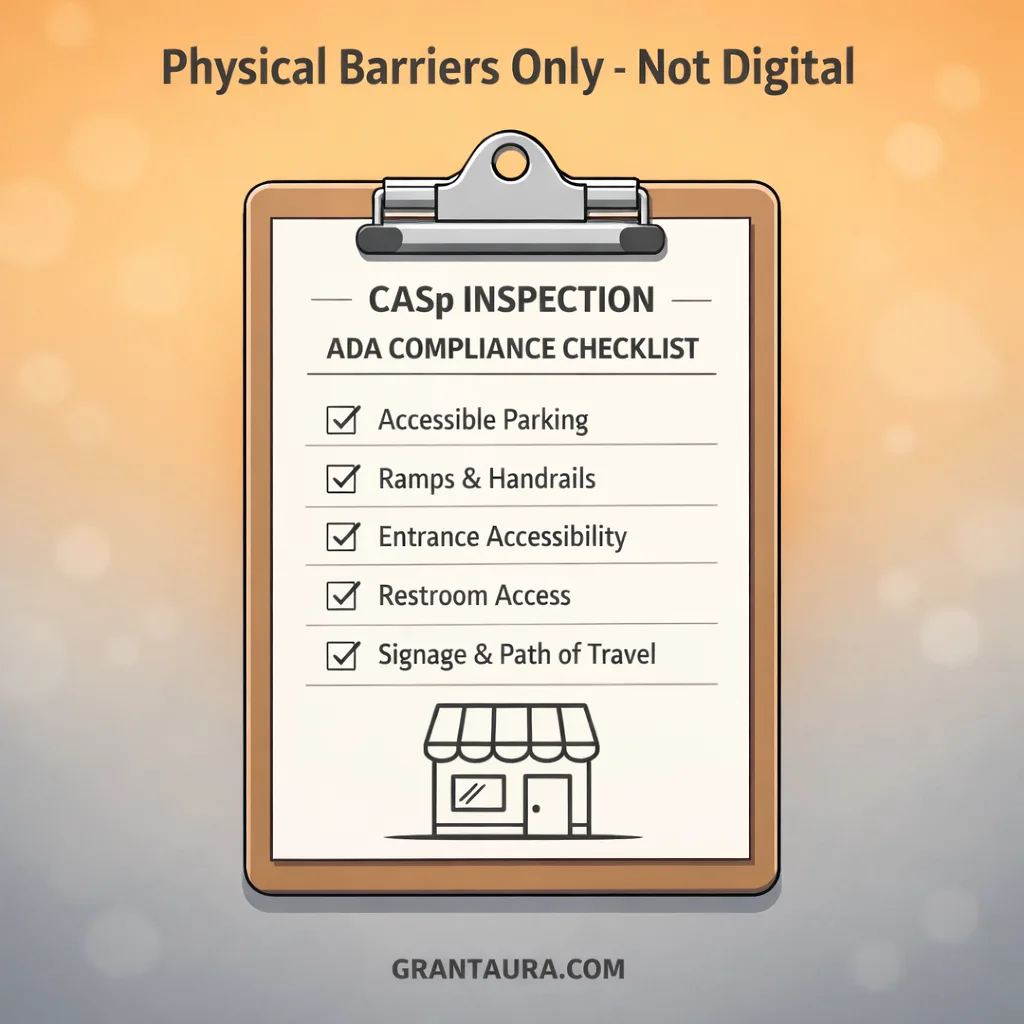
The grant covers physical ADA barrier removal. That is the whole scope. No digital. No website compliance. No apps. Strictly the physical space your customers and employees move through.
Here is what qualifies:
Key Points
CASp inspection and full written report
Power door buttons and accessible equipment
Bathroom grab bars and ADA-compliant bathroom fixtures
ADA-compliant counter sections with accessible POS placement
Construction and contractor labor costs
Architectural and engineering services
Permit fees for accessibility work
Work completed within the past 2 years
CASp Inspection Reimbursement: What the Report Needs to Show
The CASp inspection cost is itself reimbursable within the $10,000 cap - so getting one does not permanently come out of your pocket. But there is a format requirement that catches applicants off guard. The Office of Small Business requires the CASp report to follow the ADA priority table structure. That means the inspector must address entrance access barriers first, then path of travel from the entrance, then restrooms, and then other elements like counters and tables. A report that identifies the right barriers but organizes them differently may need supplementation before OSB will accept it - even if the CASp inspector is fully licensed and qualified. If you already have a CASp report from a previous inspection, check the format before assuming it qualifies.
And here is what does not qualify - worth knowing before you build any assumptions into your planning:
Things to Avoid
Website or digital accessibility improvements
Movable restaurant tables and chairs
Shared Spaces and parklet-related construction
Labor where the contractor cannot confirm prevailing wage compliance in writing
Any expense already claimed under SF Shines grants
Now, about labor. A 2022 post from a local business community organization - which still ranks in search results for this grant - flatly states that the program will not cover labor costs. That information is wrong. Labor has been reimbursable under the current program guidelines, subject to one specific condition: your contractor must confirm in writing that they pay prevailing wages to their workers and subcontractors. One email or letter from your contractor is the entire requirement for unlocking full labor reimbursement within the $10,000 cap.
Important Note
The prevailing wage confirmation is not something the Office of Small Business will chase down for you. It has to come from your contractor before or alongside your reimbursement request. If your contractor has never heard of San Francisco prevailing wage requirements, that conversation needs to happen before the project starts - not after the work is complete and the invoice is already in your hand.
San Francisco ADA Reimbursement: Apply First, or Claim Work You Already Paid For
Most people assume you need to complete the work before applying. You do not. There are two distinct ways to use this grant, and the second one is the part almost no guide currently explains with any clarity.
Path 1: Apply before you start. Submit a contractor quote dated within the last six months. The city reviews your eligibility and responds by email within 15 days. Once confirmed, the Office of Small Business works with you on a reasonable timeline for completing the project - there is no fixed deadline to finish after pre-approval. When the work is done and paid for, you submit your proof of payment, the contractor's written prevailing wage confirmation, and photos of the completed improvements. The city verifies permit completion on their end. Then you get reimbursed.
Path 2: Claim work you already paid for. Projects completed within the past two years are eligible for retroactive reimbursement. This window is real and confirmed by SF.gov. It is also one of the least-discussed details in every third-party guide currently ranking for this grant. If your business completed accessibility improvements in the last two years and you did not apply at the time, you may still have a valid claim.
Already had accessibility work done? Here is what to check before applying:
Required Steps
Work was completed within the past 24 months
Invoice or receipt is clearly labeled as invoice not estimate or work order
The contractor can provide a written prevailing wage confirmation
A CASp report or ABE Checklist identifying the work exists in OSB-required format
Permits were pulled if the project required them
Photos of the completed accessibility improvements are available
Important Note
If you already have a CASp report from a previous inspection - including one prepared during a lawsuit - check that it follows the ADA priority table format before applying. OSB requires entrance access addressed first, path of travel second, restrooms and counters third. A report covering the right work but organized differently may need supplementation.
Have documentation from past work but not sure whether it meets OSB's specific format requirements? That kind of pre-submission review is exactly where a rejected application gets saved before it is ever submitted.
Who Qualifies for San Francisco's Accessibility Grant
If you run a physical business in San Francisco that is open to the public, has under $2.5 million in annual gross revenue, and averages 100 or fewer employees, there is a good chance you already meet the basic threshold. Most registered SF small businesses do. But three specific requirements catch applicants off guard, so it is worth reading the full picture.
1. San Francisco Business Account Number (BAN). The 7-digit BAN is assigned when you register your business with the city. Every legally operating SF business has one. It is the first thing the application asks for and the first eligibility check OSB runs.
2. Place of public accommodation. This is the ADA Title III legal term for businesses open to the general public - restaurants, retail shops, hair and nail salons, medical and dental offices, gyms, theaters, day care centers, and many others. Private clubs, home-based businesses, and short-term residential rentals are explicitly excluded. The test is simple: is your business physically open to any member of the public who walks through the door?
3. Revenue thresholds. Under $2.5 million in annual gross revenue for a single location. If you have multiple locations, the threshold rises to under $8 million total across all locations. This also means each qualifying location may be separately eligible for up to $10,000 - a detail multi-location owners frequently miss entirely until someone points it out.
4. Employee count. An average of 100 or fewer employees. SF.gov uses the word "average," which suggests some flexibility in how the count is calculated - but the exact method for part-time versus full-time staff is not specified in the published guidance. If you are near this threshold, contact OSB directly at sfosb@sfgov.org for clarification before applying.
5. Owner-operator, not passive landlord. You must own and operate the place of public accommodation. Property owners who lease commercial space to other businesses are not eligible unless they also operate the business themselves. The grant is designed for the person running the business - the commercial tenant or the owner-operator - not the building owner collecting rent.
6. CASp report or ABE Checklist for existing businesses. An existing business needs a CASp inspection report identifying which barriers to address, or an ABE Category Checklist if you had one from before April 2025 when the ABE program ended. New businesses undergoing major permitted renovations are exempt - ADA-compliant design drawings are already required for that type of work. Remember: the CASp inspection cost is reimbursable under this grant, so it does not come out of your pocket permanently.
Who is excluded: Religious organizations, private clubs not open to the general public, home-based businesses, residential short-term rentals, and Shared Spaces or parklet operators.
For nonprofits: Eligible if the organization operates a place of public accommodation and is current with the California Registry of Charitable Trusts. A nonprofit running a publicly accessible clinic, thrift store, or community center would qualify. One that operates only for internal members would not.
The eligibility checker below maps your business profile against this grant's specific qualification criteria in about two minutes. Answer a short set of questions about your business type, location, revenue, and employee count - the tool does the matching automatically. No account is needed at this stage, and the results appear instantly. It is the fastest way to confirm whether this application is worth pursuing before you invest time in gathering documentation.
Eligibility Check
Eligibility for San Francisco Business Accessibility $10,000 Grant For ADA Compliance & Barrier Removal
Answer a few guided questions. Your responses are matched to this grant's criteria in real time.
Ready to check your eligibility?
We'll guide you through a short, structured flow and instantly evaluate fit for this opportunity.
Eligible
You Appear Eligible
Based on your answers, you meet the core requirements for this grant.
Recommended Next Step
Protect Your Application Before You Submit
You look eligible — but eligibility alone doesn't win grants. Most rejections happen on the application itself: missed language, wrong framing, weak impact statement. A Grantaura Expert Review takes 24–48 hours and flags every gap before the funder sees it.
✓Expert reviews your draft⏱Results in 24–48 h💰Avg. grant value $12,000+
⚠ Grant committees reject 7 in 10 applications that meet eligibility. One overlooked line can cost you thousands.
🔒 Satisfaction-backed — if our review finds nothing actionable, you pay nothing more.
This Grant Isn’t the Right Fit. Your Best One Might Be Two Clicks Away.
Missing one criterion for San Francisco Business Accessibility $10,000 Grant For ADA Compliance & Barrier Removal doesn’t mean you’re out of options — it means this grant wasn’t designed for your profile. Our expert research team identifies the grants built specifically for businesses like yours, across 500+ active opportunities.
Basic Match
$125
One-time research
A list of 5 grants only
Basic eligibility matching based on industry & location
Standard funding amount range verification
Primary criteria alignment check
Most Popular
Advanced Match
$145
One-time research
A list of 7 grants only
Advanced eligibility matching with business model analysis
Deep competitive advantage assessment
Innovation & impact potential matching
Market fit & growth trajectory alignment
Premium Match
$175
One-time research
A list of 10 grants only
AI-powered deep-match algorithm analysis
Historical success pattern matching
Priority sector & focus area alignment
Advanced sustainability impact matching
Strategic vision & long-term goals alignment
Preparing secure checkout…
✓
Order Confirmed
Your grant research order is placed. Our team will deliver your personalised report within 3–5 business days. Check your email for confirmation.
Auto-advances after each answer. Use Back to revise.
If the tool showed you as eligible, the next step is not to navigate directly to SF.gov. The application process has specific document format requirements that most applicants do not learn about until after they have submitted - and a pre-submission review is where most errors get caught and corrected before they delay a reimbursement.
If the tool showed you as not eligible for this grant, that is not the end. San Francisco has multiple active small business programs - the SF grants hub on Grantaura lists everything currently available. If your result was unclear, a short consultation usually resolves the question.
The Three Documents That Determine Whether You Get Paid
The application form takes about 20 minutes. That part, in isolation, is manageable. What creates problems is not the form - it is the supporting documentation. Three specific items cause the majority of delays and rejections.
Document 1: The CASp report. Not just any CASp report - one that follows the ADA priority table format. Entrance access issues must be identified and prioritized first, then path of travel from the entrance, then restrooms and service counters. A CASp inspection from a qualified licensed professional that organizes findings differently - perhaps alphabetically, or by cost, or as a general survey - may be returned by OSB for revision before the application can advance. If you already have a CASp report from a previous inspection or from an ADA lawsuit review, check the structure before assuming it is application-ready.
Document 2: The invoice or quote. Every document you submit must be explicitly labeled as an "invoice" or a "quote." Not a work order. Not an estimate. Not an email from your contractor listing numbers. If your accessibility project is part of a larger renovation invoice, the accessibility-related costs must appear as their own clearly labeled line item. Getting the format right before work begins is significantly easier than requesting a revised invoice from a contractor after the project is complete and paid.
Document 3: The prevailing wage letter. For any labor costs to be included in your reimbursement, your contractor must confirm in writing - an email or a letter is acceptable - that they pay prevailing wages to all employees and subcontractors on this project. Many small SF contractors are unfamiliar with this requirement. Some will be surprised you are asking. This conversation needs to happen before project work begins, not after the invoice arrives.
Do's
Label every document clearly as invoice or quote
Ask your contractor for a written prevailing wage confirmation
Itemize accessibility costs separately if bundled in a larger invoice
Confirm your CASp report follows the ADA priority table format before submitting
Don'ts
Submit unlabeled documents or informal contractor estimates
Assume your contractor already knows SF prevailing wage rules
Bundle accessibility costs into a general invoice without itemization
Use a quote that is older than 6 months at time of submission
Coordinating three external parties - a CASp inspector, a contractor, and sometimes an architect - while running your business is where this process becomes genuinely complex. Not impossible. But not just a form. If you want a second set of eyes on your documentation package before it goes to OSB, that is a specific service that has caught real errors before submission.
This grant exists because of a lawsuit wave. Starting around 2020 and accelerating through 2021, ADA filings in San Francisco's federal court district hit record numbers. The firm at the center of the worst cases was Potter Handy, also known as the Center for Disability Access - later accused by the SF and LA district attorneys of filing thousands of fraudulent claims. Many targeted Chinatown businesses. Some lawsuits alleged violations that could not have existed, including suing restaurants for inaccessible outdoor dining tables during a period when those restaurants were legally permitted to offer takeout service only.
The DA's civil prosecution was dismissed on litigation privilege grounds in 2022. The appeal was filed in October of that year. Federal ADA filings in the SF district fell from their peak to 460 cases in 2022 and then to 145 in 2023. That decline looked like progress. It was not the end.
By early 2024, serial plaintiffs had shifted to California state court, where the Unruh Civil Rights Act creates similar enforcement mechanisms with the added exposure of $4,000 in statutory damages per visit per violation. One plaintiff had filed 36 state court cases in SF in the early months of 2024 alone. The legal threat moved venues. It did not stop.
Average settlement demands from these cases have historically run between $10,000 and $20,000 per business. The Accessible Barrier Removal Grant caps at $10,000. That alignment is not a coincidence. SF created this program to let businesses fix the underlying problems before - or after - the legal pressure arrives. The city absorbs part of the remediation cost. Whether you have already received a demand letter or want to get ahead of potential exposure, this is what the program was built for.
SF Shines or This Grant - Which Program Pays for What
San Francisco's Office of Small Business runs several reimbursement programs, and two of them - SF Shines Interior and SF Shines Facade - are often confused with this grant. They are administered by the same office. But they cover different things, and the same expense cannot be claimed under more than one program.
Expense Type
Which Program Covers It
Facade paint and signage non-ADA
SF Shines Facade
Power door button
Accessible Barrier Removal Grant
ADA-compliant counter section
Accessible Barrier Removal Grant
Interior decor and non-ADA fixtures
SF Shines Interior
CASp inspection
Accessible Barrier Removal Grant
Ramp construction and labor
Accessible Barrier Removal Grant
Storefront lighting
SF Shines Facade
Bathroom grab bars
Accessible Barrier Removal Grant
A business can apply to both programs for the same renovation project - just not for the same expense line. A restaurant installing a power door button and repainting its storefront facade can claim the door button under this grant and the paint under SF Shines Facade, as long as the two cost categories are cleanly separated in the submitted documentation. The SF Shines programs also explicitly redirect ADA fixture and equipment costs to this grant, which means OSB will route those expenses here anyway if they appear in a SF Shines application by mistake.
For more SF city programs currently available to small businesses, the SF Storefront Vandalism Relief Grant is another active OSB program that many of the same businesses qualify for.
Stack It With Federal Tax Incentives
The $10,000 grant is not the only financial relief available for ADA compliance work. Two federal tax provisions can be used alongside it - and both are confirmed stackable with this grant.
Expert Tip
The IRS Disabled Access Credit Section 44 provides a tax credit of up to $5,000 for eligible accessibility expenditures. The IRS Section 190 deduction allows up to $15,000 per year in deductions for barrier removal construction costs. Both are confirmed stackable with the SF Accessible Barrier Removal Grant. Section 44 applies to businesses with $1 million or less in gross receipts or 30 or fewer full-time employees. Section 190 has no revenue cap but is a deduction - not a credit. Consult a tax accountant before claiming either alongside this grant.
Applied together, a qualifying business could potentially receive $10,000 through this grant, claim up to $5,000 through the IRS Section 44 credit, and deduct up to $15,000 in construction costs under Section 190. The full financial picture looks substantially different from the grant amount alone. A tax accountant familiar with accessibility expenditures can confirm which combination applies to your situation.
Common Questions Before You Apply
Q: Can I apply for this grant before starting the accessibility work? A: Yes. Submit a contractor quote dated within the last six months. The city reviews your eligibility and responds by email within 15 days. After confirmation, you complete the work on a timeline agreed with OSB - there is no fixed deadline after pre-approval. Once the project is done and paid for, you submit proof of payment, the prevailing wage letter, and photos of the completed work. Then you receive reimbursement.
Q: Does this grant cover labor costs? A: It does - but labor reimbursement requires one specific piece of documentation: a written confirmation from your contractor that they pay prevailing wages to employees and subcontractors on this project. Without that written confirmation, labor costs are not reimbursable. Equipment, fixtures, CASp fees, and permits are still covered regardless. If you want full reimbursement including labor, the prevailing wage conversation with your contractor needs to happen before work begins - not after. If you are unsure how to structure that documentation request, submit an assessment and a grant expert can help you prepare the right contractor communication before you start.
Q: Does this grant cover website or digital accessibility? A: No. This program is for physical ADA barrier removal only - the space your customers physically enter and move through. Website accessibility, screen reader compliance, and digital ADA compliance are separate concerns handled by different programs entirely.
Q: I already paid for accessibility improvements. Is it too late to apply? A: Not necessarily. The grant reimburses eligible projects completed within the past two years. You will need your paid invoice clearly labeled as "invoice," the contractor's written prevailing wage confirmation if labor was involved, a CASp report in the correct priority table format, and photos of the completed work. If you are unsure whether your existing documentation meets OSB's format requirements, that is worth checking before you submit - not after.
Q: What is a CASp inspection and do I need one? A: A Certified Access Specialist CASp is a state-certified professional who inspects your building for ADA and California accessibility compliance and identifies which barriers need to be addressed. For existing businesses, a CASp report is required before applying - or an ABE Category Checklist if you had one from before April 2025. One important detail: OSB requires the report to follow the ADA priority table structure, with entrance access first, path of travel second, then restrooms and counters. Not all CASp reports automatically follow this format. The CASp inspection cost itself is reimbursable under this grant.
Q: The ABE program ended in April 2025 - does that mean this grant is gone too? A: No. The Accessible Business Entrance program and the Accessible Barrier Removal Grant are two separate programs that ran alongside each other. The ABE program ended on April 7, 2025, under Ordinance 22-25. The Accessible Barrier Removal Grant is still active and accepting applications. If you completed work based on an ABE Category Checklist before the program ended, that checklist still qualifies as the documentation basis for a grant application.
More Questions About the Process
Q: Can a nonprofit apply for this grant? A: Yes, if the nonprofit operates a place of public accommodation and is current with the California Registry of Charitable Trusts. A nonprofit running a publicly accessible community clinic, thrift store, or service center qualifies. One that operates only for internal members - with no public-facing physical space - does not.
Q: Can I use this grant and SF Shines for the same project? A: Yes, as long as you are not claiming the same expense under both programs. SF Shines Interior and SF Shines Facade both explicitly redirect ADA fixture and equipment costs to this grant. You can apply to both programs for a renovation that involves both ADA improvements and non-ADA storefront upgrades - just keep the expense categories cleanly separated in your documentation.
Q: How should my invoices and quotes be formatted? A: Every document you submit must be clearly labeled as "invoice" or "quote." Not an estimate, not a work order, not an informal email with numbers in it. If your accessibility work is part of a larger contractor invoice, the accessibility portion must be broken out as a separate line item with its own labeled amount. A paid invoice should show a zero balance or be marked "paid in full." These requirements seem minor until a reimbursement claim stalls because OSB cannot identify which line covers the accessible work.
Q: Who do I contact at the Office of Small Business with questions? A: Email sfosb@sfgov.org. Include your business name, your BAN, and a brief description of your question. One practical note: OSB tends to respond to incomplete submissions with follow-up requests for more information, which adds time to the review cycle. A clean, complete submission package submitted upfront moves faster than a back-and-forth over missing documents.
Terms and Definitions
These terms come up throughout the application process. Understanding them before you start prevents misunderstandings that slow things down.
ADA Americans with Disabilities Act - The federal civil rights law passed in 1990 that prohibits discrimination against people with disabilities. Title III specifically applies to places of public accommodation - private businesses open to the general public. This is the legal framework that creates the compliance obligation this grant is designed to help SF businesses meet.
CASp Certified Access Specialist - A professional certified by the State of California to inspect buildings for ADA and California accessibility compliance. For this grant, existing businesses need a CASp report before applying. The inspector identifies existing barriers and recommends fixes - but OSB requires that report to follow a specific format, so choosing a CASp who understands the ADA priority table structure matters.
ADA Priority Table - The report format OSB requires for all CASp reports submitted with grant applications. It organizes accessibility barriers into four priority tiers: first, entrance access; second, path of travel from the entrance to the service area; third, restrooms; fourth, other elements including counters and tables. A CASp report that does not follow this order may be returned for supplementation.
BAN Business Account Number - The 7-digit number assigned to every business registered with the City of San Francisco. It is required on the grant application as the primary registration verification. If you run your business legally in SF, you already have one.
Place of Public Accommodation - The ADA Title III definition for businesses that must comply with accessibility requirements. It covers restaurants, retail stores, service businesses like salons and laundries, professional offices, healthcare providers, hotels, gyms, theaters, and many others. Private clubs and home-based businesses are excluded. The core test: is the business open to any member of the general public?
Prevailing Wage - The minimum hourly rate and benefits that contractors must pay workers on projects involving public funding in San Francisco. Because this grant is city money, any labor costs claimed must come from a contractor paying prevailing wages. The contractor documents this with a written confirmation - one email or letter - covering both direct employees and subcontractors.
Reimbursement Grant - A funding model in which the city pays you back after work is completed and paid for, rather than providing money in advance. This grant is a reimbursement program. You can apply before starting work to confirm eligibility, but the city does not pay contractors directly. You pay first, then submit documentation to receive repayment.
ABE Accessible Business Entrance Program - A separate San Francisco ordinance initiative that ran alongside this grant until it was reformed and ended on April 7, 2025, under Ordinance 22-25. It focused specifically on entrance accessibility and had its own permit and checklist requirements. ABE Category Checklists from before the program ended are still accepted as the documentation basis for this grant application.
Prevailing Wage Letter - The written contractor confirmation required to unlock labor cost reimbursement. It can be an email or a formal letter. It must confirm that the contractor pays prevailing wages to both direct employees and subcontractors on the specific project. Without this document, labor is excluded from the reimbursement - but equipment, fixtures, CASp fees, and permits remain reimbursable.
Title III - The section of the Americans with Disabilities Act that applies to private businesses open to the public. Title I covers employment. Title II covers government services. Title III is the provision that creates the accessibility compliance obligation for SF restaurants, shops, and service businesses - and what this grant is specifically designed to help those businesses meet.
Unruh Civil Rights Act - California's state-level civil rights law that, unlike the federal ADA, allows plaintiffs to seek statutory damages of $4,000 per violation per visit. This statute is the mechanism behind the wave of serial ADA litigation in California - and after the 2022 DA action reduced federal court filings in SF, serial plaintiffs shifted to Unruh Act cases in state court. It is why California leads the US in ADA-related small business lawsuits.
Serial ADA Plaintiff - A person who files large numbers of ADA or Unruh Act lawsuits against businesses, often targeting them for accessibility violations with the goal of extracting settlement payments rather than achieving remediation. After the 2022 DA action reduced federal filings in SF, some serial plaintiffs shifted entirely to state court. By early 2024, one individual had filed 36 state court cases in SF alone in just a few months.
Qualified Defendant Status - A legal protection under California law available to businesses that hold a current CASp inspection report. A business with a CASp report can limit its exposure in an Unruh Act lawsuit and request a 90-day stay to correct identified violations before damages are calculated. Since this grant reimburses the CASp inspection cost, getting inspected reduces both your compliance gaps and your litigation exposure simultaneously.
OEWD Office of Economic and Workforce Development - The broader San Francisco city department that houses the Office of Small Business. Several sources describe this grant as administered by OEWD, which is accurate but incomplete. The direct administering office for applicants is the Office of Small Business within OEWD, reachable at sfosb@sfgov.org.
IRS Section 44 Disabled Access Credit - A federal tax credit of up to $5,000 for eligible accessibility expenditures, available to small businesses. It applies to businesses with $1 million or less in gross receipts or 30 or fewer full-time employees in the previous year. It is confirmed stackable with this grant - meaning you can claim both the city reimbursement and the federal credit for the same accessibility project.
IRS Section 190 Barrier Removal Deduction - A federal tax deduction of up to $15,000 per year for barrier removal construction costs. Unlike Section 44, it does not have a revenue or headcount cap, but it is a deduction rather than a credit - meaning it reduces taxable income rather than directly offsetting tax owed. Also confirmed stackable with this grant. A tax accountant can explain which combination produces the best outcome for your specific situation.
More San Francisco Small Business Grants Worth Knowing About
San Francisco's Office of Small Business runs several active reimbursement programs alongside this one. If you are applying for the Accessible Barrier Removal Grant, it is worth checking whether you also qualify for other city programs at the same time - some cover expenses this grant does not, and combining them for a single renovation is specifically how the programs are designed to work together.
Why Most SF Barrier Removal Grant Applications Get Held Up - And How Grantaura Fixes That
The listing above explains every rule, threshold, and requirement for this grant. What it cannot do is check your specific documents, catch the wording that triggers a returned application, or coordinate the conversation with your contractor before the project starts. That is where most applications get delayed - not at the form, but at the paperwork.
Most businesses that attempt this grant without preparation run into at least one of the following:
The CASp report is organized differently from the ADA priority table format OSB requires. This means going back to the inspector - sometimes for a supplemental report - before the application can move forward.
The invoice from the contractor is not labeled "invoice." Or the accessibility work is bundled into a general renovation line item that OSB cannot evaluate separately. More common than you would expect.
The prevailing wage confirmation does not exist. The contractor completed the work, issued an invoice, and has never heard of SF prevailing wage documentation. Getting this retroactively is possible but slow and depends on the contractor's cooperation.
The quote expired before the project finished. Quotes have a six-month validity window. A project that runs longer than expected needs a refreshed quote before reimbursement can be processed - and many applicants do not track this.
A business applying for SF Shines and this grant simultaneously accidentally claims the same expense under both programs. This disqualifies both claims, not just one.
Grantaura's team reviews your application package before it goes anywhere near the Office of Small Business. Specifically: we check that your CASp report structure matches OSB's priority table requirement, confirm your invoices and quotes are correctly labeled and itemized, prepare the contractor communication around prevailing wage documentation before it becomes a problem mid-project, track quote validity windows so nothing expires between pre-approval and final submission, and flag any cost overlap between this grant and other OSB programs you are using at the same time.
The listing content explains what is required. Our review makes sure what you submit actually passes.
Grantaura has supported over 300 grant projects with a 4.9/5 expert rating. For this specific grant, what separates a complete reimbursement from a delayed one is usually a documentation problem caught before submission - not a eligibility problem discovered after.
About the Author
This listing was researched and written by Imran Ahmad, founder of Grantaura. Imran started Grantaura after watching small businesses and nonprofits miss out on funding not because they were ineligible, but because the application process was harder to navigate than it needed to be. His view is straightforward: the gap between a qualified applicant and a funded one is almost always a preparation and documentation problem, not a merit problem.
Eligibility for the Accessible Barrier Removal Grant
Oftentimes San Francisco business owners ask me: "Do I qualify for that $10,000 ADA grant?" The answer isn't always a straight yes or no. It depends on where you're located, how many people you employ, and even what part of your storefront you're fixing. I've broken down the rules below so you can check for yourself. It's not as complicated as it first seems. Let's walk through it together.
The grant is for businesses that serve the public. Restaurants. Retail shops. Salons. Even some nonprofits, if they're 501(c)(3) and registered with the state. You'll need a valid San Francisco Business Account Number (BAN) and you must be the owner-operator of the business—landlords renting out space don't qualify on their own.
Revenue matters. Single location? Under $2.5 million. Multiple locations? Under $8 million total. And employee count? Average 100 or fewer. That covers most small businesses I talk to.
Here's where it gets specific. If you're fixing an entrance—a ramp, a power door—you probably don't need a CASp inspection. That's handled by the now-ended ABE program, but existing ABE checklists are still accepted. If you're fixing a bathroom or counter inside, you'll need a full CASp report. And that report must follow a strict format: entrance first, then path of travel, then restrooms, then counters. Not all inspectors know this, so it's worth double-checking.
New businesses with permits can skip the CASp entirely, as long as their design drawings are already ADA compliant. Tenants can apply too, but you'll need written permission from your landlord—don't skip that step.
Still unsure? That's normal. The rules have layers, and one wrong document can delay your reimbursement for weeks. If you want, and our team will review your situation. We'll tell you exactly where you stand and what documents you need to get that $10,000 check.
[
  {
    "url": "https://grantaura.com/grant/san-francisco-small-business-grants/",
    "custom_description": "A curated list of other active funding programs for San Francisco businesses. Useful for applicants who may not qualify for this grant or want to stack multiple sources."
  },
  {
    "url": "https://grantaura.com/guides/ada-compliance-small-business/",
    "custom_description": "A deeper guide into ADA compliance for small businesses, covering the legal context of the 90-day stay and how to work with CASp inspectors."
  },
  {
    "url": "https://grantaura.com/grant/sf-shines-equipment-grant/",
    "custom_description": "The companion program for non-ADA storefront equipment like signage, awnings, and furniture. Often confused with this grant, but distinct."
  },
  {
    "url": "https://grantaura.com/grant/storefront-vandalism-relief/",
    "custom_description": "Another San Francisco program that provides up to $4,000 for businesses that have experienced property damage. Different purpose, same city support."
  }
]
We are your trusted grant application partners. You can navigate the entire grant application process with our expert guidance through this simple 5-step process.
300+ Projects
4.9/5 Rating
Expert Team
Step 1: Application Form
Fill out the "Apply for this grant" form with your information and grant requirements.
Step 2: Eligibility Assessment
Our grant experts will assess your eligibility and notify you via email.
Step 3: Expert Consultation
A dedicated grant expert will be assigned to discuss next steps for your application.
Step 4: Application Submission
Our expert will help you complete and submit your application with all required materials.
Step 5: Final Decision
The grant committee will make their decision and notify successful applicants.
As the founder of Grantaura, I've dedicated myself to demystifying the grant funding process. My goal is simple: to empower entrepreneurs, non-profits, and innovators like you to secure the capital needed to make a real impact. Let's build your funding strategy together.
Profile data is saved in your browser and synced to secure storage when available.
Context
Grants selected0
SLA tierNot selected yet
Billing modelNot selected yet
Due today--
Total project value--
Selection preview
No grants selected yet.
Soft estimate
Estimate only. Final pricing appears in Quote step.
Quote expiry
Quote timer starts after pricing is generated.
Verification
Verification status appears here once quote is confirmed.
Success snapshot
Success milestones appear here after confirmation.
What happens next
After quote confirmation, verify your email and complete secure payment.
ProfileReviewPayment
Choose your service
Select how you want to proceed. You will review pricing before checkout.
Next stepReview pricing, then checkout
Recommended
Full service
Full Application Submission
From USD 41.40
We prepare and submit your grant application on your behalf, with priority or rush handling applied when the deadline makes faster service necessary.
No funding guarantee. If Grantaura cannot complete due to our operational failure, refund policy applies.
Assessment
Quick review
Eligibility Assessment
USD 5.99 one-time
Find out if you qualify. Results typically within 24 hours.
FreeNo card needed
Share & Submit Free
Share this grant with your network. We will assess your application at no cost.
Why does Grantaura charge a fee?
The donor does not charge you. This fee covers Grantaura's hands-on work: expert review time, eligibility checks, application drafting, and submission handling.
You will see the exact quote before checkout. Nothing is charged just for opening this screen.
Keep your post public. Our team will verify the link before processing your assessment. If the post is deleted or made private after submission, your free assessment will be void.