



Recommended
Full Application Submission
From USD 41.40
We prepare and submit your grant application on your behalf.
Refund policy applies if ineligible.
Create a free account to get matched with grants tailored to your business.
Create Account
Funding for nonprofit massage programs serving underserved populations globally.
$20K max for 2026 (quadrupled from $5K)
Only 1-2 projects funded yearly
International nonprofits eligible
Must serve truly underserved populations
The Massage Therapy Foundation just rewrote its Community Service Award playbook. The maximum jumped from $5,000 to $20,000 for 2026. But here's the part most people miss: they're only funding 1-2 projects now, not 4-6. I dug into the foundation's own podcast to understand why – they want projects that generate real data, publishable insights, and measurable outcomes. Think less "feel-good massage session" and more "research-grade community health intervention."
Past winners include a Bosnia project that delivered 140 therapeutic massages to kids with autism and their parents, and a program in Tanzania that taught basic massage skills to community members for income generation. Your organization could be next, but you need to understand what's changed. The deadline is March 15, 2026.
Not sure if your organization qualifies? Our quick eligibility tool takes about two minutes and asks the key questions: nonprofit status, years in operation, populations served. It's not a guarantee – but it'll save you time if you're clearly not a fit. Does your target population meet the "underserved" definition? What counts as "duplicating existing services"? The tool helps you navigate these nuances.
If you're eligible, we'll invite you to for expert feedback on your competitive positioning. If you're unsure, book a free 15‑min consultation to discuss your situation. If the tool says you're not eligible, don't worry – we'll show you other grants in the More grants section below that might be a better fit.
This award is for nonprofit organizations – U.S. 501(c)(3)s or recognized international equivalents – that already deliver therapeutic or service programs. You need to have existed for at least one year, and you must designate two specific roles: a Project Leader (staff responsible for oversight and reporting) and a Massage Therapy Coordinator (a licensed/certified practitioner with professional liability insurance).
The population you serve must have little or no access to massage therapy. The foundation's definition of "underserved" is broad but specific: veterans with dementia or PTSD, children undergoing chemotherapy, migrant farmworkers, homeless individuals, survivors of trauma, medically fragile children, women living with HIV/AIDS, hospice patients, disaster survivors. If your group can easily access massage at a local spa, they likely don't qualify.
One thing this grant is not: individual funding for massage therapists. You cannot apply as a solo practitioner. But you could partner with a nonprofit as a fiscal sponsor – though the foundation hasn't explicitly endorsed this model, so verify with them first (contact Annie LaCroix at alacroix@massagetherapyfoundation.org).
International organizations are fully eligible. Past winners include projects in Tanzania, South Africa, Serbia, Bosnia, and Kenya. You'll need to provide documentation of your charitable nonprofit status in your country.
In late 2025, the foundation's Dolly Wallace sat down for a podcast episode explaining the shift. They want "to award 1-2 larger projects to make a greater impact, while collecting data and insights to serve larger goals." That's code for: we're not just writing checks for nice programs anymore. We want evidence. We want publishable results. Over $646,000 has been granted to 140 projects worldwide since 1993 – that's real scale, and now they're concentrating that investment.
So if you're applying with a 2026 mindset, your proposal must show how you'll measure outcomes – blood pressure, session counts, participant surveys, pain scales, whatever proves your intervention works. Every single past funded project I reviewed included some form of data collection. The Bridgeport Hospital program, which has run for over 20 years, tracks everything. The UCSF pediatric fellowship collects detailed feedback. Make data part of your story from the start.
Here are a few examples to spark your thinking – notice the pattern: every project had a plan to measure something.
Nowhere on the main award page does it say "you must include a data collection plan." But after reading through 10+ past project descriptions, I can tell you: every funded project had one. The foundation wants to learn from your work. They want to know how many sessions you delivered, what changed for participants, and whether those changes lasted.
What does that look like in practice? Past grantees used:
If you're not sure how to design a simple but credible evaluation, our program evaluation guide can help. And if you'd like an expert to review your draft plan, that's exactly what our consultation service does.
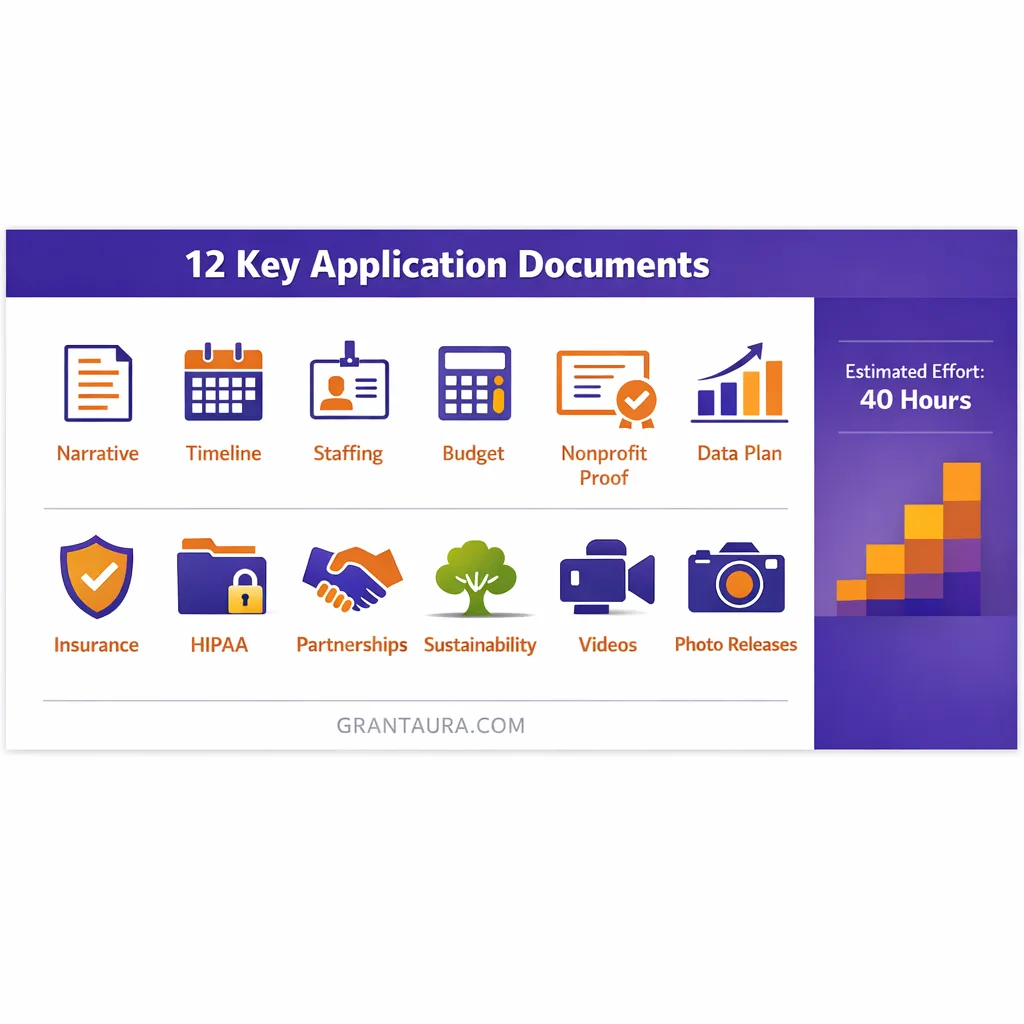
Based on past funded applications and the foundation's guidelines, here's the full list of what you should have ready:
That's twelve documents. The Grantaura dashboard can help you track progress on each piece. And when you're ready, our reviewers can spot gaps before you submit – especially on the narrative and budget, where most applications lose points.
The custom portal (GrantInterface) opens January 1 each year. The deadline for the 2026 cycle is March 15, 2026. The foundation hasn't published a decision date yet, but past cycles suggest 2‑3 months after the deadline (2025 grantees were announced in September). If you're selected, you'll have one year to complete your project.
Estimated preparation time: 40 hours. That's not a casual weekend project – it's dedicated staff time over several weeks. Quarterly financial and narrative reports are required every 90 days, plus two videos and a final comprehensive report. Any unspent funds must be returned.
Don't wait until the last minute – the shift to fewer, larger awards means more competition and higher expectations. Start drafting now.
Q: Can my organization apply if we're not a 501(c)(3) but have a fiscal sponsor?
A: The foundation doesn't explicitly mention fiscal sponsorship in its criteria. I'd recommend emailing Annie LaCroix (alacroix@massagetherapyfoundation.org) to ask before applying. If you need help finding a fiscal sponsor, our consultation can point you in the right direction.
Q: Can we apply if we don't currently have a massage therapist on staff?
A: Technically yes, if you designate a Massage Therapy Coordinator and secure professional liability insurance before the project starts. Practically, this is difficult. The application requires proof of insurance and coordinator qualifications. If you're starting from zero, the timeline to March 15, 2026 may be too tight to build this infrastructure.
Q: What counts as an "underserved" population?
A: Groups with little or no access to massage therapy. The foundation specifically highlights veterans with PTSD, medically fragile children, unhoused individuals, cancer survivors, and people in low‑resource settings. Your application must demonstrate both the population's need and their current lack of access. General wellness programming for insured, housed populations typically doesn't qualify.
Q: What if we've never done data collection before?
A: Start simple. Track number of sessions, basic participant demographics, and a simple feedback form. Our evaluation guide has templates you can adapt.
Q: What are the video requirements?
A: You need one video at project launch and one at conclusion, submitted via email to MTF staff. Plan for professional quality, patient consent, and privacy compliance. The videos are part of their case study and research mission, not just documentation. If video production is outside your capacity, factor that cost into your budget.
Q: What is the Jacquelyn Project?
A: A secondary funding track within the Community Service Awards specifically for breast cancer‑related massage therapy programs. Same application process, same deadline, separate focus. If you serve breast cancer patients or survivors, this may be less competitive than the general pool because fewer applicants target it specifically. Worth exploring if your programming fits.
Q: Can international organizations really apply?
A: Yes. The Tanzania, South Africa, Serbia, Bosnia, and Kenya projects prove it. You'll need to provide documentation of your nonprofit status in your country.
Q: When will we hear back?
A: Decision dates aren't published, but based on past cycles, expect 2‑3 months after the March 15 deadline.
Q: How competitive is this grant now?
A: With only 1‑2 awards and likely dozens of applications, competition is intense. The quadrupled award amount attracts larger, more established organizations than the previous $5,000 cycles. Your application needs to be exceptional, not just adequate.
If this grant isn't quite right, or you want to explore related opportunities, check out these programs:
The listing above tells you the rules. It can't review your actual narrative, catch disqualifying phrasing, or help you position your project against the eight evaluation criteria. That's where we come in.
Here's what we offer:
We submit on your behalf. We prepare you to submit confidently with a stronger application.
Ready to get started? and we'll match you with the right support. Or book a consultation to talk through your project one-on-one.
Full Application Pricing Strategy: This is a highly_complex grant based on the evidence: estimated 40 hours of preparation, 12 required documents, custom portal submission, quarterly reporting, and video requirements. Our pricing reflects the level of review and strategic support needed – you'll see the exact quote in the assessment modal before payment. We offer upfront, milestone, and per‑submission billing options.
I spend my days tearing apart complex foundation guidelines to find the hidden compliance rules that disqualify most applicants. After years of watching incredible community projects lose out on funding due to minor technicalities, I built Grantaura to level the playing field. My goal is to help you find the right funding and build an application that survives the review committee's scrutiny. If you're tired of generic advice, connect with me on my profile or schedule a consultation to discuss your specific project.
We are your trusted grant application partners. You can navigate the entire grant application process with our expert guidance through this simple 5-step process.
Fill out the "Apply for this grant" form with your information and grant requirements.
Our grant experts will assess your eligibility and notify you via email.
A dedicated grant expert will be assigned to discuss next steps for your application.
Our expert will help you complete and submit your application with all required materials.
The grant committee will make their decision and notify successful applicants.

No charge to start. You'll review your next steps before checkout — we'll guide you through.
Choose how you want to continue. You can resume later or close without saving.
Send a secure resume link to your account email.
Now
PendingComplete your profile to begin matching.
Profile -> Matching -> Choose grants -> Quote -> Verify -> Pay
Profile data is saved in your browser and synced to secure storage when available.
Selection preview
No grants selected yet.
Soft estimate
Estimate only. Final pricing appears in Quote step.
Quote expiry
Quote timer starts after pricing is generated.
Verification
Verification status appears here once quote is confirmed.
Success snapshot
Success milestones appear here after confirmation.
What happens next
After quote confirmation, verify your email and complete secure payment.
Select how you want to proceed. You will review pricing before checkout.
From USD 41.40
We prepare and submit your grant application on your behalf.
Refund policy applies if ineligible.
USD 5.99 one-time
Find out if you qualify. Results typically within 24 hours.
No payment required
Create your account to save these details and access your dashboard.
The donor does not charge you. This fee covers Grantaura's hands-on work: expert review time, eligibility checks, application drafting, and submission handling.
You will see the exact quote before checkout. Nothing is charged just for opening this screen.
Not ready? Email support · Contact us
Choose payment plan
Due to the approaching deadline, submission is not guaranteed. Full refund if we cannot complete it.
Completing your payment in a new tab...
If the payment page didn't open, use the manual link below.
Check your email
Need a hand? We can continue this for you.
Leave your details and we'll send a resume link so you can pick up right where you left off.
Processing payment
Please don't close this window.
Payment complete
Payment unsuccessful