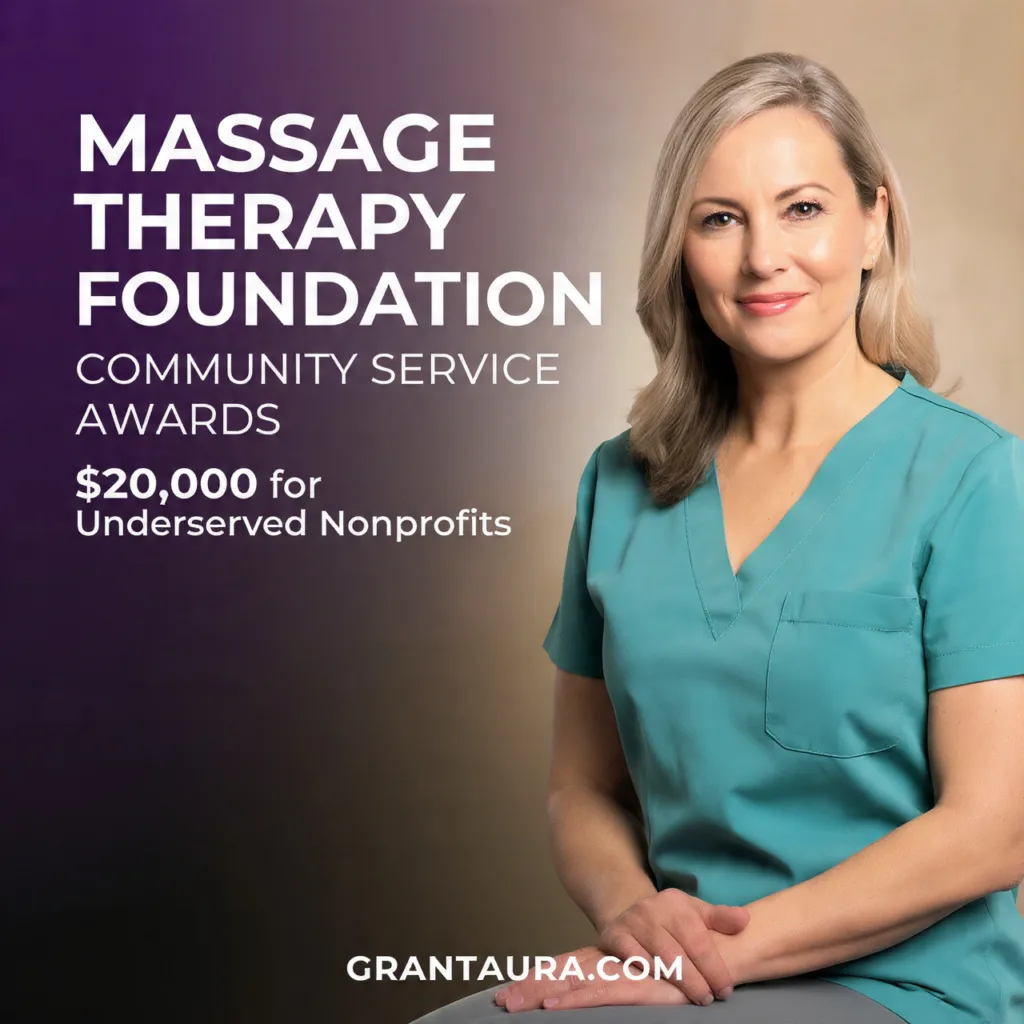
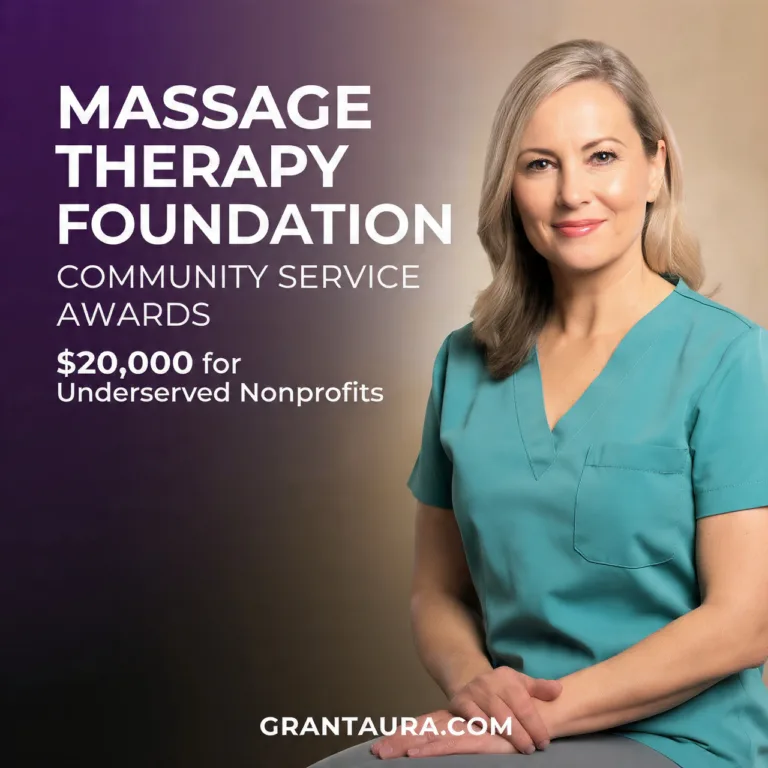
Massage Therapy Foundation Community Service Awards
Funding for nonprofit massage programs serving underserved populations globally.
$20,000Max Award
Global
Grants For Non-Profit Organizations
Imran Ahmad
Written by
Reviewed by
Your next step
See what this grant would take before you commit
Review your fit first, then choose the level of help you want. You can start with an eligibility assessment, talk through the opportunity with an expert, or get full application support.
The Massage Therapy Foundation just rewrote its Community Service Award playbook. The maximum jumped from $5,000 to $20,000 for 2026. But here’s the part most people miss: they’re only funding 1-2 projects now, not 4-6. I dug into the foundation’s own podcast to understand why – they want projects that generate real data, publishable insights, and measurable outcomes. Think less “feel-good massage session” and more “research-grade community health intervention.”
Past winners include a Bosnia project that delivered 140 therapeutic massages to kids with autism and their parents, and a program in Tanzania that taught basic massage skills to community members for income generation. Your organization could be next, but you need to understand what’s changed. The deadline is March 15, 2027.
Key Grant Information
Active
169 days left
01
Massage Therapy Foundation Community Service Awards
U.S. 501(c)(3) or international nonprofit equivalent
Organization must have existed at least one year
Must already provide therapeutic or service programs
Designated Project Leader and Massage Therapy Coordinator required
Populations served must have little or no access to massage
Proof of professional liability insurance for practitioners required
Project must include data collection and evaluation plan
HIPAA compliance documentation required if collecting health data
No conflicts of interest with MTF officers, trustees, or review committee
Grant Benefits
$20000
One-year project period
Funding for stipends, training, supplies, data collection, video production
International applicants fully eligible
04
Focus Areas
community service grantmassage therapy fundingunderserved populations massage
Not sure if your organization qualifies? Our quick eligibility tool takes about two minutes and asks the key questions: nonprofit status, years in operation, populations served. It’s not a guarantee – but it’ll save you time if you’re clearly not a fit. Does your target population meet the “underserved” definition? What counts as “duplicating existing services”? The tool helps you navigate these nuances.
Eligibility Check
Eligibility for Massage Therapy Foundation Community Service Awards $20K for Underserved Nonprofits
Answer a few guided questions. Your responses are matched to this grant’s criteria in real time.
Ready to check your eligibility?
We’ll guide you through a short, structured flow and instantly evaluate fit for this opportunity.
Eligible
You Appear Eligible
Based on your answers, you meet the core requirements for this grant.
Recommended after eligibility
You qualify. Now make sure the application is worth sending.
Eligibility only tells you that you can apply. It does not catch weak answers, missing proof, confusing budget details, or language that makes reviewers hesitate.
This Grant Isn’t the Right Fit. Your Best One Might Be Two Clicks Away.
Missing one criterion for Massage Therapy Foundation Community Service Awards $20K for Underserved Nonprofits doesn’t mean you’re out of options — it means this grant wasn’t designed for your profile. Our expert research team identifies the grants built specifically for businesses like yours, across 500+ active opportunities.
Basic Match
$125
One-time research
A list of 5 grants only
Basic eligibility matching based on industry & location
Standard funding amount range verification
Primary criteria alignment check
Most Popular
Advanced Match
$145
One-time research
A list of 7 grants only
Advanced eligibility matching with business model analysis
Deep competitive advantage assessment
Innovation & impact potential matching
Market fit & growth trajectory alignment
Premium Match
$175
One-time research
A list of 10 grants only
AI-powered deep-match algorithm analysis
Historical success pattern matching
Priority sector & focus area alignment
Advanced sustainability impact matching
Strategic vision & long-term goals alignment
Preparing secure checkout…
✓
Order Confirmed
Your grant research order is placed. Our team will deliver your personalised report within 3–5 business days. Check your email for confirmation.
Auto-advances after each answer. Use Back to revise.
If you’re eligible, we’ll invite you to for expert feedback on your competitive positioning. If you’re unsure, book a free 15‑min consultation to discuss your situation. If the tool says you’re not eligible, don’t worry – we’ll show you other grants in the More grants section below that might be a better fit.
Who this grant is for
This award is for nonprofit organizations – U.S. 501(c)(3)s or recognized international equivalents – that already deliver therapeutic or service programs. You need to have existed for at least one year, and you must designate two specific roles: a Project Leader (staff responsible for oversight and reporting) and a Massage Therapy Coordinator (a licensed/certified practitioner with professional liability insurance).
The population you serve must have little or no access to massage therapy. The foundation’s definition of “underserved” is broad but specific: veterans with dementia or PTSD, children undergoing chemotherapy, migrant farmworkers, homeless individuals, survivors of trauma, medically fragile children, women living with HIV/AIDS, hospice patients, disaster survivors. If your group can easily access massage at a local spa, they likely don’t qualify.
One thing this grant is not: individual funding for massage therapists. You cannot apply as a solo practitioner. But you could partner with a nonprofit as a fiscal sponsor – though the foundation hasn’t explicitly endorsed this model, so verify with them first (contact Annie LaCroix at alacroix@massagetherapyfoundation.org).
International organizations are fully eligible. Past winners include projects in Tanzania, South Africa, Serbia, Bosnia, and Kenya. You’ll need to provide documentation of your charitable nonprofit status in your country.
The 2026 reset: bigger awards, fewer winners
In late 2025, the foundation’s Dolly Wallace sat down for a podcast episode explaining the shift. They want “to award 1-2 larger projects to make a greater impact, while collecting data and insights to serve larger goals.” That’s code for: we’re not just writing checks for nice programs anymore. We want evidence. We want publishable results. Over $646,000 has been granted to 140 projects worldwide since 1993 – that’s real scale, and now they’re concentrating that investment.
So if you’re applying with a 2026 mindset, your proposal must show how you’ll measure outcomes – blood pressure, session counts, participant surveys, pain scales, whatever proves your intervention works. Every single past funded project I reviewed included some form of data collection. The Bridgeport Hospital program, which has run for over 20 years, tracks everything. The UCSF pediatric fellowship collects detailed feedback. Make data part of your story from the start.
Past projects that won (and what they included)
Here are a few examples to spark your thinking – notice the pattern: every project had a plan to measure something.
UCSF Benioff Children’s Hospital (USA): Used funds to train massage therapists in pediatric oncology, then delivered 368 sessions to children receiving chemotherapy. They tracked session counts, patient comfort levels, and family feedback.
Bridgeport Hospital (USA): A 20‑year‑running program serving uninsured patients with massage and health coaching. They measure blood pressure before and after each session.
JUSTtouch Oakland (USA): Recruited students from a local massage school to provide free chair massage at homeless shelters. They logged participant numbers and collected verbal feedback.
Heartfelt Community (USA): Provided Compassionate Touch to veterans with dementia.
BEAT AIDS Coalition Trust (USA): Integrated massage into monthly support groups for women with or at risk of HIV/AIDS.
Bosnia and Herzegovina: Provided massage to children with autism and their parents – 140 sessions delivered.
Tanzania: Trained community members in basic massage skills for income generation and caregiving. They documented training hours and post‑training practice.
Serbia: Introduced massage for breast cancer patients at a major hospital – a first in the country. They used patient surveys to gauge impact.
The hidden requirement: data collection
Nowhere on the main award page does it say “you must include a data collection plan.” But after reading through 10+ past project descriptions, I can tell you: every funded project had one. The foundation wants to learn from your work. They want to know how many sessions you delivered, what changed for participants, and whether those changes lasted.
What does that look like in practice? Past grantees used:
Session logs (date, duration, participant type)
Pre‑ and post‑session health metrics (blood pressure, pain scales)
Participant satisfaction surveys
Qualitative interviews or focus groups
Follow‑up surveys weeks or months later
If you’re not sure how to design a simple but credible evaluation, our program evaluation guide can help. And if you’d like an expert to review your draft plan, that’s exactly what our consultation service does.
Required documents – what you’ll need to prepare
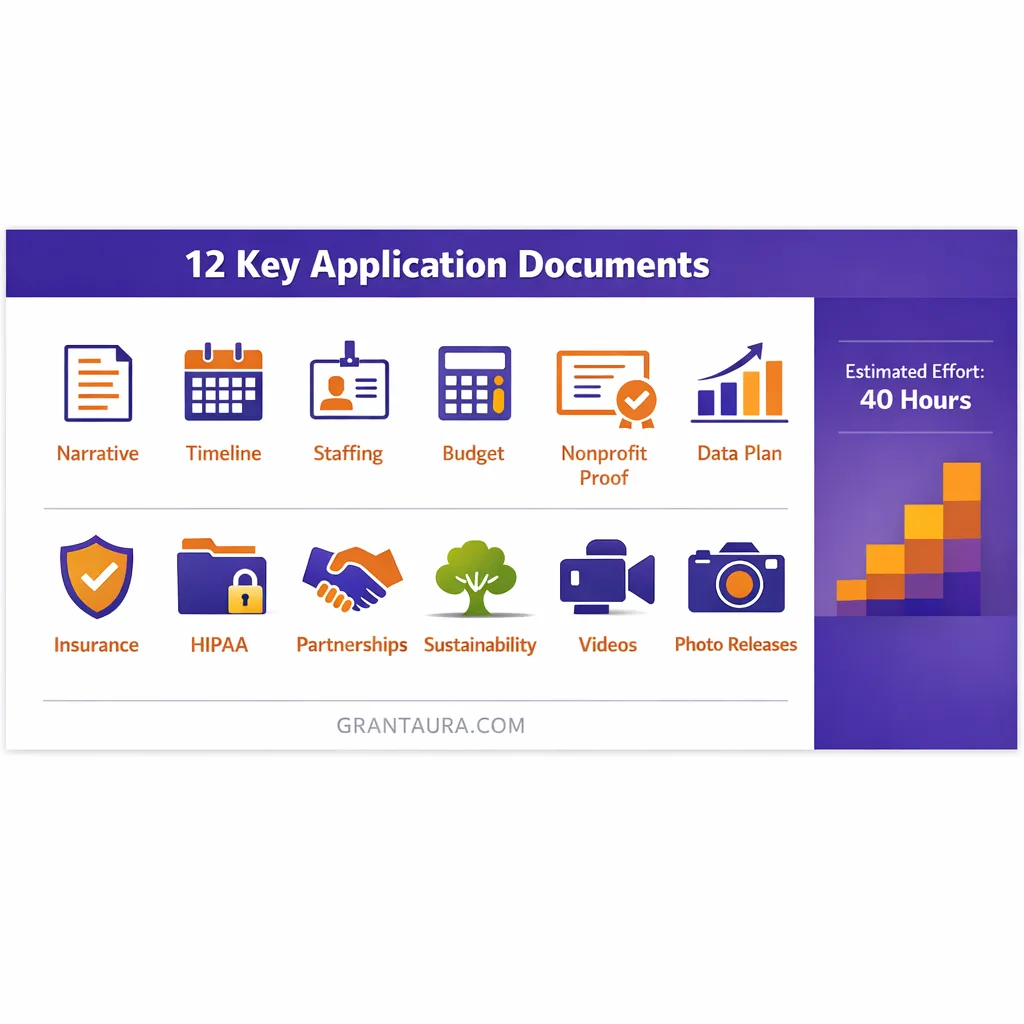
Based on past funded applications and the foundation’s guidelines, here’s the full list of what you should have ready:
Project narrative – describing your target population, why they need massage, your intervention, and expected outcomes. Aim for 5-10 pages covering need, intervention, timeline, staffing, evaluation, and sustainability.
Implementation timeline – showing when and how services will be delivered (e.g., weekly sessions over 46 weeks).
Staffing plan – identifying the Project Leader and Massage Therapy Coordinator, their qualifications, and any students or volunteers involved. Include resumes/certifications.
Detailed budget – with line‑item justification (stipends, supplies, training, data collection costs, video production). No indirect costs – keep it focused on direct service expenses.
Proof of nonprofit status – 501(c)(3) letter or international equivalent.
Data collection and evaluation plan – what you’ll measure and how. Include sample evaluation forms.
Professional liability insurance certificates – for all practitioners involved, minimum $1 million coverage.
HIPAA compliance documentation – if collecting any health information, you need procedures in place.
Partnership documentation – MOUs if you’re collaborating with hospitals, community orgs, etc. (helpful but not always required).
Sustainability plan – how the project will continue after grant funds run out. This is heavily weighted in scoring.
Video production plan – you’ll need one video at project launch and one at conclusion, plus maintain a project blog.
Photo release forms – for any photography or video involving participants.
That’s twelve documents. The Grantaura dashboard can help you track progress on each piece. And when you’re ready, our reviewers can spot gaps before you submit – especially on the narrative and budget, where most applications lose points.
Application timeline and effort
The custom portal (GrantInterface) opens January 1 each year. The deadline for the 2026 cycle is March 15, 2027. The foundation hasn’t published a decision date yet, but past cycles suggest 2‑3 months after the deadline (2025 grantees were announced in September). If you’re selected, you’ll have one year to complete your project.
Estimated preparation time: 40 hours. That’s not a casual weekend project – it’s dedicated staff time over several weeks. Quarterly financial and narrative reports are required every 90 days, plus two videos and a final comprehensive report. Any unspent funds must be returned.
Don’t wait until the last minute – the shift to fewer, larger awards means more competition and higher expectations. Start drafting now.
Frequently asked questions
Q: Can my organization apply if we’re not a 501(c)(3) but have a fiscal sponsor? A: The foundation doesn’t explicitly mention fiscal sponsorship in its criteria. I’d recommend emailing Annie LaCroix (alacroix@massagetherapyfoundation.org) to ask before applying. If you need help finding a fiscal sponsor, our consultation can point you in the right direction.
Q: Can we apply if we don’t currently have a massage therapist on staff? A: Technically yes, if you designate a Massage Therapy Coordinator and secure professional liability insurance before the project starts. Practically, this is difficult. The application requires proof of insurance and coordinator qualifications. If you’re starting from zero, the timeline to March 15, 2027 may be too tight to build this infrastructure.
Q: What counts as an “underserved” population? A: Groups with little or no access to massage therapy. The foundation specifically highlights veterans with PTSD, medically fragile children, unhoused individuals, cancer survivors, and people in low‑resource settings. Your application must demonstrate both the population’s need and their current lack of access. General wellness programming for insured, housed populations typically doesn’t qualify.
Q: What if we’ve never done data collection before? A: Start simple. Track number of sessions, basic participant demographics, and a simple feedback form. Our evaluation guide has templates you can adapt.
Q: What are the video requirements? A: You need one video at project launch and one at conclusion, submitted via email to MTF staff. Plan for professional quality, patient consent, and privacy compliance. The videos are part of their case study and research mission, not just documentation. If video production is outside your capacity, factor that cost into your budget.
Q: What is the Jacquelyn Project? A: A secondary funding track within the Community Service Awards specifically for breast cancer‑related massage therapy programs. Same application process, same deadline, separate focus. If you serve breast cancer patients or survivors, this may be less competitive than the general pool because fewer applicants target it specifically. Worth exploring if your programming fits.
Q: Can international organizations really apply? A: Yes. The Tanzania, South Africa, Serbia, Bosnia, and Kenya projects prove it. You’ll need to provide documentation of your nonprofit status in your country.
Q: When will we hear back? A: Decision dates aren’t published, but based on past cycles, expect 2‑3 months after the March 15 deadline.
Q: How competitive is this grant now? A: With only 1‑2 awards and likely dozens of applications, competition is intense. The quadrupled award amount attracts larger, more established organizations than the previous $5,000 cycles. Your application needs to be exceptional, not just adequate.
Glossary of key terms
Project Leader: The staff member responsible for project oversight, quarterly reporting, and all communication with MTF. Must be an employee (not a volunteer) and their resume must be included.
Massage Therapy Coordinator: A licensed or certified massage therapist who oversees the therapeutic aspects of your project. Must have appropriate credentials and professional liability insurance. Resumes and insurance certificates required.
Professional Liability Insurance: Malpractice coverage for massage therapists, typically with minimum $1 million coverage. Required for every practitioner involved. Certificates must be submitted with your application.
Underserved Populations: Groups with little or no access to massage therapy due to economic, geographic, medical, or social barriers. Examples: veterans with PTSD, medically fragile children, unhoused individuals, cancer survivors, farmworkers, hospice patients.
Data Collection Plan: A description of what outcomes you’ll measure (e.g., blood pressure, session counts, pain scales, satisfaction surveys) and how you’ll collect and analyze that data. Required for all funded projects.
Sustainability Plan: A concrete strategy for continuing massage services beyond the 12‑month grant period. This is one of the eight evaluation criteria and heavily weighted. Options include sliding‑scale fees, volunteer integration, or partner funding.
Evaluation Forms: The instruments you’ll use to measure project outcomes. Must be included in your application so the review committee can assess your measurement strategy.
HIPAA Compliance: Procedures ensuring patient health information privacy and security. Required documentation for any project collecting health data. Even non‑healthcare organizations need this if they document health conditions.
Quarterly Reports: Financial and narrative updates submitted every 90 days via email. Required throughout the 12‑month project period. Includes progress toward objectives, budget tracking, and preliminary outcome data.
Jacquelyn Project: An MTF initiative providing additional funding specifically for breast cancer‑related community service projects. Same application process, separate focus.
GrantInterface: The custom online portal used by MTF to accept and manage grant applications. Account creation and document uploads required.
Custom Portal: MTF’s proprietary application system (GrantInterface), not Grants.gov or a generic form platform.
Scoring Rubric: Eight explicit criteria in the guidelines: importance of the target population, feasibility, clarity of objectives, team qualifications, budget reasonableness, sustainability, innovation, and replicability.
Population Importance: A scoring criterion weighting how critically underserved your target group is – not just program quality.
Replicability: Another evaluation criterion. How easily could other organizations adapt your model? Projects with clear documentation and standardizable procedures score higher.
Duplication of Services: Providing massage therapy that your organization already offers through other funding. The grant must fund new or expanded services, not replace existing programming.
Conflict of Interest: Any relationship between your organization and MTF officers, trustees, or review committee members. Explicitly disqualifying. They check this thoroughly.
Photo Release Forms: Documentation allowing you to photograph or video record clients for the required project videos and promotion. Essential for the video deliverables.
Unallowable Expenses: Costs the donor excludes – general operating expenses not tied to the massage program, services that duplicate existing programs, and any expenses outside the 12‑month period.
Indirect Costs: Administrative overhead not directly tied to project delivery. The foundation discourages these in your budget. Keep your request focused on direct service expenses.
Budget Justification: A short explanation of why each cost is necessary to meet project goals. Label unit costs, show totals, and mark any equipment requests.
Final Report: The comprehensive evaluation due at project conclusion. Includes full financial accounting, outcome analysis, and lessons learned. More detailed than quarterly updates.
Manuscript Copies: If you submit findings to academic journals, you must provide copies to the foundation. Part of their research mission to disseminate knowledge about massage therapy efficacy.
More grants like this
If this grant isn’t quite right, or you want to explore related opportunities, check out these programs:
Project Jacquelyn breast cancer funding – another MTF track supporting massage for breast cancer patients.
Breva Thrive grant – $5,000 quarterly for massage and wellness businesses (for those who don’t qualify as nonprofits).
Select Health Awards – $5,000 grants with lighter documentation requirements for community health programs.
Quarterly $5,000 grants specifically for massage and wellness businesses. Ideal if you’re a solo practitioner or for-profit entity that doesn’t qualify for the MTF nonprofit award. No 501(c)(3) status needed; open to licensed massage therapists and small business owners.
A $5,000 grant for community health programs with lighter documentation requirements. Good fit if the MTF’s extensive reporting feels daunting or if your organization is still building evaluation capacity. Quarterly reporting is simpler, and no video required.
The listing above tells you the rules. It can’t review your actual narrative, catch disqualifying phrasing, or help you position your project against the eight evaluation criteria. That’s where we come in.
Here’s what we offer:
Narrative review: Our experts read your draft and tell you if your impact story aligns with what this program rewards. They catch vague language, missing outcomes, and disconnects between your budget and your story.
Data plan design: Not sure what to measure or how? We help you craft a simple, credible evaluation plan that reviewers will trust.
Budget optimization: We review your budget to ensure every line item is justified and aligned with the project – no red flags.
Document gap check: Before you submit, we spot missing items (like partnership docs, insurance certificates, or sustainability plans) that could get you disqualified.
Strategic positioning: We help you frame your population importance, sustainability plan, and replicability to score higher against the rubric.
We submit on your behalf. We prepare you to submit confidently with a stronger application.
Ready to get started? and we’ll match you with the right support. Or book a consultation to talk through your project one-on-one.
Full Application Pricing Strategy: This is a highly_complex grant based on the evidence: estimated 40 hours of preparation, 12 required documents, custom portal submission, quarterly reporting, and video requirements. Our pricing reflects the level of review and strategic support needed – you’ll see the exact quote in the assessment modal before payment. We offer upfront, milestone, and per‑submission billing options.
About the author
I spend my days tearing apart complex foundation guidelines to find the hidden compliance rules that disqualify most applicants. After years of watching incredible community projects lose out on funding due to minor technicalities, I built Grantaura to level the playing field. My goal is to help you find the right funding and build an application that survives the review committee’s scrutiny. If you’re tired of generic advice, connect with me on my profile or schedule a consultation to discuss your specific project.
[
  {
    "url": "https://grantaura.com/grant/project-jacquelyn-breast-cancer-funding/",
    "custom_description": "Another Massage Therapy Foundation track specifically for breast cancer–related community massage projects. Uses the same application process but a separate funding pool, often less competitive. If your organization serves breast cancer patients or survivors, this is worth exploring alongside the main award."
  },
  {
    "url": "https://grantaura.com/grant/select-health-awards/",
    "custom_description": "A $5,000 grant for community health programs with lighter documentation requirements. Good fit if the MTF's extensive reporting feels daunting or if your organization is still building evaluation capacity. Quarterly reporting is simpler, and no video required."
  },
  {
    "url": "https://grantaura.com/grant/breva-thrive-grant/",
    "custom_description": "Quarterly $5,000 grants specifically for massage and wellness businesses. Ideal if you're a solo practitioner or for-profit entity that doesn't qualify for the MTF nonprofit award. No 501(c)(3) status needed; open to licensed massage therapists and small business owners."
  },
  {
    "url": "https://grantaura.com/grant/health-equity-funding-opportunities/",
    "custom_description": "A curated list of grants supporting health equity initiatives, including many that fund therapeutic services for underserved populations. Use it to find alternatives with varying eligibility requirements and award sizes."
  }
]
We are your trusted grant application partners. You can navigate the entire grant application process with our expert guidance through this simple 5-step process.
300+ Projects
4.9/5 Rating
Expert Team
Step 1: Application Form
Fill out the “Apply for this grant” form with your information and grant requirements.
Step 2: Eligibility Assessment
Our grant experts will assess your eligibility and notify you via email.
Step 3: Expert Consultation
A dedicated grant expert will be assigned to discuss next steps for your application.
Step 4: Application Submission
Our expert will help you complete and submit your application with all required materials.
Step 5: Final Decision
The grant committee will make their decision and notify successful applicants.
Hi there 😊 I’m Imran Ahmad, the founder of Grantaura. I normally examine funding opportunities through both newer research methods and older, manual verification methods because official webpages, application forms, FAQs, archived materials, etc. do not always tell the same story.
Because I believe that “the fine print usually only shows up when you’re stubborn enough to check twice.”
You are on Massage Therapy Foundation Community Service Awards $20K for Underserved Nonprofits. I can help check fit, explain the March 15, 2027 deadline, compare effort, or decide whether Grantaura application support makes sense for this grant.
No chat history in this browser yet.
You are in queueIAGA
A Grantaura colleague can review this conversation. You can keep chatting with the assistant while you wait.
Tell us about yourself
0/1000
i
The information you add here helps the assistant answer this browser session more clearly. Close this window to continue the chat.
Check your eligibility
Check your saved details, answer the grant questions, and see your next steps.
Grant team review
Saved details where available
Free assessment
Save option
Save this grant application for later
Send yourself a private link so you can return to this grant form with your details ready.
Keep your post public. Our team will verify the link before processing your assessment. If the post is deleted or made private after submission, your free assessment will be void.