Performance-based DC incentive for established companies expanding or relocating office operations with jobs and investment commitments.
Washington
Grants For For-Profit Businesses
Imran Ahmad
Written by
Reviewed by
Your next step
See what this grant would take before you commit
Review your fit first, then choose the level of help you want. You can start with an eligibility assessment, talk through the opportunity with an expert, or get full application support.
The Vitality Fund is a live FY26 Washington DC funding opportunity with a $6M public pool, and the part most pages still miss is that DMPED starts with an intake gate before most applicants ever see the full application environment. That changes the whole read. While older pages still float around with 25-employee and CBD language, the current cycle leans on something more demanding: credible office space plans, site control, projected jobs, capital investment, and a company that already looks established enough to justify the lift. Not casual.
If your team is still deciding whether DC is the right office market, this fund can matter. If you are hoping for a broad small-business grant, wait, this is probably the wrong page for you. The workload lands after the fit question, not before it.
Before you trust your own read too much, run the eligibility tool below against the real shape of the program. It will not hand you certainty. What it can do is catch the obvious mismatch early, especially if your company is still fuzzy on site control, on-site staffing expectations, or the community-benefit commitment that follows an award. Be honest here. A messy answer now usually turns into a messy application later.
Eligibility Check
Eligibility for Vitality Fund: DC’s Corporate Attraction Incentive
Answer a few guided questions. Your responses are matched to this grant’s criteria in real time.
Ready to check your eligibility?
We’ll guide you through a short, structured flow and instantly evaluate fit for this opportunity.
Eligible
You Appear Eligible
Based on your answers, you meet the core requirements for this grant.
Recommended after eligibility
You qualify. Now make sure the application is worth sending.
Eligibility only tells you that you can apply. It does not catch weak answers, missing proof, confusing budget details, or language that makes reviewers hesitate.
This Grant Isn’t the Right Fit. Your Best One Might Be Two Clicks Away.
Missing one criterion for Vitality Fund: DC’s Corporate Attraction Incentive doesn’t mean you’re out of options — it means this grant wasn’t designed for your profile. Our expert research team identifies the grants built specifically for businesses like yours, across 500+ active opportunities.
Basic Match
$125
One-time research
A list of 5 grants only
Basic eligibility matching based on industry & location
Standard funding amount range verification
Primary criteria alignment check
Most Popular
Advanced Match
$145
One-time research
A list of 7 grants only
Advanced eligibility matching with business model analysis
Deep competitive advantage assessment
Innovation & impact potential matching
Market fit & growth trajectory alignment
Premium Match
$175
One-time research
A list of 10 grants only
AI-powered deep-match algorithm analysis
Historical success pattern matching
Priority sector & focus area alignment
Advanced sustainability impact matching
Strategic vision & long-term goals alignment
Preparing secure checkout…
✓
Order Confirmed
Your grant research order is placed. Our team will deliver your personalised report within 3–5 business days. Check your email for confirmation.
Auto-advances after each answer. Use Back to revise.
This fund filters hard
What throws people off is the label. A DC business incentive sounds broad, right, but the Vitality Fund is not built like a general small-business program and not even like a startup grant. Older partner pages still mention 25 employees and central-business-district language, which keeps confusing searchers, but the current FY26 materials lean on a different test: real office occupancy, real jobs, real investment, and a company making an actual location decision instead of browsing around. That is the screen now. If you are trying to place a meaningful office footprint in Washington DC, the fund becomes relevant fast. If not, it fades just as fast.
Because the preference markers are not random, I would not treat them like decorative bullets. DMPED signals strongest interest in applicants planning at least 15000 square feet for five years, at least 30 new jobs over three years, and at least $2M in capital improvements. Are those absolute minimums, no, not exactly. But once you notice that jobs and wages get 30 points and capital investment gets another 30, the practical meaning gets obvious: weak numbers can still be submitted, yet they enter the room already bleeding points. Hard math.
Important Note
This is where a lot of teams lose time. The Vitality Fund and the Growth Fund are not interchangeable. Vitality is the heavier office-location incentive for larger established companies, while Growth Fund serves a different part of the market.
[fit_warning_box]This fund is not for typical small-business or startup applicants. If your company lacks a serious office relocation or expansion plan with site control already in motion, the workload will not pay off.[/fit_warning_box]
For readers who fail the fit test but are still comparing regional office incentives, the MOVE Grant is the closest internal off-ramp here. Different geography. Similar decision.
Why the upside can still justify the lift
Even with the friction, the incentive is not cosmetic. The FY26 pool is $6M, awards are performance-based, and the money can support costs tied to the office move or expansion such as operational costs, rent subsidy or down-payment support, tenant improvements, workforce training not covered elsewhere, and recruitment or hiring costs. Useful stuff. I also could not find a published FY26 per-award cap, which matters because too many summary pages quietly invent one when they want the page to feel cleaner than the source material. This one stays messy where the program stays messy.
From recent official FY24 published awards, the announced amounts ran from $39000 to $162000, with an inferred median around $51000. That is context, not a promise. Then WDCEP’s one-pager adds a different benchmark, about $3600 per job, which gives you another way to think through whether your projected headcount makes the effort sensible. Not perfect. Still useful.
Site control and target-area pressure are where many cases start to wobble
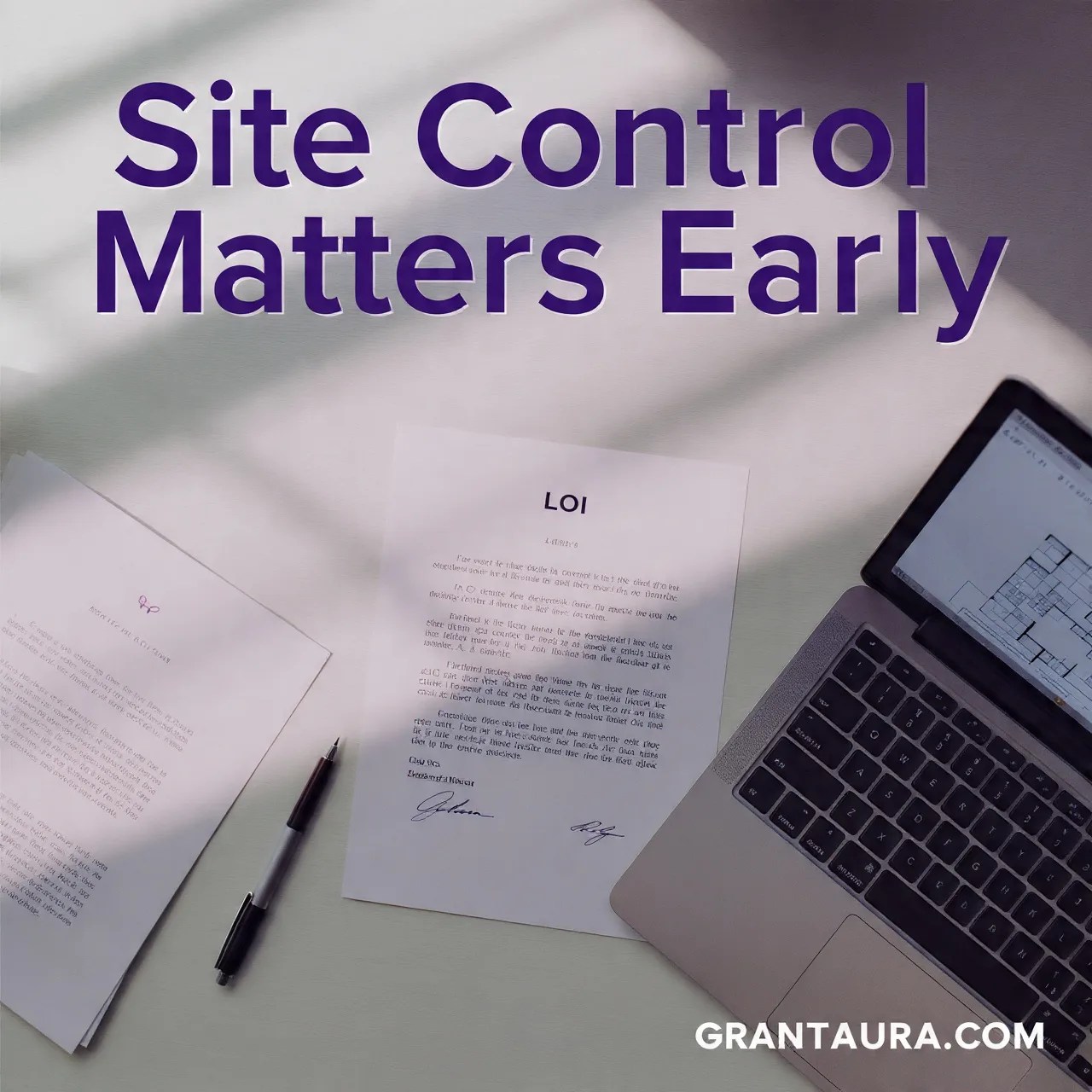
By the time a team reaches this part, the page should feel more specific, because this is not a soft concept section. DMPED wants site control, and it gives examples that are concrete enough to plan around: signed LOI, binding commitment, lease, contract of sale, or deed in the applicant’s name. No hand-waving. If your real-estate conversation is still casual and nothing is documented, the application is not really alive yet even if leadership likes the idea.
Inside the target area, projects also gain a preference edge, which turns location from a map issue into a competitiveness issue. That matters more than many partner pages admit. Why? Company Overview and Project Description carries 25 points, and Capital Investment carries 30, so your location evidence and site narrative directly reinforce more than half the scored story when combined with the investment case. If your site falls outside the target area, you may still apply, but you lose a preference layer and need stronger jobs or investment weight to make up for it. That is the trade.
Expert Tip
If your company is still comparing DC with another market, this can be the right moment to engage the program. A signed LOI or other binding commitment can help prove the decision is real before everything is final.
If that competitiveness judgment feels murky, book a consultation. This is the part where an outside read can save your team from building a full package around weak evidence.
What DMPED scores in the Vitality Fund application
Most pages talk around the review. I would rather look straight at it. The Vitality Fund uses a public 100-point rubric, and once you see the scoring buckets the application stops feeling like paperwork and starts looking like a structured argument about why your company belongs in DC. That is better. It also means vague narratives get punished even when the company itself looks impressive on paper.
Scoring Category
Points
What DMPED Reviews
Company Overview and Project Description
25
Company footprint timeline competing locations square footage and site plan
Jobs and Wages
30
Current and projected DC jobs District resident hires yearly job creation and wages
Capital Investment
30
Tenant improvements and broader capital investment at the project location
Capacity of Applicant
15
Key personnel reporting ability on-site work compliance and community benefit readiness
Read that table like an operator, not a browser. The biggest point buckets sit exactly where the preference signals sit, which is why lower-threshold applicants are not automatically barred but can still be functionally weak. Then the last 15 points on capacity ask a different question altogether: can your team carry the reporting, compliance, and execution burden after award. Smaller companies with thin back-office capacity tend to feel that part more than they expect. Late realization. Bad timing.
Live process, real sequence
The live FY26 cycle opened on February 6 2026 and runs through 2026-07-15 16:00 America/NewYork. [deadline_countdown] but the more useful fact is the sequence rather than the date. You begin with the Smartsheet intake form. Then, if DMPED clears you at the minimum-eligibility level and accepts the proposed project location as worth advancing, you move into the DMPED-branded application platform powered by Submittable. That is where the real lift begins. Older summaries still ranking in search can mislead on timing, funding pool, and even the portal vendor, so reading one stale page can throw your whole prep plan off.
DMPED also says applications are accepted and reviewed on a rolling basis through the deadline, with review and approvals expected to take about 45 days after submission. Expected, not promised. The applicant journey is best understood as intake, pre-screening, review panel, and award recommendation. Four stages. Not quick.
Fifteen attachments and a portal that punishes sloppy prep
Once you get through intake, the page stops being theoretical. The FY26 full application requires narrative responses plus 15 named attachments, uploaded separately, and the donor materials make it clear that unreadable files, missing items, password protection, nested files, mailed applications, and messy upload practices can sink the submission. No zip-file heroics. No giant combined PDF that tries to outsmart the instructions. This is a performance-based grant, but it is also a process-discipline test.
[attachment_checklist]Active DC Business License,Certificate of Good Standing,Certificate of Clean Hands,Tax Certification Affidavit,Tax-exempt status determination letter if applicable,Debarment Affidavit,Arrest and Convictions Statement,Statement of Certification,Form W-9,Insurance Policies Affidavit,Dun and Bradstreet Number or proof of enrollment,First two pages of federal tax returns for the last two years,Required Financial Document,Statement of Financial Position or audited financials,Ethics and Accountability Statement[/attachment_checklist]
Several of those items come from outside agencies. Others are DMPED forms. One carries a freshness window because the Certificate of Clean Hands must be current within the last three months. Which means this is not just document gathering, it is document timing. Add the narrative sections, internal reviews across finance and HR, and portal handling, and the estimated lift around 18 hours feels believable pretty fast. That is why execution support has a real place here.
Do’s
Start the Clean Hands and Good Standing requests early
Track each required file as a separate PDF
Use the attachment naming method from the RFA
Create the portal account before document collection peaks
Operational commitments do not start and end with the award letter
If your team treats selection like the finish line, that is a mistake. Conditional award paperwork can expand after selection and may include a certificate of insurance, ACH form, grant agreement, and threshold-triggered First Source or subcontracting documents depending on the project. More steps. The statute also requires one of two community-benefit paths: workforce development participation or at least 5% annual contracting with local business enterprises. That is not decorative policy language. It follows the grant.
Then comes the on-site rule. Employees must be on-site at the eligible program location for at least 50% of work hours in the aggregate, and disbursement is tied to verified performance milestones over a multi-year period. So the fund behaves less like a lump-sum win and more like a monitored incentive that keeps checking whether the original commitments were real. Annual disbursement over up to five years changes how finance teams should think about value, reporting, and risk. Definitely.
Must Do
Make sure HR finance and operations all understand the reporting and on-site commitments before the application goes in
Questions people ask once the fit gets real
Who is the Vitality Fund really for?
It is built for larger established companies weighing relocation to or expansion in Washington DC and able to make a credible case on office space, jobs, and capital investment. It is not the Growth Fund. Different audience.
How much can one applicant receive?
DMPED publicly states FY26 total available funding of $6000000, but the materials reviewed do not publish a per-award minimum or maximum cap. That missing cap is real. I would not fill it in with guesswork.
What do I have to submit?
First the intake form. Then, if cleared, narrative responses across the scored sections plus 15 named attachments through the DMPED-branded Submittable flow. Separate uploads matter.
What does DMPED score?
Four buckets. Company Overview and Project Description gets 25 points, Jobs and Wages gets 30, Capital Investment gets 30, and Capacity of Applicant gets 15.
Is there a matching-funds requirement?
No explicit matching-funds requirement was located in the FY26 RFA or statute. Still, applicants planning at least $2M in improvements receive preference, so investment weight matters even without a formal match rule.
Does target-area location matter?
Yes, as a preference layer. Projects inside the target area get an advantage, but being outside it does not automatically kill the application. It just raises the pressure on the rest of your case.
Can I apply without a signed lease?
Potentially, yes. A signed LOI or other binding commitment can serve as site-control evidence, which is why companies still in an active location decision can remain viable applicants.
How long does review take?
DMPED says about 45 days after submission for review and approvals. Treat that as an estimate. Not a promise.
Terms that matter here
DMPED: The Office of the Deputy Mayor for Planning and Economic Development. This is the District agency running the program.
DLCP: The Department of Licensing and Consumer Protection. Business-license and good-standing records run through here.
OTR: Office of Tax and Revenue. This is where the Certificate of Clean Hands comes from.
DOES: Department of Employment Services. Relevant when workforce and hiring obligations come into play.
Certificate of Clean Hands: A tax-compliance document from OTR that must be current within the last three months.
Site Control: Proof that your company has a real claim to the location. LOI, lease, contract of sale, binding commitment, or deed can all matter here.
Target Area: The mapped geography where projects receive a preference advantage.
Submittable: The platform powering the DMPED-branded FY26 application flow after intake clearance.
First Source: A DC hiring-related compliance framework that can be triggered post-award depending on thresholds.
Community-Benefit Path: The required commitment to either workforce development participation or 5% annual contracting with local business enterprises.
Performance-Based Incentive: Funds are tied to milestones and verified commitments, not handed over as an unrestricted lump sum.
Conditional Award: Selection before all follow-up compliance documents are finalized.
Statement of Financial Position: The financial package used to show organizational capacity and stability.
RFA: Request for Applications. The core FY26 document that governs scoring, rules, and attachment requirements.
Growth Fund: Another DC program that serves a different applicant profile and keeps getting confused with Vitality.
How I would use Grantaura on this one
I would not use support here just to repeat facts you already read. That would be pointless. The real value shows up in three places: judging whether your office, jobs, and investment case is strong enough to justify the lift, pressure-testing the narrative against the 100-point rubric, and turning the 15-document package into a controlled workflow instead of a last-minute scramble. That is where the risk lives.
If you are unsure whether your site-control evidence or competitiveness story is good enough, start with expert consultation. If the fit is real but the execution burden is the problem, use the assessment path first so the document package and narrative gaps show up before they get expensive. And if you already know this is your target program and want managed help across drafting, packaging, and submission, use start full application submission. Different stage. Different value.
The post-award side matters too. A lot of applicants think the burden ends at submit, then get hit later by insurance, ACH, agreement paperwork, and compliance triggers they should have planned for earlier. I would rather surface that before your team commits. Cleaner that way.
Other grants if this one is the wrong fit
Not every company belongs in the Vitality Fund lane. Some are too small for the burden. Some are in the wrong geography. Some do not have the office decision far enough along. If that is you, do not force it. Use the related-grants block below as the exit ramp instead of spending weeks on a program that does not line up with your actual situation.
Both are office-location incentives for companies making expansion or relocation decisions. MOVE Grant pays $8-$15 per square foot for signed leases in Montgomery County, Maryland, offering a similar audience and purpose with comparable funding ranges.
[
  {
    "url": "https://grantaura.com/grant/montgomery-county-move-grant/",
    "custom_description": "Both are office-location incentives for companies making expansion or relocation decisions. MOVE Grant pays $8-$15 per square foot for signed leases in Montgomery County, Maryland, offering a similar audience and purpose with comparable funding ranges."
  }
]
We are your trusted grant application partners. You can navigate the entire grant application process with our expert guidance through this simple 5-step process.
300+ Projects
4.9/5 Rating
Expert Team
Step 1: Application Form
Fill out the “Apply for this grant” form with your information and grant requirements.
Step 2: Eligibility Assessment
Our grant experts will assess your eligibility and notify you via email.
Step 3: Expert Consultation
A dedicated grant expert will be assigned to discuss next steps for your application.
Step 4: Application Submission
Our expert will help you complete and submit your application with all required materials.
Step 5: Final Decision
The grant committee will make their decision and notify successful applicants.
Hi there 😊 I’m Imran Ahmad, the founder of Grantaura. I normally examine funding opportunities through both newer research methods and older, manual verification methods because official webpages, application forms, FAQs, archived materials, etc. do not always tell the same story.
Because I believe that “the fine print usually only shows up when you’re stubborn enough to check twice.”
You are on Vitality Fund: DC’s Corporate Attraction Incentive. I can help check fit, explain the July 15, 2026 deadline, compare effort, or decide whether Grantaura application support makes sense for this grant.
No chat history in this browser yet.
You are in queueIAGA
A Grantaura colleague can review this conversation. You can keep chatting with the assistant while you wait.
Tell us about yourself
0/1000
i
The information you add here helps the assistant answer this browser session more clearly. Close this window to continue the chat.
Check your eligibility
Check your saved details, answer the grant questions, and see your next steps.
Grant team review
Saved details where available
Free assessment
Save option
Save this grant application for later
Send yourself a private link so you can return to this grant form with your details ready.
Keep your post public. Our team will verify the link before processing your assessment. If the post is deleted or made private after submission, your free assessment will be void.