USDA Forest Service funding for wood products and energy projects with 1:1 match requirement.
$300,000Max Award
United States
Grants For For-Profit Businesses
Grants For Environmental Projects
Grants For Non-Profit Organizations
Grants For Projects
Grants For Research
Grants For Researchers
Imran Ahmad
Written by
Reviewed by
Your next step
See what this grant would take before you commit
Review your fit first, then choose the level of help you want. You can start with an eligibility assessment, talk through the opportunity with an expert, or get full application support.
The Wood Innovations Grant Program is live right now through the USDA Forest Service, funding market development for wood products and energy projects with awards up to $300,000 for projects that expand commercial wood use while supporting forest health outcomes. If you’re exploring the wood innovations grant, know this first: the 1:1 match requirement isn’t negotiable.
You must bring an equal dollar from non-Federal sources – cash or in-kind – and document it with signed third-party letters before you even submit. That filter alone separates serious proposals from the rest. Most applicants miss that detail until it’s too late. Which means strong projects stall on paperwork, not merit.
Indian Tribes and special purpose districts eligible
Active SAM registration required
100% non-Federal match documented with third-party letters
Grant Benefits
$300000
Up to $500000 for significant market impact projects
Up to $1000000 for stationary wood energy systems over 5MW thermal
Stationary equipment funding eligible
Applied research and demonstration projects eligible
04
Focus Areas
wood innovation grantUSDA forest service grantwood energy funding
Before you invest weeks in an application, let’s talk about what the eligibility checker actually does. It walks you through the atomic rules – for-profit status, SAM registration, project scope – and gives you a clear signal fast.
Eligibility Check
Eligibility for Wood Innovations Grant For Wood Products Funding
Answer a few guided questions. Your responses are matched to this grant’s criteria in real time.
Ready to check your eligibility?
We’ll guide you through a short, structured flow and instantly evaluate fit for this opportunity.
Eligible
You Appear Eligible
Based on your answers, you meet the core requirements for this grant.
Recommended after eligibility
You qualify. Now make sure the application is worth sending.
Eligibility only tells you that you can apply. It does not catch weak answers, missing proof, confusing budget details, or language that makes reviewers hesitate.
This Grant Isn’t the Right Fit. Your Best One Might Be Two Clicks Away.
Missing one criterion for Wood Innovations Grant For Wood Products Funding doesn’t mean you’re out of options — it means this grant wasn’t designed for your profile. Our expert research team identifies the grants built specifically for businesses like yours, across 500+ active opportunities.
Basic Match
$125
One-time research
A list of 5 grants only
Basic eligibility matching based on industry & location
Standard funding amount range verification
Primary criteria alignment check
Most Popular
Advanced Match
$145
One-time research
A list of 7 grants only
Advanced eligibility matching with business model analysis
Deep competitive advantage assessment
Innovation & impact potential matching
Market fit & growth trajectory alignment
Premium Match
$175
One-time research
A list of 10 grants only
AI-powered deep-match algorithm analysis
Historical success pattern matching
Priority sector & focus area alignment
Advanced sustainability impact matching
Strategic vision & long-term goals alignment
Preparing secure checkout…
✓
Order Confirmed
Your grant research order is placed. Our team will deliver your personalised report within 3–5 business days. Check your email for confirmation.
Auto-advances after each answer. Use Back to revise.
If you’re eligible, the next step is the application submission intake modal where our experts review your match strategy. If you’re unsure about equipment eligibility or narrative scoring, you can book a live 1-on-1 video or phone call with a grant expert. And if this grant isn’t the right fit right now, we’ll route you to related opportunities that align with your capacity.
The match filter
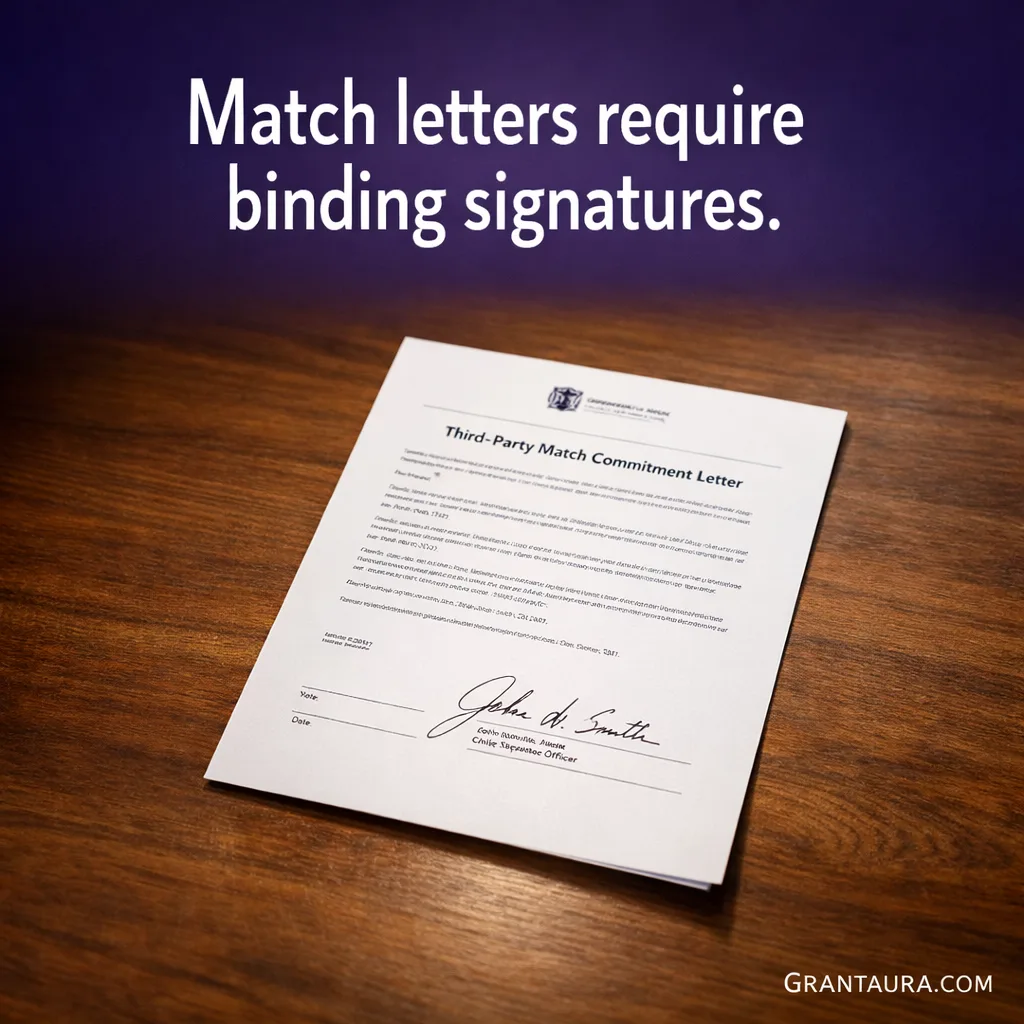
The Wood Innovations Grant demands 100% non-Federal match. That means for every dollar you request, you bring a dollar from other sources. Cash works. In-kind works too – volunteer hours valued at fair market rate, donated equipment use, pro bono consulting. But here’s what the fact sheet doesn’t emphasize enough: those contributions must be documented with signed letters from third parties specifying exact amounts. Vague promises don’t count. Which is why I’ve seen technically strong proposals fail responsiveness review before a reviewer even reads the narrative. So if you’re still building your match strategy, pause. Secure those letters first. Then come back to the application.
Because the match isn’t just a checkbox. It’s a signal to reviewers that your project has community or market backing. And that signal carries weight in the scoring. Thirty-five of the 100 points go to Project Impact alone. If your match letters come from credible partners – a tribal council, a manufacturing association, a utility company – that strengthens your impact case. The point is: match documentation isn’t administrative busywork. It’s strategic positioning.
Do’s
Secure signed third-party letters confirming exact match amounts
Verify binding signature authority on match letters
Value in-kind volunteer hours at fair market rate with documentation
Don’ts
Assume vague partner support counts as match
Submit letters without organizational letterhead
Count federal funds from other grants toward your match
What this program funds – and what it explicitly excludes
The grant funds market development. Applied research. Demonstration projects. Engineering, design, permitting costs for stationary wood energy or wood products equipment. But it does not fund construction of buildings. Or labor for ongoing operations. Or portable or mobile equipment. That last one matters. If your project relies on a trailer-mounted chipper that moves between sites regularly, it doesn’t qualify. However – and this is the nuance competitors miss – if equipment is delivered on a trailer but permanently installed at a fixed site, it does qualify. The official FAQ clarifies: permanent installation is the criterion, not the delivery method. So a stationary pellet mill delivered by truck? Eligible. A mobile sawmill that relocates monthly? Not eligible.
Because you need equipment over $10000, consider using your non-federal match dollars to purchase it, since equipment bought with federal funds creates a federal interest until fair market value drops below the threshold, and using match funds for equipment avoids that administrative layer while letting federal funds cover engineering, design, and installation – a legitimate optimization, not a loophole, just smart budgeting within the rules.
Who the USDA Forest Service grant actually serves
For-profits can apply. So can Indian Tribes, school districts, ports, conservation districts. That’s broader. Which surprises a lot of applicants who assume this is nonprofit-only. If you run a small sawmill, a mass timber startup, or a wood energy development firm, you belong in this pool. The wood innovations grant doesn’t filter by legal structure. It filters by project scope: does your work expand wood products markets, develop wood energy solutions, or support forest management through commercial activity? That’s the real gate.
Wait. There’s an edge case worth naming. Special purpose districts – public utilities, fire districts, ports – are explicitly eligible per the NOFO. If you’re a port authority exploring wood-based bioenergy for terminal operations, that counts. If you’re a conservation district piloting a wood-waste-to-energy system for forest thinning debris, that counts too. The eligibility list is longer than most applicants expect. Which is why the interactive checker helps: it walks you through the atomic rules so you don’t self-reject prematurely.
The application mechanics that cause formatting rejections
Here’s where applicants get tripped up on paperwork before content even matters. The application isn’t submitted through the Grants.gov portal. You need a Grants.gov account for SAM verification, yes. But the actual files – two separate PDFs – go via email to your designated Regional Coordinator. Part 1 contains Sections A through D, including the Project Description with its 5-page limit and 1625-character abstract blocks. Part 2 contains Sections E through G, including the Budget Justification which requires a separate line-item table. Filename conventions matter: [AppName]_Narrative_Part1.pdf, [AppName]_Narrative_Part2.pdf. And the SAM registration screenshot must show the entity registration page, not the Exclusions page. Upload the wrong page, and your application fails responsiveness review. No one reads your narrative. It just stops.
Which is why the pre-submission review service exists. Our experts check filename conventions, section splits, SAM screenshot type, and match letter formatting before you hit send. Not because the rules are complicated. Because they’re easy to miss when you’re deep in narrative drafting. The point is: formatting isn’t secondary. It’s the gate. Need help avoiding formatting rejections? start full application submission review.
How the Wood Innovations Grant scores your Project Impact section
Thirty-five points go to Project Impact. But that bucket isn’t monolithic. The rubric breaks it down: 15 points for quantifiable forest health outcomes, 10 points for market development metrics, 10 points for scalability. Which means your narrative can’t just say “this project will help forests.” It must specify acres of hazardous fuels reduced, tons of woody biomass diverted from open burning, board feet of value-added products created. Measurable deliverables. Reviewers are technical experts. They spot vagueness. So if your draft reads like a mission statement, revise it. Add numbers. Add timelines. Add verification methods. Because those 15 points for forest health outcomes often separate funded proposals from the rest.
Expert Tip
When writing your Project Impact section, lead with the forest health metric. Reviewers see hundreds of applications. If your first sentence quantifies acreage treated or tons of fuels reduced, you earn attention fast. Then layer in market metrics and scalability. Structure matters as much as content.
What prior awardees tell us about what wins
The FY2024 awardee list includes a tribal sawmill in Oregon modernizing value-added production, a mass timber startup in Montana scaling cross-laminated timber manufacturing, and a portable sawmill cooperative in Washington expanding mobile milling services – with stationary processing hubs. What they shared: documented match commitments before applying, quantified forest health metrics in their narratives, and engaged their Regional Coordinator early for pre-application feedback. None of them waited until the deadline week to assemble documents. Which makes sense. Forty estimated hours isn’t a weekend project. It’s a month of focused work. So if you’re reading this in March for an April deadline, start now. Not tomorrow. Now. Why wait?
Q: Can in-kind volunteer hours count toward the 1:1 match? A: Yes, if valued at fair market rate and documented with third-party confirmation.
Q: Does trailer-mounted wood processing equipment qualify? A: Only if permanently installed at a fixed site. The official FAQ clarifies that delivery method doesn’t determine eligibility – permanent installation does. If your equipment moves between sites regularly as part of normal operations, it doesn’t qualify. If it’s delivered on a trailer but bolted to a foundation for long-term use, it does. Need equipment eligibility verification? book a live 1-on-1 consultation.
Q: What SAM screenshot do I need to submit? A: The entity registration page from sam.gov, not the Exclusions page. Applications with the wrong screenshot fail responsiveness review. Take a screenshot showing your entity name, UEI, and registration status as Active or In Progress.
Q: Do I have to submit through Grants.gov? A: This is where sources conflict. The official simpler.grants.gov listing says yes, but the application form PDF and archived FAQ say email to a regional coordinator. I’d verify directly with the program officer before assuming either path.
Q: When will I hear back after applying? A: The archived FAQ says approximately 120-150 days after the deadline. That puts notifications around late August to late September 2026.
Key terms
De minimis rate:
The 15% indirect cost rate applicants can use if they don’t have a negotiated NICRA. Useful for small organizations without complex accounting systems. It’s a standard option that simplifies overhead calculations.
NICRA:
Negotiated Indirect Cost Rate Agreement. If your organization has one, use it for indirect costs instead of the de minimis rate.
Stationary equipment:
Equipment permanently installed at a fixed site. The eligibility criterion is permanent installation, not whether it was delivered on a trailer.
Responsiveness review:
The administrative compliance check that happens before technical review. Formatting errors, missing documents, or wrong SAM screenshots cause rejection here.
Regional Coordinator:
Your Forest Service point of contact for pre-application guidance and application submission. Email addresses vary by region; find yours on the donor page.
Project Impact sub-criteria:
The 15/10/10 breakdown within the 35-point Project Impact section: 15 for forest health outcomes, 10 for market metrics, 10 for scalability.
Third-party match letter:
A signed document from a non-federal entity confirming cash or in-kind contributions. Must specify exact amounts and be on organizational letterhead, with binding signature authority.
Federal interest threshold:
The $10000 value at which equipment purchased with federal funds creates ongoing government interest until fair market value drops below that amount.
Fireshed:
A mapped geographic area where wildfire risk intersects with forest management priorities, often referenced in Project Impact scoring for the Wood Innovations Grant.
Binding signature authority:
The legal capacity of a signatory to commit organizational funds, required for match documentation letters in the Wood Innovations Grant application.
If the Wood Innovations Grant isn’t the right fit right now – maybe the match requirement is a barrier, or your project focuses on basic research – we’ve curated related opportunities that might align better. The Value-Added Producer Grant serves similar rural businesses with different match structures. The Small Business Innovation Fund supports manufacturing innovation with comparable narrative complexity. And the Cleantech Inclusion Award offers impact measurement frameworks for sustainability-minded applicants.
Where Grantaura adds value this grant doesn’t
The donor page explains the rules. It doesn’t help you operationalize them. Which is where our experts step in. If you’re stuck on match documentation, we help structure documentation that meets reviewer expectations. If you’re unsure whether your equipment qualifies as stationary, we review your specs against the official FAQ before you budget. If your Project Impact narrative needs optimization against the 15/10/10 sub-criteria, we edit for measurable deliverables that earn points. And if you’re racing the April 22, 2027 deadline, we review formatting and submission readiness – filename conventions, section splits, SAM screenshot verification – so formatting errors don’t sink a strong proposal.
Because the friction points here aren’t theoretical. They’re documented: SAM screenshot type errors, Section C page limit exceedances, budget table format mistakes. Our reviewers have analyzed dozens of Forest Service applications. We know the phrasing patterns that trigger responsiveness rejections. Which means we catch those issues before submission. Not after.
I’ve spent years helping small business owners navigate federal grants, including the complex 1:1 match documentation this program requires. What I’ve learned: the rules are public, but the execution is where projects live or die. My focus is bridging that gap – turning donor requirements into applicant-ready submissions. If you want to see more of my work or discuss your project directly, visit my profile or book a consultation.
We are your trusted grant application partners. You can navigate the entire grant application process with our expert guidance through this simple 5-step process.
300+ Projects
4.9/5 Rating
Expert Team
Step 1: Application Form
Fill out the “Apply for this grant” form with your information and grant requirements.
Step 2: Eligibility Assessment
Our grant experts will assess your eligibility and notify you via email.
Step 3: Expert Consultation
A dedicated grant expert will be assigned to discuss next steps for your application.
Step 4: Application Submission
Our expert will help you complete and submit your application with all required materials.
Step 5: Final Decision
The grant committee will make their decision and notify successful applicants.
Hi there 😊 I’m Imran Ahmad, the founder of Grantaura. I normally examine funding opportunities through both newer research methods and older, manual verification methods because official webpages, application forms, FAQs, archived materials, etc. do not always tell the same story.
Because I believe that “the fine print usually only shows up when you’re stubborn enough to check twice.”
You are on Wood Innovations Grant For Wood Products Funding. I can help check fit, explain the April 22, 2027 deadline, compare effort, or decide whether Grantaura application support makes sense for this grant.
No chat history in this browser yet.
You are in queueIAGA
A Grantaura colleague can review this conversation. You can keep chatting with the assistant while you wait.
Tell us about yourself
0/1000
i
The information you add here helps the assistant answer this browser session more clearly. Close this window to continue the chat.
Check your eligibility
Check your saved details, answer the grant questions, and see your next steps.
Grant team review
Saved details where available
Free assessment
Save option
Save this grant application for later
Send yourself a private link so you can return to this grant form with your details ready.
Keep your post public. Our team will verify the link before processing your assessment. If the post is deleted or made private after submission, your free assessment will be void.