District 7 Exterior Improvement Grant Program for Commercial Properties
Reimbursable exterior improvement funding for District 7 commercial properties with matching fund tiers.
$50,000Max Award
Dallas
Grants For For-Profit Businesses
Imran Ahmad
Written by
Reviewed by
Your next step
See what this grant would take before you commit
Review your fit first, then choose the level of help you want. You can start with an eligibility assessment, talk through the opportunity with an expert, or get full application support.
The District 7 Exterior Improvement Grant is accepting applications now for reimbursable funding up to $50K for permanent exterior upgrades in Dallas Council District 7. A $20,000 storefront renovation costs you $4,000 out of pocket – the city covers the other 80%. Applications are processed first-come, first-served until the $796,875 bond pool runs out.
If you operate a for-profit business with a physical location in District 7 and need permanent exterior work done – facade repairs, parking lot reconstruction, ADA ramps, energy-efficient windows – the match structure on this grant is worth understanding before you hire a contractor. Because the city pays you back after you complete the work, not before. That changes everything about whether you should apply.
Key Grant Information
Ongoing
01
District 7 Exterior Improvement Grant Program for Commercial Properties
district 7 exterior improvement grantdallas small business grantfacade improvement grant dallas
Wondering if your project fits? The eligibility checker asks about your business location, entity type, project scope, and documentation readiness. It checks your details against the program’s basic requirements and points you to the next step that makes sense.
Eligibility Check
Eligibility for District 7 Exterior Improvement Grant: Facade, Hardscape, ADA Upgrades
Answer a few guided questions. Your responses are matched to this grant’s criteria in real time.
Ready to check your eligibility?
We’ll guide you through a short, structured flow and instantly evaluate fit for this opportunity.
Eligible
You Appear Eligible
Based on your answers, you meet the core requirements for this grant.
Recommended after eligibility
You qualify. Now make sure the application is worth sending.
Eligibility only tells you that you can apply. It does not catch weak answers, missing proof, confusing budget details, or language that makes reviewers hesitate.
This Grant Isn’t the Right Fit. Your Best One Might Be Two Clicks Away.
Missing one criterion for District 7 Exterior Improvement Grant: Facade, Hardscape, ADA Upgrades doesn’t mean you’re out of options — it means this grant wasn’t designed for your profile. Our expert research team identifies the grants built specifically for businesses like yours, across 500+ active opportunities.
Basic Match
$125
One-time research
A list of 5 grants only
Basic eligibility matching based on industry & location
Standard funding amount range verification
Primary criteria alignment check
Most Popular
Advanced Match
$145
One-time research
A list of 7 grants only
Advanced eligibility matching with business model analysis
Deep competitive advantage assessment
Innovation & impact potential matching
Market fit & growth trajectory alignment
Premium Match
$175
One-time research
A list of 10 grants only
AI-powered deep-match algorithm analysis
Historical success pattern matching
Priority sector & focus area alignment
Advanced sustainability impact matching
Strategic vision & long-term goals alignment
Preparing secure checkout…
✓
Order Confirmed
Your grant research order is placed. Our team will deliver your personalised report within 3–5 business days. Check your email for confirmation.
Auto-advances after each answer. Use Back to revise.
If the tool says you’re eligible, you can start the full application submission process right here. We’ll review your narrative against the scoring criteria before you email it to the city. If you’re unsure about whether your project qualifies as a capital improvement, I can hop on a live 1-on-1 video or phone call to walk through the definitions with you. If you don’t meet the geographic or business type requirements, we’ll route you to related Dallas grants that might be a better match. No dead ends.
What the district 7 exterior improvement grant actually funds
I looked at prior awardees per our research to see what actually got funded. A cafe received $38,200 for facade masonry repair, new storefront windows, and permanently affixed lighting. An auto repair shop got $45,100 for full parking lot resurfacing and new fencing. A retail store received $22,800 for an ADA-compliant ramp installation. All three projects were permanent capital improvements, not routine maintenance. That distinction matters. Stand-alone painting doesn’t qualify unless it’s part of a broader renovation. Tree planting alone doesn’t count unless integrated into a larger streetscape project. The city is looking for stuff that stays, stuff that adds lasting value to the district’s appearance. Which makes sense when you consider this is Proposition I bond money – taxpayer funds that need to show long-term impact.
Permanent art installations or murals affixed to real property
ADA compliance improvements
Energy efficiency upgrades: green roofs; efficient windows; renewable energy
Streetscape improvements: sidewalks; lighting; integrated landscaping as part of capital project
Don’ts
Routine maintenance and repairs
Stand-alone painting or signage replacement not part of broader renovation
Routine parking lot patching or restriping alone
Tree planting unless part of larger permanent infrastructure project
Temporary enhancements or cosmetic upgrades not constituting permanent capital improvements
How the district 7 exterior improvement grant matching structure works
Tiered matching depends on your total project cost. Projects $0-$25K need a 20% private match, so the city covers 80%. A $20,000 facade refresh would need $4,000 from you, $16,000 from the grant. Projects $25K-$50K need 30% private match. A $40,000 parking lot job would need $12,000 from you, $28,000 from the grant. Projects $50K-$100K split costs 50-50. A $70,000 comprehensive exterior overhaul would need $35,000 from you, $35,000 from the grant – but remember the grant caps at $50K, so your match would be higher for anything over $100K total. I see applicants miscalculate this all the time. They budget for the max $50K award without accounting for their required match, then get stuck halfway through the project. So before you design anything, run the numbers. Know your tier. Plan your cash flow accordingly.
Expert Tip
When building your budget worksheet, include a separate tab showing the match calculation with your project total, the applicable tier percentage, and the resulting city reimbursement amount. Reviewers look for this clarity.
Who qualifies
Geographic eligibility is binary: your business must be physically located within City Council District 7 boundaries, or on the adjacent side of a street where both sides are not in the district. I’d pull up the District 7 map before you get too attached to a project idea. The office of economic development can confirm boundary questions if you email them directly. Beyond location, you need to be a for-profit small business with a current Certificate of Occupancy for the project address. No nonprofits, no individuals. You also cannot have filed for bankruptcy in the past five years or owe the city money through liens or unpaid taxes. And certain business types are excluded entirely: liquor stores, pawn shops, credit access businesses, body piercing studios, tattoo studios, sexually oriented businesses. The Dallas Development Code has the exact SIC code definitions if you want to double-check your classification. If you rent your space, your landlord must sign the application and approve the improvements in writing. That coordination step adds timeline risk, so start that conversation early. Not later.
One edge case I found: projects located on corridors identified in the District 7 Small Area Plan receive slight prioritization in tiebreaker scenarios during review. It’s not a hard eligibility requirement, but if your project is on a priority corridor, mention it in your narrative. That could be the nudge that moves your application from “maybe” to “approved” when funding is tight.
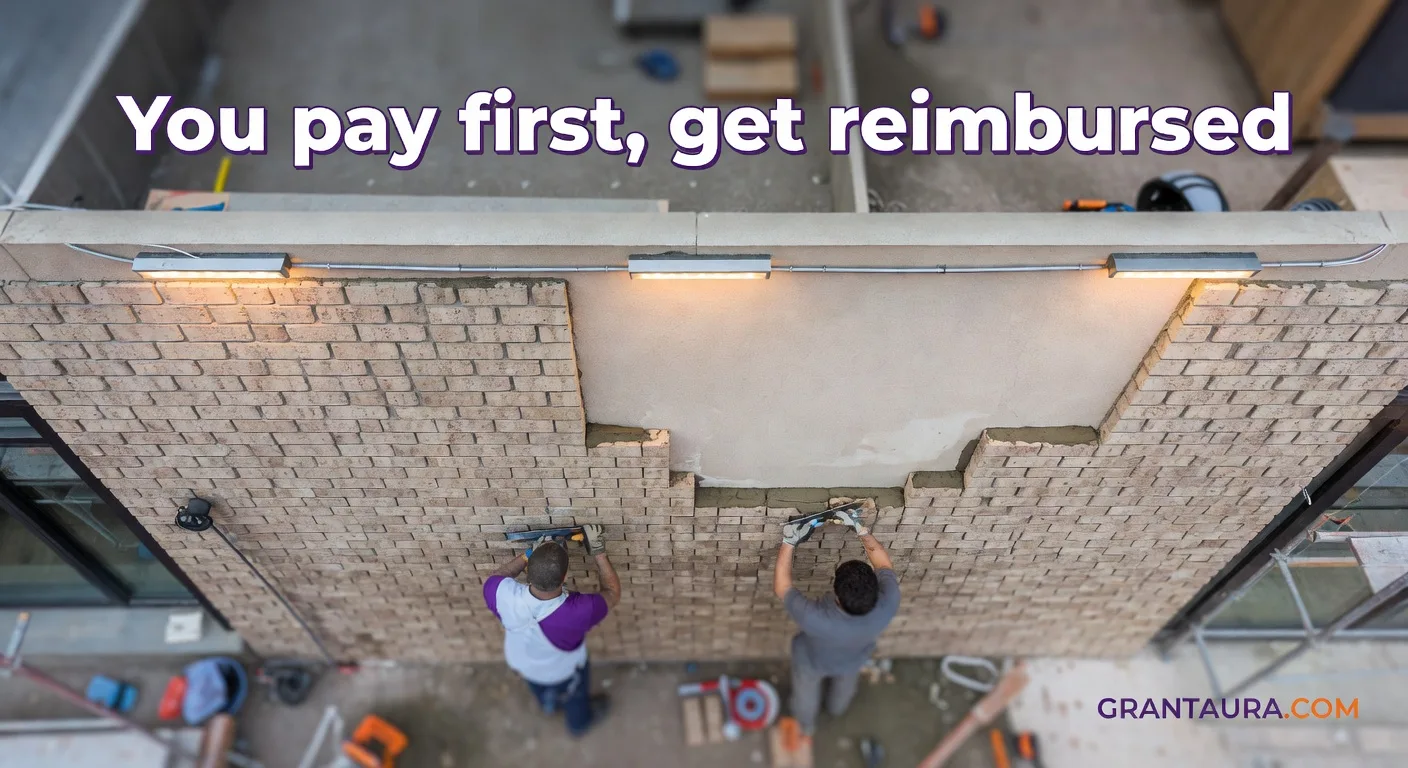
The reimbursement reality: you pay first
Because this isn’t upfront funding, you hire the contractor, you pay for the work, and then the city reimburses you after approving the completed project via EcoDevInfo@dallas.gov. That means you need cash on hand or a financing arrangement to cover your match portion before any city money flows. After the grant agreement is executed, you’re required to maintain the improvements for five years. The Office of Economic Development can conduct site inspections during that window. What happens if you sell the property during the compliance period isn’t addressed in the publicly available materials – the Program Statement would contain those terms, but we couldn’t access that document as of our research date. So read the full agreement carefully before signing.
Must Do
Do not start any improvement work before the city executes your grant agreement. Work completed before approval does not count toward the project cost. Get written approval first.
How to submit: email, exact file formats
There is no online application portal for this grant. You email your completed application and attachments to EcoDevInfo@dallas.gov. That’s both simpler and riskier. Simpler because you don’t have to learn a new system. Riskier because email submissions can get lost, flagged as spam, or delayed. So when you send, use a clear subject line: “District 7 Exterior Grant Application – [Your Business Name]”. Attach all required documents in a single email. Request a read receipt if your email client supports it. Follow up in 3-5 business days if you haven’t received an acknowledgment. Timing matters.
The application asks for seven items, and the file format specs are buried in a footnote on page 2 of the PDF. Budget worksheet must be .xlsx only, not .csv. Photographs of existing conditions must be .jpg or .png under 5MB each. Drawings or renderings must be PDF. Everything else – application form, lease agreement, Certificate of Occupancy, owner approval letter – must be PDF. I see applicants submit .csv budgets or oversized images all the time. The city returns those applications within 5-7 business days for resubmission. That’s a week or more of delay, and with first-come funding, timing matters.
Important Note
If you’re a tenant, remember the property owner approval letter must be notarized. Start that process early – notary appointments can take days to schedule, and you can’t submit without it.
Common application mistakes that get you rejected
Three issues dominate based on program requirements. First, incomplete documentation – missing the property owner signature on tenant applications. The tenant submits everything, the landlord never signs, the application sits incomplete. Second, contractor bids that aren’t sufficiently itemized for the city to verify capital improvement eligibility. “Renovate facade: $35,000” isn’t sufficient. The bid needs to break out materials, labor, permits, and specific line items. Third, starting work before the grant agreement is signed – an expensive mistake that voids reimbursement eligibility.
Things to Avoid
Submitting stand-alone painting or signage as the primary project
Using a contractor who isn't licensed or insured
Submitting without the property owner signature for tenants
Providing lump-sum bids without line-item breakdowns
Starting work before the grant agreement is signed
The clawback provision is real. If you use funds for ineligible purposes, fail to complete approved improvements, fail to maintain them during the compliance term, or misrepresent information in your application, the city can terminate the grant and require repayment. You must retain all project records per the agreement terms. This is a binding agreement with ongoing obligations.
Frequently asked questions
Q: Is this grant upfront funding or reimbursement? A: Reimbursement. You complete eligible improvements, submit documentation with invoices and photos, then receive City funds after review and approval. Plan your cash flow accordingly – you need to front the costs first.
Q: How do I calculate my matching funds? A: Use the tier that matches your total project cost: 20% private match for projects $0-$25K, 30% for $25K-$50K, 50% for $50K-$100K.
Q: Can I apply if I rent my business space? A: Yes, but your property owner must also sign the application and provide a notarized approval letter for the improvements. Start that conversation before you budget your matching funds. Need help with landlord coordination?
Q: Does stand-alone painting qualify? A: No. Painting must be part of a broader permanent capital improvement project to be eligible. If you’re just refreshing paint without other structural or aesthetic upgrades, this grant isn’t the right fit.
Q: What file formats are required for application documents? A: Budget worksheet must be .xlsx (not .csv), photographs .jpg or .png under 5MB each, drawings PDF, all other documents PDF. Format errors cause applications to be returned for resubmission, delaying your place in the first-come queue.
Q: Can a consultant prepare my application? A: Yes, third-party consultants may prepare and submit applications as long as the authorized business representative signs the final form. The signature must be from someone with legal authority to bind the business.
Q: How are applications scored? A: Applications are reviewed against criteria including project impact, feasibility, budget efficiency, and applicant capacity. Structure your narrative to address each criterion explicitly – don’t make reviewers guess.
Terms that matter for this grant
Capital expenditure: A permanent improvement to real property that adds value or extends useful life, as defined by federal tax law. This grant only funds capital expenditures, not routine maintenance.
Reimbursable grant: Funding issued after eligible expenses are documented and approved, not upfront. You must have cash flow to cover project costs before receiving reimbursement.
Matching fund tiers: The percentage of project costs you must provide from private sources: 20% for $0-$25K projects, 30% for $25K-$50K, 50% for $50K-$100K.
District 7 boundary: The geographic area represented by Dallas City Council District 7, covering southern and eastern portions of the city. Eligibility requires physical location within this boundary.
Proposition I bond: The 2017 voter-approved bond package that funds this grant. It’s a one-time allocation, not an annual budget line, which is why the funding pool is limited and non-replenishing.
Permanent capital improvements: Exterior upgrades that are affixed to the property and intended to last: facade work, hardscaping, ADA ramps, energy-efficient windows, integrated landscaping. Not temporary or cosmetic-only changes.
Exterior capital expenditures: The specific category of eligible expenses for this grant. Must be exterior-facing, permanent, and meet the federal tax definition of capital expenditure.
Scoring rubric: The weighting system used to evaluate applications: impact, feasibility, budget efficiency, capacity. Understanding this helps you structure a competitive narrative.
First-come processing: Applications are reviewed in the order received, not in batches. This makes submission timing important when funding is limited.
Corridor prioritization: Projects located on streets identified in the District 7 Small Area Plan may receive slight preference in tiebreaker scenarios during review. Not a guarantee, but a potential edge.
Clawback provision: Contractual right to recover funds if you violate program terms. The city can demand repayment if you misuse funds or fail to maintain improvements.
More grants to explore
If this grant isn’t the right fit – maybe your project isn’t in District 7, or you need upfront funding instead of reimbursement – there are other options. The Dallas grants directory lists city-wide programs that might match your situation. For facade-focused projects outside District 7, check out similar facade programs in other locations. If you’re looking for smaller, quicker funding, the Start.Pivot.Grow. Micro Grant offers different terms for Dallas small businesses.
Women entrepreneur funding with different structure. Strategic consideration for female-owned District 7 businesses evaluating multiple grant pathways for exterior work.
Similar exterior capital improvement focus for commercial properties. Different geographic scope makes this a strong alternative if your project falls outside District 7 boundaries.
Dallas-specific small business funding with different structure. Useful comparison for businesses needing smaller, quicker capital versus the reimbursable exterior focus of this grant.
Storefront improvement angle with national reach. Overlaps on facade and exterior upgrade use cases for small retail businesses considering multiple funding paths.
If you got stuck on the matching fund calculations earlier, we can help you structure the budget worksheet in the required .xlsx format with the tier logic built in. If you’re unsure whether your project qualifies as a capital improvement versus routine maintenance, I can hop on a live 1-on-1 video or phone call to walk through the definitions with your specific plans. If you’re worried about file format errors causing a 5-7 day return delay, we’ll validate your attachments before you email to EcoDevInfo@dallas.gov. And if you want your narrative optimized against what this program’s reviewers prioritize, our reviewers will catch phrasing that might undersell your project impact before submission. This isn’t about re-explaining what the donor page says. It’s about helping you execute the application correctly the first time, when timing matters.
I research grants like this one so you don’t have to dig through PDF footnotes and slide decks to find the details that actually matter. When I found the file format specs buried on page 2 of the application, or the scoring rubric in a Lunch & Learn deck, I made sure to include them here because those are the things that cause real application delays. If you have questions about this grant or want help with your submission, you can book a live consultation or read more about how I approach grant research here. No fluff. Just the stuff that helps you decide.
[
  {
    "url": "https://grantaura.com/grant/facade-improvement-grant/",
    "custom_description": "Similar exterior capital improvement focus for commercial properties. Different geographic scope makes this a strong alternative if your project falls outside District 7 boundaries."
  },
  {
    "url": "https://grantaura.com/grant/start-pivot-grow-micro-grant/",
    "custom_description": "Dallas-specific small business funding with different structure. Useful comparison for businesses needing smaller, quicker capital versus the reimbursable exterior focus of this grant."
  },
  {
    "url": "https://grantaura.com/grant/amex-shop-small-grants/",
    "custom_description": "Storefront improvement angle with national reach. Overlaps on facade and exterior upgrade use cases for small retail businesses considering multiple funding paths."
  },
  {
    "url": "https://grantaura.com/grant/dallas-small-business-assistance-program/",
    "custom_description": "City-wide Dallas program with broader eligibility. Strategic alternative for businesses outside District 7 or needing different funding structures than reimbursable exterior work."
  },
  {
    "url": "https://grantaura.com/grant/ada-compliance-grant/",
    "custom_description": "ADA accessibility improvements overlap with eligible uses in this grant. Relevant for businesses prioritizing accessibility upgrades as part of broader exterior capital work."
  },
  {
    "url": "https://grantaura.com/grant/energy-efficiency-small-business-grant/",
    "custom_description": "Energy efficiency upgrades are eligible under this grant. This related grant offers focused support for green building improvements as an alternative or complement."
  },
  {
    "url": "https://grantaura.com/grant/commercial-property-improvement-grant/",
    "custom_description": "Broad commercial property capital improvement focus. Strategic overlap for businesses evaluating exterior work alongside other property enhancement funding options."
  },
  {
    "url": "https://grantaura.com/grant/main-street-facade-grant/",
    "custom_description": "Facade-focused grants for commercial corridors. Similar aesthetic and streetscape improvement goals with different geographic targeting and application mechanics."
  },
  {
    "url": "https://grantaura.com/grant/small-business-capital-improvement-grant/",
    "custom_description": "Capital improvement funding for small businesses. Overlaps on permanent structural upgrade use cases with different eligibility gates and reimbursement structures."
  },
  {
    "url": "https://grantaura.com/grant/historic-preservation-grant-texas/",
    "custom_description": "Exterior work on older commercial buildings in Texas. Relevant for District 7 businesses in historic structures evaluating preservation-focused exterior capital improvements."
  },
  {
    "url": "https://grantaura.com/grant/texas-small-business-grants/",
    "custom_description": "Statewide Texas small business funding directory. Broader geographic scope for businesses comparing District 7-specific opportunities against regional alternatives."
  },
  {
    "url": "https://grantaura.com/grant/chasm-momentum-grant/",
    "custom_description": "Women entrepreneur funding with different structure. Strategic consideration for female-owned District 7 businesses evaluating multiple grant pathways for exterior work."
  }
]
We are your trusted grant application partners. You can navigate the entire grant application process with our expert guidance through this simple 5-step process.
300+ Projects
4.9/5 Rating
Expert Team
Step 1: Application Form
Fill out the “Apply for this grant” form with your information and grant requirements.
Step 2: Eligibility Assessment
Our grant experts will assess your eligibility and notify you via email.
Step 3: Expert Consultation
A dedicated grant expert will be assigned to discuss next steps for your application.
Step 4: Application Submission
Our expert will help you complete and submit your application with all required materials.
Step 5: Final Decision
The grant committee will make their decision and notify successful applicants.
Hi there 😊 I’m Imran Ahmad, the founder of Grantaura. I normally examine funding opportunities through both newer research methods and older, manual verification methods because official webpages, application forms, FAQs, archived materials, etc. do not always tell the same story.
Because I believe that “the fine print usually only shows up when you’re stubborn enough to check twice.”
You are on District 7 Exterior Improvement Grant: Facade, Hardscape, ADA Upgrades. I can help check fit, compare effort, or decide whether Grantaura application support makes sense for this grant.
No chat history in this browser yet.
You are in queueIAGA
A Grantaura colleague can review this conversation. You can keep chatting with the assistant while you wait.
Tell us about yourself
0/1000
i
The information you add here helps the assistant answer this browser session more clearly. Close this window to continue the chat.
Check your eligibility
Check your saved details, answer the grant questions, and see your next steps.
Grant team review
Saved details where available
Free assessment
Save option
Save this grant application for later
Send yourself a private link so you can return to this grant form with your details ready.
Keep your post public. Our team will verify the link before processing your assessment. If the post is deleted or made private after submission, your free assessment will be void.