



Recommended
Full Application support
From USD 41.40
- Application prepared for this grant
- Requirements reviewed before submission
- Submission handled on your behalf
You will review the exact price, payment timing, and refund policy before checkout.
Find funding opportunities, check your eligibility, and submit professional applications with expert support.
Choose your audience and we'll show you the most relevant grant paths.
Sign in to keep saved grants, profile details, application work, and support requests in one place.
Start with a quick fit check.
Check Eligibility
Upfront funding for Denver brick-and-mortar businesses and nonprofits to reduce emissions and save on utility costs.

Your next step
Review your fit first, then choose the level of help you want. You can start with an eligibility assessment, talk through the opportunity with an expert, or get full application support.
Sign in to pin this grant with deadline alerts, matched-grant context, and a task tracker tied to this opportunity.
Sign in to save this grantMost small business grants make you spend your own cash first, then wait months to get paid back. Denver’s Certifiably Green Mini Grants flip that. They give you the money upfront – up to $10,000 – before you buy a single thing. Kim Le knows the appliance math well. She owns Sesame Sandwich Shop, and when she looked at energy-efficient commercial ovens, the price difference between a standard model and an efficient one was the whole problem – $1,500 versus $7,000 or $8,000. Without capital upfront, that gap is just a number you walk away from. This program exists specifically for that gap. Applications are accepted on a rolling basis until funding runs out, which means your timing strategy matters as much as your project idea. About 30 businesses get funded each cycle.
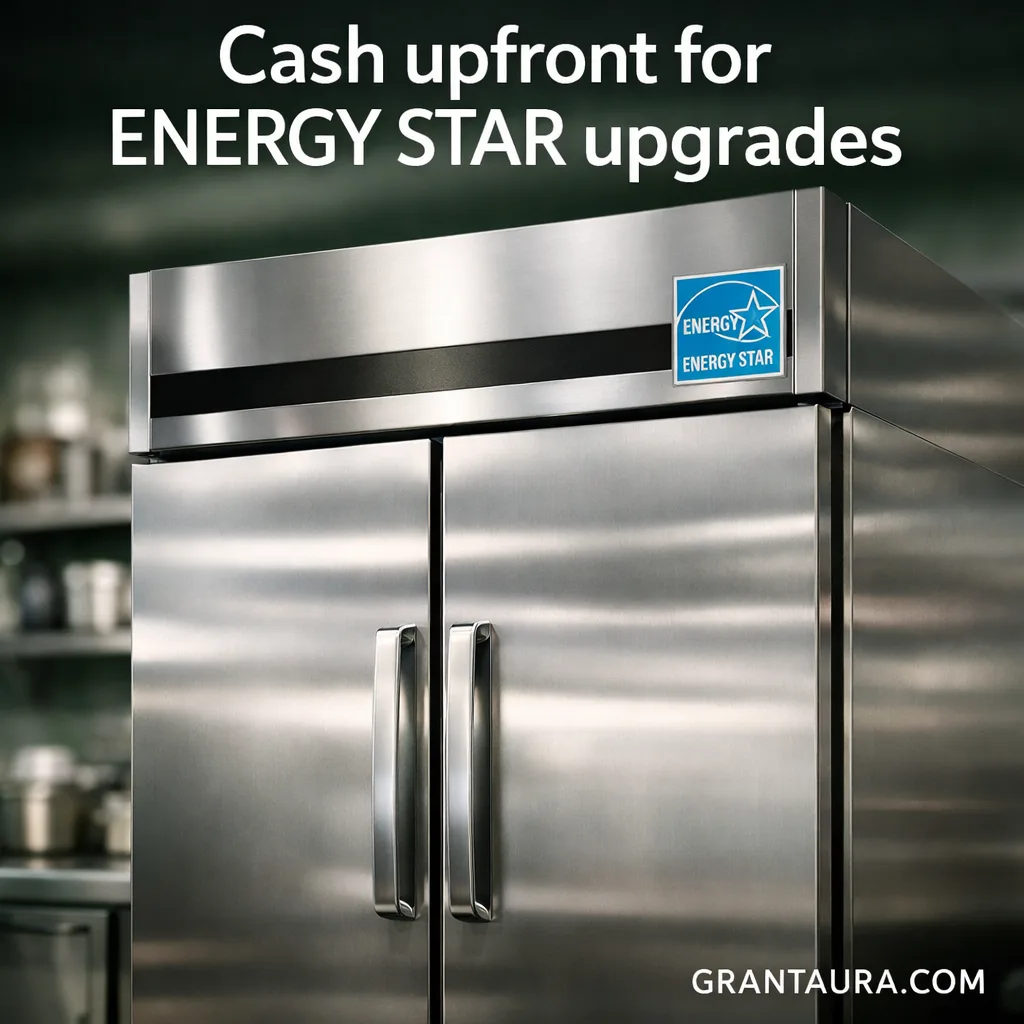
Sesame Sandwiches used theirs to buy an ENERGY STAR cooler before their old one died. Not because it was broken – because they heard about this program in time. That’s the window. More on upfront vs reimbursement grants here.

Not sure if you qualify yet? The eligibility tool below walks through the requirements – takes about 90 seconds. It flags common mismatches like a W-9 address that doesn’t line up with your Colorado Secretary of State filing, which is a surprisingly frequent rejection reason.
If the tool shows you’re eligible, the next step is getting your project reviewed before you submit. That’s where our experts come in. If you’re unsure about something – maybe your W-9 address doesn’t match your Secretary of State filing, or you’re not certain about your NEST neighborhood status – Book a live 1-on-1 consultation with a grant expert instead. And if you’re not eligible? Scroll down to the More Grants section. There are other Denver programs that might fit, or we can point you toward matched grants research based on your profile.
This isn’t a reimbursement program. You don’t spend your own money, wait months, then beg for a check. The city gives you the cash before you buy anything. You get the award, you purchase the equipment, you submit receipts to prove it happened. That’s the whole sequence. It’s rare for a city sustainability program to work this way, which is why most people assume the opposite. Don’t assume. The upfront structure is the single biggest reason to prioritize this grant over utility rebates that make you front the capital yourself.
The city publishes a clear allowable list. ENERGY STAR certified appliances – refrigerators, dishwashers, HVAC equipment. WaterSense fixtures and toilets. Smart irrigation systems and xeriscaping (replacing grass with drought-tolerant landscaping). Reusable to-go ware, dispensers, bags. Bike racks installation. Electric bikes for staff or deliveries. RTD EcoPasses for staff. Upcycling projects. Food waste prevention. Shading systems to reduce summer heat. Water bottle filling stations.
But here’s the thing people get wrong. Electric vehicles? Explicitly banned. I double-checked this because it’s counterintuitive – a green grant that won’t fund EVs. The city prioritizes emissions reductions from buildings and operations, not transportation. E-bikes for deliveries are fine though. Go figure.
The program’s five certification criteria categories give you a useful framework for thinking about your project:
Each purchase needs to be ENERGY STAR or WaterSense certified where those standards exist. You don’t need to be a Certifiably Green Denver member already – the application doesn’t require it. But the program has certified over 420 Denver businesses, so you’d be in good company.
Let me save you some time. You need a physical brick-and-mortar location inside Denver city limits. Not a home-based business. Not a food truck. Nonprofits qualify alongside small businesses – that’s in the official guidelines. You’ll need an active TIN or EIN, registration with the Colorado Secretary of State, and a Certificate of Good Standing. Your W-9 address must match what’s on file with the state. Mismatches get applications rejected.
If you’re in a NEST neighborhood – Denver’s Neighborhood Equity and Stabilization zones, basically lower-income areas the city is actively trying to stabilize – your application gets priority. The city doesn’t publish the scoring rubric, but the preference is explicit. The NEST Neighborhood Business Fund is another program worth looking at if you’re in one of these areas.
The donor page says you need to meet SBA size standards but doesn’t specify which ones. Standard small business definition applies – under 500 employees for most industries. Denver Climate Protection Fund rebates are another option if you’re working on energy efficiency.
This is where the donor page gets vague. Let me walk through what I found.
First, you submit through Submittable – it’s a custom portal, not a simple online form. You’ll describe your project and list each purchase with product links or quotes. Then the city reviews applications on a rolling basis. If selected, you don’t deal with the city directly after that point. A company called APTIM reaches out. They handle the scope of work document, budget approval, terms and conditions signature, invoice processing, and finally cutting the check.
Default payment method? A physical check mailed to you. Very 1990s but whatever works. You get the cash before you buy anything – that’s the key difference from reimbursement grants. Then you make your purchases, submit receipts to APTIM’s portal, and you’re done.
One more requirement that surprises people: your business needs $1 million in commercial general liability insurance, and the policy must name the City and County of Denver as an additional insured. Most small business policies can add this endorsement, but you need to request it. The ACORD certificate becomes non-negotiable once you win.
One awardee, Alyssa Housh at The Organic Salon, told Denver7: “I felt like the application was easy to understand and navigate. The information requested was not overwhelming.” That’s a real quote from someone who went through it.
The application asks for four things. Your W-9 – use last year’s copy if the address still matches. Certificate of Good Standing from the Colorado Secretary of State – here’s how to get one if you don’t have it. A project description – what you’re buying and why it reduces emissions or saves water. And an itemized budget breakdown with product links or quotes.
Address mismatches between your W-9 and your Secretary of State filing are a common disqualifier. Not “close.” Not “basically the same.” Exact. A minor difference – a suite number formatted differently, an abbreviation versus a spelled-out street type – can stall your application during verification. Check this before you apply. If they don’t match, update one or the other first.
The Certificate of Good Standing also needs to be current. Not from six months ago. Not “I think it’s still valid.” Current. The Colorado Secretary of State portal lets you request one online, usually within a few business days. Factor that timeline into your application planning.
The city has distributed over $650,000 since the program started in 2022. In 2024 alone, 25 businesses got funded. The press release lists names: Sesame Sandwiches, Quince Coffee House, Novel Strand Brewing, The Denver Cat Company, EarthLinks. These are real Denver businesses. The Denver Cat Company used their grant for a new ENERGY STAR cooler. EarthLinks got RTD passes for staff, an ice machine, and faucet installation.
About 30 businesses get funded per cycle, according to program administrator Gerardo Aguilera. That’s not a huge number, which means when the money’s gone, it’s gone.
The 2026 open date isn’t published yet. The city’s page just says “later this month” as of January 2026. I’m checking weekly. The scoring rubric isn’t public either – the city just says NEST neighborhoods get preference and projects need to reduce emissions or save water. Whether past awardees can apply again? Not addressed anywhere. If you got funding in 2024, I don’t know if you’re eligible for 2026. The program contact is certifiablygreendenver@denvergov.org if you want to ask.
But the rolling deadline structure is clear: apply when you’re ready, but when the funds exhaust, that’s it for the cycle.
Q: Do I need to be a Certifiably Green Denver member to apply?
A: The application doesn’t require it. The program has certified over 420 businesses, but membership isn’t listed as a prerequisite. That said, being certified probably doesn’t hurt.
Q: My W-9 address doesn’t match my Secretary of State filing. What do I do?
A: Fix it before you apply. Update one or the other. Address mismatches are a common disqualifier per the application checklist. This is the single most avoidable rejection reason.
Q: Can I apply for multiple projects in one grant?
A: Yes. The itemized budget can include multiple purchases – an ENERGY STAR fridge, bike racks, and xeriscaping all in one application. Just list everything with product links or quotes.
Q: How fast do I get the money after approval?
A: The research doesn’t have a specific timeline. APTIM handles payment after scope approval and terms signature. The default is a physical check mailed to you. Plan for weeks, not days.
Q: What if my project scope changes after approval?
A: You work with APTIM on the scope of work document before money changes hands. That’s the time to adjust. Once the check is cut, you’re locked in.
Q: I’m in a NEST neighborhood. How do I prove it?
A: The city doesn’t specify documentation. Use your business address. The NEST map is public on Denver’s website – check your address there.
Q: Can a food truck or home-based business apply?
A: No. Both are explicitly excluded in the official guidelines with no exceptions documented. If you have a brick-and-mortar location plus a food truck, email the program to ask whether the stationary business qualifies independently.
Q: Can I reapply if I received a grant in a previous cycle?
A: Not confirmed in publicly available documentation. Email certifiablygreendenver@denvergov.org with your previous award details before investing time in a second application.
If this grant isn’t the right fit – maybe you’re home-based, or you need EV charging stations, or you just missed the window – there are other programs. The Colorado Energy Office offers similar funding for energy efficiency projects. Xcel Energy has business rebates for appliances. And Denver’s Climate Protection Fund runs rebate programs year-round.
Here’s the reality. The eligibility criteria are clear enough – you can read them above. But most rejections in this program happen in the narrative, the budget section, and the paperwork gaps. Specifically, how you describe your project’s emissions reduction or water savings. Whether your project maps cleanly to one of the five CGD categories. Whether your W-9 address matches your state filing. Whether your insurance certificate has the correct “additional insured” wording.
What you think is a strong impact statement might not match what reviewers in this program expect. The CGD criteria alignment requirement is not a form field you fill out and move past. It’s the core of your application, and it demands project descriptions written to specific sustainability impact language that the city’s reviewers recognize as matching the certification framework. A project that is genuinely good but described in generic terms – “we want to reduce our environmental footprint” – reads differently than one that maps explicitly to the energy efficiency category, quantifies the expected reduction, and connects that reduction to the CGD criteria in the language the program actually uses.
Our experts have reviewed dozens of sustainability grant applications. We catch phrasing errors before submission – not what the rule says, but whether your wording triggers a reviewer’s “this feels weak” reflex. We also flag document gaps (that W-9 address mismatch thing kills applications, and the insurance requirement trips up winners after selection) and help position your project competitively relative to other applicants in the same cycle.
Do’s
Don’ts
Complexity tier for this grant: complex. Why? You need four documents, the portal is custom (Submittable, not a simple online form), and the process is multi-phase (city review then APTIM scope approval then payment). Our pricing reflects that complexity – the exact quote appears in the application submission intake modal before payment, with options for upfront, milestone, or per-submission billing.
If you’re serious about applying, here’s what I’d do. Let our team review your project description and budget before you touch Submittable. We’ll tell you if it fits – not in vague terms, but line by line.
If you’re still unsure whether your project qualifies – maybe it’s borderline on the allowable list, or you’re not certain about your NEST neighborhood status, or the insurance requirement has you confused – Book a live 1-on-1 consultation with a grant expert instead. Video or phone call. We’ll walk through your specific situation.
I’ve been tracking small business grants since before Grantaura existed. Not because I’m a grant writer by training – I’m not. Because I kept seeing business owners leave money on the table, not because they weren’t qualified, but because the donor pages were confusing or buried the key details. This grant’s upfront funding model is rare. Most city programs don’t work this way. If you’re in Denver with a brick-and-mortar location, this is worth your time. I update this listing as the city announces new cycles. Questions? The consultation link above goes to my calendar. You can also read more about my approach on my author page.
We are your trusted grant application partners. You can navigate the entire grant application process with our expert guidance through this simple 5-step process.
Fill out the “Apply for this grant” form with your information and grant requirements.
Our grant experts will assess your eligibility and notify you via email.
A dedicated grant expert will be assigned to discuss next steps for your application.
Our expert will help you complete and submit your application with all required materials.
The grant committee will make their decision and notify successful applicants.


Check your saved details, answer the grant questions, and see your next steps.
Send yourself a private link so you can return to this grant form with your details ready.
Enter your email. We will send a one-time code to verify. No account needed.
Enter the 6-digit code we just sent. It expires in 10 minutes.
We'll save your progress and send a reminder to your account email when you're ready to continue.
Check your inbox. Your resume link is valid for 14 days.
Now
PendingComplete your profile to begin matching.
Profile -> Matching -> Choose grants -> Quote -> Verify -> Pay
Profile data is saved in your browser and synced to secure storage when available.
Selection preview
No grants selected yet.
Soft estimate
Estimate only. Final pricing appears in Quote step.
Quote expiry
Quote timer starts after pricing is generated.
Verification
Verification status appears here once quote is confirmed.
Success snapshot
Success milestones appear here after confirmation.
What happens next
After quote confirmation, verify your email and complete secure payment.
Application support
You provide the details. Our team prepares, reviews, and submits the application for you.
From USD 41.40
You will review the exact price, payment timing, and refund policy before checkout.
Find out if you qualify. Results typically within 24 hours.
USD 5.99 one-time
Share the grant publicly, send us the link, and we will assess your application at no cost.
Free
The donor does not charge this fee. Grantaura's price covers hands-on preparation, review, and submission support.
You will see the exact price before payment. Funding is not guaranteed.
Need help deciding? Ask us by email
Deduction shown at checkout if your same-grant assessment is on file.
Choose payment plan
Due to the approaching deadline, submission is not guaranteed. Full refund if we cannot complete it.
Completing your payment in a new tab...
If the payment page didn't open, use the manual link below.
Check your email
Need a hand? We can continue this for you.
Leave your details and we'll send a resume link so you can pick up right where you left off.
Processing payment
Please don't close this window.
Payment complete
Payment unsuccessful