







Recommended
Full Application support
From USD 41.40
- Application prepared for this grant
- Requirements reviewed before submission
- Submission handled on your behalf
You will review the exact price, payment timing, and refund policy before checkout.
Find funding opportunities, check your eligibility, and submit professional applications with expert support.
Choose your audience and we'll show you the most relevant grant paths.
Sign in to keep saved grants, profile details, application work, and support requests in one place.
Start with a quick fit check.
Check Eligibility
Montgomery County pays $8-$15 per square foot for new or expanded commercial office leases, up to $150,000, first-come first-served.

Your next step
Review your fit first, then choose the level of help you want. You can start with an eligibility assessment, talk through the opportunity with an expert, or get full application support.
Sign in to pin this grant with deadline alerts, matched-grant context, and a task tracker tied to this opportunity.
Sign in to save this grantThe moment you sign a commercial office lease in Montgomery County, Maryland, a 180-day clock starts running — and most business owners do not find out about the MOVE Grant (Make Office Vacancy Extinct) until somewhere in the middle of that window, or after it has already closed. That is the real story of this program. In 2024, the county paid out $566,362 to 29 businesses for doing something they were already planning to do: sign or expand an office lease. Not a competitive process. No scoring rubric. First-come, first-served, full stop. The most recent named awardee I found was Powersolv, an IT consulting firm that relocated from Reston, Virginia to 100 Park Avenue in Rockville and received $9,016 in June 2025 for its first Montgomery County commercial lease. That is a real company, a verifiable amount, and a straightforward illustration of how this plays out in practice.
Before going further: a number of official-adjacent county pages still publish the pre-2024 figures — $80,000 maximum, 90-day window. Both are wrong. Bill 11-24, enacted in July 2024, raised the cap to $150,000 and extended the application window to 180 days. If you read something different on another county resource, that page has not been updated to reflect the current program.
The MOVE Grant eligibility tool checks your specific situation against the program’s key qualifying conditions: what kind of lease you have, how your space is classified, and where you are in the 180-day window. It takes a few minutes and gives you a clear directional read before you invest time gathering documents.
If the tool confirms you qualify, the practical next step is not the county application form — it is preparing your document package, and the business plan in particular deserves more time than most applicants give it. Start your application submission review here and our team will work through what that preparation looks like for your specific lease. If your result comes back uncertain — office space classification is the most common sticking point — a live 1-on-1 video or phone call with a grant expert at Grantaura can review your lease and property details before you commit to the process. If this program is not the right fit, check the more grants section below for other Maryland and Montgomery County programs that may align better.
The award calculation is simpler than it looks. Your grant equals your eligible square footage multiplied by the rate that applies to your tier — capped at $150,000. For expansion applicants, eligible square footage is the net new square footage you are adding to your existing footprint, not your total space after the expansion. For a business signing its first Montgomery County lease, eligible square footage is the total leased premises.
To make the math concrete: a 5,000 SF first lease in Bethesda earns $40,000. A 9,000 SF expansion earns $90,000. The Strategic Industry tier pays $15 per square foot regardless of total space size, capped at $150,000. What exactly qualifies as Strategic Industry? Honestly, the definition lives inside Executive Regulation ER-12-24, which is not available in readable form from the public URL at the time of this writing. The 2024 county annual report shows that 38% of all MOVE square footage went to Biotechnology, Life Science, and Medical Practice companies — which suggests these sectors are the primary recipients of the higher rate. But the county has not published a plain-language sector list. If you think your business might qualify, call the Business Center directly at 240-777-0311 or email BusinessCenter@montgomerycountymd.gov. They respond within two business days and that conversation is worth having before you submit.
One important note on craft alcohol producers: breweries, cideries, distilleries, and wineries qualify for the MOVE Grant as long as production — not retail sales — is their primary use of the leased space. That is an explicit exception in the county code to the general retail exclusion, and it often surprises founders in those sectors who assumed they were out.
The 2024 update changed who can apply in a way that most secondary coverage still has not fully absorbed. Before July 2024, only businesses that were new to Montgomery County could apply. A company that had been operating in Rockville for five years and wanted to expand could not get a MOVE Grant under the old rules. That changed with Bill 11-24.
Now there are two distinct qualifying scenarios. The first is an Inaugural Commercial Lease: your business signs its very first commercial office lease in Montgomery County. The second is an Expanded Commercial Lease: your business already has a Montgomery County office presence and is signing a new lease or amendment that adds at least 500 square feet to your existing footprint. Both scenarios trigger the same 180-day application clock from the lease execution date. Both use the same award tier structure. And if you are relocating from one Montgomery County address to another — not adding square footage, just moving within the county — that counts as a new inaugural lease and qualifies on the same terms as a business coming to the county for the first time.
Your lease might say “office” in plain English. Your landlord might describe it as office space. None of that determines eligibility. What matters is how the space is classified in third-party real estate software — platforms like CoStar that the county uses to verify building designations.
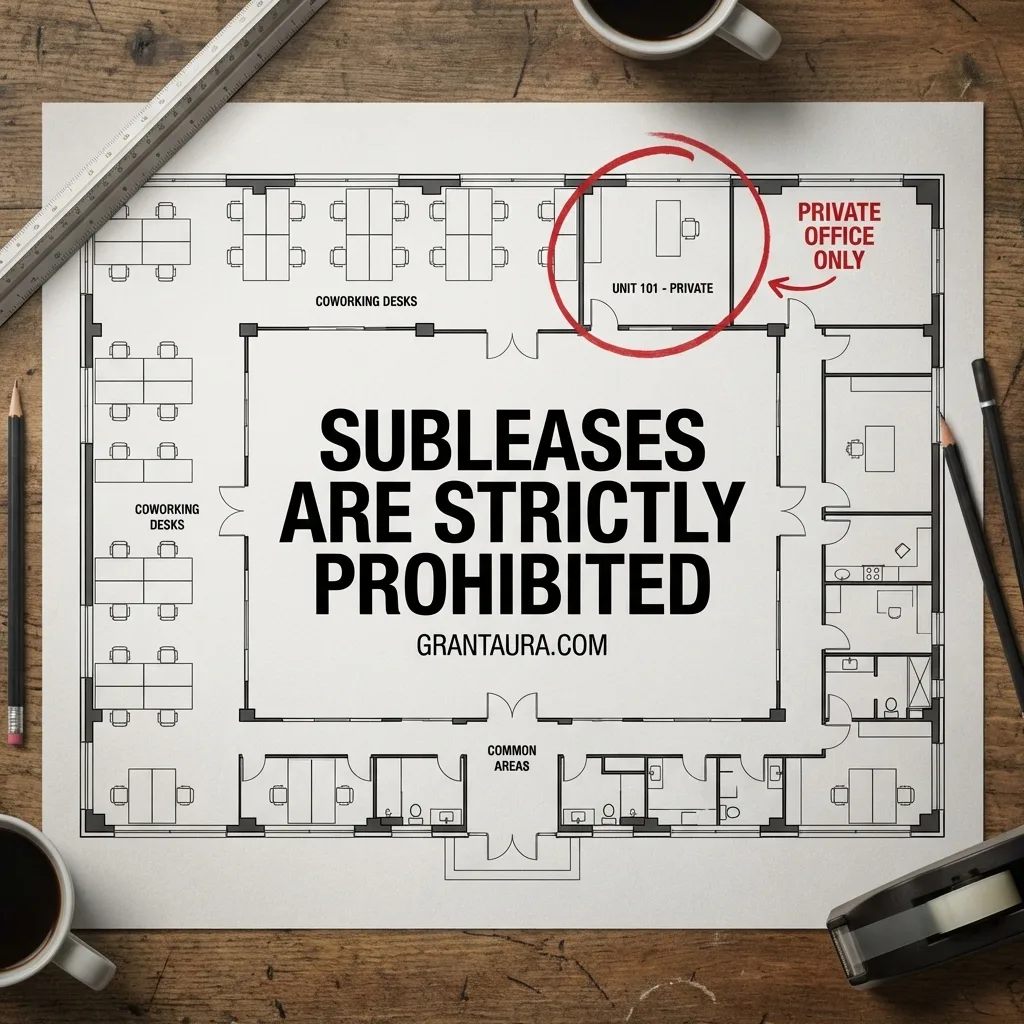
If your space is classified as flex, mixed-use, coworking, or industrial in that database, the county will likely reject your application regardless of how you actually use the space, regardless of what your lease says, and regardless of whether every neighbor in your building runs a professional services firm. The label in the software is what counts. Before you begin gathering documents, check how your building and specific suite are classified in CoStar or the equivalent platform your county contact references. You cannot easily change that classification after the fact. Discovering the problem after submission means starting over — inside a window that is already running.
Coworking tenants have a specific pathway: the county allows an occupancy permit in place of a traditional signed lease for shared-office arrangements. The office space classification requirement still applies to the underlying building, but the document substitution is explicitly permitted. What does not qualify: floating desks, hot desks, or any arrangement where you do not have a dedicated and fixed private suite. If your coworking agreement does not give you a consistent assigned space for the full term, the county will treat it as a sublease or a non-qualifying arrangement.
Talk Through Your Space Classification With a Grant Expert
The clock starts on the date you and the landlord execute the lease. Not the date you receive the keys. Not the date your furniture arrives. Not the date you notify the county. The execution date on the signature page of your lease is day zero, and you have 180 calendar days from that moment to submit a complete application.
That distinction matters more than it sounds. A business that signs a lease in January and plans a March move-in is already 60 days into its window by the time the space is ready to occupy. Proof of occupancy — one of the five required documents — cannot be obtained until you have actually moved in. If buildout or logistics delays push move-in to month five, your window for gathering and submitting all documents may be uncomfortably tight.
The program has no annual program-level deadline — it is ongoing until appropriated funds are exhausted. Your personal deadline is the only one that matters. First-come, first-served means the completeness of your application and the date it arrives both determine your position in the funding queue. An incomplete application does not hold your place in line — review only begins once all five required documents are present in the submission portal.
Applications go through the county’s GovOS portal (formerly SeamlessDocs) at montgomerycountymd.seamlessdocs.com. Five documents are required for a complete submission:
The utility bill requirement is where applications most often stall on a technicality. The county requires that the proof of occupancy be “generated by a party other than the Business or landlord for the leased premises.” That means: a welcome letter from your landlord does not work. A utility transfer confirmation in your business name does not work if your business is also the account holder. What works: a bill from the local utility company registered to the physical address of your leased space, where the account holder is your business and the document originated from the utility provider — not from your own records or your landlord’s system. Suite number variations between the lease address and the utility bill address can trigger rejection. PO box addresses on utility documents are rejected. The service address must match your lease address specifically.
New businesses face a specific version of this problem: if your LLC was formed recently and you have not yet established utility accounts at your new space, you will not have a utility bill to submit until after move-in. Moving company invoices addressed to the leased space also work. A Certificate of Use and Occupancy from Montgomery County’s permitting services is another valid substitute. Plan for this document early, not as an afterthought.
The business plan is the other friction point. The county requires “a complete business plan that clearly identifies the type, purpose, and financial projection of the business.” No template is provided. No word count is specified. No format is required. What is clear from the program structure is that the depth of financial projection the county expects to see scales with the award size. A business applying for $40,000 based on a 5,000 SF lease is in a different position than a business applying for $120,000 based on a 10,000 SF expansion. In both cases the plan needs to demonstrate that the business is legitimate, has a defined purpose, and has a credible financial trajectory. In the larger-award case, reviewers are looking at substantially more money — and the plan needs to reflect that.
After the county reviews and approves your application, disbursement is contingent on a physical site visit. A program manager or Business Center staff member visits your leased space to verify you are physically occupying it. The visit is scheduled after you notify the county that you have taken occupancy. How long that scheduling takes is not publicly specified — I could not find a published timeline anywhere in county documentation. Plan for a gap between application approval and cash receipt, and do not count on the funds arriving in the same month you submit.
The City of Rockville runs its own separate MOVE supplement through Rockville Economic Development Inc (REDI). It adds up to $4 per square foot on top of the county grant. For a Strategic Industry business in Rockville, that combination reaches $19 per square foot from two government sources for the same lease — up to $190,000 combined. In 2024, Rockville accounted for 55% of all county MOVE grants, with 13 of the 29 awarded to Rockville businesses. The county program and the city program are administered independently and reviewed independently, which means you need to manage two separate applications and two sets of timelines.
The Rockville program has two fixed application deadlines each year: April 30 and September 30. Applications that arrive after each deadline roll into the next review cycle. One thing worth flagging: the Rockville REDI website was written against the pre-2024 county program figures, so some of its published reference information may not reflect the current county terms. Verify directly with Richelle Wilson at Rockville REDI (richelle@rockvilleredi.org, 301-315-8096) before submitting to both programs.
Here is the piece most people miss entirely: the Rockville supplement program explicitly includes retail and restaurant businesses. Those categories are excluded from the county MOVE Grant — but if your business is retail or restaurant and your space is within Rockville city limits, you may still qualify for the city-level supplement. Two different programs, two different eligibility rules, covering some businesses the county program will not touch. Worth checking if that describes your situation. The Maryland grants archive on Grantaura has other programs worth reviewing alongside this one if you want a fuller picture of what is available in the region.
Winning the grant is not the end of the county’s involvement. Based on the county code structure and COMCOR 20.76G references, awardees are expected to maintain occupancy of the eligible square footage for 36 consecutive months. If you vacate early or reduce your space below the eligible threshold before that period ends, the county can require pro-rata repayment — calculated as the number of months remaining in the 36-month window divided by 36, multiplied by the total award amount. Leave at month 18 of a 36-month commitment and you owe back half the grant.
Annual reporting to the county is referenced in the program structure, requiring awardees to update occupancy status and business metrics for the three years following the award. The specific reporting dates and exact certification requirements are not fully detailed in the publicly accessible program documentation — if this commitment matters to your business planning, ask the Business Center directly about the post-award obligations before submitting your application.
Q: My lease was signed 90 days ago and I just found out about this program. Am I still in time?
A: Yes — if you are within 180 days of your lease execution date, you are still eligible to apply. Pull out your lease, find the date both parties signed it, and count 180 calendar days forward. That is your personal deadline.
Q: I have seen 90 days listed on another county page. Which is correct?
A: 180 days is correct for the current program. Bill 11-24, enacted in July 2024, extended the window from the original 90 days and raised the maximum award from $80,000 to $150,000. The primary program page at montgomerycountymd.gov/business/programs/move-grant.html carries the updated figures. Several other county-adjacent pages have not been updated.
Q: I already expanded my footprint once and received a MOVE Grant. If I expand again, can I apply?
A: Each executed lease is its own triggering event, and the program describes each award as tied to a specific qualifying lease. Whether a business can receive multiple awards across separate lease events is not explicitly confirmed or denied in the current public documentation. This is worth a direct question to BusinessCenter@montgomerycountymd.gov before investing time in a second application.
Q: My office is in a coworking building. Can I apply?
A: Shared-office tenants can substitute an occupancy permit for a traditional signed lease. The bigger question is whether your specific space is classified as Office Space in the county’s third-party real estate data. If your building is classified as flex or coworking rather than office, that creates a disqualification risk regardless of the occupancy permit. Verify the property classification before applying.
Q: Can the county MOVE Grant stack with the Rockville city program?
A: Yes — the two programs are independent and can be pursued simultaneously for the same lease if your space is within Rockville city limits. Combined, they can reach up to $19 per square foot for Strategic Industry businesses.
Q: My business is a nonprofit. Does that disqualify us?
A: The county code’s definition of “Business” under this program includes nonprofit corporations and firms that are not owned or controlled by a government agency. Based on that language, nonprofits appear eligible. However, the donor page does not explicitly confirm this, and I was not able to verify it from a county official. Email the Business Center to confirm before submitting.
Q: What should my business plan actually contain?
A: The county specifies a plan that “clearly identifies the type, purpose, and financial projection of the business.” In practice, a solid submission covers what your business does and the industry it operates in, why you chose Montgomery County for this lease, and a financial projection showing revenue trajectory and key expense assumptions. The depth of financial detail matters more for larger awards — a business applying for $120,000 based on a 10,000 SF lease will benefit from more substantive projections than one applying for a $20,000 award. If you want a second set of eyes on your plan before submitting, start your application submission review and our team will assess it against what county reviewers expect to see.
Q: I am relocating from one Montgomery County address to another, not adding square footage. Does that qualify?
A: Yes. Relocating within the county to a new commercial office lease counts as an Inaugural Commercial Lease for MOVE Grant purposes. The program does not require the business to be new to the county — only that the specific lease is a first lease at that location.
Q: Can someone else submit the application on my behalf?
A: The county’s policy on third-party submission is not stated in the public program documentation. This is an open question we are working to confirm directly with the Business Center.
If the MOVE Grant is not the right fit — whether because your lease category is excluded, you missed the 180-day window, or the office space classification does not work out — there are other programs worth investigating in Montgomery County and across Maryland. The Maryland grants archive on Grantaura covers state and local programs for businesses at various stages. The full grants directory filters by location, business type, and funding amount if you want to search more broadly.
The eligibility rules for the MOVE Grant are clear enough to follow on your own. But two specific points in this process generate most of the problems I see — and both happen in execution, not in understanding the criteria.
The business plan is the first. The county gives you a requirement (“type, purpose, financial projection”) with no format guidance, no template, and no stated expectations for depth. A reviewer approving a $120,000 award based on a 10,000 SF lease is looking for a substantially different level of financial projection than one approving a $20,000 award for 2,500 SF. Getting that calibration wrong does not automatically kill an application — but it can generate follow-up requests that delay processing in a first-come, first-served program where every day of delay matters. Our team reviews your business plan against what county reviewers have seen in this program and what the award size warrants, not against generic startup writing advice.
The utility bill document is the second. The third-party generation rule — “generated by a party other than the Business or landlord” — sounds clear but creates specific failure modes: bills in the business’s own name, bills from landlord-managed building services, suite number mismatches between the utility account address and the lease address. These disqualify applications that are otherwise complete. Before the county flags the issue, we check your document package for exactly these gaps.
For businesses locating in Rockville specifically, coordinating both the county and city applications simultaneously requires managing two separate timelines, two document sets, and two review processes. Our team handles that coordination so neither application is submitted incomplete or out of sync with the other.
The complexity tier for this application is complex — based on five required documents, a custom county portal (GovOS/SeamlessDocs), estimated preparation time of six hours, and the business plan requirement that has no published format guidance. Exact quote details appear in the application submission intake modal before any payment. No upfront commitment to see your options.
I spend a lot of time reading county legislation and cross-referencing program pages to find the gaps between what the official documentation says and what actually trips up real applicants. The outdated $80,000 cap and 90-day window on some official county pages were the first things I wanted to correct here. The Rockville stacking opportunity — up to $19 per square foot combined from two government programs for the same lease — was the finding I did not see documented anywhere else. I run Grantaura because that gap between “the program exists” and “your application is actually ready to submit” is where most eligible businesses lose out. If you want to talk through your specific situation, you can reach me at my profile page or book directly with the team at /consultation.
We are your trusted grant application partners. You can navigate the entire grant application process with our expert guidance through this simple 5-step process.
Fill out the “Apply for this grant” form with your information and grant requirements.
Our grant experts will assess your eligibility and notify you via email.
A dedicated grant expert will be assigned to discuss next steps for your application.
Our expert will help you complete and submit your application with all required materials.
The grant committee will make their decision and notify successful applicants.





Check your saved details, answer the grant questions, and see your next steps.
Send yourself a private link so you can return to this grant form with your details ready.
Enter your email. We will send a one-time code to verify. No account needed.
Enter the 6-digit code we just sent. It expires in 10 minutes.
We'll save your progress and send a reminder to your account email when you're ready to continue.
Check your inbox. Your resume link is valid for 14 days.
Now
PendingComplete your profile to begin matching.
Profile -> Matching -> Choose grants -> Quote -> Verify -> Pay
Profile data is saved in your browser and synced to secure storage when available.
Selection preview
No grants selected yet.
Soft estimate
Estimate only. Final pricing appears in Quote step.
Quote expiry
Quote timer starts after pricing is generated.
Verification
Verification status appears here once quote is confirmed.
Success snapshot
Success milestones appear here after confirmation.
What happens next
After quote confirmation, verify your email and complete secure payment.
Application support
You provide the details. Our team prepares, reviews, and submits the application for you.
From USD 41.40
You will review the exact price, payment timing, and refund policy before checkout.
Find out if you qualify. Results typically within 24 hours.
USD 5.99 one-time
Share the grant publicly, send us the link, and we will assess your application at no cost.
Free
The donor does not charge this fee. Grantaura's price covers hands-on preparation, review, and submission support.
You will see the exact price before payment. Funding is not guaranteed.
Need help deciding? Ask us by email
Deduction shown at checkout if your same-grant assessment is on file.
Choose payment plan
Due to the approaching deadline, submission is not guaranteed. Full refund if we cannot complete it.
Completing your payment in a new tab...
If the payment page didn't open, use the manual link below.
Check your email
Need a hand? We can continue this for you.
Leave your details and we'll send a resume link so you can pick up right where you left off.
Processing payment
Please don't close this window.
Payment complete
Payment unsuccessful