FY26 Made in DC Curator & Retail Innovation Grant Program
Curator-led temporary retail pop-up grant for DC operators with space control and 15+ MiDC-certified makers
$25,000Max Award
Washington
District of Columbia
Grants For For-Profit Businesses
Grants For Minority Entrepreneurs
Grants For Startups
Imran Ahmad
Written by
Reviewed by
Your next step
See what this grant would take before you commit
Review your fit first, then choose the level of help you want. You can start with an eligibility assessment, talk through the opportunity with an expert, or get full application support.
The FY26 Made in DC Curator & Retail Innovation Grant Program is open now, and it is built for a curator who can already line up one DC retail space and at least fifteen MiDC-certified businesses for a temporary activation. That changes the whole calculation. I am not looking at a light local grant for one maker, or some vague placemaking idea that gets sorted out after award. I am looking at a District application that starts filtering people out before scoring even begins, because the right-to-operate document has to be real, the space has to be operational by July 1 2026, the maker bench has to deep enough to hit fifteen, and the DES packet is loaded with business-license, tax, insurance, and budget requirements that punish wishful thinking fast. The money matters. Sure. But this grant reads like a readiness test first and a funding chance second, and the gap between those two things is where most applicants lose their footing.
Up front: the application does not happen on the public MiDC grant page. It happens in the District Enterprise System at des.dslbd.dc.gov. One system informs you. The other is where your packet lives, gets built, gets reviewed, and either clears or dies. I say this early because a well-ranked third-party summary of this grant gets the portal, the deadline, and the award framing wrong, and that page looks useful to a rushed searcher. It is not. The RFA controls. Always.
[deadline_countdown]
Key Grant Information
Expired
Closed
01
FY26 Made in DC Curator & Retail Innovation Grant Program
District-based business with active DC business license or acceptable alternative licensure
Corporate registration in good standing with active file number
Certificate of Clean Hands issued within the last 90 days
TIN must match the digits shown on the CCH
Most recent complete tax filings submitted to the IRS within one year before application
Valid unexpired lease or other legally verifiable document showing right to operate in the identified DC retail space
Retail space must be operational by Jul 1 2026
Retail Space Attestation in DES
Proof of commercial general liability insurance
Workers comp and auto liability if applicable
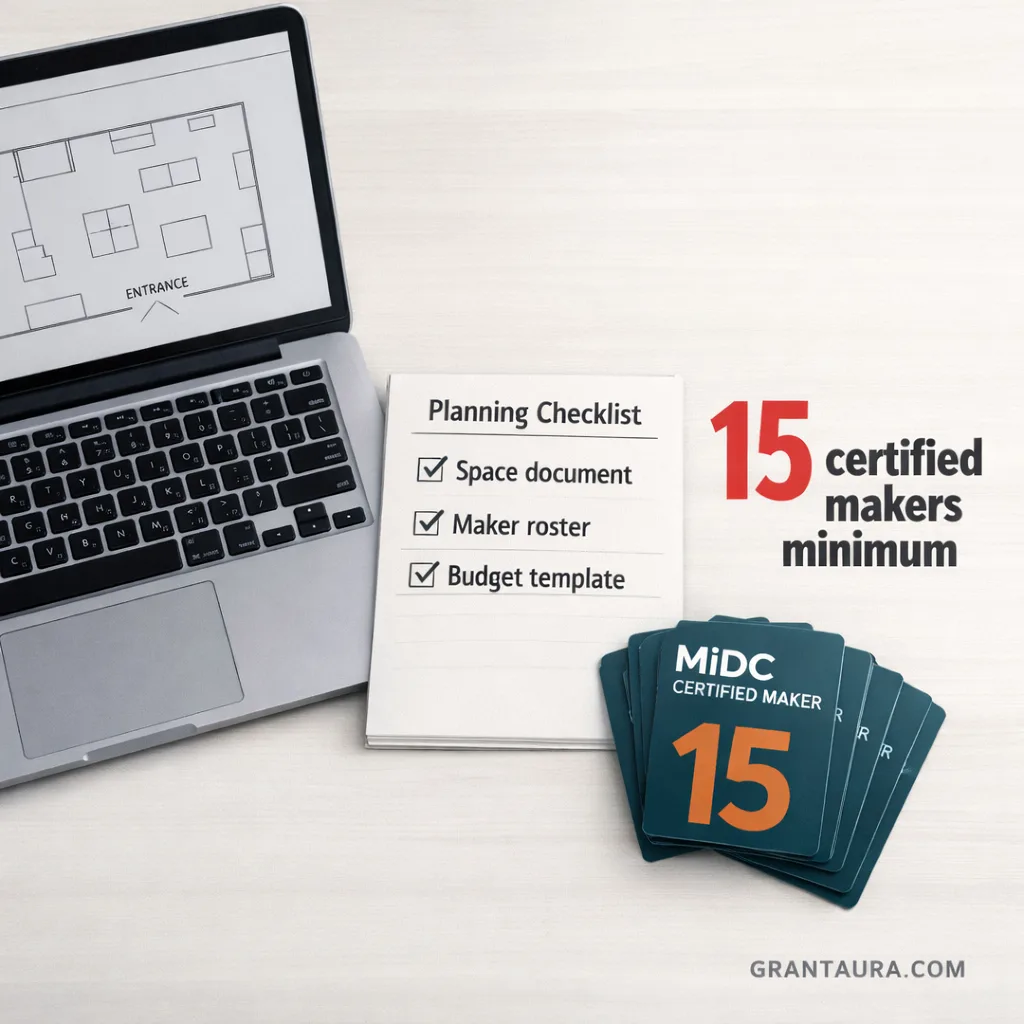
Activation plan must support at least 15 MiDC-certified businesses
Each business needs its own MiDC certification and that process takes 4-6 weeks
Applicant and officers not suspended from a District grant program within the last 5 years
Signed Statement of Certification
Owner and team resumes
Budget worksheet and budget narrative
04
Focus Areas
Made in DC curator grantDC pop-up retail grantDES DSLBD grant application
If you are trying to figure out whether this grant fits before you sink real hours into DES, the tool below is where I would start. Be blunt with it. A soft maybe on the lease, a shaky Clean Hands certificate, or a vendor list full of people who still need certification is not a small issue here. It is the issue.
Eligibility Check
Eligibility for FY26 Made in DC Curator & Retail Innovation Grant Program for DES-Ready Pop-Up Operators
Answer a few guided questions. Your responses are matched to this grant’s criteria in real time.
Ready to check your eligibility?
We’ll guide you through a short, structured flow and instantly evaluate fit for this opportunity.
Eligible
You Appear Eligible
Based on your answers, you meet the core requirements for this grant.
Recommended after eligibility
You qualify. Now make sure the application is worth sending.
Eligibility only tells you that you can apply. It does not catch weak answers, missing proof, confusing budget details, or language that makes reviewers hesitate.
This Grant Isn’t the Right Fit. Your Best One Might Be Two Clicks Away.
Missing one criterion for FY26 Made in DC Curator & Retail Innovation Grant Program for DES-Ready Pop-Up Operators doesn’t mean you’re out of options — it means this grant wasn’t designed for your profile. Our expert research team identifies the grants built specifically for businesses like yours, across 500+ active opportunities.
Basic Match
$125
One-time research
A list of 5 grants only
Basic eligibility matching based on industry & location
Standard funding amount range verification
Primary criteria alignment check
Most Popular
Advanced Match
$145
One-time research
A list of 7 grants only
Advanced eligibility matching with business model analysis
Deep competitive advantage assessment
Innovation & impact potential matching
Market fit & growth trajectory alignment
Premium Match
$175
One-time research
A list of 10 grants only
AI-powered deep-match algorithm analysis
Historical success pattern matching
Priority sector & focus area alignment
Advanced sustainability impact matching
Strategic vision & long-term goals alignment
Preparing secure checkout…
✓
Order Confirmed
Your grant research order is placed. Our team will deliver your personalised report within 3–5 business days. Check your email for confirmation.
Auto-advances after each answer. Use Back to revise.
What this really is
Strip past the public-facing language and the picture sharpens fast. This is a curator grant. Not a solo maker grant. Not a permanent storefront renovation program dressed up with nicer language. The operator here is supposed to build and run a shared temporary retail activation in DC, featuring at least fifteen MiDC-certified businesses during the activation period, which is why a single-brand pitch or a solo pop-up concept collapses almost immediately. And because the words “Made in DC” can pull people toward the wrong assumption, I want that framing visible before anything else on this page does its job.
That said, one thing I would not gloss over: a well-ranked third-party summary of this grant gets core mechanics wrong, including timing and award framing. Wrong in ways that could cost a serious applicant a week of prep work. When the public web is fuzzy and the RFA is not, I trust the RFA. Every time.
Important Note
If your entity is a standalone nonprofit without an active DC business license or corporate good-standing record, this grant may not be your lane. The governing RFA frames the applicant as a District-based business and uses business-style eligibility mechanics throughout. That does not automatically exclude every nonprofit, but it does mean you cannot assume eligibility without verifying the checklist first.
The first two kill-switches hit before your writing does
First comes the space. Then the maker bench. That order is brutal, but fair. If you do not already control a DC retail space through a valid unexpired lease or another legally verifiable right-to-operate document, this grant is still an idea for you, not an application. I keep seeing people soften this into “maybe an LOI works?” No. That is exactly where they drift off course. The governing record does not ask for conceptual interest. It asks for legal evidence that you can operate from the identified space. Those are not the same thing and the distance between them has killed plenty of applications before the first scored section.
After that comes the fifteen-business rule, which is one of the sharpest fit tests in the whole program. Fifteen. Minimum. And each participating business needs its own Made in DC certification, which takes about four to six weeks to obtain, meaning a late roster is not just annoying. It can make the whole activation plan physically unrealistic before anyone even scores the narrative. Six weeks of certification lag stacked against a May 13 close is not a problem you solve by writing faster. Which is why I would verify certification status for every maker on your list before you write a single word of the program plan. Every single one.
If your roster is still “we know a few people and the rest should come together soon,” you are not late in a normal way. You are structurally late for this grant.
DES is the real application point, not the public grant page
In the search results, this distinction gets blurred fast. The public MiDC grant page is useful because it gives you the program overview and routes you toward the documents, but the actual submission system is the District Enterprise System at des.dslbd.dc.gov. Different thing entirely. One page informs you. The other is where your packet lives, gets built, gets reviewed, and either clears or dies. And DSLBD says submissions must go through DES only – no hand delivery, no email, no mail, no courier. One door. So the question is not whether you understand the grant. It is whether you are building your prep inside the right system from the start.
That separation matters because people keep treating DES like the final click after the “real work” is done. It is not the final click. It is the real work container, and it holds everything: license details, tax records, attestations, insurance proof, resumes, budget worksheet, and narrative logic. Start cold in the portal and you end up organizing a rejection rather than building an application. Big difference, and the clock is shorter than it looks once you account for the certification prep your makers may still need.
[des_portal_note]
Where people lose time
The public page tells you what the grant is. DES forces you to prove you are ready for it. If you start the portal before the space document, the maker roster, and the compliance file are solid, you end up building a neater version of something that was never going to clear.
The compliance stack gets heavy faster than the grant amount suggests
What makes this application long is not the form count. It is what each form is asking you to prove at the same time. Business license active. Corporate standing good. Certificate of Clean Hands no older than 90 days. TIN matching that CCH. Tax filings recent. Insurance covered. Certification signed. Resumes uploaded. Budget worksheet complete with narrative attached. Ten distinct proof points, and DSLBD will check each one against the DES file. Not close enough. Not missing one field. Right.
The smarter move is to stop thinking “upload everything” and start thinking sequence. Start with the documents that prove your existence and standing as a District-based business. Then the space-control document and retail-space attestation. Then insurance and tax materials. Then the budget sheet and narrative. Then the scored program responses. That order matters because each layer builds on the last, and one missing document early in the stack can freeze the build in DES while time evaporates and your maker certifications are still processing.
Active DC business license or acceptable alternative licensure
Corporate registration file in good standing
Certificate of Clean Hands issued within 90 days
TIN matching the CCH record
Most recent complete tax filings submitted within one year before application
Retail space control document and attestation
Commercial general liability insurance, plus other required policies if applicable
Signed Statement of Certification
Owner and team resumes
Budget worksheet and budget narrative
[eligibility_checklist]
By the time you clear that stack, the real question is no longer “Can I apply?” It is “Can I clear this cleanly enough to deserve time on the scored sections?” Different question. Harder one.
Where the points really sit, and why weak plans still look weak
The scoring rubric is public, which is useful because it tells you exactly where DSLBD expects substance rather than generic local-business enthusiasm. Program Plan and Strategy carries 20 of the 50 total points. Budget Plan and Cost Allocation carries 16. That is 36 points sitting in the part of the application where your activation logic, your cost math, your customer-facing plan, and your claimed business benefit have to line up without wobbling, and a panel that reads grant applications every cycle will notice when those pieces feel assembled after the fact rather than built together from the start.
Vision alone does not travel here. If your plan sounds inflated, your roster sounds padded, your customer-engagement story reads like filler, or your budget numbers feel attached after the concept was already written, the panel has room to punish you hard even when the basic checklist is complete. Organizational Overview and Experience and Capacity are both worth 7 points each. They matter. But this grant leans heavily toward execution quality in the plan and the budget, which is a different skill than most local grant narratives require. Plan like an operator.
Expert Tip
Write the activation like an operator, not like a promoter. Reviewers need to see how the pop-up will function, who it will support, what the costs actually do, and why the timeline makes sense given the space and maker roster you already claim to control. “This will create community impact” is not a plan. It is a placeholder.
Budget math bites
The budget template is not a boring attachment off to the side. It is one of the quietest filters in the whole program, and it has teeth. DSLBD allows listed hard costs up to 100 percent of the grant request, while several soft-cost categories including marketing, e-commerce systems, and certain public safety costs can only go up to 50 percent of grant funds. That split is not something you explain away in the narrative. The template tracks it automatically, and the tracking does not care how good your story sounds.
The sheet has three tabs. The line-item structure automatically calculates hard versus soft cost percentages as you build. So you can write a clean narrative, recruit a real vendor bench, line up a valid space document, and then still get flagged because the spreadsheet quietly shows your soft costs drifting past the limit while you were busy writing the program plan section. Ugly way to lose. Preventable. The fix is building inside the required template from day one, not mapping a separate budget over it at the end when the math is already wrong.
Allowable costs include build-out of new or vacant space, interior and exterior renovations, operational fees, insurance, utilities, staffing added during the grant period, rent during the period of performance, independent contractor fees, website development, and certain marketing and e-commerce supports within the soft-cost cap. The disallowed list is just as important: no pre-existing debt, no expenses outside the performance window, no double-counting with other grants, no vehicle purchases or real estate, no lobbying or lawsuit-related costs, and nothing DSLBD decides is ineligible in its sole discretion. That last one is not boilerplate. Read it as real authority.
Do’s
Build the budget inside the required template and keep soft costs under the cap and tie every line item to the activation plan
Don’ts
Backfill numbers later and treat marketing as unlimited and assume a good narrative fixes a bad ratio
What happens after submission and why this timeline feels unusual
This is a fixed-deadline grant, not rolling, so the window closes at 2026-05-13 14:00 America/NewYork. After that, something worth knowing: a corrections window runs after the main close, which tells me DSLBD may allow limited fixes when a file is otherwise viable but has a narrow issue. Useful. Not a strategy. That window exists to calm careful applicants, not to rescue careless ones, and treating it like a safety net is exactly how people build underdone applications on purpose.
Review panel work begins shortly after the close. Applicant status notices are expected around late June. The space must be operational by July 1 2026. Then the period of performance runs through September 30 2026, with a final report due a month after that. Short runway between award and operational deadline. Which makes the early space requirement feel less like bureaucracy and more like a hard alignment test: if you cannot prove the space is already in motion before funding exists, DSLBD has legitimate reason to doubt you can activate by July 1 after it does.
If the result goes against you, the debrief matters. Rejected applicants can request one within 5 business days of notification. Not a consolation call. One of the few practical ways to learn exactly where the packet or the scoring story broke, and that information is worth more in the next cycle than vague disappointment is now.
Questions that keep coming up once the grant becomes real
Where do I actually apply?
Inside the District Enterprise System at des.dslbd.dc.gov. The public MiDC grant page helps you understand the program and reach the materials, but it is not the submission system.
[application_button_dslbd]
How much money is this, really?
DSLBD says one or more grants will be awarded from a total pool of $25,000. What is still not resolved publicly is the likely split, so I would not build assumptions around winning one specific number. Your requested budget needs to defend itself on its own terms regardless of how the pool gets distributed.
Do I need a space before I apply?
Yes. And not in a casual way. You need an identified DC retail space plus a valid unexpired lease or another legally verifiable document showing your right to operate there, along with an attestation that the space will be active and operational by July 1 2026.
Is a letter of intent enough for the space requirement?
No. That is one of the biggest confusion points around this grant. The governing documents require a legally verifiable right-to-operate document, not a hopeful conversation dressed up as progress. An LOI and a lease are not the same instrument under this program.
How strict is the fifteen-business rule?
Very strict. The floor is fifteen MiDC-certified businesses during the activation period, and each one needs its own certification. If your roster is still half recruiting plan and half aspiration, your application is not ready.
What are the most important documents?
Active DC business license
Corporate good standing record
Recent Certificate of Clean Hands
Matching TIN
Recent tax filings
Insurance proof
Space-control document and attestation
Signed Statement of Certification
Resumes
Budget worksheet and budget narrative
Is the scoring rubric public?
Yes. Fifty points total. Program Plan and Strategy gets 20, Budget Plan and Cost Allocation gets 16, and the remaining 14 points are split between Organizational Overview and Experience and Capacity. That weighting tells you exactly where weak applications get exposed and where a strong activation plan can separate itself.
Can I email the application if DES gives me trouble?
No. DSLBD says submissions must go through DES and will not be accepted by hand delivery, email, mail, or courier. That is why portal prep matters earlier than most people expect, not the day before the deadline.
Does the budget file do anything automatically?
Yes. The template structure tracks hard and soft cost percentages as you fill it in, which is why building your budget outside the required file and trying to map it over later is such a risky move. You cannot see the cap problem until you are already inside the template.
What if I get rejected?
You can request a debrief within 5 business days of notification. Worth using. A lot of local programs leave applicants with vague silence. This one at least leaves a door open to understand what went wrong before the next cycle starts.
Is this cleanly open to nonprofits?
I would stay careful here. The governing RFA frames the applicant as a District-based business and uses business-license mechanics throughout. The safer question is not “nonprofit or not?” It is whether the entity still clears the business-style requirements this grant is actually built around.
What is the deadline for the FY26 Made in DC Curator Grant?
Applications close on 2026-05-13 14:00 America/NewYork.
When the fit is there, the work changes shape fast
If you got this far and the grant still looks realistic, you are probably past the curiosity stage. Now it is about packet quality. Which document is weak. Which maker on the roster is not certified yet. Whether the budget logic survives contact with the spreadsheet. Whether the activation plan reads like a real operating model or a nice idea with local language sprayed on top.
The lower-friction first step is the assessment. Your Grant Assessment fee is non-refundable, but the base assessment fee can be deducted once toward the same grant’s Full Application when you choose the optional checkbox at checkout. That step makes sense when your fit feels close but not settled, or when the packet exists in pieces and you need someone to identify what breaks first. It is not a formality. It is a pressure test.
If you are clearly proceeding, the next move is full application support built around the exact pressure points this grant creates: space-document review, maker-roster readiness, scored narrative development, budget alignment, and cleaner sequencing before you finish the DES build. If you are still unsure, a live call usually makes more sense than guessing. If you now know this cycle is wrong for you, leave early and redirect. That is a win too.
Ready and document-clean? Use the modal and move. Unsure about the lease, the roster, or the budget logic? Book the consultation. Clearly wrong fit for this cycle? Skip the sunk-cost spiral and move to a better match below.
Not your lane this cycle? Better to pivot now
Some readers are going to hit the hard truth here: the operator profile fits, but the DC space does not. Or the roster is strong but the certifications are not. Or the whole thing looked like a permanent-store grant at first and clearly is not. Fine. Better now than after a week of document hunting.
For temporary-retail overlap, The Pop Up Grocer Fund is the closest thematic companion in the bundle even though the geography is different. If you are really a physical-store owner rather than a curator building a shared activation, Amex Shop Small Grants is the cleaner contrast. And if your strength is more placemaking and collaborative activation than DC retail compliance, Miami Downtown Creative Collaborators Grant shows the same strategic muscles in a different setting.
Strong overlap in temporary retail activation and product-brand support. Different geography but similar operator profile for curators building short-term retail experiences.
Useful contrast for physical store owners versus curator-led multi-vendor activations. Helps applicants self-select based on whether they run a single storefront or a shared pop-up model.
Activation and curatorial-planning overlap in a different city. Similar strategic muscles for operators who coordinate creative collaborations and temporary retail experiences.
Terms that matter once you stop reading this like a brochure
Curator
The operator organizing the shared pop-up activation. Not one maker selling only their own line.
DES
The District Enterprise System. This is the actual application system, not the public MiDC information page.
MiDC-certified business
A business that has completed Made in DC certification. Each participating business needs its own certification, and the process takes 4-6 weeks.
Certificate of Clean Hands
A District record showing no outstanding liability. Must be no older than 90 days at time of application.
Right-to-operate document
A legally verifiable document proving you can operate in the identified retail space. A loose LOI is not the same thing.
Retail Space Attestation
The required statement in DES confirming the space will be active and operational by July 1 2026.
Soft-cost cap
The limit on certain expense categories including marketing and e-commerce. If those costs push past 50 percent of grant funds, the budget becomes a problem that narrative cannot fix.
Hard costs
Physical and structural costs such as build-out and certain renovation work. These can absorb a larger share of the request than soft costs can.
Period of performance
The spending window for the grant, running through September 30 2026. Costs outside that period are not allowable.
Statement of Certification
A signed required document carrying disclosures and certifications that belong in the application packet alongside everything else.
Budget narrative
The written cost logic behind the worksheet. Explains how the numbers were built and why they support the activation, not just what they are.
Debrief
The formal path a rejected applicant can request within 5 business days of notification to understand why the application was not selected.
Why I wrote this one the way I did
I read grant RFAs the way other people read assembly instructions after the furniture is already wobbling. Usually too late. So when I sat with the FY26 MiDC curator RFA, what stood out was not the $25,000 pool. It was the shape of the burden underneath it: space control before award, fifteen certified businesses with their own four-to-six-week certification clocks, a budget template that flags you before you realize it is tracking, and a DES packet that punishes people who confuse “understanding the grant” with “being ready to apply for it.” That is not a casual local application. It is a government readiness filter wearing a grant announcement.
So I wanted the friction visible early. Not to scare anyone off who belongs here. To stop the wrong applications from starting. There is a real difference between an operator who already controls space, already has relationships with certified makers, and already knows what a government panel wants to see in a budget narrative, and someone who got excited after reading a thin summary. This page is for the first kind of person, even when it has to disappoint the second. If the right operator finds this and moves faster because they understood the stack early, that is the whole job.
[
{
"url": "https://grantaura.com/grant/the-pop-up-grocer-fund",
"custom_description": "Strong overlap in temporary retail activation and product-brand support. Different geography but similar operator profile for curators building short-term retail experiences."
},
{
"url": "https://grantaura.com/grant/amex-shop-small-grants",
"custom_description": "Useful contrast for physical store owners versus curator-led multi-vendor activations. Helps applicants self-select based on whether they run a single storefront or a shared pop-up model."
},
{
"url": "https://grantaura.com/grant/miami-downtown-creative-collaborators-grant",
"custom_description": "Activation and curatorial-planning overlap in a different city. Similar strategic muscles for operators who coordinate creative collaborations and temporary retail experiences."
}
]
We are your trusted grant application partners. You can navigate the entire grant application process with our expert guidance through this simple 5-step process.
300+ Projects
4.9/5 Rating
Expert Team
Step 1: Application Form
Fill out the “Apply for this grant” form with your information and grant requirements.
Step 2: Eligibility Assessment
Our grant experts will assess your eligibility and notify you via email.
Step 3: Expert Consultation
A dedicated grant expert will be assigned to discuss next steps for your application.
Step 4: Application Submission
Our expert will help you complete and submit your application with all required materials.
Step 5: Final Decision
The grant committee will make their decision and notify successful applicants.
Hi there 😊 I’m Imran Ahmad, the founder of Grantaura. I normally examine funding opportunities through both newer research methods and older, manual verification methods because official webpages, application forms, FAQs, archived materials, etc. do not always tell the same story.
Because I believe that “the fine print usually only shows up when you’re stubborn enough to check twice.”
You are on FY26 Made in DC Curator & Retail Innovation Grant Program for DES-Ready Pop-Up Operators. I can help check fit, explain the May 13, 2026 deadline, compare effort, or decide whether Grantaura application support makes sense for this grant.
No chat history in this browser yet.
You are in queueIAGA
A Grantaura colleague can review this conversation. You can keep chatting with the assistant while you wait.
Tell us about yourself
0/1000
i
The information you add here helps the assistant answer this browser session more clearly. Close this window to continue the chat.
Check your eligibility
Check your saved details, answer the grant questions, and see your next steps.
Grant team review
Saved details where available
Free assessment
Save option
Save this grant application for later
Send yourself a private link so you can return to this grant form with your details ready.
Keep your post public. Our team will verify the link before processing your assessment. If the post is deleted or made private after submission, your free assessment will be void.