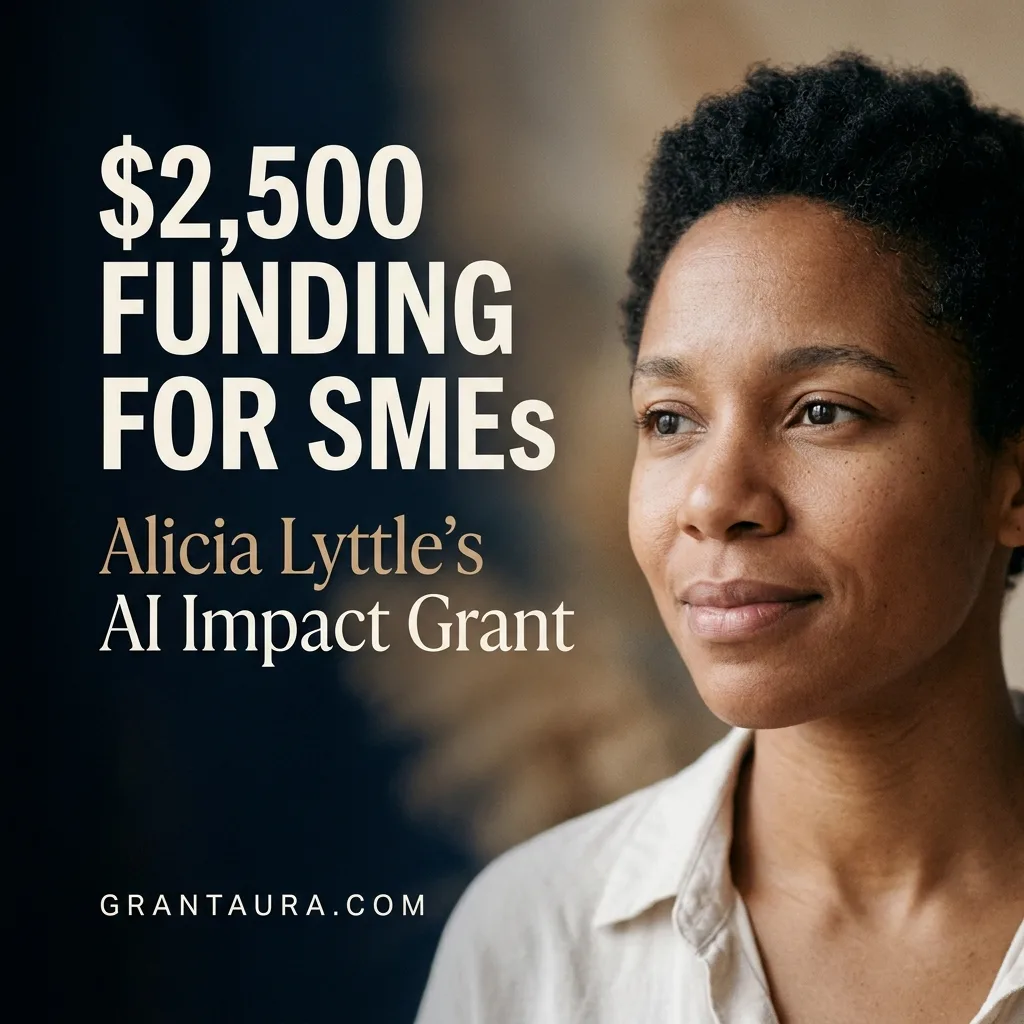

Alicia Lyttle's AI Impact Grant
- Grant Award
- $2,500
- Application Deadline
- Periodic; next cycle unannounced
- Eligible Region
- United States
- Adults 18 and older who can legally operate a business in their own jurisdiction
- Complete and truthful application form required
- One entry per business owner per selection period
- Separate application video required for a complete entry
- Complete AI beginners and applicants without a business are accepted
- $2,500 cash award paid in two payments within 30 days of selection
- Payment method chosen by the winner
- Donor-named uses include AI tools and software, AI training, marketing systems, launching an AI-powered offer, and freelancer help
- Free to enter with no business plan and no credit check
When does the AI Impact Grant reopen?
I’d hold off on setting a monthly reminder for this one. The application schedule is described in three different ways across the donor’s own channels, and none of them gives you a date to plan around. That’s not a small discrepancy.
The last published window required both submissions to be completed by 11:59 PM EST on . No extension or replacement window has been confirmed.[2] That cutoff covered the separate video as well as the form, so the second submission was never a grace-period extra.
This wasn’t the first round. An archived copy of the official grant page shows an earlier cutoff on February 13, 2026.[3] So the money has gone out more than once, which is worth knowing, but it still doesn’t hand you a date.
Look at what you’d be planning around, depending on which page you read:
- Alicia Lyttle has described a monthly application cutoff on the 15th.
- The official grant page also refers to a quarterly selection period.
- The affiliated AI InnoVision Foundation says applications are always open.
Monthly on the 15th would have you drafting for next month. Quarterly would mean a wait of up to three. Always open would mean you could submit this afternoon, and that’s the version I’d least want to bet a recording session on.[4] Watchlist, yes. Calendar entry, no.
There’s also a winner livestream listed on the confirmation page for November 19 at 1 PM. No year stated, no timezone stated. If you’re planning to watch from another timezone, confirm both against the official announcement before you set an alarm for the wrong hour.[5]
The latest published application window has ended. Neither an extension nor the next selection period has been confirmed. Do not rely on the homepage countdown alone or assume the next cutoff from previous rounds.
Preparation and submission are two quite different activities right now. Draft the plan. Draft the answers. Then wait for the official AI Impact Grant page to show an open window before you submit anything at all.
What could $2,500 actually help you build?
Start with a bill, not an ambition. What’s the one expense standing between your AI-related business idea and something you could actually deliver to a paying customer? That’s the sentence the rest of your application hangs on.
The donor’s published list gives you five places to look:
- AI tools and software.
- AI training or participation in a paid AI program.
- Marketing systems.
- Launching an AI-powered offer or service.
- Paying a freelancer or contractor.
Take an example. Say you’re developing an AI-assisted content service for small businesses. You might need a software subscription to produce the content, training to improve how you use that software, and a freelancer to set up part of your customer onboarding.
Three purchases, one business. Each has a job in the same proposed business, and that’s what makes the list convincing. A subscription, a course and a freelancer attached to three unrelated ideas read like shopping; attached to one service you’re trying to launch, they read like a plan.
That’s my example, not a donor-approved budget. The published uses are examples rather than a complete expense-approval schedule. If a purchase outside those examples is essential to your plan, clarify whether it’s acceptable before making it the centerpiece of your entry.[6]
The weak point in a plan like this isn’t usually the idea. It’s the cash flow. The money doesn’t arrive in one piece, and the official terms are quite specific about how it does arrive instead.
The $2,500 arrives in two separate payments within 30 days of selection, by a method the winner specifies (PayPal and bank transfer are the examples given). How much lands in the first payment, though? The terms don’t say, and I’m not going to guess.[7]
Two payments doesn’t mean two equal payments. Nothing in the published terms says the split is even. You could have a perfectly sensible $2,500 spending plan and still be unable to pay a single $2,500 invoice the week you’re selected, so don’t commit money you haven’t received or budget on an assumed $1,250 installment.
This is why I separate cash from service credit. The Shophand Small Business Boost Grant combines cash and restricted service value in its advertised support, while Alicia Lyttle’s program describes two payments to the winner instead. If the software you need is already chosen, that distinction may matter considerably more than the headline award value.
The donor’s homepage also promotes a separate $500 Jade fund. That amount is not an additional payment under Alicia Lyttle’s AI Impact Grant. Keep the two opportunities separate when comparing funding amounts and requirements.Important Information
Who has received Alicia Lyttle’s AI Impact Grant?
Start with a name you can check. Annie Miles is listed as a recipient, associated with Women on a Mission & Brothers without Boundaries. An organization attached to a name is checkable in a way that a first name printed on a winner graphic isn’t.
Names beat claims. For a private grant you’ve probably never heard of, a published roster is the difference between a promise and a record. The AI InnoVision Foundation lists nine recipients, and the grant’s official homepage carries individual winner cards.[8]
These recipients were confirmed through official grant program records.Who received this grant
Five of these recipients appear across four winner cards on the grant’s official homepage. The other four come from the Foundation’s roster. Where a name comes from matters, so I’d rather tell you which list holds which name than blur them together.
There’s a limit to what names can tell you. Nine recipients, no published account of what each one applied with. Reverse-engineering the ideal applicant from that is guesswork dressed up as research, so use the names to check the money is real rather than to reshape your own story.
Who’s behind the grant, and is there a purchase requirement?
You’ll see two names around this grant: AI InnoVision and AI InnoVision Foundation. Only one of them is the presenter. The terms name AI InnoVision LLC, a Florida limited liability company, as the entity behind the award and the agreement you’re accepting.
Alicia Lyttle, the founder and CEO of AI InnoVision, is the public face of the program. Her background includes AI education, entrepreneurship, TEDx speaking, and authorship of ChatGPT Made Easy, and her AI work has also drawn CBS Atlanta coverage and recognition through Georgia House Resolution HR295.[9] That’s a checkable public record.
This is a private-company grant, not government funding. AI InnoVision also runs a commercial AI education business, and since paid AI training is one of the published uses of the award, it’s fair to wonder whether you’re expected to buy something first. That’s a reasonable suspicion, and it deserves a straight answer.
You don’t. The donor describes entry as free, and nothing in the published grant terms requires you to buy its training or any other product.[10] If a later cycle reads differently, the terms for that cycle are the ones to check.
Would you still buy the course if this grant didn’t exist? That’s my test. Training can be genuinely useful for your business without buying it becoming a published route to selection, and I’d keep those two ideas apart.
Something still unclear? The official company contact page is the published route to use. It’s a general organizational contact page rather than a grant-specific support desk, so write a question that can be answered in one line.
You don’t need an AI business yet. So who can enter?
Picture two people getting ready to apply. One runs a marketing agency and wants to bring AI tools into client work. The other has never used an AI tool professionally, has no registered business, and is still deciding what to offer.
The form makes room for both. It asks whether you own a business and lets you identify yourself as a complete AI beginner. Neither an established company nor advanced AI experience is a published entry requirement, which is why the second person isn’t automatically out.
Inexperienced isn’t the same as ineligible. Six conditions decide this, and not one of them asks how experienced you are with AI or how polished your idea sounds. Miss one and the hours you spend on the video won’t rescue the entry.
- Age: You must be at least 18 years old.
- Legal capacity: You must be legally able to operate a business in your own jurisdiction.
- Complete entry: Submit the required form and separate application video.
- Entry limit: One application per business owner per selection period.
- Accuracy: Provide truthful information and agree to the grant terms.
- Instagram: The form requires an Instagram handle.
The official terms exclude incomplete applications from consideration, remove duplicate entries and allow disqualification for false information.[11] Standard stuff, mostly. The completeness rule is the one I’d worry about, and it’s the one this two-portal setup makes easy to fail.
No published minimum revenue, no employee count, no business age, no AI-experience threshold. The Instagram field is the odd one. If your account has been sitting unused for two years, the donor hasn’t said whether that still counts, and I’d rather you ask that before recording anything.
What if you live outside the United States?
This one I can’t settle for you. There’s no published list of eligible countries, and that silence is doing a lot of work in both directions at once. It isn’t an invitation, and it isn’t a ban either.
The terms say you must be legally able to operate a business in your own jurisdiction. They name no countries. Florida tells you where the sponsor is registered, not who may apply, and a missing restriction isn’t the same thing as permission.
Skip “is this an international grant?” It’s too broad to be useful. That wording invites a vague answer, and a vague answer is useless when you’re deciding whether to spend a weekend on an application. Be specific. Ask about your own country, and ask about the money too:
“I live in ______ and can legally operate a business here. Can I enter this selection period and receive the award if chosen?”
Those last few words matter. You want clarification that covers receiving the money as well as submitting an application, because an entry answer alone doesn’t settle the payment question. Until you have that answer in writing, don’t read silence as acceptance, and don’t read it as exclusion either.
Run the known requirements through the checker below. It won’t answer the country question, and it isn’t an eligibility decision from AI InnoVision LLC. What it will do is catch the obvious gaps before you spend an evening recording something you can’t submit yet.
The form is step one. Your video completes the entry.
Light paperwork, then. Roughly a dozen form fields (most of them required), no business plan, no credit check, and a separate video answering three questions. The real burden here is the thinking, not the typing.
How long will it take? No estimate is published, and I’m not going to invent one. Most of the time goes into deciding what the money would actually do for you, which is why I’d settle that before opening either submission page.
First, complete the donor’s application form
When the application window is confirmed, the official application page asks for information covering:
- Your name, email, optional phone number, and Instagram handle.
- Whether you own a business and applicable business details.
- Your AI experience, city, and current business stage.
- Your intended use of the money, referral information, and agreement to the terms.
If you’re still developing the idea, say so. There’s a field for your current stage, and an early stage is a legitimate answer to it. Inflating that stage doesn’t help you here, because you’ll describe the same business again on video and the two have to agree.
Then submit your video through the second portal
After the form, the donor’s confirmation instructions direct you to a separate Testimonial.to submission portal. Not an optional introduction. The video is required for a complete entry, and it has to carry the same name and email address you used on the form.[12]
The portal asks three questions:
- Why should you receive the $2,500?
- What would you do with the funds?
- What sets you apart?
One story, three angles. My suggestion is to treat the answers as three parts of one explanation rather than three separate auditions. Start where your idea stands today, move into the specific expenses, then explain what’s distinctive about your approach or the service you’re trying to deliver.
That’s not an official scoring formula. No rubric is published, and I’m not pretending to have one. It’s a practical way to stop yourself introducing a slightly different business idea every time a question changes on you.
Here’s how it goes wrong. Your form says you want tools for an AI-assisted content service, and your video says you’d spend the whole award on unrelated training for a different business. Which plan is the money supposed to fund? Each answer can sound impressive on its own and still leave that question open.
A preparation order that keeps the answers consistent
- Identify the expense. Choose a concrete AI-related purchase, training need, or business activity that the award could support.
- Explain the problem it solves. What can you not build or deliver right now, and what would change with that expense covered?
- Outline your three video answers. You can draft and rehearse these while you wait for a confirmed window. Keep them connected to your actual experience and intended business stage.
- Complete the form when a new window is confirmed. Review the required fields and make sure the written explanation agrees with your video.
- Submit the video after the form. Once the donor form is complete, record and submit the separate video through the Testimonial.to portal. Use the same name and email, answer all three questions, and confirm both submissions are complete before the applicable cutoff.
No published length limit, no published format requirement. Write and rehearse the answers now, then check the submission instructions before you commit to a particular recording setup or length. There’s no point filming something you’ll only have to redo.
Three things you can finish this week, window or no window:
Instagram handle ready One concrete AI-related expense identified Three video answers outlinedRequired Steps
On submission day, the checks change:
Complete every required form field Submit the separate video on the Testimonial.to portal Use the same name and email on both submissions
Two form submissions are not a video. Obvious on paper, and much less obvious when a confirmation page has just told you the form went through successfully. Check that both submissions exist before you call yourself entered.
Give the person reviewing your entry one connected explanation instead of three unrelated answers. Identify where your business idea stands today, name the specific AI-related expense you want to cover, and explain what that expense would help you do next.
If explaining your business on video suits you, the Sky’s the Limit Friends & Family Fund is another opportunity that uses a video pitch. Some of the thinking you’ve done here may be useful there. The rules aren’t the same. Assess its eligibility requirements and application questions separately before you put the same evening into a second pitch.
Want someone to check your form and video answers together?
Perhaps you know exactly what you’d buy with the $2,500, but you’re having trouble explaining how those purchases fit your business. Or you’ve prepared your video answers and aren’t sure whether they still agree with what you’ve written in the form.
That’s the kind of problem we can help with through Grantaura’s Grant Assessment. We can review the application material you’ve prepared, identify missing information or unclear explanations, and look at whether your form and video answers describe the same funding plan.
You don’t need to purchase an Assessment to enter this grant. The donor’s application is free, and you’re welcome to prepare and submit it independently. Our help is optional, and we can’t reopen a closed window, determine the sponsor’s selection decision or guarantee an award.
If you’d like another pair of eyes on your preparation, you can request an Assessment here:
Request a Grantaura Grant Assessment
Your Grant Assessment fee is non-refundable, but the base assessment fee can be deducted once toward the same grant’s Full Application when you choose the optional checkbox at checkout.
Winning means the camera comes out a second time
Two videos, not one. The application video is part of your entry, and the testimonial is part of being paid. They’re separate obligations agreed at the same moment, which is why I’d read the second one before you record the first.
The terms require a selected recipient to provide a testimonial video about the grant’s impact. They also give AI InnoVision LLC permission to use the winner’s name, likeness, business name and testimonial in promotional materials. Editing is allowed, provided the testimonial stays true to the recipient’s message.[13] That’s the trade.
Being happy to pitch on camera isn’t the same as being happy to appear in someone else’s marketing. If your business isn’t public yet, or your name is attached to a job you’d rather keep separate, this is the clause to sit with. Decide it now. Walking away still costs you nothing.
The rest reads like a contract, because it is one:
- The award is non-transferable and cannot be exchanged for other goods or services.
- AI InnoVision LLC determines the selection criteria, and its decisions are final.
- The terms allow the sponsor to cancel, modify, or suspend the grant.
- Florida law and binding arbitration in Florida apply under the published terms.
- The published terms require applicants to indemnify the sponsor against claims arising from participation and include limits on the sponsor’s liability.
Versions matter. The published terms carry an effective date of September 1, 2025. If you’re entering a later period, read the version that applies to that entry, particularly its publicity and legal provisions.[14]
Your odds? The sponsor publishes neither a scoring rubric nor an applicant volume. A previous donor announcement describes one $2,500 winner, which is a data point about one round, not a promise about the next.[15]
If a condition matters to you and the wording doesn’t settle it, ask before you enter, not after you’ve been selected. $2,500 is useful. It isn’t so much money that you should agree to a clause you haven’t properly read.
Is this opportunity worth preparing for?
The access is what appeals to me. Someone with no company can still explain what an AI-related investment would help them build. That’s the part I’d keep if I were choosing one thing to praise about this program, and it isn’t the money.
Prepare, don’t depend. Preparation is worthwhile if you’ve named a useful expense, can meet the entry requirements and are comfortable with the winner’s obligations. Building your plans around an award with no confirmed next application date is a different thing entirely.
If you know what you’d buy, write the plan down now and outline the three answers. That work keeps. Rehearsing a full video before you’ve settled your country eligibility or the Instagram question is the part I’d hold back.
The publicity terms are the other exit. If you’d rather not have your name and business used in someone else’s marketing, walking away is a legitimate decision. Useful money doesn’t turn an uncomfortable condition into a mandatory one.
More grants worth comparing
Three others worth comparing, for three different reasons:
- Nehemiah Davis Greatness Grant: Another recurring founder micro-grant that welcomes first-time founders, uses a short narrative form, and has a two-payment award structure and livestream announcement.
- Hustler’s MicroGrant: A smaller recurring cash award worth exploring if you prefer a comparatively light application and a lower preparation commitment.
- Skip $10,000 Grants: An opportunity to compare if your intended business expenditure calls for a larger recurring award rather than a micro-grant.
Check each one separately. Each program sets its own rules and runs its own cycle. Satisfying Alicia Lyttle’s requirements doesn’t make you eligible anywhere else, and I’d hate to see the same assumption cost you a second application.
Keep promising opportunities organized in your Grantaura dashboard, including this one while its next window remains unannounced. No need to camp on the homepage. You can come back to your AI Impact Grant preparation without putting the rest of your funding search on hold.
Questions worth settling before you record your video
Can I apply without owning a business?
Yes. The donor form accepts applicants who do not currently own a business.
Do I need previous AI experience?
No. The form includes a complete-beginner option, and no minimum AI-experience threshold is published.
Does completing the web form finish my entry?
No. A separate video on Testimonial.to is required, and it must use the same name and email as the web form.
What are the three video questions?
The portal asks: “Why should you receive the $2,500?” “What would you do with the funds?” and “What sets you apart?”
Can someone outside the United States enter?
The donor publishes no eligible-country list, and the terms require applicants to be legally able to operate a business in their own jurisdiction. Non-US applicants should seek donor confirmation rather than assume acceptance or exclusion.
When is the next confirmed cycle?
The donor publishes no confirmed forward calendar. Its posts describe recurring cutoffs followed by winner announcements, but the different schedule descriptions do not establish when the next window will open.
How are the $2,500 payments made?
The award is paid in two payments within 30 days of selection by a method the winner specifies. The amount of each payment is not published.
What must a winner allow the donor to publish?
A winner must provide a separate testimonial video and allow promotional use of their name, likeness, business name, and testimonial. The testimonial may be edited while remaining true to the recipient’s message.
Is the grant funded by a government agency?
No. The official terms identify AI InnoVision LLC, a private Florida company, as the grant presenter.
Is an Instagram handle required?
Yes, the application form requires an Instagram handle. The donor has not stated whether an inactive account is sufficient.
Is the award taxable?
The published grant information does not address tax treatment. Read the official terms and seek qualified tax advice about the rules applicable to your circumstances if needed.
Are the award’s selection odds published?
No; the sponsor determines the selection criteria and its decisions are final. Neither a scoring rubric nor applicant volume is published.
Is the current cycle still open?
The most recent published window has ended. Neither an extension nor a replacement window has been confirmed.
Source Notes
- Official AI Impact Grant page and confirmation instructions. These establish the published selection window for this cycle and the two-part entry process. BACK to readingBACK
- Official application page and confirmation instructions. The published cutoff time and its application to both the form and the separate video submission. BACK to readingBACK
- Archived official grant homepage captured February 2, 2026. Evidence of the earlier February selection period, not a future application schedule. BACK to readingBACK
- Alicia Lyttle’s public announcement, official grant homepage, and AI InnoVision Foundation website. These sources describe the recurrence of applications differently. BACK to readingBACK
- Official confirmation page and application page. Published winner-announcement information; the timezone and the year are not established consistently. BACK to readingBACK
- Official grant homepage, Alicia Lyttle’s funding announcement, and donor video announcement. These describe practical uses of the award. BACK to readingBACK
- Official AI Impact Grant terms and conditions. Award amount, payment count, payment timing, and winner-selected payment method. BACK to readingBACK
- AI InnoVision Foundation recipient roster, official homepage winner cards, and Alicia Lyttle’s announcement identifying Annie Miles. BACK to readingBACK
- Official grant terms, Alicia Lyttle’s official website, AI InnoVision company website, CBS Atlanta coverage, and Georgia House Resolution HR295. BACK to readingBACK
- AI InnoVision company website, official grant homepage, and grant terms and conditions. Commercial company context and free-entry conditions. BACK to readingBACK
- Official eligibility and entry conditions, application form, and official grant homepage. Age, legal capacity, completeness, duplicate entries, accuracy, applicant experience, and required form information. BACK to readingBACK
- Official application confirmation instructions and dedicated video submission portal. Mandatory second submission, matching name and email, and the three video questions. BACK to readingBACK
- Official grant terms and conditions. Post-selection testimonial, promotional-use permissions, and editing conditions. BACK to readingBACK
- Official grant terms effective September 1, 2025. Non-transferability, selection authority, cancellation provisions, Florida law, binding arbitration, indemnification, and liability limitations. BACK to readingBACK
- Donor video announcement describing one $2,500 winner and official grant terms. Evidence supporting the single-winner format without establishing a guaranteed future recipient count or selection probability. BACK to readingBACK