High Road Kitchens Grant – Restaurant Wage Equity Funding
High Road Kitchens provides up to $30,000 to restaurants committed to paying full minimum wage with tips on top. Rolling applications. Free equity training included.
Active Closes on: September 30, 2026
196 days left
$30,000
United States
Grants For For-Profit Businesses
TL;DR
Key Takeaways
1
High Road Kitchens funds up to $30k for wage equity
2
Active Michigan round: $8k for full-service restaurants
3
Commit to One Fair Wage, equity training & community meals
4
Applications vary by city; Michigan uses a Google Form
There's an $8,000 grant for Michigan full-service restaurants right now, and it's called High Road Kitchens. But that's just one piece of a much bigger story. Since 2020, this program run by One Fair Wage and their RAISE network—has funneled about $8 million into independent restaurants across a dozen cities, from Chicago to Cleveland to San Diego. It's not your typical relief fund. It's a business model transformation initiative that happens to include cash. You get money.
In exchange, you commit to paying all workers a full minimum wage with tips on top, completing a nine-month equity training, and serving free or sliding-scale meals to your community. The application might be a Google Form or a city portal. The commitments after approval? That's where the complexity lives.
Michigan, Chicago, Cleveland, San Diego, Boston, New York City
03
Eligibility and Benefits
Eligibility Criteria
Independent, full-service restaurant (no chains or counter service)
Located in an active city round (Michigan is currently confirmed)
Willing to commit to One Fair Wage (full minimum wage + tips) by a set deadline
Willing to complete 9-month equity training
Willing to serve free/sliding-scale meals to the community (approx. 1 meal per $10-$20 granted)
Willing to become a member of RAISE High Road Restaurants (free)
Grant Benefits
$5000 to $30000 (amount varies by city and partner)
$8000 confirmed for Michigan's current round
Up to $30,000 in Chicago through performance-based increments
Technical assistance and wage transition planning
Access to On-the-Job Training (OJT) wage subsidies (up to $3,000 per restaurant)
RAISE network membership and peer support
04
Focus Areas
high road kitchensrestaurant grantwage equityrestaurant relief grants
Not sure if your restaurant is in an active city or if you can make the core commitments? Grantaura's eligibility tool checks the basic gates in about two minutes. It's not a full review, but it'll tell you whether you're in the right ballpark before you invest serious time.
Eligibility Check
Eligibility for High Road Kitchens Grant – Restaurant Wage Equity Funding
Answer a few guided questions. Your responses are matched to this grant's criteria in real time.
Ready to check your eligibility?
We'll guide you through a short, structured flow and instantly evaluate fit for this opportunity.
Eligible
You Appear Eligible
Based on your answers, you meet the core requirements for this grant.
Auto-advances after each answer. Use Back to revise.
If the tool shows you're eligible, you're ready for the next step: full application submission with expert review. If you're unsure—maybe you're in a city that had a round in 2023 but don't know about 2026—book a consultation and we'll track down the current status together. If you're not eligible right now, don't bounce. Check out the Santander X Cultivate grant for food businesses or scroll down to the More Grants section for other options.
It's Happened Before: Proof From Cleveland, Chicago & Beyond
I always look for proof a program actually delivers before I get excited. High Road Kitchens has real history. In Cleveland, October 2023, 10 restaurants got $5,000 each through the Gund Foundation. Mayor Bibb announced it himself—places like The Fly, Bop Stop, and Sauce the City made the list. In Chicago, an earlier round gave restaurants $10,000 to $30,000 for committing to 500 free meals and scaling wages to $15 by 2026. San Diego saw Ponce's and Super Cocina get funding. Los Angeles had Alta Adams and Barcito. Boston's program, funded through ARPA dollars, has supported 57 restaurants as of mid-2024. This isn't theoretical. It's happened, in different ways, in different cities.
So when I say this grant is active, I'm not guessing. I'm looking at a pattern. The trick is knowing which city's pattern applies to you right now.
The Money: What You Get and How It's Paid
In Michigan right now, through the Kellogg Foundation partnership, it's a flat $8,000. Nationally, grants have ranged from $5,000 to $30,000 depending on the local partner. Chicago's model is the most aggressive: you get an initial $5,000 for meal supplies, then up to $25,000 more in $10,000 increments—each tied to serving 500 free meals.
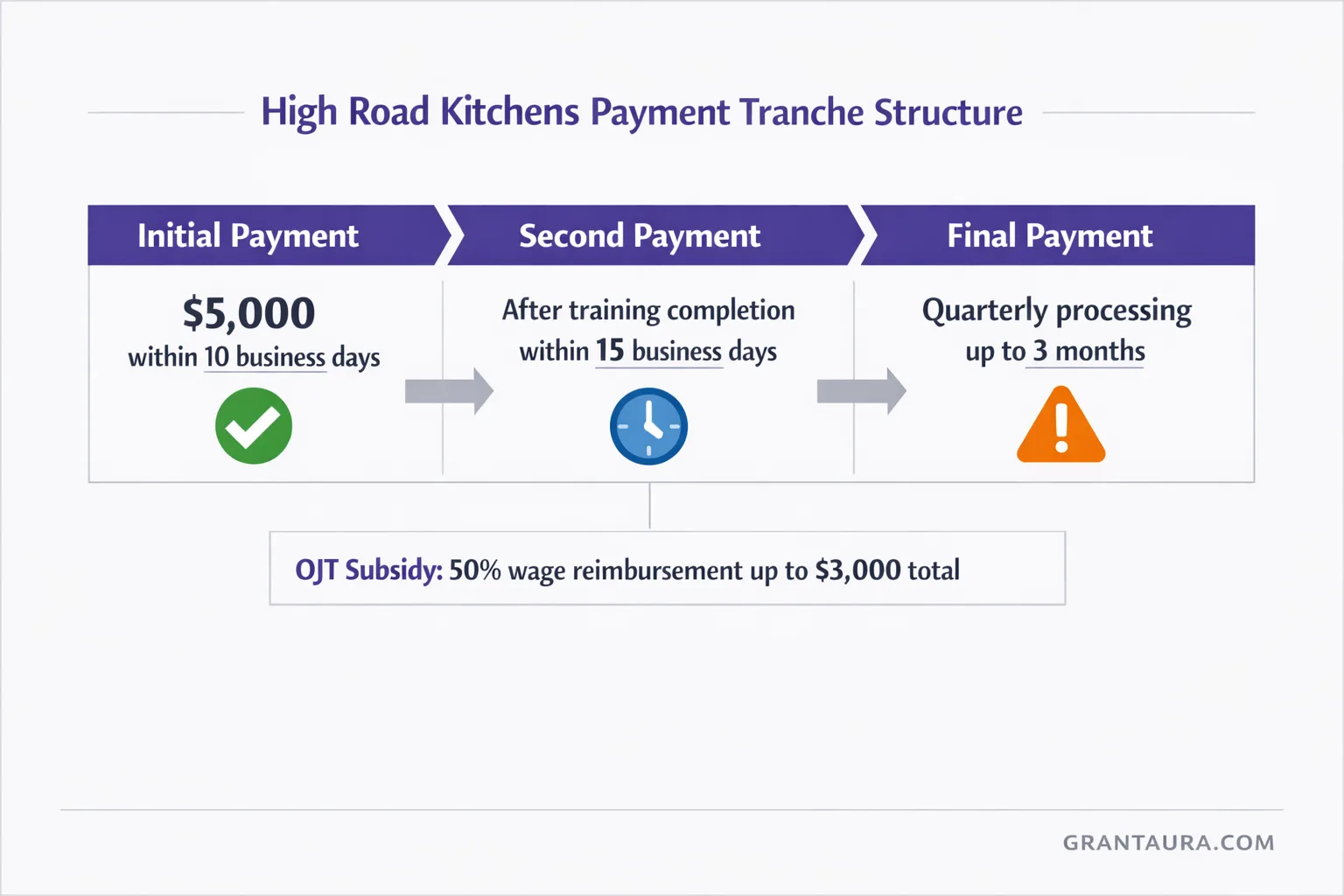
Beyond the cash, there's a wage subsidy. Through On-the-Job Training (OJT) agreements, you can get 50% reimbursement for wages paid to enrolled W-2 staff. It's capped at $15 per hour per employee, for up to 2 months per employee, with a maximum of 5 employees. That's a potential extra $3,000 per restaurant. But here's the catch: the final payment tranche can take up to 3 months to process quarterly after you complete your advocacy requirements. Cash flow planning matters.
The Real Commitment: Wage, Training & Meals
Here's where most people get confused. They see a dollar amount and think it's a simple transaction. It's not.
The wage commitment. You're signing up to transition to One Fair Wage—the same base wage for tipped and non-tipped employees—by a fixed deadline. In Michigan, that's January 2027. In Chicago, it was 2026. It's phased. You're not flipping a switch tomorrow. But the deadline is in the agreement. If you don't meet it, you return the money.
The training. Within nine months of receiving funds, you complete their Equity Toolkit. What's that actually cover? Based on reporting from Next City and the Chicago Sun-Times, it includes tip sharing, service charges, implicit bias, racism, assessing the racial makeup of front versus back of house, and alternatives like apparel and catering as revenue streams. Some owners find this challenging. Others find it eye-opening. Either way, it's required.
The meals. You serve free or sliding-scale meals to your community. In Michigan, the application says one meal for every $20 granted over eight weeks, and it's negotiable if it's a barrier. In Chicago, it was one meal per $10 granted. Customers order with advance notice and pay on a $0-$20 sliding scale. When someone pays $20, they've covered their own meal and funded one free meal for someone else.
How applications are scored. San Diego's published rubric is the only public reference. It weights:
Criterion
Weight
What Reviewers Look For
Wage transition plan quality
30 points
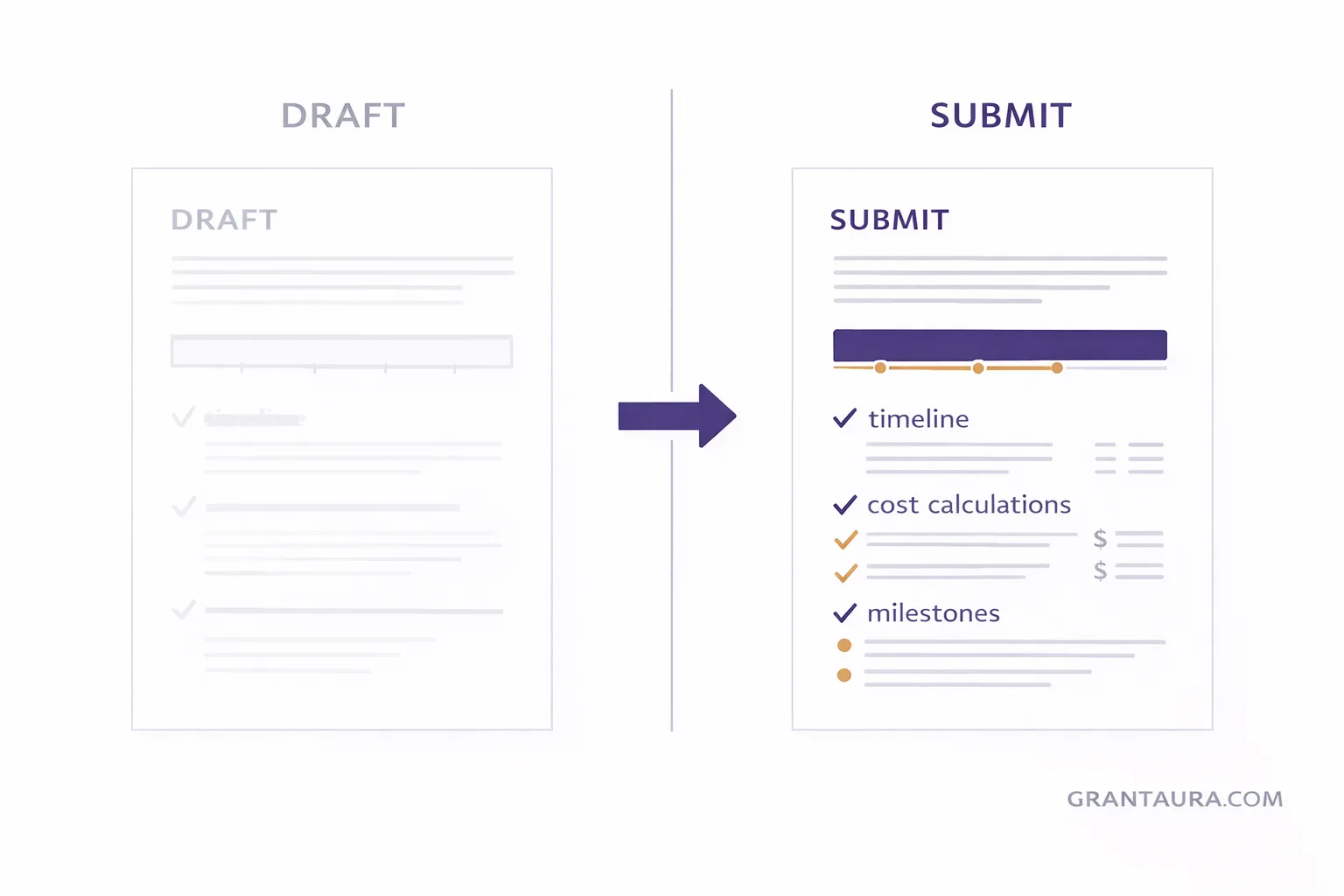
Month-by-month roadmap with specific cost calculations and milestones
Community meal program design
30 points
Target population identified (unhoused
High-road employment practices
20 points
Current wage structure
Financial viability
10 points
12-month P&L projection showing sustainability under new wage model
Diversity and equity commitment
10 points
Owner background
Your wage transition plan and your community meal design together account for 60% of your score. Not your compelling story. Your concrete plan.
Who This Grant is For (Location, Revenue & Readiness)
You have to be in an active city. Right now, the only live, verifiable application I can point you to is the Michigan Google Form. The program has run in California, Massachusetts, New York, Ohio, and Illinois at various points. If you're in one of those states, the program may come back—but don't apply yet. Check with program manager Teresa Contreras (teresa@highroadrestaurants.org) to see if a round is planned.
You have to be an independent, full-service restaurant. Counter service, fast food, chains? Not eligible.
Most rounds target restaurants under $3 million in annual revenue and require documentation of at least a 25% COVID-related revenue loss. If you're above that, your chances drop significantly.
And you have to be willing to make the commitments above. That's not eligibility in the traditional sense. It's a decision. You decide if you're open to the model.
How to Apply: Emails, Documents & Word Limits
The application process is not centralized. It varies by city. In Michigan, it's a Google Form. In other cities, it might be a city portal. In some cases, you email your application directly.
Based on multiple city rounds, here's what you'll likely need:
Document
Format
Notes
Business financial statements
PDF under 10MB
Show annual revenue under $3M
COVID-19 revenue loss documentation
PDF under 10MB
Comparative statements showing 25%+ loss
Wage equity transition plan
PDF under 10MB
500 words max
Free meal distribution plan
PDF under 10MB
300 words max
RAISE membership application
Online or email
Free membership required
IRS Form 4506-C
PDF under 10MB
Tax transcript authorization
12-month P&L projection
PDF under 10MB
Forward-looking under new wage model
Detailed wage transition timeline
PDF under 10MB
Specific milestones and cost calculations
If you're emailing your application (some rounds use info@onefairwage.org with the subject line "High Road Kitchens Application - [Restaurant Name]"), make sure every PDF is under 10MB and you've combined files if necessary to meet attachment limits.
The word limits matter. Reviewers have read thousands of applications. Vague platitudes about "paying fair wages" score zero. Specific month-by-month implementation roadmaps with cost calculations score high.
Frequently Asked Questions
Q: Is this grant still open outside Michigan? A: I can't verify current applications in other states right now. The program has run in California, Massachusetts, New York, Ohio, and Illinois in the past. If you're in one of those states, I'd email Teresa (teresa@highroadrestaurants.org) and ask if a round is planned. In the meantime, check grants by state for other options.
Q: What if I can't serve the required meals? A: The Michigan application explicitly says if the meal requirement is a barrier, reach out to discuss it. They're flexible. The goal is feeding people, not enforcing a rigid formula. Also, smart operators serve meals during slow periods (like Tuesday afternoons) when staff are already on the clock, minimizing incremental cost.
Q: What does the equity training actually cover? A: Based on reporting from Next City and the Chicago Sun-Times, it includes tip sharing, service charges, implicit bias, racism, assessing front versus back of house racial makeup, and alternatives like apparel and catering. It's not just a lecture—there's discussion and planning involved.
Q: What happens if I don't meet the wage commitment by the deadline? A: The agreement says funds "will be returned." It's a binding commitment. Extensions are possible with documented justification, but you must request them before the original deadline. That's why planning the transition now matters.
Q: How does the wage subsidy (OJT) work? A: You get 50% reimbursement for wages paid to enrolled W-2 staff, capped at $15/hour per employee, for up to 2 months per employee, with a maximum of 5 employees. Total subsidy cap is $3,000 per restaurant. 1099 contractors, owners, and family members do not qualify.
Q: How are applications scored? A: San Diego's published rubric weights wage transition plan (30%), community meal design (30%), high-road employment practices (20%), financial viability (10%), and diversity commitment (10%). Other cities may differ, but this is the only public reference.
Q: When do I get paid? A: Initial payment often arrives within 10 business days. Second payment comes after training completion. Final payment processes quarterly after advocacy completion—you may wait up to 3 months. Plan cash flow accordingly.
Key Terms You Should Know
One Fair Wage: The policy of paying tipped and non-tipped employees the same full minimum wage, eliminating the sub-minimum wage for tipped workers.
Equity Toolkit: A nine-month training program covering wage equity, implicit bias, front/back of house demographics, and revenue diversification.
Sliding scale: A pricing model where customers pay $0-$20 in $5 increments for meals. $20 pays for the meal and funds one free meal.
Full-service restaurant: Sit-down dining with table service. Counter service and fast food not eligible.
RAISE High Road Restaurants: A membership network for restaurants committed to fair wages. Free for grantees.
OJT Wage Subsidy: On-the-Job Training reimbursement providing 50% of wages for enrolled W-2 staff, capped at $15/hour, 2 months per employee, 5 employees maximum, $3,000 total.
Performance-based distribution: Grant funding released in increments tied to verified completion of community service milestones (e.g., serving 500 free meals).
Written Wage Phase-in Timeline: A key application document detailing your exact quarterly plan to reach full minimum wage by the program deadline.
More Restaurant Grants to Consider
If High Road Kitchens isn't the right fit—wrong city, can't make the wage commitment, need funding faster—here are alternatives. I maintain this list specifically for restaurant owners who need wage equity funding or general operating support.
For a national option with fewer restrictions, the Santander X Cultivate grant serves food businesses nationally.
How Grantaura Helps With Your Application
The wage transition plan is where most applicants get stuck. Not because they don't care about paying fair wages. Because they've never built a financial model showing exactly how to maintain profitability while increasing labor costs by 30% or more.
Our team helps you construct the month-by-month roadmap that scores those 30 points on the rubric. We model menu pricing adjustments, labor cost optimization, and turnover reduction calculations. We review your 500-word narrative to catch vague phrasing that reviewers have seen a thousand times. We verify your document package meets the technical requirements—PDF format, file size limits, word counts before you submit.
This grant is complex because the application is just the start. The real work and the real support you need is in the commitments that follow. That's where we come in.
If you're ready to apply but overwhelmed by the document requirements, Our team will guide you through the wage transition narrative, P&L projection, and timeline documentation that this program requires.
If you're unsure whether your restaurant qualifies—revenue calculations, COVID documentation, or which city's round applies—book an expert consultation. We'll review your situation in a live 1-on-1 video call and give you a straight answer.
About the Author
I review restaurant grants daily. Most are straightforward—apply, get money, spend it. High Road Kitchens is different. It asks you to change your business model, not just your bank balance. I've studied the Cleveland cohort data, the Boston ARPA reports, the San Diego scoring rubrics. What I found is that restaurants succeed here when they treat the wage transition as a strategic business decision, not a compliance exercise. If you're trying to figure out whether this program fits your restaurant, or you need help building the financial model to make it work, read more about my work or schedule a consultation.
Eligibility for High Road Kitchens
If you're an independent full-service restaurant owner in Michigan, you might be eligible for the High Road Kitchens grant. But it's not just about location. This program asks you to make real commitments: paying all workers a full minimum wage with tips, completing a nine-month equity training, and serving community meals. I've dug into the details so you can quickly check whether your restaurant fits the current active round. Use the questions below to see if you're on the right track. If you are, we can help you prepare a strong application. If not, I'll point you to other grants that might be a better fit.
What the eligibility tool won't tell you
The tool above checks the basic gates, but the real nuance is in the commitments. Many applicants underestimate the operational lift of the training schedule or the cash flow impact of the performance-based payments. That's where expert review makes a difference. If you're unsure about any requirement—like whether your revenue is under the typical $3M cap, or if you can document COVID loss—book a consultation and we'll walk through your specific situation. When you're ready, and we'll help you build the wage transition plan and assemble your documents.
[
  {
    "url": "https://grantaura.com/grant/santander-x-cultivate-small-business-grant-for-women-and-minority-owned-food-businesses/",
    "custom_description": "Supports food and beverage businesses with a focus on women and minority owners. Offers grants and training for growth and resilience."
  },
  {
    "url": "https://grantaura.com/grant/restaurants-care-resilience/",
    "custom_description": "Provides $5,000 grants to California restaurants for operational resilience and recovery. Open to independent eateries statewide."
  },
  {
    "url": "https://grantaura.com/grant/west-hollywood-restaurant-grant/",
    "custom_description": "Tiered grants for restaurants in West Hollywood, California, supporting local food businesses with funding for improvements and stability."
  },
  {
    "url": "https://grantaura.com/grant/cook-county-brite/",
    "custom_description": "Assists small businesses in Cook County, Illinois, including restaurants, with grants for growth, recovery, and capital improvements."
  }
]
We are your trusted grant application partners. You can navigate the entire grant application process with our expert guidance through this simple 5-step process.
300+ Projects
4.9/5 Rating
Expert Team
Step 1: Application Form
Fill out the "Apply for this grant" form with your information and grant requirements.
Step 2: Eligibility Assessment
Our grant experts will assess your eligibility and notify you via email.
Step 3: Expert Consultation
A dedicated grant expert will be assigned to discuss next steps for your application.
Step 4: Application Submission
Our expert will help you complete and submit your application with all required materials.
Step 5: Final Decision
The grant committee will make their decision and notify successful applicants.
As the founder of Grantaura, I've dedicated myself to demystifying the grant funding process. My goal is simple: to empower entrepreneurs, non-profits, and innovators like you to secure the capital needed to make a real impact. Let's build your funding strategy together.
Profile data is saved in your browser and synced to secure storage when available.
Context
Grants selected0
SLA tierNot selected yet
Billing modelNot selected yet
Due today--
Total project value--
Selection preview
No grants selected yet.
Soft estimate
Estimate only. Final pricing appears in Quote step.
Quote expiry
Quote timer starts after pricing is generated.
Verification
Verification status appears here once quote is confirmed.
Success snapshot
Success milestones appear here after confirmation.
What happens next
After quote confirmation, verify your email and complete secure payment.
ProfileReviewPayment
Choose your service
Select how you want to proceed. You will review pricing before checkout.
Next stepReview pricing, then checkout
Recommended
Full service
Full Application Submission
From USD 41.40
We prepare and submit your grant application on your behalf, with priority or rush handling applied when the deadline makes faster service necessary.
No funding guarantee. If Grantaura cannot complete due to our operational failure, refund policy applies.
Assessment
Quick review
Eligibility Assessment
USD 5.99 one-time
Find out if you qualify. Results typically within 24 hours.
FreeNo card needed
Share & Submit Free
Share this grant with your network. We will assess your application at no cost.
Why does Grantaura charge a fee?
The donor does not charge you. This fee covers Grantaura's hands-on work: expert review time, eligibility checks, application drafting, and submission handling.
You will see the exact quote before checkout. Nothing is charged just for opening this screen.
Keep your post public. Our team will verify the link before processing your assessment. If the post is deleted or made private after submission, your free assessment will be void.