
Meta AI Glasses Impact Grant Has Two Tracks – Most Apply to the Wrong One
Meta funds US organizations using AI glasses with $25K-$200K. Two tracks: Accelerator for active users, Catalyst for developers.
Key Takeaways
Two tracks: Accelerator and Catalyst
$25K to $200K for US orgs only
Accelerator: must already use glasses
Catalyst applies by email to Meta
Grant Overview
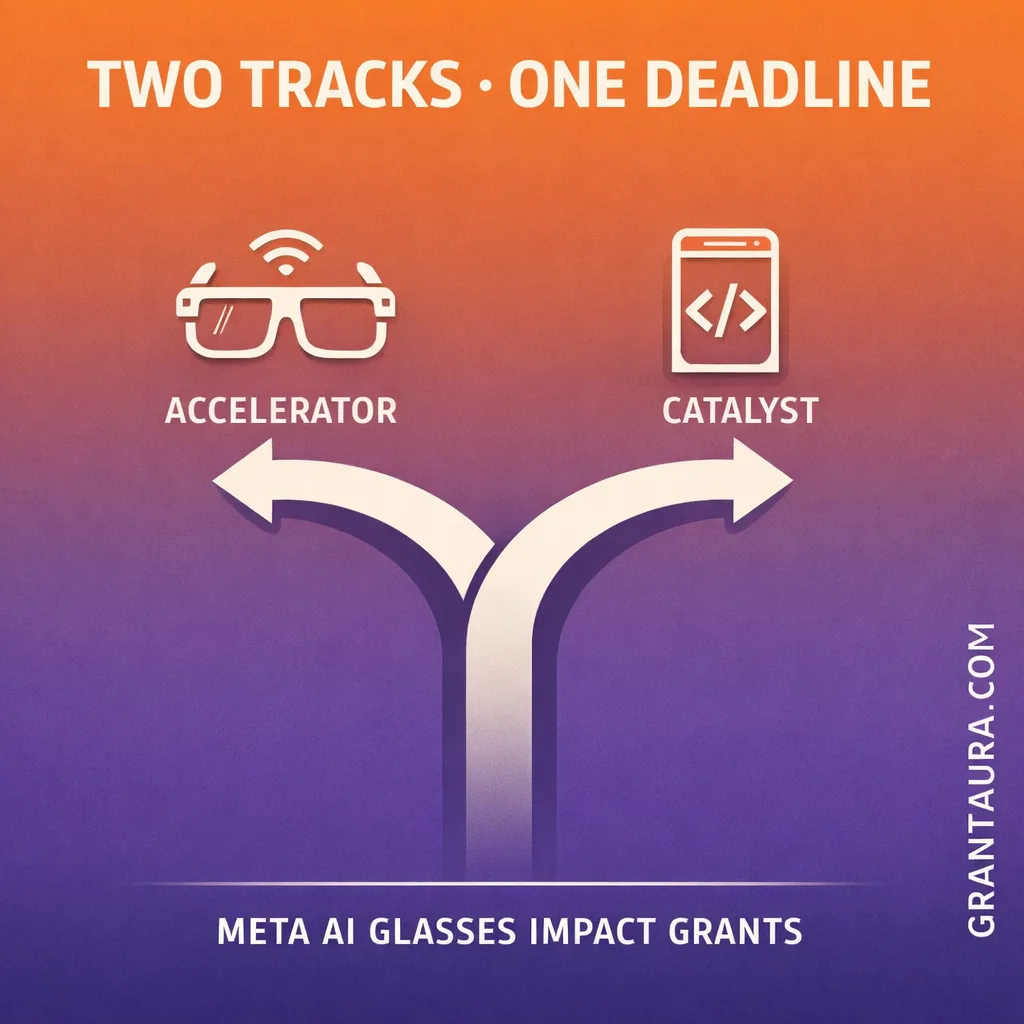
Two completely different applications exist inside the Meta AI Glasses Impact Grant. If you are going for the $200,000 Catalyst track, the Submittable portal is not your application channel. That is for Accelerator applicants only. Catalyst submissions go to glassesimpactgrants@meta.com - an email, with no template provided. Both tracks close on March 9, 2026.
Meta is distributing nearly $2 million across more than 30 US organizations already using AI glasses to produce real societal and economic impact. Not organizations planning a pilot. Not teams with an interesting concept about wearable technology. Organizations that have already deployed the hardware - in agricultural fields, on athletic training grounds, in veterans support programs - and can point to measurable outcomes from that deployment.
Meta AI Glasses Impact Grants
- Grant Award
- $200,000
- Application Deadline
- March 9 2026
- Eligible Region
- United States
- US-based organization only
- Incorporated for 12+ months and in good standing
- Not a government entity
- For Accelerator: currently using Meta AI glasses with measurable impact
- Evidence of active deployment required
- For Catalyst: existing mobile app with consumer audience required
- Domain expertise in your field required
- Technical capability to build on Meta Wearables SDK required
- $200000
- Catalyst: 5 grants at $200000 each
- Accelerator: 15 grants at $25000 and 10 grants at $50000
- Meta Wearables Community access for recipients and selected applicants
- Catalyst recipients: bi-weekly check-ins with Meta team
Why This Grant Works Differently From Most Programs You Have Seen
Meta is not a foundation. It does not have an annual grant cycle, a dedicated philanthropy team, or a program handbook waiting for download. This is a first-cycle initiative from a hardware company that wants its wearables ecosystem to grow - and understanding that context changes how you should approach the application entirely.
Most grant programs fund ideas. This one funds deployments. The Accelerator track is closed to organizations planning to use Meta glasses. You must already be using them, with outcomes you can point to. That eliminates a larger portion of initial interest than most people expect when they first read the announcement headline.
The Catalyst track is a different program again - not for nonprofits with a wearables idea, but for developers who have already built a mobile app with a real consumer base and want to extend that app onto Meta's glasses hardware. Be My Eyes, which connects blind and low-vision users to sighted volunteers via video call, is the kind of organization the Catalyst track was designed around. One million users. Growing by sixteen thousand a month. A clear deployment pathway that makes sense on the glasses' specific hardware capabilities. That is the implicit bar.
Getting the track wrong before writing anything is the most expensive mistake in this process. For Catalyst applicants specifically, it means sending your application to the wrong channel entirely - the one thing no amount of good writing can fix after the fact.
The Numbers - and the Benefit Most Summaries Do Not Mention
Twenty-five Accelerator grants are on the table. Fifteen at $25,000. Ten at $50,000. When you fill in the Submittable form, you choose which amount to apply for - and that choice matters more than it first appears. Meta reserves the right to award a different amount than you requested. So the budget section is a persuasion document, not a formality. A $50,000 ask backed by a detailed budget that maps spend to specific outcomes at a defined scale reads very differently from the same number with a vague narrative behind it.
Five Catalyst grants are available at $200,000 each. No tiers. Five awards. Real competition for every slot.
The cash is only part of what recipients get. All grant recipients join Meta's Wearables Community - the network of developers, researchers, and innovators Meta is actively building around its glasses hardware. Catalyst recipients get more: bi-weekly check-ins with Meta's team, plus an async support channel. For a startup or small developer building on a new SDK from a major platform, that level of access is genuinely unusual. You normally get documentation and a forum thread.
Here is the fact almost nobody mentions. Meta Wearables Community access is not only for winners. Selected non-winning Accelerator applicants also receive it. Applying and not winning does not leave you empty-handed if your application was strong enough to be noticed.
Total pool: approximately $1.875 million across more than 30 US organizations. Meta describes this as "nearly $2 million." The math: 15 grants at $25K ($375K) plus 10 grants at $50K ($500K) plus 5 grants at $200K ($1M) equals $1.875M.Important Information
The Organizations Already in This Ecosystem - and What the Bar Actually Looks Like
Meta named several organizations in the grant announcement and the earlier toolkit launch. Reading what they actually do tells you more about what a competitive Accelerator application looks like than any eligibility checklist.
Oscar Mike was founded by Marine Corps veteran Noah Currier, who is quadriplegic. His organization uses Meta glasses to give physically disabled and vision-impaired veterans the ability to record photos and video hands-free. Specific population. Defined use case. Impact tied directly to the one capability the glasses uniquely provide.
Agerpoint CEO Kevin Lang deploys the glasses to give farmers and agricultural workers real-time, hands-free AI capability in the field: crop health diagnostics, harvest readiness projections, spatial data capture. The outcome is economic and quantifiable - better decisions for people whose livelihood depends on what they harvest each season.
Blinded Veterans Association partnered with VA Blind Rehabilitation Centers to develop a training guide and distribute the glasses to blind and low-vision veterans. An established nonprofit, an established population, an established device - all three in place before the grant was announced.
National Athletic Trainers Association member David Gallegos uses the glasses' voice recognition to record real-time injury notes and update patient charts hands-free during games and training. Specific professional context. Clear operational advantage. No pilot required.
What all four share: active deployment, named users, and a measurable context. None of them are described as planning to start. They were already there. That is the Accelerator archetype. And for Catalyst applicants - Be My Eyes (one million users, growing sixteen thousand per month) and Disney Imagineering built integrations during the developer preview before the grant launched. Those are the implicit benchmarks for "existing mobile app with an established consumer audience."
Eligibility - the Shared Rules First, Then the Fork
Two baseline rules apply to every applicant before track-specific requirements come into play. Then the path splits completely.
What Both Tracks Require
US-based organization incorporated and operating under US law Incorporated for more than 12 months and currently in good standing Not a state or local or federal government entity Partnership applications are explicitly welcomed - a developer with technical expertise partnering with a nonprofit for domain expertise is a valid structure for either trackRequired Steps
Both for-profit and nonprofit organizations are eligible. Sole proprietors are not specifically addressed in the published rules - if that describes your situation, confirm with Meta directly before investing time in the application.
Accelerator Track - The Deployment Requirement
The qualifier that eliminates most initial interest: you must currently be using Meta AI glasses with measurable, demonstrable impact. The application asks for "a demonstration and evidence of your active use of AI glasses to drive societal or economic impact." That word "evidence" is doing real work in that sentence.
Anecdotal descriptions of how the glasses fit into your workflow are not the same as documented outcomes. Before writing a single sentence of the Accelerator application, you should be able to answer two questions with actual data. How many people does this deployment reach? What measurable outcome has it produced? If those answers are vague, the application will be vague too - and it will not survive multiple rounds of review by Meta employee teams who score by specific criteria.
You also need a clear plan for how additional funding and more glasses will scale that impact. Not a narrative about growth potential. A specific plan that maps dollars to outcomes at a defined scale.
Meta reserves the right to award a different amount than you applied for. If you apply for $50,000 and your budget justifies $25,000 in Meta's assessment, that is what you will receive. Build your budget around what your project actually needs at the scale you are describing - not around the highest defensible number.
Catalyst Track - The Developer Bar
Catalyst eligibility has more dimensions than Accelerator, and each one is a genuine hurdle rather than a formality.
Existing mobile app with an established consumer audience - prototype or soft launch does not qualify Domain expertise in the problem area you are addressing - Meta's FAQ describes this as "preferably a country-leading authority" Technical capability to build on Meta's Wearables Device Access Toolkit - your team must have reviewed the SDK documentation and understand what it can and cannot do Proposed integration must deliver genuine social or economic value with a plausible path to adoption Partnership applications are explicitly permitted - a developer without domain expertise can apply with a domain-expert nonprofit as a named partnerRequired Steps
SDK Technical Scope - Read This Before Writing Your Catalyst Proposal
The Wearables Device Access Toolkit is narrower than the marketing language around Meta's AI glasses suggests. A Catalyst application built around a feature that is not in the SDK will not survive the first review stage. This is the single most avoidable failure mode for developer applicants - and no amount of strong writing fixes a proposal that depends on a capability the hardware does not currently expose.
Supported devices are Ray-Ban Meta Gen 1, Ray-Ban Meta Gen 2, and Oakley Meta HSTN. Camera and audio via Bluetooth profiles is the technical surface area for Catalyst proposals in this cycle. Build within that scope or redesign before you apply.
Check Your Specific Situation Against Both Tracks
The rules above cover published criteria. What they cannot do is evaluate your specific organization against those criteria - accounting for edge cases like unusual org types, partnership structures, or use cases that fall between the named sectors. The eligibility checker below runs a structured assessment of your situation against both the Accelerator and Catalyst tracks and surfaces the dimensions worth investigating further before you commit to an application.
If the checker confirms you are eligible for either track, the next step is not the Submittable portal or the Catalyst email. Most rejections in a first-cycle program like this happen in the narrative - specifically in how impact is described, how the budget is justified, and whether the application addresses the criteria reviewers are actually using. Submit your details using the button below and an expert will review your approach before the deadline.
If the result is unclear - particularly around "demonstrated impact" or "established consumer audience" - a specialist consultation will clarify your situation faster than re-reading the FAQ. Book a consultation here.
If the checker confirms this program is not the right fit, the related grants section toward the end of this page has three alternatives that serve overlapping audiences at different stages of technology deployment.
How the Application Actually Works - Both Tracks
Applying for the Accelerator
Create a Submittable account at submittable.com before you open the form - creating one mid-application is an unnecessary risk given the deadline. The application closes March 9, 2026.
The form asks you to choose between $25,000 and $50,000. That is not just a number field. It is a signal to reviewers about how well you understand the scope and scale of your project - and Meta may adjust it. Build your case carefully.
Documented evidence of active Meta AI glasses use with measurable societal or economic impact A clear and specific plan for how the funding will scale that impact A detailed budget showing exactly how money will be spent and what outcomes result from each spend category Description of your organization's current scale and reach so reviewers can assess the appropriate award tier Clear plan for how additional glasses hardware will be deployed as part of the funded project
Applying for the Catalyst
Email glassesimpactgrants@meta.com. That is your entire application channel. No form. No Submittable account. No prescribed length or required attachment format in any official Meta source. What you do have is the four scoring criteria - and structuring your email around those four dimensions, even though Meta has not published a template, gives you a real structural advantage over applicants who write without that framework in mind.
Social and economic value - a real problem with a plausible path to adoption or pilot Originality and innovation - a clear reason why wearables unlock hands-free in-the-moment value Critical timing - how this integration advances your org or cause right now User experience and trust - evidence that privacy and data controls have been considered in your design
The review timeline is the same for both tracks. All applicants are notified of results by May 31, 2026. Funding is scheduled for the first half of 2026.
The Catalyst email has no form fields, no character limits, and no required attachments. That looks like freedom. It is actually a trap for applicants who have not internalized all four scoring criteria. Unstructured emails tend to address two criteria thoroughly and skip two others - particularly UX and trust, which technically-focused developers often treat as an afterthought. Your email should address all four scoring dimensions explicitly, even if you do not label them by name.
Choosing Between $25,000 and $50,000 - A Framework for the Call Most Applicants Agonize Over
Skip this section if you are applying for Catalyst. That track has one amount: $200,000.
For Accelerator applicants, the self-selection between $25K and $50K is one of the more genuinely difficult decisions in this application. The form gives no guidance. Here are three questions to work through before you choose an amount.
First: how many additional people will this funding actually reach, and can you show that with specific projections? A deployment adding fifty users represents a different scale from one adding five hundred. Second: how many additional pairs of glasses will you acquire, deploy, and operate with the funding? Hardware costs are real and should be line-itemed in your budget - not bundled into a general operations figure. Third: does your itemized budget actually add up to the amount you are requesting? If your costs total $28,000, do not apply for $50,000 and assume the narrative will bridge the difference. It will not.
The $50,000 tier is not a prestige signal. It is a scale signal. Organizations whose programs genuinely require more hardware, more staff time, and broader geographic reach are the natural fit for the higher tier. Smaller organizations with focused, well-defined deployments are usually better served by the $25,000 ask - where budget justification is easier to make airtight and the pool of competing applications is slightly less concentrated.
One more variable worth holding: Meta may award a different amount than you requested, and will tell you if they do. A strong $25K application that receives $25K beats an inflated $50K application that receives nothing.
What Winning Recipients Actually Get Beyond the Cash
The non-cash benefits matter to the application decision - especially for organizations uncertain about whether the competitive effort is justified given the timelines involved.
All grant recipients join Meta's Wearables Community. More than eighty developers, researchers, and operators attended Meta's first Wearables Community Summit in December 2025. Access to that network means access to peers solving similar problems with the same hardware, which has ongoing value beyond this grant cycle.
Catalyst recipients get something additional: bi-weekly check-ins with Meta's team, plus an async support channel for the duration of their project. For a developer building on a new SDK from a major platform, that is not standard. Normally you get documentation and a public forum. Catalyst winners get actual conversations with the team that built the hardware and designed the toolkit.
And the detail almost no summary of this grant includes: Meta Wearables Community access is also available to selected non-winning Accelerator applicants. Not to everyone who applies. To strong ones. Applying and not winning can still place you inside the ecosystem if your application demonstrated genuine quality - which means the effort of putting together a good application has potential upside even if the award itself does not come through.
Questions That Come Up Before You Apply
Q: Can both nonprofits and for-profit businesses apply?
A: Yes. Both are eligible for both tracks. No nonprofit-only restriction exists. What matters is US-based incorporation, twelve-plus months of operating history, and not being a government entity. A two-person for-profit startup qualifies. A multistate nonprofit qualifies. Sole proprietor eligibility is not explicitly addressed in the published rules - if that is your situation, email glassesimpactgrants@meta.com and ask before investing time in the application.
Q: What if I do not currently own Meta AI glasses?
A: For the Accelerator, you are ineligible. The requirement is active, demonstrated use - not a commitment to purchase after receiving the grant. There is no workaround for this. For Catalyst, the SDK is available for development and testing via a Mock Device Kit that does not require physical hardware, but your application still needs an existing mobile app and consumer audience that predate the grant. Idea-stage without hardware fits neither track in this cycle.
Q: Can I apply for both tracks at once?
A: The published rules do not address this directly. Most organizations fit one track based on their current situation. If you genuinely believe you qualify for both, email glassesimpactgrants@meta.com before March 9 and ask explicitly. Do not assume.
Q: What does "established consumer audience" actually mean for Catalyst?
A: Meta has not defined this numerically anywhere in the published FAQ or official communications. The implicit bar from Meta's named early partners is high - Be My Eyes has one million users. That does not mean one million is the minimum threshold. But a soft launch, a beta with a few hundred participants, or an app in early growth stage is probably not what Meta means by "established." Tens of thousands of users in a defined population with documented engagement puts you closer to the right range.
Q: What does the review process look like after submission?
A: Meta has confirmed multiple review stages scored by multiple teams of Meta employees. Selected recipients then go through a separate internal compliance and eligibility vetting process before any award is finalized. Meta has not described specific stage names, whether interviews occur, or the timeline within the review window. All applicants receive a decision by May 31, 2026.
Q: What are the four Catalyst scoring criteria?
A: Social and economic value (a real problem with a plausible path to pilot or adoption), originality and innovation (a specific reason why wearables unlock hands-free in-the-moment value for this use case), critical timing (how building this integration right now advances the organization or cause), and user experience and trust (evidence at application stage that privacy, data controls, and end-user experience have been thought through). These four are published in Meta's official FAQ and should all be addressed in a Catalyst email application.
Q: Can a Catalyst integration use Hey Meta voice commands or Meta AI features?
A: No. The current Wearables Device Access Toolkit does not support Hey Meta voice invocations or custom Meta AI integration. Camera and audio via Bluetooth profiles only. A proposal that depends on voice AI features, in-lens display, or EMG wristband input is out of scope for this grant cycle and will not survive the first review stage regardless of how compelling the use case sounds.
Q: When is funding actually distributed after notification?
A: Meta has indicated H1 2026 for disbursement. Notifications go to all applicants by May 31, 2026. Recipients then pass an internal compliance vetting process before the award is formally issued. The exact timeline between notification and disbursement is not specified in any official source.
Terms Worth Understanding Before You Apply
- Accelerator Grant
- The $25,000 or $50,000 grant track for US organizations currently using Meta AI glasses with demonstrable societal or economic impact. Applied for via the Submittable portal at glassesimpactgrants.submittable.com. Twenty-five awards total across two tiers: fifteen at $25,000 and ten at $50,000.
- Catalyst Grant
- The $200,000 grant track for developers building new, high-impact integrations on Meta's Wearables Device Access Toolkit. Applied for via email to glassesimpactgrants@meta.com only - not through the Submittable portal. Five awards total. Evaluated against four published scoring criteria.
- Wearables Device Access Toolkit (DAT)
- Meta's software developer kit for building integrations on supported glasses hardware. Provides access to the 12MP ultra-wide camera and five-microphone audio array via Bluetooth profiles. Does not support Hey Meta voice commands, custom Meta AI integration, or in-lens display in the current version.
- Meta Wearables Community
- Meta's network of innovators, researchers, and developers working with glasses hardware. Over eighty members attended the inaugural Wearables Community Summit in December 2025. Access is extended to grant recipients and to selected non-winning Accelerator applicants.
- Active Use
- The Accelerator eligibility standard requiring current, operational use of Meta AI glasses in a real program context. Planning to use, piloting on a preliminary basis, or being in the process of purchasing hardware does not satisfy this requirement. Evidence of outcomes from that use is required.
- Societal or Economic Impact
- Meta's framing for what a qualifying deployment produces. Impact must be real, demonstrable, and specifically connected to what the glasses enable - not to AI in general or wearable technology broadly. Reviewers are looking for outcomes that can be named and measured.
- Domain Expertise
- The Catalyst eligibility requirement that the applying developer or their partner organization has recognized expertise in the problem being addressed. Meta's FAQ uses the phrase "preferably a country-leading authority." Self-declared in the email application.
- Established Consumer Audience
- The Catalyst requirement that the developer's existing mobile app already serves a real user base at meaningful scale. Meta has not defined this numerically. The implicit benchmark from named early partners is high. Soft launches and beta-stage apps are unlikely to qualify.
- Mock Device Kit
- A testing tool provided by Meta that allows Catalyst developers to build and test integrations without owning physical glasses hardware. Available via the DAT documentation at developers.meta.com. Relevant for developers in early integration work who have not yet acquired supported devices.
- Multi-Stage Review
- Meta's confirmed review structure: multiple stages, scored by multiple teams of Meta employees. Selected recipients then pass a separate internal compliance and eligibility vetting process before the award is formally issued. The specific stage names and timeline within the review window are not published.
- UX and Trust Criterion
- One of the four published Catalyst scoring criteria. Requires that the application demonstrates - at submission, not post-award - that privacy considerations, data controls, and end-user experience have been designed thoughtfully into the proposed integration. Many technically strong applications underscore this dimension.
- Critical Timing Criterion
- One of the four published Catalyst scoring criteria. Evaluates specifically how building this integration right now advances the applying organization's mission or the cause it serves. A general argument for why the integration is a good idea is insufficient - the "why now for this org" must be specific and compelling.
- Partnership Application
- A joint application submitted by two or more organizations. Explicitly permitted for both tracks. The most common viable Catalyst structure pairs a developer organization (technical capability) with a nonprofit (domain expertise) to jointly satisfy all eligibility dimensions neither party could meet alone.
- Wearables Community Summit
- Meta's in-person gathering held in December 2025 for the early glasses developer and operator community. More than eighty participants. Referenced in the grant announcement as the community from which the grant program emerged. Participation in this network is part of the post-award benefit package.
- H1 2026 Funding
- Meta's stated disbursement window for grant awards. All applicants receive a decision notification by May 31, 2026. Actual funding is expected in the first half of 2026, with exact disbursement timing determined by the post-notification compliance vetting process. The gap between notification and receipt is not specified in any published source.
Where Applications Fall Apart - and What Grantaura Does Before You Submit
Eligibility is not where most applications in this program will fail. The rules are specific enough that organizations who do not qualify usually figure that out during research. The failure points come later - in how the application is written - and they are harder to see from inside the process.
For Accelerator applicants, the most common gap is evidence framing. A description that reads "we believe our users benefit significantly from hands-free access" does not score the same as "over six months, forty-seven agricultural workers used the glasses to capture spatial data across twelve thousand acres, reducing crop assessment time by forty percent." That difference is not about having better data. It is about how existing data is framed for reviewers who are Meta employees evaluating multiple applications, not grant specialists who will give you benefit of the doubt on a vague claim.
For Catalyst applicants, the four scoring criteria are the hidden structural requirement. Most developers write well about what they are building - the originality criterion - and less well about why this moment is right for their specific organization (critical timing) or how they have designed for end-user privacy (UX and trust). A Catalyst email that addresses two criteria strongly and skims two others is a weaker application than one that builds all four into a coherent argument from the first paragraph. Writing that kind of email without a framework is genuinely difficult work.
For both tracks, the budget section is consistently underestimated. It is not a spreadsheet to attach. It is a persuasion document that must survive review by multiple teams who do not know your organization and will not extend goodwill to an unexplained line item.
Talk to a grants specialist about your situation
Other Grants Worth Looking at If This One Does Not Fit
Three situations bring readers here that actually point toward a different program.
If your organization deploys AI technology but not specifically Meta glasses, the Lenovo Evolve Small AI Technology Grant is the closest structural parallel in the Grantaura database. Same audience shape - for-profit and nonprofit both eligible, US only - same tech-company-as-donor dynamic, similar award scale. Worth reviewing alongside this one if AI deployment is your primary use case but the hardware is flexible.
If you are a nonprofit that did not qualify for the Accelerator because you do not currently use Meta glasses - but you want to build visibility with tech ecosystem donors - the LinkedIn Pro Bono Ad Grants program follows a similar ecosystem logic: a tech company giving nonprofits resources to build community presence, with real impact as the output. Different resource type, same underlying calculus.
If your use case is still at the idea or early proposal stage and you did not clear the Accelerator's active-deployment bar, Emergent Ventures funds bold ideas before deployment exists. No hardware use required. No active program required. A completely different funding philosophy - but worth knowing about if the Meta Accelerator is a goal for a future cycle rather than a current fit.
About This Listing
Researched and written by Imran, founder of Grantaura. Sources include Meta's official grant newsroom announcement (January 21, 2026), the official AI Glasses Impact Grants FAQ, the Submittable application portal, the Meta Wearables Device Access Toolkit developer blog and developer FAQ, the Blinded Veterans Association partner page, and Meta's accessibility feature story naming Oscar Mike and other confirmed partner organizations. Research was conducted on March 4, 2026. The Catalyst scoring criteria were confirmed from the official FAQ via multiple corroborating sources when the FAQ page itself rendered incompletely in direct access. All major factual claims carry confidence classifications in the underlying research documentation. Questions about this listing or the grant program can be directed to Grantaura's specialist team.
How to apply for this grant
We are your trusted grant application partners. You can navigate the entire grant application process with our expert guidance through this simple 5-step process.
Step 1: Application Form
Fill out the "Apply for this grant" form with your information and grant requirements.
Step 2: Eligibility Assessment
Our grant experts will assess your eligibility and notify you via email.
Step 3: Expert Consultation
A dedicated grant expert will be assigned to discuss next steps for your application.
Step 4: Application Submission
Our expert will help you complete and submit your application with all required materials.
Step 5: Final Decision
The grant committee will make their decision and notify successful applicants.