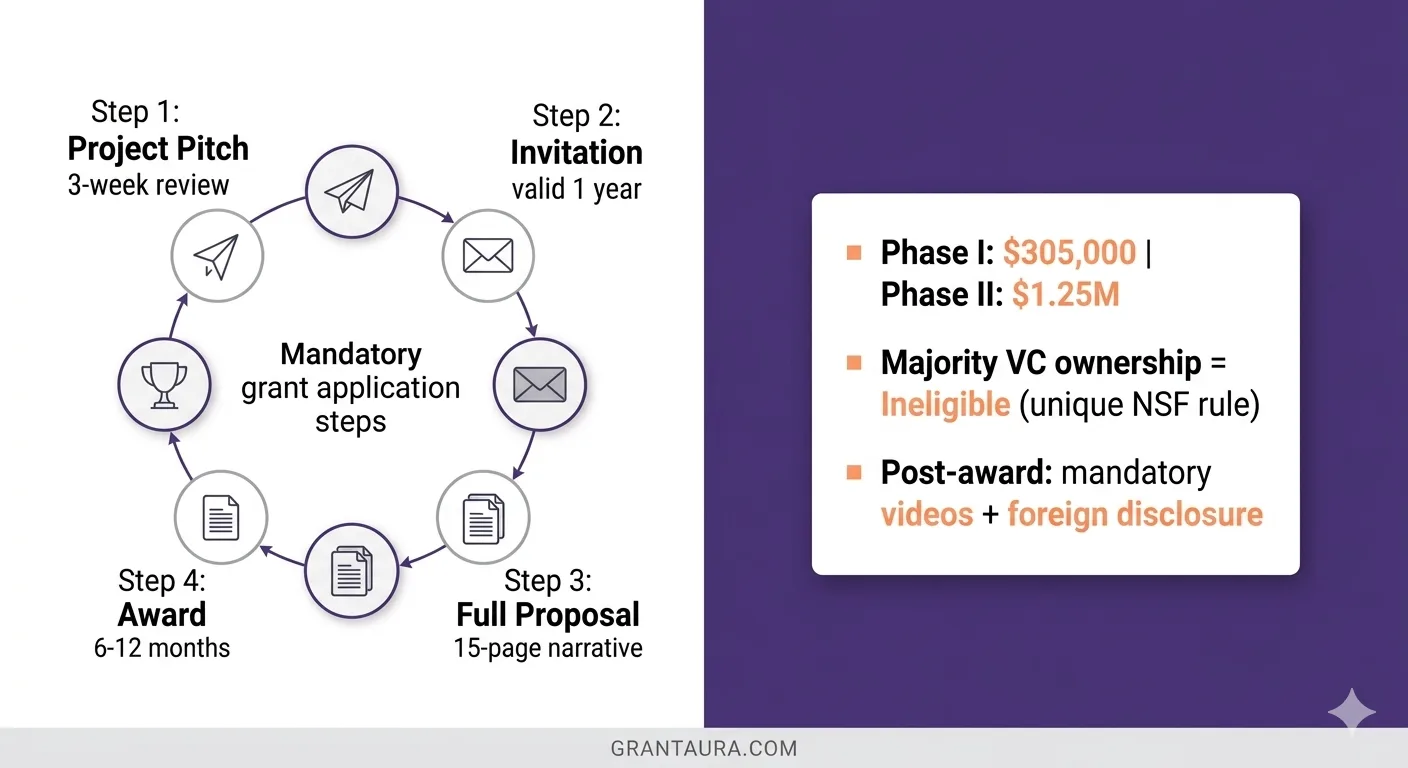
You can't just apply for NSF SBIR STTR Fund as you do for other government grants. You pitch first. And if they like it, they invite you to apply - that invitation is good for one year. Also, if VC firms own more than 50% of your company, you're automatically out. This restriction is unique to NSF among federal SBIR programs. I've been digging into this program for years, and the number of founders who miss these two gates still surprises me.
America's Seed Fund offers up to $305,000 in Phase I non‑dilutive R&D funding, and Phase II adds another $1.25 million. But the path is gated, and the rules are strict. Let's walk through what actually matters.
Is This Grant for You? Run a Quick Eligibility Check
Before you spend weeks on SciENcv forms and the 15‑page proposal, check the basic gates – especially the VC ownership rule that trips up half of applicants. Our tool surfaces that trap early. It walks you through the key requirements: US ownership, headcount, PI commitment, and the unique NSF restriction on VC ownership.
Eligibility Check
Eligibility for NSF SBIR STTR Fund – Businesses, Scientists, Researchers Can Apply
Answer a few guided questions. Your responses are matched to this grant's criteria in real time.
Ready to check your eligibility?
We'll guide you through a short, structured flow and instantly evaluate fit for this opportunity.
Eligible
You Appear Eligible
Based on your answers, you meet the core requirements for this grant.
Recommended Next Step
Protect Your Application Before You Submit
You look eligible — but eligibility alone doesn't win grants. Most rejections happen on the application itself: missed language, wrong framing, weak impact statement. A Grantaura Expert Review takes 24–48 hours and flags every gap before the funder sees it.
✓Expert reviews your draft⏱Results in 24–48 h💰Avg. grant value $12,000+
⚠ Grant committees reject 7 in 10 applications that meet eligibility. One overlooked line can cost you thousands.
🔒 Satisfaction-backed — if our review finds nothing actionable, you pay nothing more.
This Grant Isn’t the Right Fit. Your Best One Might Be Two Clicks Away.
Missing one criterion for NSF SBIR STTR Fund – Businesses, Scientists, Researchers Can Apply doesn’t mean you’re out of options — it means this grant wasn’t designed for your profile. Our expert research team identifies the grants built specifically for businesses like yours, across 500+ active opportunities.
Basic Match
$125
One-time research
A list of 5 grants only
Basic eligibility matching based on industry & location
Standard funding amount range verification
Primary criteria alignment check
Most Popular
Advanced Match
$145
One-time research
A list of 7 grants only
Advanced eligibility matching with business model analysis
Deep competitive advantage assessment
Innovation & impact potential matching
Market fit & growth trajectory alignment
Premium Match
$175
One-time research
A list of 10 grants only
AI-powered deep-match algorithm analysis
Historical success pattern matching
Priority sector & focus area alignment
Advanced sustainability impact matching
Strategic vision & long-term goals alignment
Preparing secure checkout…
✓
Order Confirmed
Your grant research order is placed. Our team will deliver your personalised report within 3–5 business days. Check your email for confirmation.
Auto-advances after each answer. Use Back to revise.
If the tool shows you're eligible, your best next step is to with us so we can craft your pitch and proposal. If you're unsure about your ownership structure or PI setup, book a live consultation with a grant expert. And if you're not eligible, don't worry – scroll down to the More Grants section for other opportunities matched to your profile.
What Is NSF SBIR/STTR? (And Why the Pitch Matters)
The National Science Foundation runs this program through its SBIR and STTR tracks. SBIR is for companies doing the research themselves; STTR requires a formal partnership with a research institution (university or federal lab) that performs at least 30% of the work. Both share the same funding, the same eligibility, and the same weird first step: the Project Pitch.
You submit a three‑page online form covering your technology, the technical challenges, the market opportunity, and your team. If a Program Director likes it, you get an email invitation to submit a full proposal. That invitation is gold – it's valid for one full year. I learned that from the official solicitation (NSF 23‑515). Most people don't realize they have twelve months to write the 15‑page proposal.
The amounts changed in 2024. Phase I now goes up to $305,000 for proof‑of‑concept work. Phase II up to $1.25 million to develop the prototype further. If you get both, you're looking at roughly $1.55 million – the “up to $2M” figure includes both phases and possible supplements. It's real money, and it's non‑dilutive. No equity given up.
The Project Pitch: Your First Filter
The pitch is not a formality. It's the primary gate. NSF program directors review these to determine if your innovation aligns with their mandate for high‑risk, high‑impact technical development. You submit through the NSF portal anytime. One to two months later, you receive either an invitation or a decline with feedback.
The pitch has four sections with strict character limits: Technology Innovation (3,500), Technical Objectives and Challenges (3,500), Market Opportunity (1,750), and Company/Team (1,750). These limits are enforced by the portal. Exceed them, and your pitch gets rejected administratively without review. I always draft outside the portal and paste in.
What kills pitches? The most common reasons are insufficient technical risk (your innovation can be built with existing methods), unclear market opportunity, weak team credentials, and misalignment with NSF scope (incremental engineering rather than fundamental advance). The feedback is specific – use it to decide whether to revise or pivot.
Also, you can only have one active Project Pitch per submission cycle. No duplicates.
Expert Tip
The most competitive Project Pitches demonstrate technical risk explicitly. NSF funds what has not been proven, not incremental improvements. If your innovation can be built with existing engineering practices, it likely does not qualify.
Eligibility: Who Gets Invited?
Before you fall in love with the numbers, check these gates. They're non‑negotiable.
Business structure: For‑profit, U.S.‑based, fewer than 500 employees (including affiliates).
Ownership: At least 51% owned by U.S. citizens or permanent residents on a fully diluted basis (including options and warrants). Venture capital, private equity, and hedge funds cannot collectively own more than 49%. This is a unique NSF rule – NIH and DOE allow majority VC ownership.
Principal Investigator: Must be primarily employed by your company (≥20 hours a week during the project, and >50% for the award duration). No consultants or split‑appointment academics unless their primary employment is with your startup.
Work location: All R&D must happen in the U.S., including work by consultants and subcontractors.
One proposal per window: You can submit only one Phase I proposal per submission window. Choose wisely.
STTR extra: If you go the STTR route, your research partner must do at least 30% of the work, and you must have a written agreement.
High‑risk tech: The project must involve unproven, high‑risk technological innovation – not incremental product development.
There are also immediate disqualifiers: including URLs in the Project Description (forbidden by the solicitation), proposing clinical trials, or having any connection to malign foreign talent recruitment programs. The pre‑award forms (OMB 3145‑0270) ask detailed questions about foreign affiliations – be ready to answer honestly.
The Registration Maze: Plan 4‑6 Weeks Minimum
Before you can submit a Project Pitch or full proposal, you need three registrations. Start these immediately – they take longer than you think.
SAM.gov: Get your Unique Entity Identifier (UEI) and register with financial assistance authority. Current processing is 4‑6 weeks. Start this before you write a single word of the pitch. Our step‑by‑step SAM.gov guide can help.
Research.gov: NSF's proposal submission system. Company registration takes about 48 hours after SAM is active.
SBIR Company Registry: Get your Small Business Concern Control ID (SBC ID) from the SBA. Required for submission.
Miss one step and the portal blocks you hours before deadline. NSF doesn't grant extensions for registration failures.
The Full Proposal Burden: 14 Documents and a 15‑Page Narrative
Once you get the invitation, the real work begins. The full proposal is extensive. Here's what you'll need:
Project Description (15‑page PDF, no URLs allowed)
Biographical Sketches (SciENcv format – mandatory)
Budget and Budget Justification (5‑page limit)
Current and Pending Support
Letters of Support (optional, up to 3)
Data Management Plan
Facilities and Equipment list
For Phase II: Company Commercialization History (Excel), Blank Milestone Chart (Excel), Funding Agreement Certification (PDF), Certificate of Current Cost/Pricing Data (DOC)
Technical and Business Assistance (TABA) plan – you should budget up to $6,500 for third‑party commercialization help
I‑Corps training plan – up to $25,000 for customer discovery training
That's at least 14 items. The Project Description must follow strict headers (Intellectual Merit, Broader Impacts, Commercial Potential) and be written for dual audiences: scientists and commercialization reviewers. Formatting violations (wrong font, margins, missing headers) trigger automatic return without review.
Voluntary cost sharing is prohibited. Some costs are unallowable: equipment purchases, foreign travel, publication costs, marketing, and sales expenses. Customer letters of support are banned in Phase I – reviewers want to see technical proof first.
Important Note
The $305,000 cap is firm. Proposals exceeding it are returned without review. You must choose between the 50% safe rate on salaries or the 15% de minimis rate on Modified Total Direct Costs. The de minimis rate is the forward‑looking choice for most applicants.
How Your Application Gets Reviewed
Once submitted, your proposal goes to peer review. NSF guarantees at least three expert reviewers. They evaluate based on three criteria:
Intellectual Merit: Is the science/engineering sound and novel?
Commercial Impact: Can this become a product or service, and what's the pathway?
The exact weights aren't public, but funded proposals demonstrate technical risk explicitly. They explain why the technology might fail and how they'll find out. They also show commercial awareness without overselling – specific customers, revenue models, and competitive landscape.
Timeline: Pitch (1‑2 months) → invitation → registration and proposal prep (2‑4 months) → merit review (4‑6 months) → award notification and contracting (1‑2 months). Total: 6‑12 months minimum. If you need funding within 90 days, this program isn't a fit.
What Happens After You Win (The Part No One Talks About)
You get the email. You celebrate. Then you discover the pre‑award paperwork. Before any money moves, your PI and Authorized Organizational Representative must certify they've watched:
The NSF award rules video
The NSF Research Security Training Condensed Module
Three SBA cybersecurity tutorials
You also fill out a detailed form (OMB 3145‑0270) disclosing every owner with more than 5% equity, their citizenship, any foreign affiliations, and any ties to malign foreign talent programs. It's invasive, but it's mandatory. Fail to disclose, and you risk losing the award – or worse.
We help clients through this step too. Because winning shouldn't feel like a second job.
Should You Apply? A Decision Framework
If your technology is truly deep tech – rooted in fundamental science – and you meet the eligibility gates, you should absolutely pitch. The worst that happens is you get a no, and you've only spent a week on the pitch, not 100 hours on a full proposal.
If you're building a straightforward software product with no research component, or if your cap table includes majority VC ownership, this isn't the right program. Look at other non‑dilutive options like NIH SBIR (which allows VC ownership) or state grants.
If you're unsure about the STTR vs SBIR decision, read our SBIR vs STTR explained guide.
Frequently Asked Questions
Q: Are venture capital‑backed startups eligible for NSF SBIR? A: No. Companies where venture capital, private equity, or hedge funds collectively own more than 50% are ineligible. This restriction is unique to NSF – NIH and DOE SBIR programs allow majority VC ownership under SBA rules. The prohibition applies even if ownership is split across multiple firms.
Q: What are the Project Pitch field limits? A: Four sections with explicit caps: Technology Innovation 3500 characters, Technical Objectives and Challenges 3500, Market Opportunity 1750, and Company and Team 1750. Draft outside the portal and paste to avoid truncation.
Q: Do I need preliminary data to apply? A: No. NSF explicitly states preliminary data is not required for Phase I. They want high‑risk unproven R&D – not de‑risked prototypes. This differs from NIH SBIR, which often expects preliminary data.
Q: How long does NSF take to make a decision? A: 6‑9 months from full proposal submission to award notification. No status updates during review – just email when decisions land. Factor in the 1‑2 months for pitch review, and total timeline is 6‑12 months.
Q: What is the difference between SBIR and STTR? A: SBIR requires the small business to perform at least two‑thirds of the research. STTR requires a formal partnership with a research institution (university or federal lab) that performs at least 30% of the work. STTR is designed for academic spinouts.
Q: Can I resubmit a declined Project Pitch? A: No. NSF prohibits resubmission of declined Project Pitches for the same concept within 12 months. This raises the stakes of your first submission – which is why pre‑submission review is valuable.
Q: How do I choose between the 50% safe rate and 15% de minimis indirect cost rate? A: The 50% safe rate applies to total budgeted salaries and wages. The 15% de minimis applies to Modified Total Direct Costs (excluding equipment, tuition, and subawards over $25,000). For personnel‑heavy projects, the safe rate often yields higher indirect cost recovery. The safe rate is being phased out, so de minimis is the forward‑looking choice.
Q: What happens after Phase I? A: If successful, you may apply for Phase II funding up to $1.25 million for 24 months of continued development. Phase II requires commercialization progress, not just technical milestones. Fast‑Track applicants submit Phase I and II proposals simultaneously.
Q: Does reauthorization mean pitches reopened? A: The program operates on periodic cycles. Check the official seedfund.nsf.gov for current status. If you have an existing invitation, it remains valid for one year.
Key Terms You'll Encounter
SBIR
Small Business Innovation Research – federal program reserving R&D funds for small businesses. NSF's version focuses on deep tech.
STTR
Small Business Technology Transfer – similar to SBIR but requires a research institution partner performing ≥30% of the work.
Project Pitch
Mandatory 3‑page online form. If a Program Director likes it, you're invited to submit a full proposal. We have a deep dive on the Project Pitch.
PI (Principal Investigator)
The technical lead. Must be primarily employed by the company (≥20 hrs/wk, >50% for duration).
SAM.gov UEI
Unique Entity Identifier required for federal registration. Processing takes 4‑6 weeks. Use our step‑by‑step guide.
Research.gov
NSF's proposal submission portal. Requires separate account.
SBC ID
Small Business Concern Control ID from SBIR.gov, needed for submission.
TABA
Technical and Business Assistance – up to $6,500 for third‑party commercialization help.
I‑Corps
NSF's customer discovery training program; up to $25,000 can be budgeted.
Fast‑Track
Pilot program allowing single proposal for Phase I and II ($400k Phase I). Requires prior NSF funding and I‑Corps training within two years.
Indirect Cost Rate
Overhead recovery. Options: 50% safe rate on salaries or 15% de minimis on Modified Total Direct Costs.
Intellectual Merit
Review criterion evaluating technical innovation and potential to advance knowledge.
Pre‑award form (OMB 3145‑0270) disclosing all >5% owners, foreign affiliations, and talent program participation.
VCOC
Venture Capital Operating Company – NSF disqualifies companies majority‑owned by these entities.
Not a Fit? Explore Other Grants
If NSF SBIR/STTR isn't right for you – maybe your tech is earlier stage, or you're blocked by the VC rule – there are other non‑dilutive options. Use the tool below to find grants matched to your profile.
A geographic and stage alternative. If the federal SBIR process is too complex, this local program offers up to $20K for businesses in Downtown Baltimore with fewer barriers.
For life science and biomedical research. A much larger funding ecosystem (up to $500K+ annually) with different review criteria, ideal if your tech has clear health applications.
Another NSF program, but for larger-scale, multi-year research projects (up to $3M). A fit if your work is in cyber, eco, or biomanufacturing and you have a research institution partner.
The friction points in this application are specific and costly. The Project Pitch character limits are not software‑enforced, so over‑length submissions get rejected administratively after weeks of waiting. The ownership calculation requires fully diluted analysis that many founders get wrong. The three‑portal registration maze has failure modes that cost months. The 15‑page technical narrative must satisfy dual audiences with different evaluation criteria. And the 12‑month resubmission ban means your first submission must be your best.
That's where we come in. Our team includes former NSF reviewers and proposal writers who know exactly what Program Directors want to see. We don't just check boxes – we help you frame your technical risk so it sounds like an opportunity to NSF rather than a red flag. We review your cap table against NSF's specific interpretation, identifying disqualifying issues before you invest in SAM registration. We handle the tedious SciENcv formatting and budget justification to ensure you don't get disqualified for a formatting error. And we offer full application submission support, including writing the narrative and managing the Research.gov upload, when the grantor allows third‑party submission.
If you've already received an invitation, or you're ready to craft a pitch that gets you invited, click below to start your full application with us.
Or if you're still deciding, grab a free 15‑minute call to ask a specific question. No pressure, just clarity.
I'm the founder of Grantaura, and I've spent the last decade helping founders navigate federal grants. This page is based on the actual solicitation documents, my conversations with program officers, and the experiences of real applicants. If you spot something that's changed, or you have a question I haven't answered, book time with me – I'd love to help.
You can also read more about my background if you're curious.
Eligibility for America's Seed Fund (NSF SBIR/STTR Phase I/II)
I've talked to dozens of founders who got stuck on the same hidden gates: the 51% US‑ownership rule, the VC ownership prohibition that's unique to NSF, and the principal‑investigator employment trap. This page is my attempt to make those rules plain. No fluff, just the criteria you need to check before you invest 120+ hours in a full proposal.
Below you'll find the exact questions our interactive eligibility tool uses. If you answer them honestly, you'll know within minutes whether you're in the ballpark. But here's the thing – even if you pass every gate, the real filter is the Project Pitch. That three‑page document decides whether a Program Director invites you to apply. So after you run through the rules, I'll show you how we help founders turn eligibility into an invitation.
What this tool checks (and what it doesn't)
The tool covers the non‑negotiable eligibility criteria from the official solicitation (NSF 23‑515) and the pre‑award forms (OMB 3145‑0270). It asks about your company structure, ownership, VC involvement, Principal Investigator commitment, work location, and the mandatory STTR partnership if you're going that route. It also flags the 12‑month resubmission ban – a rule that catches many repeat applicants off guard.
What it doesn't check is the technical merit of your innovation or the quality of your broader impacts narrative. Those are subjective and best reviewed by a human who's read hundreds of funded proposals. That's where our live experts come in.
If you're eligible – what's next?
If the tool says you're eligible, the smart move is to start your Project Pitch with our support. The pitch has brutal character limits (3500/3500/1750/1750) and must frame your technology as high‑risk unproven research, not an incremental product. We've seen too many strong teams get declined because they treated it like a sales deck.
If you're unsure – let's talk
Maybe your cap table is messy, or your PI's employment is split between your startup and a university. Those edge cases are exactly why we offer live 1‑on‑1 consultations. I'll review your specific situation and tell you honestly whether you should proceed or pivot. Book a consultation – no pressure, just clarity.
[
  {
    "url": "https://grantaura.com/grant/nsf-future-manufacturing/",
    "custom_description": "Another NSF program, but for larger-scale, multi-year research projects (up to $3M). A fit if your work is in cyber, eco, or biomanufacturing and you have a research institution partner."
  },
  {
    "url": "https://grantaura.com/grant/downtown-baltimore-boost-program/",
    "custom_description": "A geographic and stage alternative. If the federal SBIR process is too complex, this local program offers up to $20K for businesses in Downtown Baltimore with fewer barriers."
  },
  {
    "url": "https://grantaura.com/grant/nih-research-grants/",
    "custom_description": "For life science and biomedical research. A much larger funding ecosystem (up to $500K+ annually) with different review criteria, ideal if your tech has clear health applications."
  }
]
We are your trusted grant application partners. You can navigate the entire grant application process with our expert guidance through this simple 5-step process.
300+ Projects
4.9/5 Rating
Expert Team
Step 1: Application Form
Fill out the "Apply for this grant" form with your information and grant requirements.
Step 2: Eligibility Assessment
Our grant experts will assess your eligibility and notify you via email.
Step 3: Expert Consultation
A dedicated grant expert will be assigned to discuss next steps for your application.
Step 4: Application Submission
Our expert will help you complete and submit your application with all required materials.
Step 5: Final Decision
The grant committee will make their decision and notify successful applicants.
As the founder of Grantaura, I've dedicated myself to demystifying the grant funding process. My goal is simple: to empower entrepreneurs, non-profits, and innovators like you to secure the capital needed to make a real impact. Let's build your funding strategy together.
Profile data is saved in your browser and synced to secure storage when available.
Context
Grants selected0
SLA tierNot selected yet
Billing modelNot selected yet
Due today--
Total project value--
Selection preview
No grants selected yet.
Soft estimate
Estimate only. Final pricing appears in Quote step.
Quote expiry
Quote timer starts after pricing is generated.
Verification
Verification status appears here once quote is confirmed.
Success snapshot
Success milestones appear here after confirmation.
What happens next
After quote confirmation, verify your email and complete secure payment.
ProfileReviewPayment
Choose your service
Select how you want to proceed. You will review pricing before checkout.
Next stepReview pricing, then checkout
Recommended
Full service
Full Application Submission
From USD 41.40
We prepare and submit your grant application on your behalf, with priority or rush handling applied when the deadline makes faster service necessary.
No funding guarantee. If Grantaura cannot complete due to our operational failure, refund policy applies.
Assessment
Quick review
Eligibility Assessment
USD 5.99 one-time
Find out if you qualify. Results typically within 24 hours.
FreeNo card needed
Share & Submit Free
Share this grant with your network. We will assess your application at no cost.
Why does Grantaura charge a fee?
The donor does not charge you. This fee covers Grantaura's hands-on work: expert review time, eligibility checks, application drafting, and submission handling.
You will see the exact quote before checkout. Nothing is charged just for opening this screen.
Keep your post public. Our team will verify the link before processing your assessment. If the post is deleted or made private after submission, your free assessment will be void.