NIH Small Business Transition Grant: Funding for First-Time Biomedical Founders
NIH funding for scientists transitioning to entrepreneurship. First-time PI requirement, mandatory mentorship, up to $306K Phase I. Currently suspended pending reauthorization. [159 chars]
Ongoing SUSPENDED - Program authority expired Oct 2025; watch for reauthorization
Most postdocs watching their advisors launch companies do not know this mechanism exists. Or if they do, they click the NIH page and find the same expired deadlines from last year. The NIH Small Business Transition Grant for New Entrepreneurs is not the standard SBIR program. It is a narrow corridor carved out for a specific profile: early-career scientists who understand the science cold but have never written a commercialization plan, never served as principal investigator on a major research grant, and need structured mentorship to make the leap from academia to entrepreneurship.
Right now the entire program sits frozen. SBIR authority expired in October 2025. But that does not mean you wait idly. The researchers who use this pause to position themselves correctly will have a serious advantage when applications reopen.
Key Grant Information
Ongoing
01
Small Business Transition Grant for New Entrepreneurs
SUSPENDED - Program authority expired Oct 2025; watch for reauthorization
Eligible Region
United States
03
Eligibility and Benefits
Eligibility Criteria
US citizen or lawful permanent resident
First-time independent PI (never served as PD/PI on major research grant over $100K direct costs)
For-profit small business concern
Identified mentor with extensive entrepreneurial experience (minimum 5% effort)
Majority of research performed in US
Active SAM registration with UEI required before submission
Grant Benefits
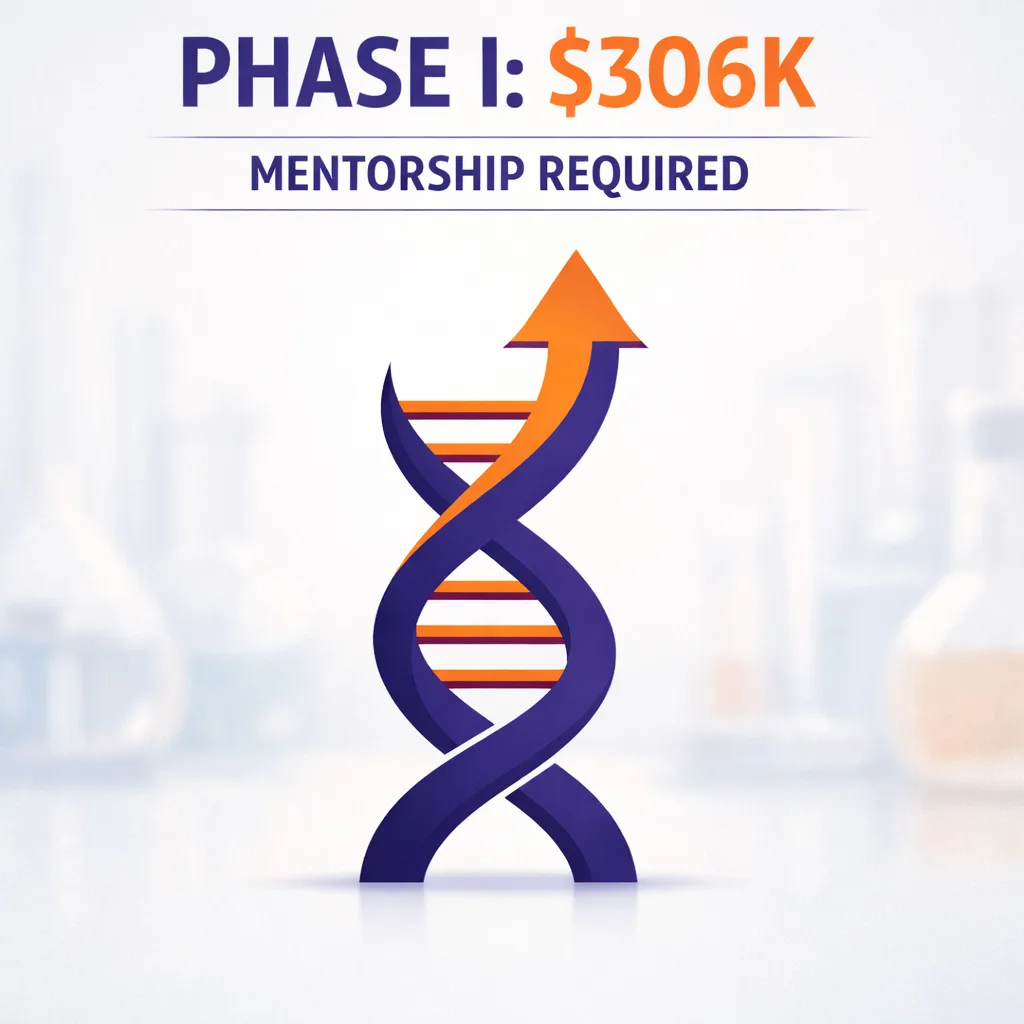
$306872 Phase I total costs
Up to $2,045,816 Phase II total costs
NHGRI exception: up to $400K Phase I, $2,150,000 Phase II for genomics topics
Mentorship from experienced entrepreneur (scored review criterion)
SBIR fee: up to 7% of total costs for any business purpose
04
Focus Areas
NIH Small Business Transition GrantPAR-24-131first-time PI grant
Does This Grant Fit You?
The Transition Grant is not for established professors looking to commercialize decades of research. It is not for serial entrepreneurs with previous SBIR awards. The optimal candidate is a postdoc, late-stage PhD student, or early-career researcher who has never been the independent principal investigator on a major research grant. You might have been a co-investigator on your advisor's R01. That is fine. You might have received fellowship funding. That does not disqualify you. But if you have ever served as PD/PI on an NIH R01, R21, DP2, or equivalent grant exceeding $100,000 in direct costs annually, you cannot apply. The program is that specific.
What makes this different from the parent SBIR program? The review happens through a special emphasis panel with more industry veterans and fewer academic basic scientists. That changes what succeeds. Commercialization feasibility matters as much as scientific merit. Market analysis carries weight. The mentorship requirement is not decorative. Your mentor cannot be a paid consultant. They must have an advisory or equity relationship with your company and commit at least 5% effort. Many applicants get this wrong.
The Hidden Gate Most People Miss
Here is where applicants stumble. The registration requirements. Before you can submit, you need active SAM registration, a UEI (which replaced DUNS in 2022), an eRA Commons account, and SBA Company Registry status. SAM registration alone takes eight business days minimum. The full process requires six to eight weeks. When the program reopens, you will not have time to wait.
And here is another trap. Your institution's Signing Official must register you in eRA Commons before you can even access the application workspace. If your small business is new, if you have never applied for federal funding, this bureaucratic maze can kill your timeline before you write a single word of your research strategy.
What the Funding Actually Covers
The budget structure mirrors standard SBIR Phase I and Phase II, but with important nuances. Phase I caps at $306,872 in total costs. Phase II caps at $2,045,816. However, NHGRI offers higher caps for genomics waiver topics: up to $400,000 for Phase I and $2,150,000 for Phase II. Indirect costs are allowed at your negotiated rate. Personnel costs, equipment under $5,000 per item, supplies, travel, and subcontracts to research institutions are all allowable.
What you cannot fund: Mentor compensation as fee-for-service. Your mentor can hold equity or serve in an advisory capacity, but if they are billing you hourly for grant writing or business consulting, that relationship disqualifies your application. The SBIR fee of up to 7% of total costs is separate from direct and indirect costs and can be used for any business purpose, including tax liabilities.
Four Parallel Tracks to Understand
This program operates through four separate Notices of Funding Opportunities. PAR-24-131 covers SBIR without clinical trials. PAR-24-132 covers SBIR with clinical trials required. PAR-24-133 and PAR-24-134 handle the STTR equivalents. Which you choose depends on your project and which NIH institutes participate. Not all institutes support all variants. NCCIH, NEI, NHLBI, NIA, NIAAA, NICHD, NIDA, NIDCD, NINR, and NLM support the clinical trial required versions. NCATS, NIAMS, NIDCR, NIEHS, and NIGMS only support the non-clinical trial versions. NINDS accepts Phase I only under this NOFO. CDC does not support Fast-Track applications. Check the participation table before you commit to a track.
The Application Requirements
The technical proposal is constrained. Twelve pages maximum including your Specific Aims page. Font must be 11pt Arial or larger. Margins minimum 0.5 inches. These are hard limits, not suggestions. Exceed them and your application returns without review.
Your Research Strategy must include three required subsections: Significance, Innovation, and Approach. Not optional headers. Required structural elements. The Significance section needs to justify why your project matters for human health. The Innovation section must distinguish what is novel from what already exists. The Approach section details your methodology, timelines, and milestones. This is where first-time applicants often falter.
Beyond the research strategy, you need a Project Summary (30 lines maximum), Specific Aims (one page), Budget Justification, Facilities and Resources, Biographical Sketches for all key personnel (five pages each, NIH format), Bibliography, and two critical documents unique to this mechanism: a Mentor Letter and a Career Development Plan.
The Mentor Letter and Career Development Plan
These documents make or break your application. The Mentor Letter must come from your identified mentor on letterhead, committing to provide technical and commercial guidance throughout the award period with at least 5% effort. It cannot read like a generic recommendation. It needs specifics about how they will help you navigate the entrepreneurial process.
Your Career Development Plan, limited to three pages, describes how this mentorship will advance your entrepreneurial goals. What do you need to learn? How will their experience fill gaps in your background? Why is this specific mentor the right fit for your project? The plan must include three sections: background and project fit, career objectives and plan for professional growth, and mentor utilization. Generic platitudes fail here. Reviewers want evidence that you have thought seriously about the transition from scientist to founder.
This is where speaking with a grant expert pays off. Not for explaining the requirements. You can read those yourself. But for catching the phrasings that trigger reviewer skepticism. The budget justifications that signal inexperience. The mentor descriptions that read as transactional rather than developmental. Our reviewers have seen what succeeds in this specific mechanism.
Eligibility: The Atomic Checklist
Let us be precise. Eligibility for the NIH Small Business Transition Grant requires meeting every criterion below. One failure disqualifies you.
US citizenship or lawful permanent resident status. Non-negotiable. Foreign nationals on visas cannot apply. Foreign institutions cannot serve as primary performance sites, though international collaboration is allowed.
First-time independent principal investigator. You have never served as PD/PI on an NIH R01, R21, DP2, or equivalent grant exceeding $100,000 in direct costs annually. Co-investigator roles are fine. Fellowship funding is fine. Small grants under the threshold are fine. But if you have led a major research grant, you are ineligible for this mechanism. Consider the parent SBIR program instead.
For-profit small business concern. Non-profits, universities, and research institutions cannot apply directly. You must be a US small business meeting SBA size standards.
Identified mentor with extensive entrepreneurial experience. Your mentor must have a track record of commercializing biomedical technologies or operating successful life sciences companies. They must commit at least 5% effort and be listed as key personnel. They cannot be compensated as a consultant for this role.
Registration compliance. Active SAM registration, valid UEI, eRA Commons account, and SBA Company Registry status. Your Signing Official must complete the eRA Commons institutional registration before you can access the application. This process takes six to eight weeks. Start now.
Eligibility Check
Eligibility for NIH Small Business Transition Grant: Funding for First-Time Biomedical Founders
Answer a few guided questions. Your responses are matched to this grant's criteria in real time.
Ready to check your eligibility?
We'll guide you through a short, structured flow and instantly evaluate fit for this opportunity.
Eligible
You Appear Eligible
Based on your answers, you meet the core requirements for this grant.
Recommended Next Step
Protect Your Application Before You Submit
You look eligible — but eligibility alone doesn't win grants. Most rejections happen on the application itself: missed language, wrong framing, weak impact statement. A Grantaura Expert Review takes 24–48 hours and flags every gap before the funder sees it.
✓Expert reviews your draft⏱Results in 24–48 h💰Avg. grant value $12,000+
⚠ Grant committees reject 7 in 10 applications that meet eligibility. One overlooked line can cost you thousands.
🔒 Satisfaction-backed — if our review finds nothing actionable, you pay nothing more.
This Grant Isn’t the Right Fit. Your Best One Might Be Two Clicks Away.
Missing one criterion for NIH Small Business Transition Grant: Funding for First-Time Biomedical Founders doesn’t mean you’re out of options — it means this grant wasn’t designed for your profile. Our expert research team identifies the grants built specifically for businesses like yours, across 500+ active opportunities.
Basic Match
$125
One-time research
A list of 5 grants only
Basic eligibility matching based on industry & location
Standard funding amount range verification
Primary criteria alignment check
Most Popular
Advanced Match
$145
One-time research
A list of 7 grants only
Advanced eligibility matching with business model analysis
Deep competitive advantage assessment
Innovation & impact potential matching
Market fit & growth trajectory alignment
Premium Match
$175
One-time research
A list of 10 grants only
AI-powered deep-match algorithm analysis
Historical success pattern matching
Priority sector & focus area alignment
Advanced sustainability impact matching
Strategic vision & long-term goals alignment
Preparing secure checkout…
✓
Order Confirmed
Your grant research order is placed. Our team will deliver your personalised report within 3–5 business days. Check your email for confirmation.
Auto-advances after each answer. Use Back to revise.
Our eligibility tool checks your specific situation against these criteria. Not just the obvious ones. The edge cases. The co-investigator status question. The fellowship funding ambiguity. The mentor relationship nuances that trip people up.
If the tool clears you, the next step is submitting an assessment for expert review of your readiness. Not the application itself. Your readiness. The gaps in your mentor relationship. The weaknesses in your preliminary data. The timeline risks you have not spotted.
If you are unsure about any criterion, book a live 1-on-1 video or phone call with a grant expert. We have navigated these eligibility questions with dozens of transitioning scientists. The clinical faculty titles that create confusion. The mentor equity versus advisory distinction. The co-investigator versus co-PI confusion. These are real questions with real consequences.
If you are ineligible, we will point you toward better-matched opportunities. The NIH Parent SBIR program if you have prior PI experience. The NSF SBIR program if your work is less clinically focused. Early-career mechanisms if you need different eligibility pathways.
Timeline and Current Status
The program is suspended. SBIR and STTR legislative authority expired on October 1, 2025. All NIH NOFOs for this grant formally expired on November 17, 2025. No applications are being accepted. No deadlines are active.
Three competing reauthorization bills are under consideration in Congress: H.R.5100 (a one-year clean extension, already passed by the House), the SBIR/STTR Reauthorization Act of 2025 (permanent authorization with structural reforms), and the INNOVATE Act (major overhaul with potential structural changes). The last comparable lapse, from 2009 to 2011, lasted over two years. There is no confirmed timeline for reopening.
When the program does reopen, standard due dates will likely resume: January 5, April 5, and September 5. Review takes four to six months. Award negotiation and activation take another two to three months. From submission to funding can easily stretch nine months. This is not emergency funding. It is structured career development support for scientists playing the long game.
What to Do While Waiting
Use this pause productively. Identify your mentoring team now. Good mentors are not found overnight. Draft your Career Development Plan. Complete customer discovery interviews that will strengthen your commercialization narrative. Get your SAM registration in order. When the program reopens, there will be a narrow window before the first deadline. Researchers who have prepared will have a significant advantage.
Monitor simpler.grants.gov for forecasted opportunities. Subscribe to NIH SEED updates. Add this grant to your Grantaura dashboard for alerts when it reopens.
Common Questions and Edge Cases
Q: I was co-investigator on my advisor's R01. Does that disqualify me?
A: No. The restriction applies only to serving as PD/PI (principal investigator) on a major research grant. Co-investigator roles are explicitly allowed. The distinction matters because many postdocs worry about this. If you were not the one listed as PD/PI in the eRA Commons system, you are fine.
Q: What counts as a "major research grant" over $100,000?
A: R01, R21, DP2, or equivalent NIH/CDC research grants. Fellowship awards (F32, K99/R00) do not count. Small grants under the threshold do not count. Training grants do not count. The key is whether you served as independent PD/PI with full responsibility for the scientific direction.
Q: Can my mentor be my co-founder who holds equity?
A: Yes. Equity relationships are allowed and often stronger than advisory roles alone. The prohibition is on fee-for-service consulting arrangements. Your mentor should have a genuine stake in your success, whether through equity, formal advisory role, or other meaningful commitment. They cannot be billing you hourly for grant writing while also serving as your mandatory mentor.
Q: How is this different from regular NIH SBIR?
A: Three key differences. First, eligibility: this mechanism requires first-time PI status. Second, mentorship: mandatory and structured, with the mentorship plan scored during review. Third, review: special emphasis panel with more industry representation, reportedly more focused on commercialization feasibility than academic basic science. If you have prior PI experience, apply to parent SBIR instead.
Q: What if I cannot find a mentor?
A: You cannot apply. The mentor requirement is absolute. Start networking now. Attend NIH SEED webinars. Reach out to successful SBIR awardees in your field. Consider joining entrepreneur-in-residence programs at research institutions. The mentor relationship takes time to develop. It cannot be manufactured in the weeks before a deadline.
Q: When will the program reopen?
A: No confirmed timeline exists. Three bills are under consideration in Congress, but none have passed both chambers. Historical precedent from the 2009-2011 lapse suggests a potential gap of two years or more. Monitor simpler.grants.gov and NIH SEED updates for the earliest signal of reauthorization.
Key Terms for This Grant
PD/PI: Program Director/Principal Investigator. The person with independent responsibility for the scientific direction of a grant. If you have never been listed as PD/PI in eRA Commons, you likely qualify for the Transition Grant.
Direct costs: Expenses directly attributable to your project: personnel, supplies, equipment. The $100,000 threshold for disqualification refers to direct costs, not total costs which include indirect costs.
Total costs: Direct costs plus indirect costs (overhead). The $306,872 Phase I cap refers to total costs.
eRA Commons: NIH's electronic Research Administration system. Where applications are submitted, tracked, and managed. Requires institutional registration before you can access it.
SAM: System for Award Management. The federal government's vendor database. Required for all federal grant applicants. Takes eight business days minimum to activate.
UEI: Unique Entity Identifier. Replaced DUNS numbers in 2022. Assigned automatically upon SAM registration. Required for all federal applications.
Career Development Plan: A required three-page document unique to this mechanism, describing how mentorship will advance your entrepreneurial goals. Must include three sections and is scored during review.
SBIR fee: Up to 7% of total direct plus indirect costs per phase. Not treated as a cost and can be used for any purpose including tax liabilities.
Special emphasis panel: A review committee convened for specific grant mechanisms. For the Transition Grant, reportedly includes more industry veterans than academic researchers.
Fast-Track: An option to submit Phase I and Phase II applications simultaneously. Available for Transition Grants but requires strong preliminary data. NINDS and CDC do not support Fast-Track.
STTR: Small Business Technology Transfer. A variant requiring collaboration with a research institution. The Transition Grant offers both SBIR and STTR tracks.
Signing Official (SO): The person at your institution authorized to submit grants. For new small businesses, establishing SO credentials in eRA Commons can be a bottleneck.
Clinical trial required: A variant of the funding opportunity (PAR-24-132) where the project must include a clinical trial. Different institutes participate than the non-clinical trial version.
Mentor letter: A required document from your identified mentor committing to ongoing guidance with at least 5% effort. Must be specific about the support provided, not a generic recommendation.
I-Corps at NIH: An entrepreneurship training program required for some institute awardees (NCI, NHGRI, NIDA, NIMH). Requires customer discovery interviews during Phase I.
C3i program: NIBIB's commercialization training program, required for NIBIB awardees. 10-15 hours per week commitment.
Payline: The funding cutoff score. Applications scoring above the payline are likely funded; those below are not. Paylines vary by institute and are not publicly specified for this mechanism.
Indirect costs: Overhead expenses not directly attributable to your project but necessary for operations. Allowed at your institution's negotiated rate.
Phase I: The initial feasibility study phase. Six months to one year. Up to $306,872 total costs for Transition Grants.
Phase II: The expanded development phase. Up to two years. Up to $2,045,816 total costs. Requires Phase I completion or Fast-Track approval.
Similar Grants You Might Consider
While the Transition Grant is suspended, or if its eligibility gates exclude you, several related mechanisms exist. The NIH Parent SBIR program serves established researchers without the first-time PI restriction. The NSF SBIR program supports non-biomedical technologies with different review criteria. For early-career researchers not yet ready for SBIR, first-time PI mechanisms offer smaller awards with less complex applications.
If you are specifically interested in the mentorship model but need different eligibility, explore whether your institution offers entrepreneur-in-residence programs or similar structured support.
Why Grantaura for This Application
The NIH Small Business Transition Grant is high-stakes and high-complexity even when active. The eligibility filters are precise. The registration requirements are unforgiving. The review panel reportedly prioritizes commercialization feasibility over basic science excellence. And the mentorship requirement, while valuable, creates a relationship that must be documented and justified in ways that trip up first-time applicants.
We help with what the listing cannot do. Not explaining the requirements. You can read those yourself. But catching the phrasings in your Specific Aims that signal academic rather than commercial thinking. Identifying whether your mentor relationship documentation meets the unstated expectations. Optimizing your budget justification against what this specific review panel expects to see. Managing the six-to-eight-week registration timeline so you do not miss deadlines when they reopen. Reviewing your Career Development Plan for the developmental narrative that reviewers want.
Our grant writers have worked with transitioning scientists before. We know how to position academic achievements as entrepreneurial foundations. How to frame preliminary data for industry reviewers. How to avoid the budget justifications that scream first-time applicant.
Or book a consultation to discuss your specific situation: your eligibility edge cases, your mentor identification strategy, your timeline constraints. We will give you an honest assessment of whether this mechanism fits your profile and what it would take to submit a competitive application when the program reopens.
About the Author
Imran is the founder of Grantaura, where he helps scientists and small business owners navigate federal funding mechanisms. He has reviewed hundreds of SBIR applications and has particular interest in the transition from academic research to commercial entrepreneurship. Before Grantaura, he worked with research institutions on technology transfer and commercialization strategy. You can read more about his background or schedule a consultation to discuss your specific grant strategy.
Eligibility for Small Business Transition Grant for New Entrepreneurs
Most scientists who find this page are asking one question: do I actually qualify or am I wasting my time? The NIH Small Business Transition Grant has some of the strictest eligibility gates in federal funding. Not because NIH wants to exclude people arbitrarily. But because this mechanism was designed for a specific profile that most grant programs ignore entirely. You need to be a US citizen or permanent resident. You must never have served as an independent principal investigator on a major research grant. You need a for-profit small business. And you must have identified a mentor with real entrepreneurial scars who is willing to commit actual time to your development. One failure on any of these criteria disqualifies you. This page walks through each gate. Use the checker below to see where you stand.
The Citizenship Gate
This is absolute. No exceptions. You must be a US citizen or lawful permanent resident (green card holder). Visa holders, even those who have worked in US labs for years, cannot serve as the contact PD/PI. Foreign institutions cannot be the primary performance site. International collaboration is allowed. But the lead applicant and the majority of the work must be US-based.
The First-Time PI Rule That Trips Up Postdocs
Here is where confusion lives. Many postdocs worry that being a co-investigator on their advisor's R01 disqualifies them. It does not. The restriction targets independent PI status. Have you ever been listed as the PD/PI in eRA Commons? Have you ever led a grant with direct costs exceeding $100,000 annually? If the answer is no, you likely qualify. But clinical faculty titles create ambiguity. "Clinical Assistant Professor" sounds junior. Yet if you have independent research space or hiring authority, you may be disqualified. When in doubt, contact your target IC's Program Officer before investing months in preparation.
Unlike standard SBIR where mentorship is optional, this grant scores your mentoring plan as a formal review criterion. Your mentor must commit at least 5% effort. They must have entrepreneurial experience, not just academic credentials. And they cannot be billing you as a consultant while serving as your mandatory mentor. The relationship must be advisory, equity-based, or developmental. Not transactional.
Registration Requirements That Kill Timelines
Even if you meet every eligibility criterion, you cannot submit without active SAM registration, a valid UEI, and eRA Commons access. SAM alone takes eight business days minimum. The full process requires six to eight weeks. Your institution's Signing Official must register you before you can access the application workspace. Start this process now, while the program is suspended, so you are ready when it reopens.
What If You Are Ineligible?
If the first-time PI gate excludes you, the NIH Parent SBIR program serves established researchers. If your work is less clinically focused, the NSF SBIR program has different eligibility. If you need smaller awards with less complex applications, explore first-time PI mechanisms. The eligibility checker will route you to better-matched opportunities if this grant is not right for you.
[
  {
    "url": "https://grantaura.com/grant/nih-parent-sbir/",
    "custom_description": "The standard NIH SBIR program for established researchers who do not meet the first-time PI requirement of the Transition Grant. Same agency, similar mechanism, but without the mentorship component and career development plan requirements."
  },
  {
    "url": "https://grantaura.com/grant/nsf-sbir/",
    "custom_description": "For researchers whose work is less clinically focused or who need different eligibility pathways. NSF SBIR has broader technology scope and different review criteria than NIH mechanisms."
  },
  {
    "url": "https://grantaura.com/grant/first-time-pi-grants/",
    "custom_description": "Alternative early-career funding mechanisms for researchers not yet ready for the full SBIR application complexity. Smaller awards with less stringent requirements."
  },
  {
    "url": "https://grantaura.com/grant/nih-sttr/",
    "custom_description": "The Small Business Technology Transfer variant requiring formal research institution partnership. Relevant if your project still depends heavily on university resources or collaborators."
  },
  {
    "url": "https://grantaura.com/grant/nci-small-business-transition/",
    "custom_description": "The NCI-specific variant of the Transition Grant with a structurally different Fast-Track pathway and I-Corps requirements. Critical to check if your research is cancer-focused."
  }
]
We are your trusted grant application partners. You can navigate the entire grant application process with our expert guidance through this simple 5-step process.
300+ Projects
4.9/5 Rating
Expert Team
Step 1: Application Form
Fill out the "Apply for this grant" form with your information and grant requirements.
Step 2: Eligibility Assessment
Our grant experts will assess your eligibility and notify you via email.
Step 3: Expert Consultation
A dedicated grant expert will be assigned to discuss next steps for your application.
Step 4: Application Submission
Our expert will help you complete and submit your application with all required materials.
Step 5: Final Decision
The grant committee will make their decision and notify successful applicants.
As the founder of Grantaura, I've dedicated myself to demystifying the grant funding process. My goal is simple: to empower entrepreneurs, non-profits, and innovators like you to secure the capital needed to make a real impact. Let's build your funding strategy together.
Profile data is saved in your browser and synced to secure storage when available.
Context
Grants selected0
SLA tierNot selected yet
Billing modelNot selected yet
Due today--
Total project value--
Selection preview
No grants selected yet.
Soft estimate
Estimate only. Final pricing appears in Quote step.
Quote expiry
Quote timer starts after pricing is generated.
Verification
Verification status appears here once quote is confirmed.
Success snapshot
Success milestones appear here after confirmation.
What happens next
After quote confirmation, verify your email and complete secure payment.
ProfileReviewPayment
Choose your service
Select how you want to proceed. You will review pricing before checkout.
Next stepReview pricing, then checkout
Recommended
Full service
Full Application Submission
From USD 41.40
We prepare and submit your grant application on your behalf, with priority or rush handling applied when the deadline makes faster service necessary.
No funding guarantee. If Grantaura cannot complete due to our operational failure, refund policy applies.
Assessment
Quick review
Eligibility Assessment
USD 5.99 one-time
Find out if you qualify. Results typically within 24 hours.
FreeNo card needed
Share & Submit Free
Share this grant with your network. We will assess your application at no cost.
Why does Grantaura charge a fee?
The donor does not charge you. This fee covers Grantaura's hands-on work: expert review time, eligibility checks, application drafting, and submission handling.
You will see the exact quote before checkout. Nothing is charged just for opening this screen.
Keep your post public. Our team will verify the link before processing your assessment. If the post is deleted or made private after submission, your free assessment will be void.