Grant Overview
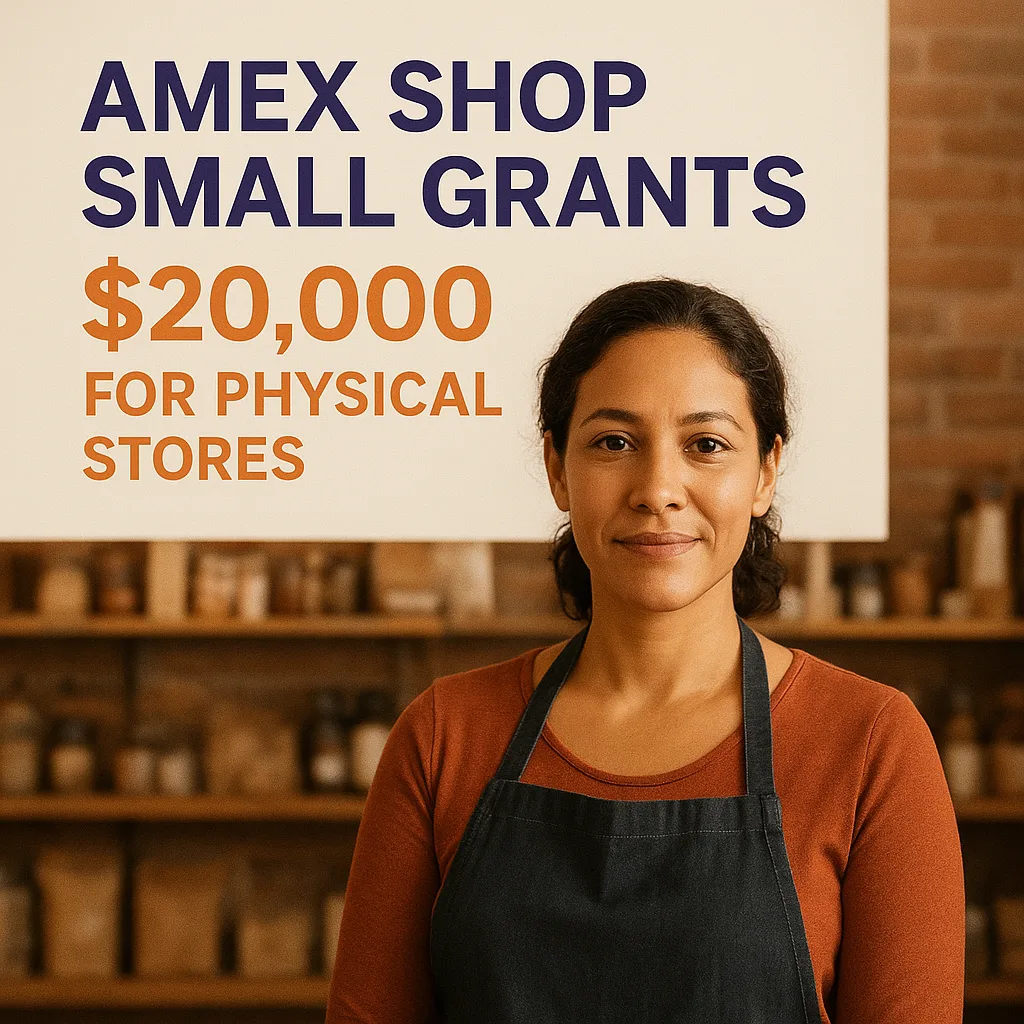
Real money for real stores - American Express teams up with Main Street America to help brick-and-mortar businesses grow their operations and strengthen their communities with Amex Shop Small Grants
The Amex Shop Small Grants program brings $20,000 checks to 250 independent small businesses operating physical locations in the 50 U.S. states and Washington, D.C.
Title: Amex Shop Small Grants Program
Donor: American Express, Main Street America (National Main Street Center, Inc.)
Focus: small business funding, brick-and-mortar businesses, community impact, business growth, retail support, Main Street revitalization, local economies, physical storefront funding, independent business grants, neighborhood business development, Small Business Saturday
Region: All 50 U.S. States, Washington D.C., United States
Eligibility:
- Applicant must be 18 years or older
- Must be owner of eligible small business since January 1, 2025 or earlier
- Business must be for-profit and independently owned
- Business start date: January 1, 2024 or earlier
- Must operate from physical brick-and-mortar location
-- Permanent structure (not mobile, temporary, or home-based)
-- Located in 50 U.S. states or Washington D.C. only
-- Exclusively used by applying business (not shared spaces)
-- Operating from location since January 1, 2025 or earlier
- Currently employ 20 or fewer Full Time Equivalent (FTE) employees
- Meet all federal, state, and local legal operation requirements
- Businesses must have updated licenses, permits, and good standing status
- Franchises are not eligible
- Nonprofits are not eligible
- Online-only businesses are not eligible
- Home-based businesses are not eligible
- Coworking spaces, pop-up locations, shared spaces are not eligible
Benefits:
- Financial Award: $20,000 cash grant (no repayment required)
- Network Opportunities: Connect with fellow grant recipients
- Education: Self-guided e-learning courses from Main Street America
- Visibility: Potential marketing exposure and story-sharing opportunities
- Support Period: 6-month grant period (April-September 2026) to complete projects
Deadline: January 23, 2026 at 11:59 PM CT

When American Express created Small Business Saturday back in 2010, they started something bigger than a shopping day. Over $210 billion in reported consumer spending has flowed to independent businesses since then. Now they're putting serious money where their mouth is with the Amex Shop Small Grants.
Here's the thing most grant programs won't tell you upfront - this one started with an initial commitment of $5 million to fund 250 grants at $20,000 each. That's guaranteed money already allocated. Plus, every time someone uses an eligible American Express Card at a qualifying small business on Small Business Saturday (November 29, 2025), American Express adds another dollar to the pot for additional grants. The more people shop small on that single day, the more grants get funded beyond that initial 250.
Think about what sets this apart from typical funding opportunities you'll find on Grants.gov or through state programs. Most federal small business grants focus on research, technology development, or specific industries like agriculture. This program? It's built for the restaurant on the corner, the boutique selling handmade goods, the hardware store that's been there for decades.
Main Street America brings something crucial to the table here. They're not just cutting checks and disappearing. Founded in 1980 as part of the National Trust for Historic Preservation, they've worked with over 2,000 communities to revitalize downtowns and commercial districts. Their involvement means grant recipients get connected to a network that actually knows how small business districts function and thrive.
Q: Can I apply if my business has multiple locations?
A: No. One application per business owner, even if you own multiple locations.
Q: What exactly counts as a Full Time Equivalent employee?
A: Calculate it this way - establish baseline full-time hours, divide each part-timer's hours by that baseline, sum those results, then add 1 for each full-time employee including yourself.
The application window runs from Small Business Saturday (November 29, 2025) through January 23, 2026. That's a narrow window, which tells you something important - they want businesses that are ready to move, not ones still figuring out what they might do with funding. Applications must be submitted through Main Street America's Submittable portal in English.
What Makes a Project "Ready to Execute"
Main Street America uses this phrase deliberately. They're not looking for vague ideas or wishful thinking.
A ready-to-execute project means you've already obtained quotes from contractors and suppliers. Specific names, specific numbers. You've scheduled the project timeline to stay on track during the April-September 2026 grant period. You've researched what permits or permissions you'll need and started pursuing them. You've thought through how you'll measure success and gathered baseline data for comparison.
Why such specificity? Because winners need to spend all grant funds during that six-month window. If your project budget exceeds $20,000, your application must show exactly where the additional funding will come from. If your main project costs less than $20,000, you can use remaining funds for equipment, inventory, or marketing - but only during the grant period and only if these items appear in your application budget.
Acceptable vs. Prohibited Uses
Grant funds must help your business grow, innovate, and support your local community. If your business already supports the community, you can use the full amount for growth and innovation. If not, dedicate a portion to community-focused initiatives plus your business development.
Think large capital purchases, physical renovations, marketing overhauls, new revenue streams. Consider creating community gathering spaces like patios or performance stages. Hosting events in your existing space counts too.
What you absolutely cannot do: pay invoices or credit card charges from before April 2026, repay debt or loans, cover rent or utilities, fund payroll (except for contracted labor from other businesses, like hiring an electrician or branding consultant), or spend on personal expenses.
How Selection Actually Works
Applications get reviewed based on five weighted criteria.
Eligibility comes first - meet the requirements or you're out. Business impact follows - what outcomes does your project create for growth and innovation? Community impact matters - does your business already support the community, or does your project plan clearly show how it will? Local significance gets evaluated - is your business exemplary in how it represents and interacts with the community? Feasibility wraps it up - can you complete or substantially complete this project with $20,000 in six months?
Q: Do I need to be on the Shop Small Map to apply?
A: No, but being on it helps raise additional funds through Saturday shopping.
Q: Can sole proprietors apply?
A: Yes, sole proprietors and businesses with no employees are eligible.
Q: What if I received other American Express Foundation grants in 2025?
A: You can still apply if you meet eligibility criteria.
Main Street America will notify all applicants in March 2026 via email. If selected, you'll get a call and email requiring you to execute a grant agreement, submit a valid W-9, and provide banking information within seven days. Miss that window and you forfeit the grant.
The Broader Context Worth Understanding
Small Business Saturday has generated over $220 billion for independent retailers, restaurants, and service businesses since 2010. The U.S. Small Business Administration has co-sponsored the day since 2011, giving it significant institutional backing beyond American Express's corporate initiative.
What's different about 2025? American Express is connecting their Shop Small movement directly to tangible capital through this grants program. They're also doing it through Main Street America rather than managing it internally, which suggests they recognize the value of working with organizations that understand place-based economic development.
Main Street America operates as a subsidiary of the National Trust for Historic Preservation. They work with over 1,600 community coalitions nationwide using a framework centered on transformation strategies - focused paths to revitalize or strengthen downtown and commercial district economies. Their approach organizes around four points: Economic Vitality, Design, Promotion, and Organization.
If you're running a business in a designated Main Street community, you might already be familiar with their work. If not, winning this grant connects you to their broader network and resources.
Timeline and Key Dates
November 29, 2025: Applications open (Small Business Saturday)
January 23, 2026, 11:59 PM CT: Application deadline
March 2026: Recipient notifications begin
April-September 2026: Six-month grant spending period
Spring 2026: Public announcement of recipients
Recipients get opportunities to connect through networking events, access self-guided e-learning courses, and share their project journey stories across various audiences. Main Street America facilitates these connections, recognizing that peer networks often provide as much value as the funding itself.
Documents You'll Actually Need
Get these ready before starting your application.
Your detailed, itemized budget with supporting documentation comes first - quotes from contractors and suppliers, design documents, whatever backs up your numbers. Gather up to five photos or a 1-2 minute video showing your business (exterior storefront, surrounding street area, interior public spaces, main workspaces). If you're planning physical improvements, include "before" photos of those specific areas.
You won't upload these with your application, but have them nearby: your recent business tax return (2024 or 2025), financial records showing 2024 actual revenue and net profit plus 2025 estimates. If Main Street America requests additional documents during February or March review, you'll have seven days to respond or risk disqualification.
Q: Can I change my application after submitting?
A: No changes allowed once submitted.
Q: Will I get feedback if rejected?
A: No, due to high volume they can't provide personalized feedback beyond acceptance or rejection.
Q: Are grants taxable?
A: Yes, you're responsible for all taxes. Main Street America will report awards to the IRS as required.
What This Means for Different Business Types
Retail stores can use this for inventory systems, point-of-sale upgrades, store redesigns that improve customer flow and experience. Restaurants might tackle kitchen equipment, dining area expansions, outdoor seating additions. Service businesses could invest in specialized equipment, workspace renovations, or technology that improves service delivery.
The community impact requirement matters more than some applicants realize. Main Street America wants to see how your business contributes to neighborhood identity and economic health. Long-standing businesses that provide continuity and sense of place have an advantage here. So do businesses operating from historic buildings or providing products and services emblematic of local trade or custom.
But newer businesses shouldn't assume they're shut out. If your project specifically addresses community needs - creating gathering spaces, hosting community events, collaborating with other local businesses, providing free needed resources, installing public art, making accessibility improvements - that demonstrates community focus even for a relatively new operation.
Geographic Considerations
The 50 U.S. states and Washington D.C. eligibility seems straightforward until you dig into what's excluded. U.S. territories - Puerto Rico, Guam, U.S. Virgin Islands, American Samoa, Northern Mariana Islands - are not eligible despite being under U.S. jurisdiction. If your business operates in a territory, you'll want to explore our Sky's the Limit Friends & Family Fund or other programs with broader geographic inclusion.
Within the 50 states and D.C., location doesn't affect selection - rural businesses compete on equal footing with urban ones. Main Street America's network includes small towns, mid-sized communities, and urban commercial districts, suggesting they value geographic diversity in their awards.
The Real Competition
Let's be direct about odds. At minimum, 250 grants are available for however many thousands of eligible businesses apply. Main Street America won't publish application numbers or selection rates, but you should assume significant competition.
What gives some applicants an edge? Demonstrable community impact, clear project feasibility, detailed budgets with actual quotes (not estimated guesses), and compelling narratives about local significance. Generic applications that could describe any business in any location won't cut through.
Your application needs to show why your specific business in your specific location with your specific project deserves selection. The businesses that win grants like this understand they're not just asking for money - they're making a case for their role in their community's economic future.
Q: What happens if I don't spend all the money during the grant period?
A: Grant agreement may be terminated and you could be required to return unused funds.
Q: Can I use funds for a location I own but another business operates?
A: No, funds must benefit your operating business at your operating location.
Honestly, putting together an application this comprehensive is substantial work. If you're serious about this and want expert guidance, that's what we do at Grantaura. Professional eyes on your grant proposal can make all the difference between an application that gets filed and one that gets funded. Just something to consider. CLICK HERE to get the GRANT PROPOSAL WRITING help.
Check Your Eligibility
Before diving deep into your application, make sure you actually qualify. The eligibility checker below asks the critical questions that determine whether your business meets the program requirements. Answer honestly - if you don't qualify, spending time on the full application won't change that outcome.
More Small Business Funding Grants for Physical Locations
Looking beyond the Amex Shop Small Grants? These additional opportunities support brick-and-mortar businesses, retail operations, and community-focused enterprises. Each offers unique benefits for different business types, locations, and stages of development.
- Start.Pivot.Grow. Micro Grant for Established Businesses: Quarterly $2,500 grants for U.S. for-profit businesses operating for at least two years with minimum $50,000 annual revenue. Perfect for addressing critical financial gaps that prevent stability and growth.
- Donor: Integrality, The UPS Foundation, The Dallas College Foundation, Wells Fargo
- Focus: Operational expenses, growth capital, business stability
- Deadline: Ongoing quarterly
- Square Cornerstone Grant: $10K Business Funding: Four winners receive $10,000 each plus year-long mentorship from Forbes-recognized professionals and marketing exposure to over one million subscribers. Designed for current Square sellers with at least 6 months of transactions.
- Donor: Square Financial Services, Inc. and Square Banking
- Focus: Small business growth, minority business support, financial mentorship
- Deadline: September 30, 2025
- Thrive – Breva Company Grant for Community Impact: Quarterly $5,000 grants for businesses demonstrating positive community impact through job creation, innovation, or service accessibility in underrepresented neighborhoods.
- Donor: Breva, Cadence Financial Group, Inc.
- Focus: Community impact, underrepresented communities, economic development
- Deadline: Quarterly (Q1: Jan 31, Q2: Apr 30, Q3: Jul 31, Q4: Oct 31)
- NJ Small Business Improvement Grant: $50K Reimbursement: Up to $50,000 reimbursement for completed facility upgrades or equipment purchases. Part of $60 million Main Street Recovery Finance Program for New Jersey businesses and nonprofits.
- Donor: New Jersey Economic Development Authority (NJEDA)
- Focus: Facility upgrades, equipment purchases, business improvements
- Deadline: Rolling applications
- San Francisco Business Accessibility Grant: Up to $10,000 reimbursement for ADA compliance and accessibility modifications. Rolling applications, first-come first-served for San Francisco small businesses.
- Donor: City and County of San Francisco, Office of Economic and Workforce Development
- Focus: ADA compliance, accessibility improvements, barrier removal
- Deadline: Rolling (limited funding)
- Idea Cafe Small Business Grant for Women: $1,000 funding for women entrepreneurs with no business plan required. Since 1995, supporting diverse women-led businesses from bakeries to retail operations.
- Donor: Idea Cafe
- Focus: Women entrepreneurship, business development, retail ventures
- Deadline: Ongoing
- Secretsos™ Small Business Grant: Quarterly $2,500 grants targeting underserved entrepreneurs who've been sidelined by traditional funding. No business plan required, complete spending flexibility.
- Donor: Secretsos™
- Focus: Underserved entrepreneurs, breakthrough business funding, flexible use
- Deadline: Quarterly
- Progressive® Driving Small Business Forward: Twenty grants of $50,000 each for purchasing commercial vehicles plus 12-week virtual Boost Camp coaching. Specifically for businesses needing transportation for operations.
- Donor: Progressive, Hello Alice
- Focus: Commercial vehicles, transportation, business expansion
- Deadline: June 20, 2025
- Olga Loizon Memorial Foundation Grant: Up to $10,000 in annual grants totaling $75,000 for Michigan women entrepreneurs. Supports retail ventures, healthcare services, food industry businesses, and wellness sector enterprises.
- Donor: TEAM Schostak Family Restaurants and Olga's Kitchen
- Focus: Women entrepreneurship, retail, healthcare, Michigan business growth
- Deadline: Varies annually
- MUSE Accelerator Program by Ulta Beauty: $50,000 grants for eight BIPOC-owned beauty brands plus 10-week curriculum covering retail business development, brand strategy, and financial management.
- Donor: Ulta Beauty
- Focus: Beauty brands, retail readiness, BIPOC entrepreneurship, beauty industry innovation
- Deadline: Varies annually
- Wish Local Empowerment Program: $500-$2,000 grants for approximately 4,000 Black-owned brick-and-mortar stores with 20 or fewer employees and under $1 million annual revenue. Part of $2 million fund.
- Donor: Wish Local
- Focus: Black-owned businesses, brick-and-mortar retail, diversity and inclusion
- Deadline: Rolling
- Creative Business Boost Initiative: One hundred grants of $5,000 each plus 8-week virtual Boost Camp for creative entrepreneurs contributing to the creative economy. Supported by Etsy's Uplift Fund.
- Donor: Hello Alice, Global Entrepreneurship Network, Etsy's Uplift Fund
- Focus: Creative economy, creative entrepreneurship, business coaching
- Deadline: May 9, 2025
- ZenBusiness $5K Small Business Grant: $5,000 grants for ZenBusiness customers who used formation services within last 3-6 months. Includes access to ZenBusiness Money Pro and Banking for 30 days.
- Donor: ZenBusiness
- Focus: Small business funding, entrepreneurship, business growth, community impact
- Deadline: January 1, 2025 (Check for 2026 cycle)
- Hustler's MicroGrant: Monthly $1,000 grants for U.S. entrepreneurs with user-friendly application process. Modest $10 administrative fee required to apply.
- Donor: Deja Vu Parker of WBLS, in collaboration with HerSuiteSpot
- Focus: Small business support, entrepreneurial growth, accessible funding
- Deadline: Monthly
- Nehemiah Davis Greatness Grant: Quarterly $2,500 grants plus 90 days of mentorship and lifetime founder community access for first-time startup founders. No revenue requirements, just determination.
- Donor: Nehemiah Davis
- Focus: First-time founders, startup funding, mentorship, entrepreneurial support
- Deadline: Quarterly
- More Grants in United States: Browse hundreds of additional funding opportunities for U.S.-based businesses, nonprofits, and individuals across all 50 states and territories.
- Donor: Various
- Focus: Diverse funding opportunities across industries and business types
- Deadline: Varies for each grant in the United States.
Want to find more funding opportunities? Grantaura's free platform lists hundreds of grants for businesses like yours. Filter by location, industry, amount, and deadline to discover opportunities you might have missed. Whether you're looking for larger grants, specialized industry funding, or programs with different eligibility requirements, our comprehensive database helps you find the right fit.
Terms
Understanding grant terminology helps you navigate the application and compliance requirements effectively. These definitions clarify key concepts specific to the Amex Shop Small Grants Program and broader small business funding landscape.
- Brick-and-Mortar Location: Physical permanent structure where business operates and serves customers directly. Must be solely used by the applying business, excluding mobile vehicles, temporary structures, home-based operations, and shared spaces like coworking facilities or indoor marketplaces.
- Full Time Equivalent (FTE): Measurement representing part-time employee hours as portions of full-time employment. Calculate by dividing each part-timer's hours by full-time baseline, summing results, and adding 1 for each full-time employee including owners.
- Ready-to-Execute Project: Project plan demonstrating immediate implementation capability with detailed itemized budgets, identified suppliers and contractors with obtained quotes, scheduled timeline for grant period, pursued necessary permits and permissions, and established success metrics with baseline data.
- Small Business Saturday: Annual shopping day created by American Express in 2010, celebrated on Saturday after Thanksgiving to encourage consumer support for small businesses. November 29, 2025 for this grant cycle.
- Main Street America: Subsidiary of National Trust for Historic Preservation, leading national program for preservation-based economic development in downtowns and commercial districts. Operates through network of 1,600+ community coalitions using Four Point Approach: Economic Vitality, Design, Promotion, Organization.
- Shop Small Movement: Year-round initiative backed by American Express promoting small business support globally. Extends beyond Small Business Saturday to encourage ongoing community engagement with independent businesses.
- Independently Owned Business: Business not operating as franchise or part of larger corporate chain. Franchises are explicitly excluded even if locally owned, as are franchise brands with over 250 total stores or over 25 corporate-owned stores.
- Community Impact: Measurable positive effect business creates in surrounding area through job creation, community gathering spaces, local event hosting, collaboration with other businesses, free community resources, accessibility improvements, or public art installations.
- Local Significance: Business's recognizable importance and involvement in surrounding community. Often applies to long-standing or legacy businesses providing continuity and neighborhood identity, historic building operations, or businesses offering products and services emblematic of local trade or custom.
- Grant Period: Six-month window (April-September 2026) during which all grant funds must be spent and projects must be implemented and operational. Extensions are not permitted; unused funds may require return.
- Grant Agreement: Legal contract between Main Street America and grant recipient outlining fund usage requirements, reporting obligations, project completion deadlines, and breach consequences. Must be executed within seven days of recipient notification.
- W-9 Form: IRS tax form certifying taxpayer identification number used for reporting grant income. Required from all grant recipients within seven days of notification for tax compliance and payment processing.
- Submittable Portal: Online application platform used by Main Street America for grant submissions. Requires account creation and enables application auto-save, though maintaining separate backup document is recommended.
- Designated Main Street Program: Officially recognized Main Street America programs following established best practices and maintaining full-time staff (often called Main Street managers). Over 860 Nationally Accredited programs currently operate across United States.
- Transformation Strategy: Focused, deliberate path articulated by businesses for revitalizing or strengthening economic vitality. Main Street America's approach centers around transformation strategies organized through Four Points framework.
- Coordinating Program: Statewide or regional Main Street America affiliates providing support and resources to local programs. Forty-four Coordinating Programs currently operate, offering technical assistance, training, and networking opportunities.
- Good Standing Status: Business registration status with Secretary of State or similar organization indicating compliance with all filing requirements, no outstanding violations, and current operational authorization in respective locality.
- Contracted Labor: Work performed by employees of separate businesses rather than direct employees of grant recipient. Permitted expense category allowing payment for services like electricians, branding consultants, designers, contractors, and other professional service providers.
- Operational Expenses: Day-to-day business costs necessary for normal operations. For this grant, acceptable operational expenses include equipment, inventory, and marketing only when part of documented project plan and spent during grant period.
- Feasibility: Project's practical capability for completion or substantial completion within six-month grant period using $20,000 funding. Selection criteria evaluating realistic timelines, adequate budgets, necessary resources, and achievable outcomes.
- Business Start Date: Date business first operated providing goods or services with potential to generate income. Must be January 1, 2024 or earlier for Amex Shop Small Grants eligibility, demonstrating established operations beyond startup phase.
- Ownership Date: Date applicant became business owner. Must be January 1, 2025 or earlier, ensuring owners have adequate operational experience and business understanding before receiving grant funding.
- Location Operating Date: Date business began operations at current physical location. Must be January 1, 2025 or earlier, demonstrating established presence in community and commitment to permanent physical location.
- Shop Small Map: Interactive digital map maintained by American Express showing qualifying small businesses accepting American Express Cards. Businesses on map benefit from customer recommendations and November 29, 2025 transaction-based additional grant funding.
- Eligible American Express Card: Credit cards issued by American Express qualifying for Shop Small program benefits. Excludes American Express Debit Cards from November 29, 2025 donation program generating additional grant funding.
Author
I'm Imran Ahmad, and I started Grantaura because I kept seeing the same pattern - established businesses with real community presence struggling to access funding that could take them to the next level. Banks want perfect credit and two years of financials. Investors want tech startups with massive scale potential. But what about the bakery that's been serving your neighborhood for five years and needs to expand? The hardware store looking to modernize? The cafe that wants to add outdoor seating?
That's where programs like the Amex Shop Small Grants matter. They recognize that Main Street businesses - the ones with physical locations where neighbors actually gather - form the backbone of local economies. When I work with business owners applying for opportunities like this, I emphasize the community impact piece. It's not enough to say "we've been here for years." Show how your business creates gathering spaces, supports local suppliers, hosts events, employs neighborhood residents, or fills gaps in community needs.
After working with over 300 clients with a 4.9 rating, I've learned that successful grant applications tell specific stories about specific places. Generic applications get generic results. If you're serious about securing funding for your brick-and-mortar business, let's talk about your specific situation and build a strategy that positions you competitively. Book a Free Consultation · About Imran