The Creative Experiences grant Massachusetts organizations can apply for is live right now - $2,500 or $5,000 from Mass Cultural Council for projects where arts, humanities, or sciences actually drive the experience, not just decorate it. That distinction matters because program staff confirmed in their March 2026 info session that the $5,000 tier requires the creative component to be primary, not incidental. Which means if your festival includes a mural but the mural isn't the point, you're looking at $2,500. Anyway.
Applications close on April 30, 2026 at 11:59pm ET. If you're wondering whether your specific project fits the $5K criteria, the self-assessment logic is straightforward once you know what reviewers prioritize.
Project incorporates arts, humanities, or sciences
Experience accessible to people with disabilities
Sub-point: Schools must use DESE ID and list school location for priority scoring
Grant Benefits
$5000
Sub-point: $2500 tier available if arts are component not primary purpose
No matching funds required
04
Focus Areas
Creative Experiences grantMass Cultural Council arts fundingMassachusetts cultural grant
Before you dive into the application, I recommend checking your fit with our interactive eligibility tool. It asks the same core questions Mass Cultural Council staff use during initial review, but frames them as a conversation rather than a gate. Which helps you self-assess without the anxiety of a hard yes/no.
Eligibility Check
Eligibility for Creative Experiences Grant For Massachusetts Cultural Projects
Answer a few guided questions. Your responses are matched to this grant's criteria in real time.
Ready to check your eligibility?
We'll guide you through a short, structured flow and instantly evaluate fit for this opportunity.
Eligible
You Appear Eligible
Based on your answers, you meet the core requirements for this grant.
Recommended Next Step
Protect Your Application Before You Submit
You look eligible — but eligibility alone doesn't win grants. Most rejections happen on the application itself: missed language, wrong framing, weak impact statement. A Grantaura Expert Review takes 24–48 hours and flags every gap before the funder sees it.
✓Expert reviews your draft⏱Results in 24–48 h💰Avg. grant value $12,000+
⚠ Grant committees reject 7 in 10 applications that meet eligibility. One overlooked line can cost you thousands.
🔒 Satisfaction-backed — if our review finds nothing actionable, you pay nothing more.
This Grant Isn’t the Right Fit. Your Best One Might Be Two Clicks Away.
Missing one criterion for Creative Experiences Grant For Massachusetts Cultural Projects doesn’t mean you’re out of options — it means this grant wasn’t designed for your profile. Our expert research team identifies the grants built specifically for businesses like yours, across 500+ active opportunities.
Basic Match
$125
One-time research
A list of 5 grants only
Basic eligibility matching based on industry & location
Standard funding amount range verification
Primary criteria alignment check
Most Popular
Advanced Match
$145
One-time research
A list of 7 grants only
Advanced eligibility matching with business model analysis
Deep competitive advantage assessment
Innovation & impact potential matching
Market fit & growth trajectory alignment
Premium Match
$175
One-time research
A list of 10 grants only
AI-powered deep-match algorithm analysis
Historical success pattern matching
Priority sector & focus area alignment
Advanced sustainability impact matching
Strategic vision & long-term goals alignment
Preparing secure checkout…
✓
Order Confirmed
Your grant research order is placed. Our team will deliver your personalised report within 3–5 business days. Check your email for confirmation.
Auto-advances after each answer. Use Back to revise.
If the tool indicates you're eligible, the next step is our full application submission review via modal - we'll help you align your narrative with what reviewers prioritize. If you're unsure about the $2.5K versus $5K tier, a live 1-on-1 video or phone call with a grant expert can clarify the distinction using your specific project details. And if the tool shows you don't qualify right now, we'll route you to related grants that might be a better match for your organization and timeline.
Who qualifies for the Creative Experiences grant Massachusetts funds?
Mass Cultural Council accepts applications from nonprofits, for-profits registered in Massachusetts, government entities, pre-K-12 schools with a DESE ID, and unincorporated groups with an eligible fiscal agent. Which means you don't need 501c3 status to apply - a detail that surprises a lot of small business owners. But here's the part that trips people up: sole proprietors and single-member LLCs typically need a fiscal agent that's a Massachusetts-registered nonprofit or municipality. The sample application PDF shows a toggle for "applicants without a fiscal agent," which feels contradictory, so if that's your situation, I'd recommend a quick consultation to clarify before investing hours in the form.
Your organization also needs to be responsible for producing, presenting, or facilitating the proposed experience - venues, sponsors, or participants alone don't qualify. And the experience must be accessible to people with disabilities, which isn't just a checkbox; reviewers look for specific accommodations in your 500-character plan. Because vague statements like "we welcome everyone" won't pass the eligibility screen.
Do's
Describe concrete accommodations: ASL interpreters
captioning
ramp access
sensory-friendly options
Don'ts
Use generic phrases like 'accessible to all' without specifics
$5K Tier Eligibility Requirements
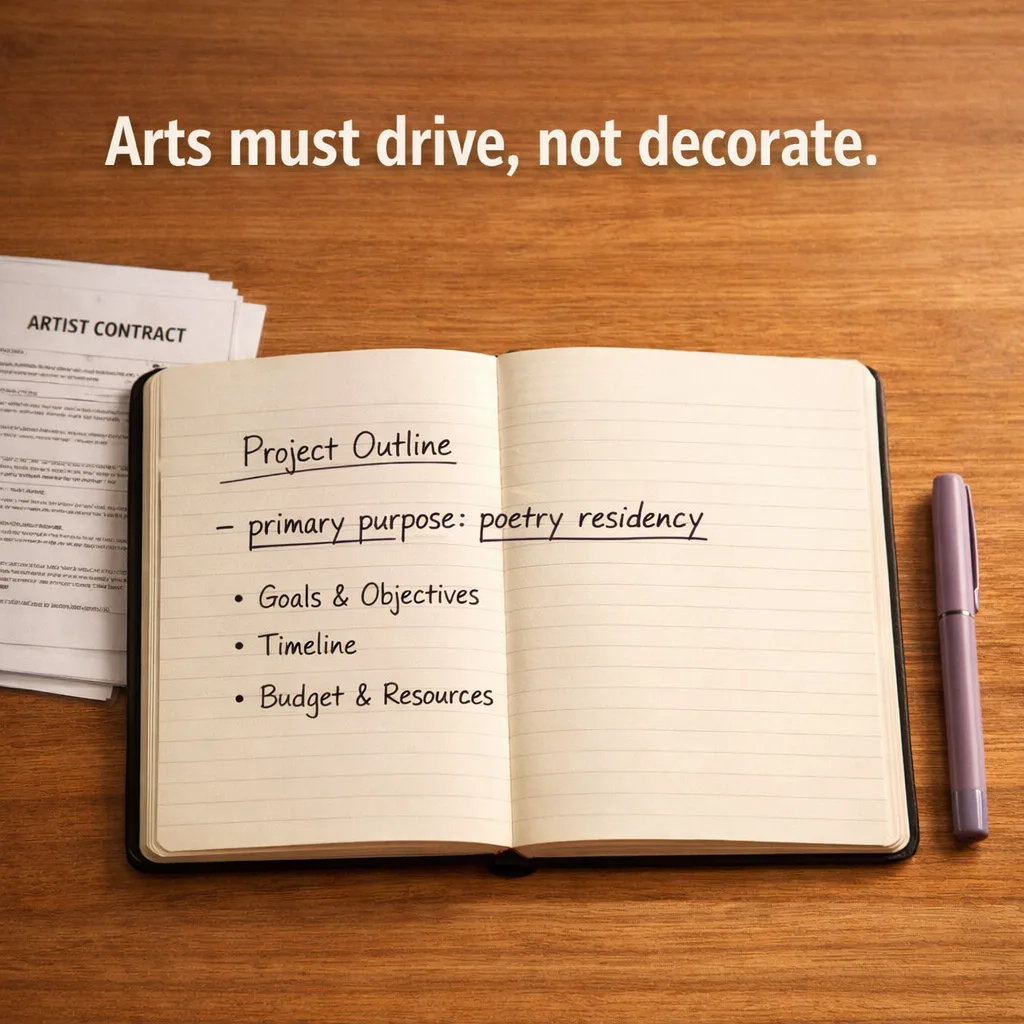
This is where most applicants lose points without realizing it. The $5,000 award requires that arts, humanities, or sciences be the primary purpose of your experience - not just a component. Program staff clarified in their YouTube info session that if the creative element is decorative or incidental, you qualify for $2,500 only. So a community festival with a poetry reading as one of twenty activities? That's $2,500. A poetry-focused residency with public readings as the core offering? That could be $5,000. Which means your project narrative needs to explicitly frame the creative component as the driver, not an add-on.
Expert Tip
When drafting your narrative, lead with the arts/humanities/sciences purpose in the first sentence. Reviewers scan for that signal early, and if they don't see it, they may categorize your application for the lower tier before reading the full proposal.
Also, at least 50% of your public-facing activity must occur between July 1, 2026 and June 30, 2027. Virtual programming is eligible only if your target audience is in Massachusetts and your organization has a Massachusetts address. So if you're a Boston-based nonprofit streaming a workshop to a national audience, you'd need to demonstrate how Massachusetts residents are the primary beneficiaries.
What does the Submittable portal require that the donor page doesn't mention?
Here's the stuff that causes silent failures if you don't know it ahead of time. The project narrative field has a 2000-character limit with hard truncation - no warning, it just cuts off, and if you paste without checking the counter first or upload a budget PDF over 2MB or use the same email for both contract contacts, the portal will silently fail or truncate your content without a clear error message, wasting your submission time. Draft externally first. The accessibility plan field truncates at 500 characters. And the portal requires two distinct contract contacts with unique email addresses; using the same email for both the Authorized Signatory and Authorized Officer triggers a validation error you won't see until submission.
Important Note
Draft your narrative and accessibility plan in a separate text editor with a character counter before pasting into Submittable. Compress your budget PDF before uploading. And verify that your two contract contacts have different email addresses ready to enter.
One more operational detail that's easy to miss: the EFT form must be signed by the same person listed as the Authorized Signatory. If those don't match, your contract processing gets delayed, sometimes by weeks. Which matters because projects can start before contract execution with retroactive payment, but only after the full contracting process completes.
How does Mass Cultural Council prioritize applications within the eligible pool?
Based on FY26 data, about 45% of eligible applications received funding - 712 awards from roughly 1,560 submissions. Which means eligibility gets you in the door, but prioritization factors determine who gets funded. The council favors projects that engage Massachusetts artists and cultural workers, offer free or low-cost public access, center BIPOC communities and perspectives, serve under-resourced geographic areas, and come from first-time applicants. So if your project checks any of those boxes, make sure your narrative explicitly connects your work to those priorities.
Prioritization factor
How to highlight it in your application
MA artists and cultural workers
Name local collaborators and their roles in the project narrative
Free or low-cost access
Specify ticket prices or free admission details in the budget section
BIPOC-centered work
Describe community engagement methods and leadership representation
Under-resourced communities
Include demographic data or geographic service area details
First-time applicants
Note if your organization hasn't received MCC funding before
But here's what the FAQs don't say: the exact weighting of these factors isn't public. So don't try to game a scoring rubric that doesn't exist. Instead, weave the relevant factors naturally into your project description and budget justification. Because authenticity reads stronger than checkbox optimization.
What timeline should I expect after submitting?
Applications close on April 30, 2026. Staff review eligibility and completeness from May through June, then prioritize applications from July to mid-August. Notification is anticipated by the end of August 2026, but that date depends on state budget appropriation - House Bill 5100 appropriated funding for Mass Cultural Council programs, but the exact allocation timing can shift. If you're awarded, contract execution takes 4-8 weeks, and projects can begin before the contract is fully executed with retroactive payment for eligible activities. Final reports are due July 15, 2027 via the same Submittable portal.
Which means if your project starts in July but your contract isn't executed until October, you can still get paid for July-September activities - but only after the contracting process completes. So plan your cash flow accordingly.
Q: Can I apply for the $5,000 award if my project includes arts but isn't primarily about arts? A: No. The $5,000 tier requires that the primary purpose of your experience is producing, presenting, or facilitating arts, humanities, or sciences. Program staff clarified that if arts are just decorative or one component of a broader project, you can apply for $2,500 only. Which means your narrative needs to explicitly frame the creative component as the driver. Q: Do I need to be a nonprofit to apply? A: No. Eligible applicants include nonprofits, for-profits registered in MA, government entities, MA schools with DESE IDs, and unincorporated groups with an eligible fiscal agent. 501c3 status is not required. Q: What file format and size limits apply to budget uploads? A: Budget narratives must be uploaded as PDF files no larger than 2MB in the Submittable portal. Files exceeding this limit will fail to upload without a clear error message. So compress before submitting. Q: Can the same person serve as both Authorized Signatory and Authorized Officer? A: No. The Submittable portal requires two distinct contacts with unique email addresses for these roles. Using the same email for both will trigger a validation error. Q: What if my project starts before I receive the grant funds? A: Applicants with funded activities happening before contract execution may be paid retroactively. However, you must still complete the full contracting process before funds are disbursed. Q: Is virtual programming eligible? A: Yes, but only if your target audience is in Massachusetts and your organization has a Massachusetts address. The experience must still be accessible to people with disabilities.
Grant-specific terms explained
DESE ID: The Massachusetts Department of Elementary and Secondary Education identifier assigned to public schools. School applicants must include this ID and list their school's location (not the field trip destination) for priority scoring.
Fiscal agent: A Massachusetts-registered nonprofit or municipality that agrees to receive and manage grant funds on behalf of an unincorporated organization, sole proprietor, or single-member LLC. The fiscal agent assumes legal and financial responsibility for the award.
Authorized Signatory: The individual legally empowered to sign contracts on behalf of your organization. This person must also sign the EFT form to avoid contract processing delays.
Authorized Officer: A distinct individual from the Authorized Signatory who serves as the primary administrative contact for the grant. The Submittable portal requires unique email addresses for both roles.
Hard character truncation: Submittable portal behavior where text fields cut off content at the character limit without warning or ellipsis. Drafting in an external editor with a counter prevents lost content.
Retroactive payment: Reimbursement for eligible project activities that occur before contract execution. Requires full contracting process completion before funds disburse.
Prioritization factors: Non-mandatory criteria Mass Cultural Council uses to rank eligible applications: engagement of MA artists, free/low-cost access, BIPOC-centered work, service to under-resourced communities, and first-time applicant status.
Submittable: The grants management platform Mass Cultural Council uses for Creative Experiences applications. Features include character-limited text fields, PDF upload limits, and email uniqueness validation for contract contacts.
Card to Culture: A Massachusetts program that gives EBT, WIC, and ConnectorCare cardholders discounted admission to cultural events; participation in this program earns priority points for Creative Experiences applications.
BIPOC-centered organization: An organization whose leadership, mission, and programming primarily serve Black, Indigenous, and People of Color communities; self-identifying as such in the application earns priority points.
When Grantaura's review adds value beyond the donor page
The donor page explains the rules. What it doesn't do is help you apply those rules to your specific project. If you're unsure whether your arts component qualifies as "primary" for the $5,000 tier, our expert review can analyze your narrative draft against program officer guidance and suggest framing adjustments before you submit. Which matters because rejections often stem from tier misclassification, not ineligibility.
If the Submittable portal's technical constraints feel overwhelming - the 2MB PDF limit, the hard character truncation, the email uniqueness validation - our application writing service can prepare your materials in the exact format the portal expects. So you avoid silent failures that waste your submission.
And if coordinating two distinct contract contacts with matching EFT signatures feels like a logistical headache, our consultation service includes a live 1-on-1 video or phone call to map your organizational structure and identify eligible contacts before you start the form.
Either path routes you through Grantaura first - because the donor application isn't the starting point, it's the finish line. And we help you cross it without the avoidable stumbles.
About the author
I research grants so you don't have to waste hours on applications that won't fit your project. For this listing, I reviewed the Mass Cultural Council's official materials, sample applications, portal documentation, prior awardee data, and community feedback to surface the nuances that affect your odds. If you want to discuss how this grant aligns with your specific goals, I offer live 1-on-1 consultations to walk through your eligibility and strategy. You can also read more about my research approach on my profile page.
So you found the Creative Experiences grant and you're wondering if your project actually qualifies. I get it - the eligibility page on the donor site lists a bunch of criteria but doesn't always explain how they play out in practice. I dug through the sample applications, the portal documentation, and last year's awardee data to figure out what really matters. The short version: if you're a Massachusetts organization with a cultural project ready to execute between July 2026 and June 2027, and you can show how arts, humanities, or sciences drive your experience, you're probably in the running. But there are a few landmines - like the cash-only budget rule or the Submittable portal's character limits - that trip people up even when they're eligible. Which is why I built this checker to help you self-assess before you invest hours in the form.
The fiscal agent question that confuses everyone
Here's the part that trips up creative businesses and sole proprietors: if you're not incorporated, you can't receive grant funds directly. You need a fiscal agent - a Massachusetts-registered nonprofit or municipality - to hold the money on your behalf. The sample application PDF shows a toggle for "applicants without a fiscal agent," which feels contradictory, and honestly I'm not entirely sure why that toggle exists if the rule is firm. Which means if that's your situation, I'd recommend a quick consultation to clarify before you start drafting. Because wasting three hours on a narrative only to discover you need a fiscal agent first is the kind of annoyance I try to help people avoid.
Anyway. If you've got a fiscal agent lined up or you're a nonprofit, school, or government entity, the rest of the eligibility gates are pretty straightforward. Your project needs to incorporate arts, humanities, or sciences - and if you want the $5,000 tier, those disciplines need to be the primary purpose, not just a decorative component. Program staff confirmed that distinction in their March 2026 info session, which is helpful because the FAQ language is a bit policy-heavy. So if your festival includes a poetry reading as one of twenty activities, that's $2,500. If poetry is the core offering, that could be $5,000.
What the portal doesn't tell you about character limits
The Submittable portal has hard truncation on the narrative fields - 2000 characters for the project description, 500 for the accessibility plan - with no warning before it cuts you off. I learned this the hard way reviewing sample applications, and it's the kind of detail that can waste your submission if you paste without checking first. Which is why I always draft in a separate text editor with a character counter before pasting into the portal. And compress your budget PDF before uploading; files over 2MB fail without a clear error message.
If you're unsure whether your project fits the $5K criteria or you want help navigating the portal constraints, our expert review can analyze your draft against program officer guidance and suggest framing adjustments before you submit. Because rejections often stem from tier misclassification or technical formatting issues, not ineligibility.
[
  {"url": "https://grantaura.com/grant/local-cultural-council-grants-massachusetts/", "custom_description": "Local Cultural Council grants offer smaller awards with rolling deadlines for community cultural activities in Massachusetts. Strategic overlap: same donor, same region, complementary funding scale for organizations building toward larger Creative Experiences projects."},
  {"url": "https://grantaura.com/grant/cultural-facilities-fund-massachusetts/", "custom_description": "Cultural Facilities Fund supports capital projects for Massachusetts cultural organizations. Related because both programs serve MA cultural sector but target different project types - operations vs infrastructure."},
  {"url": "https://grantaura.com/grant/youthreach-grants-massachusetts/", "custom_description": "YouthReach Grants fund multi-year youth development programs with cultural components. Overlap: Mass Cultural Council donor, MA focus, cultural programming - but different audience and timeline structure."},
  {"url": "https://grantaura.com/grant/operating-grants-organizations-massachusetts/", "custom_description": "Operating Grants provide general support to Massachusetts cultural organizations. Complementary to Creative Experiences for orgs seeking both project-specific and operational funding from same donor."},
  {"url": "https://grantaura.com/grant/card-to-culture-program-massachusetts/", "custom_description": "Card to Culture participation earns priority points for Creative Experiences applications. Strategic connection: programs designed to work together for organizations serving low-income Massachusetts residents."},
  {"url": "https://grantaura.com/grant/mass-cultural-council-festivals-projects/", "custom_description": "Festivals and Projects grant supports larger-scale cultural events in Massachusetts. Related audience and donor, with Creative Experiences better suited for single-experience projects under $5K."},
  {"url": "https://grantaura.com/grant/new-england-foundation-arts-grants/", "custom_description": "NEFA grants serve artists and organizations across the six New England states including Massachusetts. Broader regional scope but similar cultural focus for applicants who may not qualify for MA-only programs."},
  {"url": "https://grantaura.com/grant/arts-council-england-project-grants/", "custom_description": "Arts Council England Project Grants fund creative projects with public benefit. Included for comparative research by Massachusetts applicants exploring international cultural funding models."},
  {"url": "https://grantaura.com/grant/national-endowment-arts-challenge-america/", "customdescription": "NEA Challenge America provides matching grants for arts projects reaching underserved communities. Strategic overlap: public access priority, BIPOC-centered work emphasis, though federal vs state funding structures differ."},
  {"url": "https://grantaura.com/grant/massachusetts-cultural-council-individual-artist-grants/", "custom_description": "Individual artist grants from Mass Cultural Council serve solo creators. Related donor and region, but Creative Experiences requires organizational applicant structure - useful for artists seeking fiscal sponsorship pathways."},
  {"url": "https://grantaura.com/grant/boston-cultural-council-grants/", "custom_description": "Boston Cultural Council offers hyperlocal grants for city-based cultural projects. Complementary geographic scope for organizations operating in Boston who may qualify for both city and state funding."},
  {"url": "https://grantaura.com/grant/mass-humanities-grants/", "custom_description": "Mass Humanities grants support humanities programming in Massachusetts. Strategic overlap: same region, complementary disciplinary focus for projects blending arts and humanities components."}
]
We are your trusted grant application partners. You can navigate the entire grant application process with our expert guidance through this simple 5-step process.
300+ Projects
4.9/5 Rating
Expert Team
Step 1: Application Form
Fill out the "Apply for this grant" form with your information and grant requirements.
Step 2: Eligibility Assessment
Our grant experts will assess your eligibility and notify you via email.
Step 3: Expert Consultation
A dedicated grant expert will be assigned to discuss next steps for your application.
Step 4: Application Submission
Our expert will help you complete and submit your application with all required materials.
Step 5: Final Decision
The grant committee will make their decision and notify successful applicants.
As the founder of Grantaura, I've dedicated myself to demystifying the grant funding process. My goal is simple: to empower entrepreneurs, non-profits, and innovators like you to secure the capital needed to make a real impact. Let's build your funding strategy together.
Profile data is saved in your browser and synced to secure storage when available.
Context
Grants selected0
SLA tierNot selected yet
Billing modelNot selected yet
Due today--
Total project value--
Selection preview
No grants selected yet.
Soft estimate
Estimate only. Final pricing appears in Quote step.
Quote expiry
Quote timer starts after pricing is generated.
Verification
Verification status appears here once quote is confirmed.
Success snapshot
Success milestones appear here after confirmation.
What happens next
After quote confirmation, verify your email and complete secure payment.
ProfileReviewPayment
Choose your service
Select how you want to proceed. You will review pricing before checkout.
Next stepReview pricing, then checkout
Recommended
Full service
Full Application Submission
From USD 41.40
We prepare and submit your grant application on your behalf, with priority or rush handling applied when the deadline makes faster service necessary.
No funding guarantee. If Grantaura cannot complete due to our operational failure, refund policy applies.
Assessment
Quick review
Eligibility Assessment
USD 5.99 one-time
Find out if you qualify. Results typically within 24 hours.
FreeNo card needed
Share & Submit Free
Share this grant with your network. We will assess your application at no cost.
Why does Grantaura charge a fee?
The donor does not charge you. This fee covers Grantaura's hands-on work: expert review time, eligibility checks, application drafting, and submission handling.
You will see the exact quote before checkout. Nothing is charged just for opening this screen.
Keep your post public. Our team will verify the link before processing your assessment. If the post is deleted or made private after submission, your free assessment will be void.