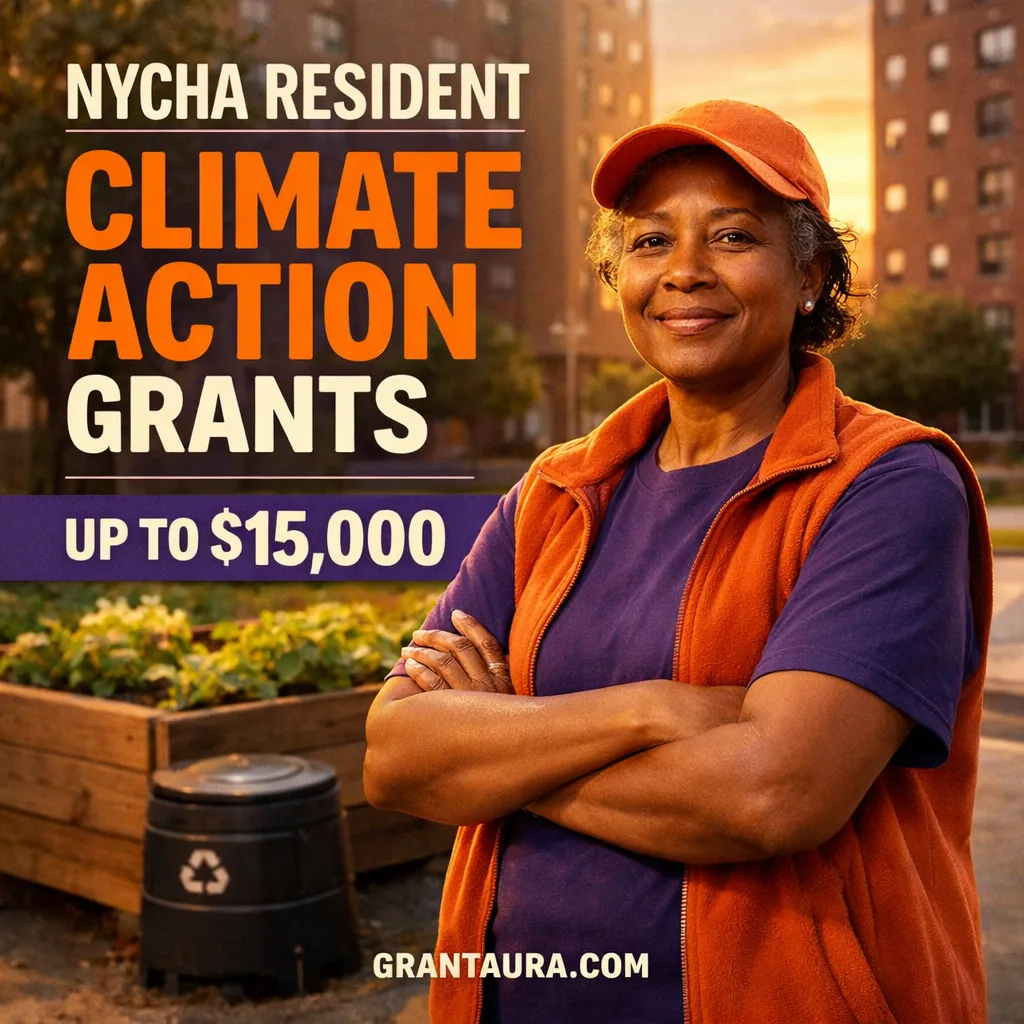
Living in NYCHA, you probably have a running list of fixes to make your daily life cleaner, safer, less stressful, and more to follow... The NYCHA Resident Climate Action Grants are designed to fund resident-led climate and sustainability projects, starting with a short screening application. For 2026, the program uses three funding tiers so a small pilot and a bigger proven project can both fit.
Below you will find the key facts, a quick eligibility checker, and a practical application steps, so you can decide fast and apply with a clear plan.
Check Your Eligibility For The NYCHA Resident Climate Action Grants
Use the following checker tool to confirm the basics in under a minute and see what to do next. It is built for NYCHA residents who want a straight answer before spending hours on the form. You will get a simple result you can act on today.
Eligibility Check
Eligibility for NYCHA Resident Climate Action Grants Program – Funding for resident-led climate projects
Answer a few guided questions. Your responses are matched to this grant's criteria in real time.
Ready to check your eligibility?
We'll guide you through a short, structured flow and instantly evaluate fit for this opportunity.
Eligible
You Appear Eligible
Based on your answers, you meet the core requirements for this grant.
Recommended Next Step
Protect Your Application Before You Submit
You look eligible — but eligibility alone doesn't win grants. Most rejections happen on the application itself: missed language, wrong framing, weak impact statement. A Grantaura Expert Review takes 24–48 hours and flags every gap before the funder sees it.
✓Expert reviews your draft⏱Results in 24–48 h💰Avg. grant value $12,000+
⚠ Grant committees reject 7 in 10 applications that meet eligibility. One overlooked line can cost you thousands.
🔒 Satisfaction-backed — if our review finds nothing actionable, you pay nothing more.
This Grant Isn’t the Right Fit. Your Best One Might Be Two Clicks Away.
Missing one criterion for NYCHA Resident Climate Action Grants Program – Funding for resident-led climate projects doesn’t mean you’re out of options — it means this grant wasn’t designed for your profile. Our expert research team identifies the grants built specifically for businesses like yours, across 500+ active opportunities.
Basic Match
$125
One-time research
A list of 5 grants only
Basic eligibility matching based on industry & location
Standard funding amount range verification
Primary criteria alignment check
Most Popular
Advanced Match
$145
One-time research
A list of 7 grants only
Advanced eligibility matching with business model analysis
Deep competitive advantage assessment
Innovation & impact potential matching
Market fit & growth trajectory alignment
Premium Match
$175
One-time research
A list of 10 grants only
AI-powered deep-match algorithm analysis
Historical success pattern matching
Priority sector & focus area alignment
Advanced sustainability impact matching
Strategic vision & long-term goals alignment
Preparing secure checkout…
✓
Order Confirmed
Your grant research order is placed. Our team will deliver your personalised report within 3–5 business days. Check your email for confirmation.
Auto-advances after each answer. Use Back to revise.
If you look eligible, open the screening form and draft your answers while the questions are fresh OR you can submit the assessment application by clicking the "Proceed to Application" button inside the tool's result screen - our experts will review your eligibility and support you further with the application. If you do not look eligible, do not force it, use the related grants section to find better-fit options. If you are not sure, email climate@communityfund.nyc with your question in one sentence, then keep your draft ready.
How The NYCHA Climate Action Grants Work In 2026?
The first step is a short screening application. You describe your project idea, how you intend to spend the funds, who is already involved, and whether you have received funding from this program before. After that, the Fund and The Exchange review screeners, may follow up with questions, and place applicants into the appropriate funding category.
Important Note
You do not pick a tier on day one. You start with the screener and then you are placed into the appropriate funding category based on your screener.
The official page also notes grantees will be announced by Earth Day on April 22, 2026. If anything about your situation is unclear, use the donor email above rather than guessing.
Expert Tip
In the screener say if your idea is new, growing, or proven so you get the right tier invite.
What Counts As Climate Action At A NYCHA Development?
This program is broader than solar panels. The official guidelines list several focus areas and they are meant to inspire, not limit. If your idea blends categories, that can be a strength as long as the plan is clear.
Gardens and outdoor spaces: Projects related to composting, native flora gardens, improving public garden space, solar-based lighting, or urban farming.
Advocacy and education campaigns: Workshops, events, and community actions that build local climate knowledge and momentum.
Climate arts: Creative projects that spark conversation about adaptation and mitigation in ways residents actually engage with.
Adaptation: Practical work that helps residents prepare for heat, flooding, or other climate impacts.
Energy: Efforts that reduce energy use or improve efficiency through education and hands-on community projects.
Screening Application Checklist For NYCHA Residents
If you prep these pieces first, the screener is easier and your tier placement is more accurate. Keep your answers simple, specific, and grounded in what you can actually do.
Your project in one paragraph: What problem you are solving in your development and what you will do about it.
Spending plan: A short list of what you will buy or pay for and why each item matters.
Who is involved: Names or roles of residents and any partners helping you deliver the work.
Prior funding history: Be ready to say whether you have received funding from this program before.
Simple impact metric: One number you can track, like residents reached, workshops held, or pounds diverted.
Basic timeline: What you will do first, what happens mid-way, and what completion looks like.
Do's
Use plain language
Match budget to actions
Add one clear impact metric
Don'ts
Assume you pick the tier
Leave spending vague
Skip who is involved
Small but important: Some operational details can vary year to year, like how payments are issued or whether a fiscal sponsor is needed in certain situations. If you see any detail you want confirmed before you submit, we can help you verify it and avoid a preventable mistake.
Budget Tips For NYCHA Resident Climate Projects
A clean budget is one of the fastest ways to look serious. It also makes implementation easier after you are funded.
Itemize: Break costs into line items that are easy to understand.
Explain the why: Tie each cost to an activity or outcome.
Keep it realistic: Use prices you can defend and avoid vague totals.
Plan for proof: Be ready to save receipts and take photos as you go.
FAQs Related To NYCHA Resident Climate Action Grants
Q: Do I apply directly for Seed, Growth, or Sustain? A: No. You start with the screening application. The Fund and The Exchange review screeners and place applicants into the appropriate funding category.
Q: What is the screening application asking for? A: A brief project description, how you intend to spend funds, who is already involved, and whether you have received funding from this program before.
Q: Can we apply as a team? A: Yes. The program is for NYCHA residents and teams can be involved. The official guidelines also encourage partnering with youth living in NYCHA.
Q: What if my idea mixes multiple focus areas? A: That is fine. The official examples are meant to inspire, not limit. Just keep the plan clear and show how the pieces connect.
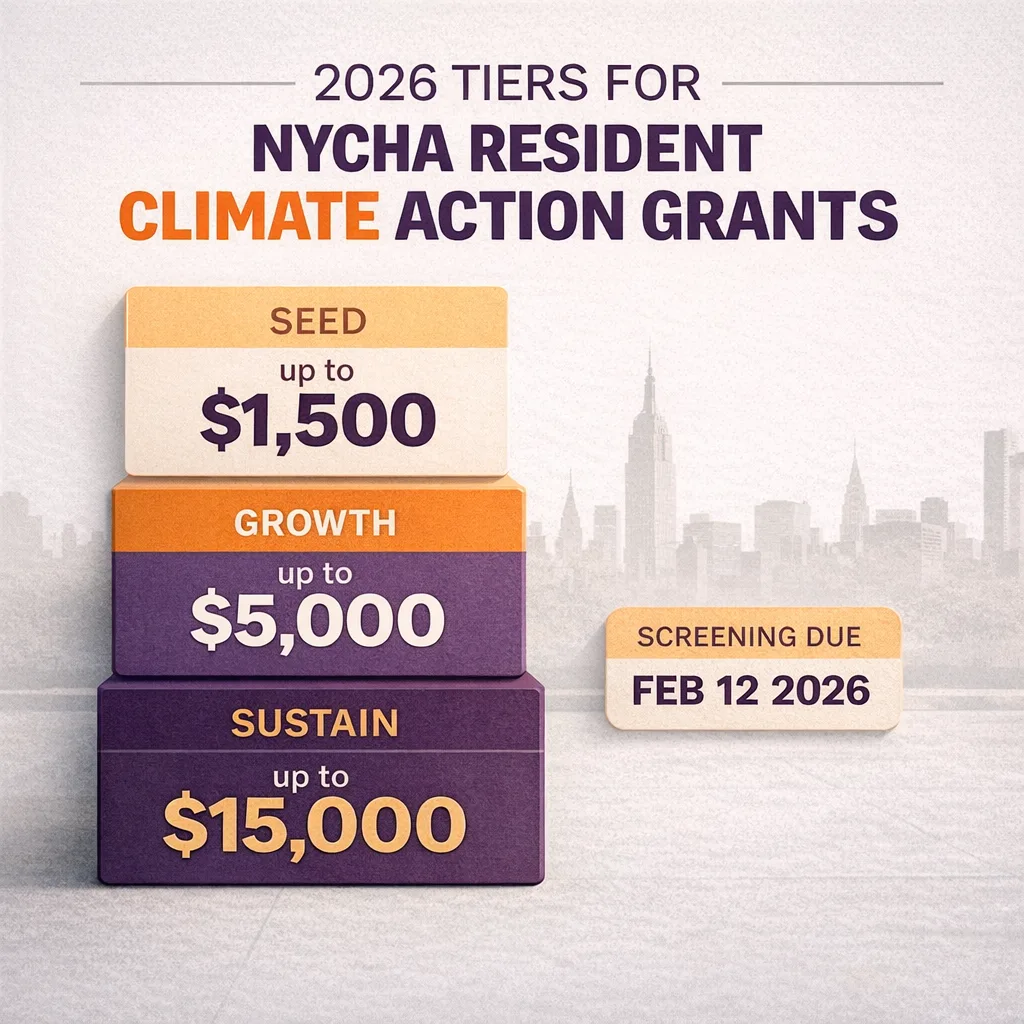
Q: How much funding is available? A: The official tiers list Seed Grants at $1,500 or less, Growth Grants at $5,000 or less, and Sustain Grants at $15,000 or less.
Q: When are grantees announced? A: The official program page says grantees will be announced by Earth Day on April 22, 2026.
Q: I received funding before. Can I apply again? A: UNKNOWN. The screener asks whether you have received funding before, but the rules for repeat applicants are not fully stated in the drafts. Email climate@communityfund.nyc to confirm.
Q: Do I need a nonprofit or fiscal sponsor? A: UNKNOWN. One draft mentions fiscal sponsor handling in some cases, but this detail is not clearly stated in the official text we extracted. Confirm directly with the donor email before assuming.
Glossary: NYCHA Climate Grant Terms
NYCHA Development: A New York City Housing Authority residential community. This grant is designed for projects that happen within NYCHA developments so the benefit stays close to residents. When you write your plan, name the development clearly so reviewers understand the context.
Screening Application: The first short form you submit before any tier application. It is where you describe your idea, spending plan, team, and whether you have received funding before. A strong screener helps you get placed into the right funding category.
Tier Placement: The process where the Fund and The Exchange place applicants into Seed, Growth, or Sustain based on the screener. This matters because your full application deadline depends on the tier you are placed into. It also shapes how detailed your full plan needs to be.
Seed Grant: The smallest funding tier at $1,500 or less. It is built for early-stage ideas or one-time projects that test a concept. Seed works well when you can explain a simple pilot and a clear community benefit.
Growth Grant: The mid-level tier at $5,000 or less. It supports more robust or fully formed projects that need extra resources or coordination. It is a strong fit when you have a plan that is ready to run or expand.
Sustain Grant: The largest tier at $15,000 or less. It is meant for existing projects that have shown impact and want long-term sustainability and community benefit. Sustain usually needs a clear story of what is already working and what scaling looks like.
Resident-led Project: Work that is led by NYCHA residents, not outsourced leadership. The point is local ownership and practical solutions that come from lived experience. In your application, show how residents drive decisions and delivery.
Address Check: A verification step that may be used for awardees. It helps confirm the applicant is a current NYCHA resident. Keep your contact details accurate so there are no delays.
Technical Assistance: Support offered alongside funding. It can include guidance on planning, implementation, or strengthening your approach. Treat it as part of the value of the program, not just a bonus.
Spending Plan: A clear description of how you intend to use funds. It is not about fancy formatting, it is about clarity and logic. Reviewers should be able to connect each dollar to an activity.
Budget Line Item: A single cost you list in your budget, like materials, printing, or event supplies. Line items make your budget easier to review and easier to execute later. They also help you avoid vague totals.
Community Benefit: The direct value residents get from the project. It can be cleaner spaces, better education, safer outdoor areas, or stronger resilience during heat and flooding. Be specific about who benefits and how.
Impact Metric: A simple number you can track to show your project worked. Examples include residents reached, workshops hosted, or pounds diverted. Pick something realistic so reporting does not become a burden.
Project Timeline: The sequence of steps from start to finish. A timeline shows readiness and helps reviewers believe the work can be completed. Keep it simple and tied to your budget items.
Youth Partnership: Involving youth who live in NYCHA as collaborators. The official guidelines encourage this. Youth involvement can strengthen community building when it is real and meaningful.
Climate Adaptation: Actions that help residents prepare for climate impacts like heat and flooding. Adaptation projects are practical and often visible quickly. If your development faces a specific risk, name it and show how you reduce it.
Energy Focus: Projects that explore reducing energy use, improving efficiency, or expanding access to clean energy through community action. Energy can be education-based or hands-on. Make the actions measurable and resident-facing.
Advocacy and Education: Campaigns, workshops, events, and public actions that build awareness and mobilize residents. This category is a fit if your project changes habits or builds local knowledge. Tie your plan to what people will actually attend and use.
Gardens and Outdoor Spaces: Projects that improve shared spaces with green infrastructure, composting, native plantings, or related upgrades. These projects can also support intergenerational connection. Explain maintenance plans so the work lasts.
Climate Arts: Artistic approaches that spark climate conversations and local engagement. Arts can make climate topics more relatable inside a development. Make sure the art activity connects to a clear community outcome.
More Grants For NYC Resident Projects
If this program closes before you submit, or if your idea is a better fit elsewhere, use the related grants tool below to find alternatives focused on community projects, sustainability, and resident leadership.
Useful to compare if your project is an early-stage idea with a clear social or environmental impact. It can be a backup path when you need flexible support for piloting a resident-led concept.
A good comparison point if your climate idea is evolving into a startup or a scalable innovation model. It is less about place-based resident work and more about climate innovation support, which can suit some applicants.
Relevant if your project is NYC-based and community-focused and you also align with the eligibility focus on women-led efforts. It can serve as a smaller supplemental option for outreach or pilot activities.
A strong fit if your work is clearly environmental and community-driven. This is worth comparing when you need a broader environmental funding route beyond NYCHA-specific programs.
Consider this if your climate project is connected to a neighborhood-facing small business, such as a resident-run community service effort. It is also useful as an alternative when you need a community improvement grant in NYC.
Need Help With Your NYCHA Climate Action Grant Application?
If you want help without losing your voice, we can review your screening answers, tighten your budget, and point out what is missing before you submit. We can also help you draft a short email to the donor if you need a rule confirmed.
Imran runs Grantaura and focuses on making grant applications practical for real people, not just organizations with staff. He helps applicants turn guidelines into clear steps, clean budgets, and simple language that reviewers understand quickly.
Eligibility for NYCHA Resident Climate Action Grants
This page focuses only on eligibility and quick decision checks for the NYCHA Resident Climate Action Grants, based on the official program page. If you are trying to figure out whether you can apply as the lead, or whether your idea fits the program scope, start here.
Core eligibility checks (the must-haves)
The official eligibility description is short and strict on the basics. If any of the items below are a "no", your application is likely not eligible as written.
NYCHA resident: You must be a current NYCHA resident. Awardees may be subject to an address check.
Age: You must be 18 years of age or older.
Project location: The program is framed around projects within NYCHA developments.
Project purpose: Your idea needs to be climate action or sustainability focused.
Resident-led: The program describes resident-led projects, meaning a resident is the primary leader.
What is encouraged (not stated as required)
The official page also notes that applicant teams are encouraged to partner with youth living in NYCHA. Treat this as a positive signal, not a hard requirement, unless the donor provides additional written rules elsewhere.
Funding tiers do not change eligibility
For 2026, the program uses a screening application first and then invites selected applicants to apply to one of three tiers (Seed, Growth, Sustain). The official page indicates the Fund and The Exchange place applicants into the appropriate funding category based on the screener. This means you can focus on fit and clarity rather than guessing a tier.
Eligibility details that are still UNKNOWN
Some common questions are not clearly stated in the official text we extracted for this listing. If any of these affect your situation, mark them as UNKNOWN until confirmed directly with the donor.
Payment method and fiscal sponsor: UNKNOWN whether a fiscal sponsor is required for some applicants or how funds are issued in all cases.
Repeat applicants: UNKNOWN whether prior grantees can apply again under specific conditions, beyond the screener asking whether funding was received before.
[
  {
    "url": "https://grantaura.com/grant/community-leaders-grants-citizensnyc/",
    "custom_description": "Related because it supports community leadership and local projects in NYC. It can be a strong comparison if you want a resident-led community project option that is not limited to NYCHA developments."
  },
  {
    "url": "https://grantaura.com/grant/patagonia-international-grants-program/",
    "custom_description": "Related for projects with an environmental focus that may extend beyond one housing development. This is useful as a comparison when your work is climate and sustainability oriented but your eligibility does not hinge on NYCHA residency."
  },
  {
    "url": "https://grantaura.com/grant/catalyst-fund-by-roddenberry-foundation/",
    "custom_description": "Related as an option for early-stage, mission-driven ideas that need support to get moving. It can complement a resident-led climate concept when you want to compare different selection priorities and project framing."
  },
  {
    "url": "https://grantaura.com/grant/empowerher-fund-nyc/",
    "custom_description": "Related because it is NYC-based and can overlap with community improvement goals. It can be relevant when the project team and audience fit the fund's focus and you want an additional city-level path for community work."
  },
  {
    "url": "https://grantaura.com/grant/neighborhood-business-grant/",
    "custom_description": "Related if your climate action work connects to neighborhood-facing economic or community activity. It provides a comparison point for projects that blend community improvement with practical local services."
  },
  {
    "url": "https://grantaura.com/grant/climatelaunchpad-competition/",
    "custom_description": "Related for applicants whose climate idea is evolving into a scalable innovation concept. It is a useful comparison when you want to understand how innovation-focused climate support differs from place-based resident projects."
  }
]
We are your trusted grant application partners. You can navigate the entire grant application process with our expert guidance through this simple 5-step process.
300+ Projects
4.9/5 Rating
Expert Team
Step 1: Application Form
Fill out the "Apply for this grant" form with your information and grant requirements.
Step 2: Eligibility Assessment
Our grant experts will assess your eligibility and notify you via email.
Step 3: Expert Consultation
A dedicated grant expert will be assigned to discuss next steps for your application.
Step 4: Application Submission
Our expert will help you complete and submit your application with all required materials.
Step 5: Final Decision
The grant committee will make their decision and notify successful applicants.
As the founder of Grantaura, I've dedicated myself to demystifying the grant funding process. My goal is simple: to empower entrepreneurs, non-profits, and innovators like you to secure the capital needed to make a real impact. Let's build your funding strategy together.
Profile data is saved in your browser and synced to secure storage when available.
Context
Grants selected0
SLA tierNot selected yet
Billing modelNot selected yet
Due today--
Total project value--
Selection preview
No grants selected yet.
Soft estimate
Estimate only. Final pricing appears in Quote step.
Quote expiry
Quote timer starts after pricing is generated.
Verification
Verification status appears here once quote is confirmed.
Success snapshot
Success milestones appear here after confirmation.
What happens next
After quote confirmation, verify your email and complete secure payment.
ProfileReviewPayment
Choose your service
Select how you want to proceed. You will review pricing before checkout.
Next stepReview pricing, then checkout
Recommended
Full service
Full Application Submission
From USD 41.40
We prepare and submit your grant application on your behalf, with priority or rush handling applied when the deadline makes faster service necessary.
No funding guarantee. If Grantaura cannot complete due to our operational failure, refund policy applies.
Assessment
Quick review
Eligibility Assessment
USD 5.99 one-time
Find out if you qualify. Results typically within 24 hours.
FreeNo card needed
Share & Submit Free
Share this grant with your network. We will assess your application at no cost.
Why does Grantaura charge a fee?
The donor does not charge you. This fee covers Grantaura's hands-on work: expert review time, eligibility checks, application drafting, and submission handling.
You will see the exact quote before checkout. Nothing is charged just for opening this screen.
Keep your post public. Our team will verify the link before processing your assessment. If the post is deleted or made private after submission, your free assessment will be void.