FY26 Capitol Hill Construction Impact Grant Program
DC small business relief for construction disruption on Capitol Hill corridors.
$15,000Max Award
Washington
Grants For For-Profit Businesses
Shahzad Nawaz
Written by
Imran Ahmad
Reviewed by
Your next step
See what this grant would take before you commit
Review your fit first, then choose the level of help you want. You can start with an eligibility assessment, talk through the opportunity with an expert, or get full application support.
If your Capitol Hill storefront sits on Pennsylvania Avenue SE, Potomac Avenue SE, or 8th Street SE, roadwork may be keeping customers away. The FY26 Capitol Hill Construction Impact Grant offers $5,000 to $15,000 to help cover rent, utilities, and other essential costs while construction disrupts your block. But eligibility is not about being “on Capitol Hill.” It is about being inside the exact impact zone for one of two named DDOT projects, and those projects have different start dates. The Pennsylvania Avenue and Potomac Avenue SE Intersection project is active now[1].
The 8th Street Bus Priority Project had not yet broken ground when this funding cycle opened[1]. That timing difference shapes what revenue loss you can document and when your disruption window begins. Applications close at 4:00 PM ET on June 12, 2027 via the DC grants portal. With no published scoring rubric, your ability to prove a direct link between the named project and your financial need is the deciding factor.
Key Grant Information
Active
258 days left
01
FY26 Capitol Hill Construction Impact Grant Program
Impact Zone: Located in the official DDOT construction impact zone for two named projects — Pennsylvania Avenue and Potomac Avenue SE Intersection (currently underway) — 8th Street Bus Priority Project corridor from Pennsylvania Ave SE to Virginia Ave SE — Verify with ArcGIS map (appid 19119b86708d4ce5b1d656080ea1dd62)
Business Type: For-profit small business — Fewer than 100 employees — Under $15 million annual revenue — Independently owned with 3 or fewer franchise locations
Brick-and-Mortar: Physical storefront with walk-in customer services and valid lease or deed
Good Standing: Valid DC business license — OTR Tax Certification (Clean Hands) required
DIFS Registration: DIFS Supplier Portal registration must be completed before funds are released — Multi-factor authentication (MFA) now required — Accounts inactive since before August 2024 must re-enroll before registration is usable
04
Focus Areas
Capitol Hill construction reliefDC small business grantDDOT construction impact
Before gathering tax returns or lease documents, confirm your address lands inside the official impact zone. This grant is hyper-local. The ArcGIS map referenced in the NOFA, not a general neighborhood boundary, determines whether you qualify.
Eligibility Check
Eligibility for Capitol Hill Construction Impact Grant
Answer a few guided questions. Your responses are matched to this grant’s criteria in real time.
Ready to check your eligibility?
We’ll guide you through a short, structured flow and instantly evaluate fit for this opportunity.
Eligible
You Appear Eligible
Based on your answers, you meet the core requirements for this grant.
Recommended after eligibility
You qualify. Now make sure the application is worth sending.
Eligibility only tells you that you can apply. It does not catch weak answers, missing proof, confusing budget details, or language that makes reviewers hesitate.
This Grant Isn’t the Right Fit. Your Best One Might Be Two Clicks Away.
Missing one criterion for Capitol Hill Construction Impact Grant doesn’t mean you’re out of options — it means this grant wasn’t designed for your profile. Our expert research team identifies the grants built specifically for businesses like yours, across 500+ active opportunities.
Basic Match
$125
One-time research
A list of 5 grants only
Basic eligibility matching based on industry & location
Standard funding amount range verification
Primary criteria alignment check
Most Popular
Advanced Match
$145
One-time research
A list of 7 grants only
Advanced eligibility matching with business model analysis
Deep competitive advantage assessment
Innovation & impact potential matching
Market fit & growth trajectory alignment
Premium Match
$175
One-time research
A list of 10 grants only
AI-powered deep-match algorithm analysis
Historical success pattern matching
Priority sector & focus area alignment
Advanced sustainability impact matching
Strategic vision & long-term goals alignment
Preparing secure checkout…
✓
Order Confirmed
Your grant research order is placed. Our team will deliver your personalised report within 3–5 business days. Check your email for confirmation.
Auto-advances after each answer. Use Back to revise.
Which Project Applies to You
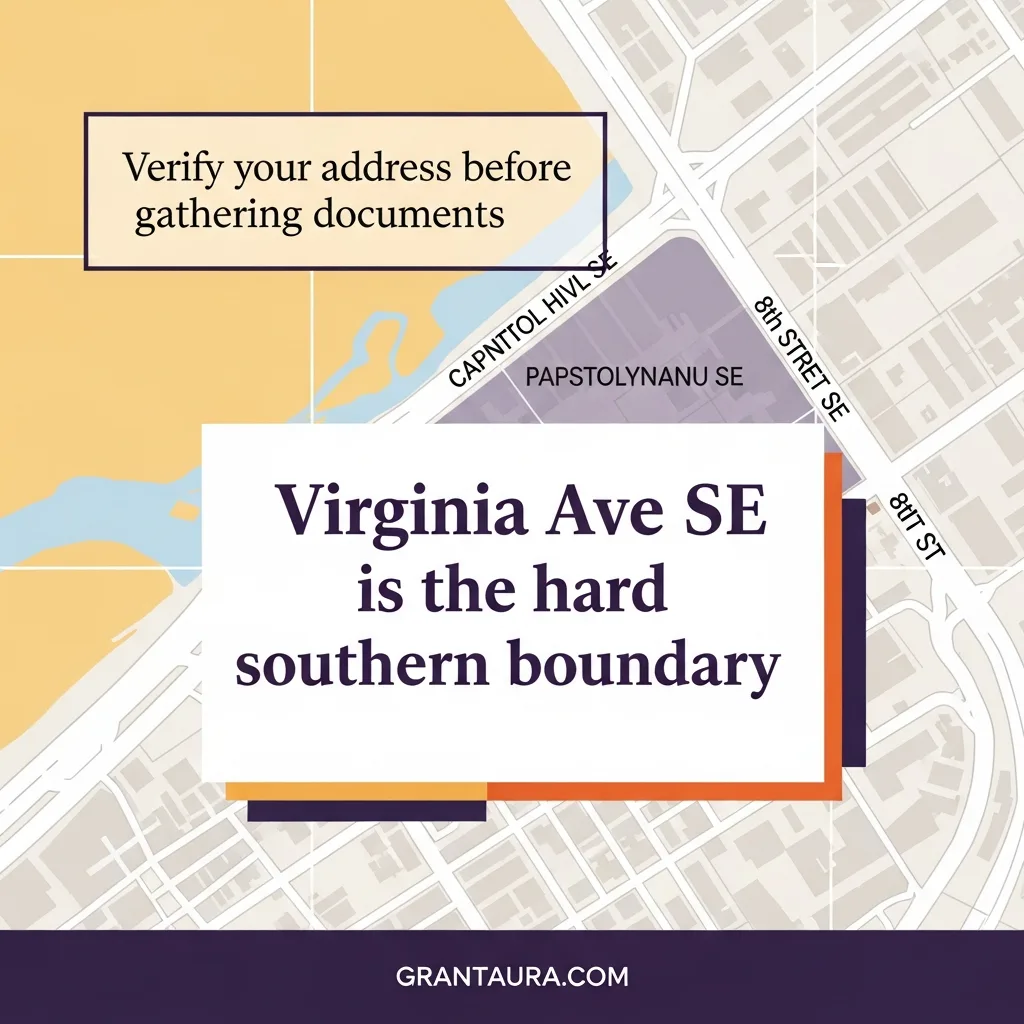
DMPED tied this funding to two distinct infrastructure projects, and their construction timelines are not the same[1]. The Pennsylvania Avenue and Potomac Avenue SE Intersection project is active now. Businesses there can document revenue loss since physical barriers appeared. The 8th Street Bus Priority Project corridor runs from Pennsylvania Ave SE south to Virginia Ave SE. The NOFA confirmed this project had not yet started when applications opened[1]. Virginia Ave SE is the hard southern boundary. A storefront one block further south does not qualify for this specific funding.
The timing gap on 8th Street creates a documentation challenge. You are applying before major work begins, so a straight sales comparison to a pre-construction baseline may not yet tell the story. If DDOT activity has already redirected traffic, narrowed lanes, or posted signage on your block, document those preliminary disruptions now. Foot traffic counts, POS data tied to specific dates, and copies of any DDOT notices help establish when the impact on your business actually started.
Project Name
Current Status
Corridor
Key Documentation Angle
PA and Potomac Ave SE Intersection
Currently active
Intersection and adjacent blocks
Revenue loss since barriers went up
8th Street Bus Priority Project
Not yet started as of NOFA date
PA Ave SE to Virginia Ave SE
Preliminary disruptions and advance DDOT activity
If your address is close to Virginia Ave SE on the 8th Street corridor, verify your exact position using the official ArcGIS tool before investing time in the application. The southern boundary is a hard stop, not an approximate line.
Award Amounts and Allowable Costs
DMPED is offering $5,000 to $15,000 per award from a total pool of $150,000, which funds 10 to 30 businesses[2]. No matching funds are required. The funds are designed to cover operating costs you are struggling to pay because construction is keeping customers away. Allowable costs include:
Rent and mortgage payments
Utility bills including gas, electric, and water
Business insurance premiums
Common Area Maintenance (CAM) fees
Other reasonable operating costs documented and approved by DMPED
Costs outside that list will not survive panel review. Lobbying, capital improvements unrelated to construction mitigation, and any expense incurred outside the construction project period are explicitly unallowable[1]. Budget your request around what you can prove with receipts, not around the maximum possible award. Since FY24 awardee data is no longer publicly accessible, there is no verified benchmark for what a “typical” award looks like. The only safe guidance is to request what you can substantiate.
Do’s
Size your request to costs you can document with receipts
Start DIFS registration before you apply
Tie every line item to the active construction period
Don’ts
Request capital improvements or renovation costs
Assume the reviewers know which street you are on
Skip DIFS registration until after an award decision
Documents and DIFS Registration
This application carries a genuine documentation load. DMPED requires 11 distinct items, including a package of seven separate affidavit forms[3]. Each one needs to be signed and uploaded. Running through the list now, before you start the portal, will save significant time.
Required Steps
DC Business License
OTR Tax Certification (Clean Hands) from DC Office of Tax and Revenue
IRS W9 Form
Revenue Loss Statement with supporting financial documentation
Impact Narrative linking your business to a specific named DDOT project
Lease or Deed proving site control
DMPED Insurance Policies Affidavit Form
DMPED Required Financial Documents Statement Form
DMPED Statement of Certification Form
DMPED Ethics and Accountability Form
DIFS Supplier Portal registration with MFA setup completed
The DIFS Supplier Portal step deserves specific attention. DIFS is the DC government’s payment system. DMPED cannot issue grant funds to a business that has not completed supplier registration[4]. This is not a submission requirement for the application itself, but it is a disbursement prerequisite that many applicants discover only after receiving an award. The portal now requires Multi-Factor Authentication (MFA). If your account has been inactive since before August 2024, you must complete MFA re-enrollment before the system recognizes your registration as usable. Registration is at cfo.dc.gov/page/supplier-portal. For help: suppliers@dc.gov or (202) 442-6870.
Important Note
Start DIFS registration before you submit. Winning an award and then discovering your supplier registration is incomplete, or that MFA re-enrollment has locked your account, creates delays that have nothing to do with application quality. It is a separate process that runs on its own timeline.
The Clean Hands certificate also requires advance planning. The DC Office of Tax and Revenue issues this certification, and resolving any outstanding tax balance or fine before the deadline can take time. If your account has an open item, address it now rather than after you have assembled the rest of your package.
How to Build Your Revenue Loss Case
Because DMPED does not publish a scoring rubric, the application offers no point-by-point optimization target[2]. A panel reviews each application and evaluates whether the financial need is real and whether the causal link between the construction and the revenue drop is credible. That means the strength of your narrative is doing most of the work.
A credible causal narrative answers a specific question: what changed on a specific date, and what did that change do to your revenue? “Business has been slow” will not satisfy a panel reviewer. What will: a month-by-month POS comparison showing sales before and after DDOT work began on a named street, photos of construction barriers blocking your storefront or parking, copies of DDOT project notices, and a budget showing which line items you cannot cover because foot traffic dropped. The more precisely you can anchor the drop to the DDOT project by name and date, the more credible the narrative becomes.
Expert Tip
If your business is on the 8th Street corridor where construction had not yet started, build your narrative around the concrete preliminary disruptions already visible on your block: lane shifts, signage, utility prep work, or detour signage that redirects traffic. Document with dates and photos. A panel reading your application should not have to guess why your storefront is being affected before heavy equipment arrives.
Confirming Your Address: The ArcGIS Impact Zone Map
Geographic eligibility is the first hard gate. The NOFA directs all applicants to a specific ArcGIS web app to verify whether their address falls within the construction impact zone[1]. The app ID is 19119b86708d4ce5b1d656080ea1dd62, accessible at dcgis.maps.arcgis.com.
Type your exact business address into the tool. If the result places your location outside the shaded zone, the application will not advance regardless of how strong the narrative is. Addresses near the zone boundary, particularly near Virginia Ave SE on the 8th Street corridor, are worth verifying with particular care. If you are on the edge and believe the DDOT project activity genuinely affects your block, that boundary position should appear explicitly in your impact narrative with geographic specificity about the detour or lane closure affecting your access.
The Review Timeline
All applications submit electronically through grants.dc.gov by June 12, 2027. No hand delivery or mailed submissions are accepted. After the deadline, DMPED conducts a screening review, then a panel review, then Deputy Mayor approval. The NOFA specifies 45 business days from the deadline for notifications[1], which puts the estimated decision date around mid-August 2026.
If the ArcGIS map confirms your address does not fall inside the impact zone, there are two other DMPED-adjacent programs that may apply. The Restaurant and Retail Stabilization Grant launched in May 2026 with a total pool of $3.875 million and awards up to $50,000 for restaurants and retailers that experienced revenue loss in 2025. It covers a much broader geographic area than the CHCI program and carries a separate deadline. Worth checking if the Capitol Hill map excludes you.
Frequently Asked Questions
What streets and projects are covered?
The Pennsylvania Avenue and Potomac Avenue SE Intersection project (currently underway) and the 8th Street Bus Priority Project (corridor between Pennsylvania Ave SE and Virginia Ave SE, not yet started as of the NOFA date). Use the ArcGIS tool with appid 19119b86708d4ce5b1d656080ea1dd62 to verify your exact address.
What does the award cover?
Rent, mortgage payments, utilities, business insurance, Common Area Maintenance fees, and other operating costs that DMPED approves as directly tied to the construction period. Capital improvements and costs outside the construction window are not allowable.
How competitive is this?
The total pool is $150,000, funding 10 to 30 businesses at $5,000 to $15,000 each. No match is required, which lowers the barrier to apply, but the geographic constraint keeps the applicant pool small and the competition focused.
What is Clean Hands?
A certification from the DC Office of Tax and Revenue confirming you do not owe more than $100 in outstanding taxes or fines. Required for all District grant funding. If there are any open balances on your account, resolve them well before the application deadline.
Is there a scoring rubric I can review?
No. The NOFA confirms panel review but does not publish scoring weights or category criteria. Your narrative and documentation quality carry the full weight of the case.
What is DIFS registration and why does it matter?
DIFS (DC Integrated Financial System) is the District’s supplier payment portal. DMPED cannot disburse grant funds until your registration is complete. If your account has been inactive since before August 2024, you also need to re-enroll in MFA before the system is usable. Register at cfo.dc.gov/page/supplier-portal. Support: suppliers@dc.gov or (202) 442-6870.
What if I am a new business without year-over-year data?
You will need to demonstrate financial need through whatever documentation is available: month-over-month POS comparisons, industry benchmarks, customer count records, or any data that shows a measurable decline coinciding with construction activity on a named DDOT project.
Key Terms
Clean Hands
Tax compliance certification from DC OTR; required for all District grant funding.
DIFS
DC Integrated Financial System; the District’s supplier payment portal at cfo.dc.gov/page/supplier-portal.
MFA
Multi-Factor Authentication; now mandatory for DIFS portal access. Accounts inactive since before August 2024 must re-enroll.
Impact Narrative
The written section of the application that establishes a direct causal link between a specific named DDOT project and your documented revenue loss.
Site Control
Legal proof (lease or deed) that the applicant has the right to operate at the business address named in the application.
CAM
Common Area Maintenance fees; a standard commercial lease cost that is explicitly allowable under this grant.
NOFA
Notice of Funding Availability; the primary governing document for this grant, released April 10, 2026, and available on the DMPED website.
Source Notes
FY26 Capitol Hill Construction Impact Grant NOFA (Executed): Names both DDOT projects, identifies the 8th Street corridor boundary at Virginia Ave SE, confirms the 8th Street Bus Priority Project was not yet underway at NOFA publication, provides the ArcGIS app ID, specifies 45 business days post-deadline for review and notification, and lists unallowable costs. Back to claim
DMPED Grant Opportunities Hub: Lists official names for the seven required affidavit and compliance forms included in the standard DMPED application package. Back to claim
The application itself is not long, but the proof of impact is. Most of the difficulty is in building a credible causal narrative without a scoring rubric to work against, and in making sure every compliance document is complete before the portal deadline. The 11-item document list and the DIFS registration step each have their own timelines that run alongside the application process itself.
If you want a professional to review your impact narrative and compliance package before submission, a Grant Assessment is the right starting point. It is a lower-friction way to find gaps in your proof of loss before they reach a panel reviewer. The base assessment fee can be applied toward the Full Application service if you choose that path. For businesses that want the full package handled, from narrative construction through DIFS registration coordination, the managed Full Application service covers the process end to end.
Shahzad Nawaz is an author and researcher. This page was built by working through the executed NOFA, the live ArcGIS map endpoint, and the DIFS Supplier Portal documentation directly. The focus on the 8th Street corridor boundary, the two-project timeline split, and the MFA re-enrollment requirement reflects what the official sources actually say, not what the program’s landing page highlights.
We are your trusted grant application partners. You can navigate the entire grant application process with our expert guidance through this simple 5-step process.
300+ Projects
4.9/5 Rating
Expert Team
Step 1: Application Form
Fill out the “Apply for this grant” form with your information and grant requirements.
Step 2: Eligibility Assessment
Our grant experts will assess your eligibility and notify you via email.
Step 3: Expert Consultation
A dedicated grant expert will be assigned to discuss next steps for your application.
Step 4: Application Submission
Our expert will help you complete and submit your application with all required materials.
Step 5: Final Decision
The grant committee will make their decision and notify successful applicants.
My name is Shahzad Nawaz, and I work as a freelancer. Writing for my readers isn’t just something I enjoy it’s central to what I do. I’m constantly exploring new ways to improve my craft, because writing isn’t merely a hobby for me; it’s an essential part of my professional life.
You are on Capitol Hill Construction Impact Grant. I can help check fit, explain the June 12, 2027 deadline, compare effort, or decide whether Grantaura application support makes sense for this grant.
No chat history in this browser yet.
You are in queueIAGA
A Grantaura colleague can review this conversation. You can keep chatting with the assistant while you wait.
Tell us about yourself
0/1000
i
The information you add here helps the assistant answer this browser session more clearly. Close this window to continue the chat.
Check your eligibility
Check your saved details, answer the grant questions, and see your next steps.
Grant team review
Saved details where available
Free assessment
Save option
Save this grant application for later
Send yourself a private link so you can return to this grant form with your details ready.
Keep your post public. Our team will verify the link before processing your assessment. If the post is deleted or made private after submission, your free assessment will be void.