Small Business Infrastructure Grant Program (SmBIZ)
NC local governments can apply for Helene-damaged public infrastructure repairs serving small businesses.
$1,000,000Max Award
Virginia
Florida
Georgia
North Carolina
South Carolina
Tennessee
Grants For Projects
Shahzad Nawaz
Written by
Imran Ahmad
Reviewed by
Your next step
See what this grant would take before you commit
Review your fit first, then choose the level of help you want. You can start with an eligibility assessment, talk through the opportunity with an expert, or get full application support.
Three rounds of the Small Business Infrastructure Grant Program have already moved $29.6 million into 41 Helene-damaged communities across western North Carolina. Roughly $23-25 million remains[7], and the next quarterly award date is approaching. The name says “small business” but the money flows through local governments – towns and counties – to repair the publicly owned sidewalks, water lines, sewer pipes, storm drains, and utility infrastructure that those businesses depend on.
And here is the fact that changes everything for understaffed rural offices: the official guidelines allow your local government to hire a contract administrator or grant consultant to prepare and manage the application while keeping legal and financial accountability with the town.[2] That single clause, buried in the program’s technical document, means the application does not have to live on a town clerk’s desk alongside everything else Helene left behind.
Key Grant Information
Active
64 days left
01
Small Business Infrastructure Grant Program (SmBIZ)
Local government (city/county) in Helene-designated county
Must be within the 26-county FEMA disaster area or Eastern Band of Cherokee Indians
Publicly owned infrastructure serving businesses with 150 or fewer employees
Verified via NCUI101 quarterly wage reports from each beneficiary business
Infrastructure damaged by Hurricane Helene specifically
Must demonstrate with photos and documentation
Eligible project type (water/sewer/gas/telecom/electric/sidewalk/curb/stormwater)
Buildings, roads, parking lots, and land acquisition are ineligible
04
Focus Areas
small business infrastructure grantSmBIZNC Helene recovery
The eligibility tool below walks through the core requirements. It asks the same questions the Rural Connect portal will ask, but with explanations for what each question actually means. Answer honestly. If a red flag surfaces early, you will know exactly where to focus before committing hours to the full application.
Eligibility Check
Eligibility for NC SmBIZ: Up to $1M Helene Infrastructure Grants
Answer a few guided questions. Your responses are matched to this grant’s criteria in real time.
Ready to check your eligibility?
We’ll guide you through a short, structured flow and instantly evaluate fit for this opportunity.
Eligible
You Appear Eligible
Based on your answers, you meet the core requirements for this grant.
Recommended after eligibility
You qualify. Now make sure the application is worth sending.
Eligibility only tells you that you can apply. It does not catch weak answers, missing proof, confusing budget details, or language that makes reviewers hesitate.
This Grant Isn’t the Right Fit. Your Best One Might Be Two Clicks Away.
Missing one criterion for NC SmBIZ: Up to $1M Helene Infrastructure Grants doesn’t mean you’re out of options — it means this grant wasn’t designed for your profile. Our expert research team identifies the grants built specifically for businesses like yours, across 500+ active opportunities.
Basic Match
$125
One-time research
A list of 5 grants only
Basic eligibility matching based on industry & location
Standard funding amount range verification
Primary criteria alignment check
Most Popular
Advanced Match
$145
One-time research
A list of 7 grants only
Advanced eligibility matching with business model analysis
Deep competitive advantage assessment
Innovation & impact potential matching
Market fit & growth trajectory alignment
Premium Match
$175
One-time research
A list of 10 grants only
AI-powered deep-match algorithm analysis
Historical success pattern matching
Priority sector & focus area alignment
Advanced sustainability impact matching
Strategic vision & long-term goals alignment
Preparing secure checkout…
✓
Order Confirmed
Your grant research order is placed. Our team will deliver your personalised report within 3–5 business days. Check your email for confirmation.
Auto-advances after each answer. Use Back to revise.
What a funded project looks like
The best way to understand SmBIZ is to look at what has already been awarded. In Round 2 alone, the City of Asheville secured three separate awards totaling close to $2.5 million for historic sidewalk restoration, ADA-ramp reconstruction, and curb replacement throughout Biltmore Village – infrastructure that serves multiple small businesses in one of the hardest-hit commercial districts.[6] The Town of Bakersville, a much smaller community, landed four awards in Round 3, covering everything from reinforced concrete retaining walls to critical flood-damaged infrastructure. Morganton received $1 million for its River Village Boardwalk. Bryson City used an emergency-track award to install 1,600 feet of water main under the Tuckasegee River – off the standard quarterly calendar entirely.
These are active construction projects, priced from $80,000 to the $1 million cap, spread across water, sewer, sidewalks, stormwater systems, and buried utilities. The average award across 41 projects sits around $722,000, so a well-prepared application from a town with visible Helene damage and the right supporting documents has a genuine path to serious funding.
Who actually applies – and who can help
Only local governments can apply. A restaurant owner cannot submit directly. A downtown merchants’ association cannot submit. This is the most common bounce point for small business owners who land on this page, and I want to handle it before you leave.
If you own a business in an eligible county and your storefront is still dealing with damaged sidewalks, failing drainage, or unreliable utility service, your path is through your town hall. But you do not have to be the one who assembles the application. The SmBIZ guidelines explicitly state: “The local government is legally, financially, contractually, and programmatically responsible for the project, even if the local government employs a contract administrator or contracts with a sub-recipient for the project.”[2]
That means your town can hire a grant consultant, a contract administrator, or an outside firm to handle every step of the application – from narrative writing to engineering report coordination to NCUI101 form collection – while elected officials retain accountability. For a rural town with a three-person administrative staff already stretched thin by ongoing recovery, this clause is what makes the application actually feasible.
Expert Tip
If you are a town manager considering outside help, Grantaura’s application assessment evaluates your project concept against the full SmBIZ checklist. It is the first step before committing to a full preparation process.
What infrastructure qualifies – and what does not
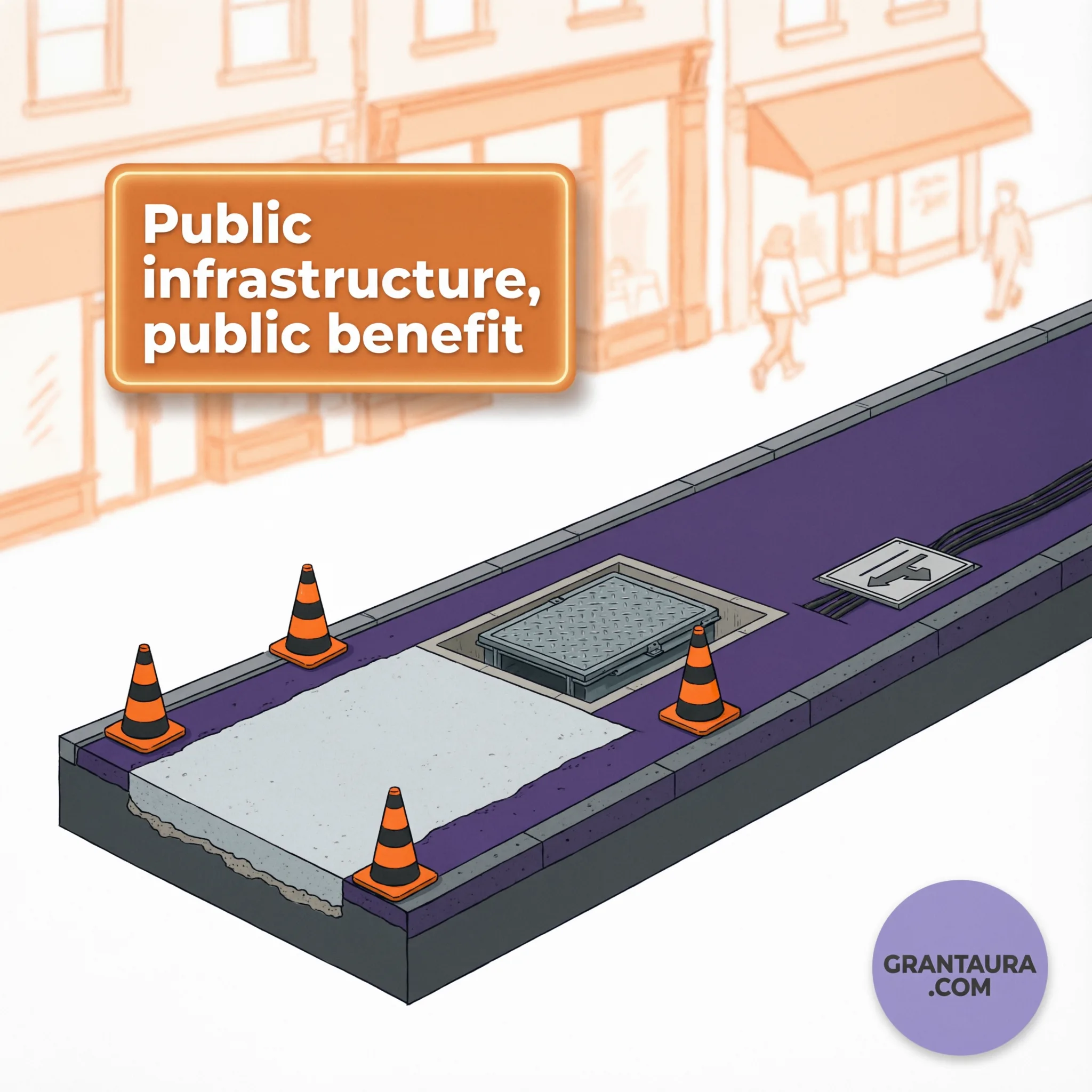
The eligible categories are specific and not negotiable:
Required Steps
Water lines and systems
Sewer lines and systems
Gas utility lines
Broadband conduit and telecom
Electric utility lines
Sidewalks and curbs
Stormwater systems
What does not qualify: building construction of any kind (vertical improvements), roadways and parking lots, land acquisition, privately owned infrastructure or anything maintained by an individual business, and any cost incurred before the award date except limited application preparation expenses. If your project is a road repaving, a parking lot expansion, or a privately owned HVAC replacement, SmBIZ will reject it outright.
Eligible counties – full list
All 26 counties designated under the Hurricane Helene presidential disaster declaration are eligible, plus the Eastern Band of Cherokee Indians. The complete list per FEMA Federal Register: Alexander, Alleghany, Ashe, Avery, Buncombe, Burke, Caldwell, Catawba, Clay, Cleveland, Gaston, Haywood, Henderson, Jackson, Lincoln, Macon, Madison, McDowell, Mitchell, Polk, Rutherford, Transylvania, Watauga, Wilkes, and Yancey. Macon County is confirmed eligible though some secondary coverage omits it.[3]
The 11-document application, grouped for your sanity
I am not going to list 11 requirements as a flat wall of text that makes you close the tab. Every town manager who has glanced at the SmBIZ guidelines knows the real work is the coordination. So here is the document load organized by what kind of effort each piece demands, and what relief options exist.
Required Steps
Government Authorization docs
Business Verification docs
Technical Documentation
Narrative Responses
Compliance Add-ons
Group 1: Government Authorization
Board-approved Local Government Resolution authorizing the specific project and application amount
Local Government Certifications Document
These require a board meeting and formal vote. The timing of your next board meeting relative to the quarterly award date is the real gate. If your board meets monthly and your project is not on the agenda yet, count backward from the next award date and plan accordingly.
Group 2: Business Verification
Business Listing Excel Template with names, addresses, and employee counts for every benefiting business
NCUI101 Forms – quarterly unemployment insurance wage reports from the North Carolina Department of Labor for each beneficiary business
The Business Listing is straightforward. The NCUI101 collection is the hardest coordination task in the entire application. You become both grant applicant and collections agent for multiple external parties. You must contact every business whose property fronts the infrastructure you want to repair and ask them to provide quarterly wage reports that prove they have 150 or fewer employees.
Important Note
If you need help planning the NCUI101 collection – what to say in your first email or how to handle unresponsive business owners – Grantaura’s expert consultation can provide outreach templates and escalation strategies specific to your project’s beneficiary list.
Group 3: Technical Documentation
Project map with labeled infrastructure and adjacent businesses
Preliminary Engineering Report (PER) with certified cost estimates from a licensed professional
Photos of pre- and post-damage conditions demonstrating Helene impact
Project timeline
The PER is a professional engineering deliverable. Getting a cost estimate, map, and photos together will take weeks. The 20% advance payment exists specifically to help with this front-loaded cost.[1]
Correction: Advance payment is 20%, not 25%
Some published coverage states the SmBIZ advance payment is 25%. That is incorrect. The official guidelines cap the advance at 20%. If your town calculates cash flow on 25%, you will face a funding gap. The advance requires a written request, an advance form, invoices, and proof of payment within 60 days. The remainder of the award is reimbursement-based.
Group 4: Narrative Responses and Compliance
Five narrative responses in the Rural Connect portal covering project description, Helene damage documentation, small business benefit explanation, timeline, and budget justification
State Historic Preservation Office documentation if the project affects historic properties
The narratives need to be specific and paired with the technical attachments. If your town does not have a grant writer on staff – and most small western NC towns do not – the consultant allowance from the guidelines matters here: an outside grant professional can draft every narrative while your team focuses on the technical pieces.
Rural Connect portal
Submit all applications through the official Rural Connect portal at https://nccommercedws.my.site.com/ruralconnectportal/s/login/. New users must register before submitting. The portal is Salesforce-hosted and may feel unfamiliar to rural government staff – allow extra time for account setup.
Your Grant Assessment fee is non-refundable, but the base assessment fee can be deducted once toward the same grant’s Full Application when you choose the optional checkbox at checkout.
The county cap is a silent deadline
SmBIZ has a $5.5 million per-county maximum – 10% of the total $55 million program. That sounds generous until you see what happened in Round 2 and Round 3. Asheville received three awards in one round totaling approximately $2.49 million. In Round 3, Mitchell County saw at least $3.3 million in awards across Bakersville and Spruce Pine. A county cap that looks comfortable on paper can evaporate in one or two award cycles once multi-project applications start stacking.[6]
There is no public real-time tracker for county cap status. The only way to check is to call Hazel Edmond, the program’s Director of Rural Engagement & Investment, at 984-297-5082. Ask for your county’s remaining allocation before you spend a dollar on engineering or application preparation.
Round
Award Date
Status
Round 1
June 30 2025
Completed
Round 2
Oct 31 2025
Completed
Round 3
Feb 28 2026
Completed
Round 4
November 30, 2026
Upcoming
Tier 1 and Tier 2 counties get special consideration
The SmBIZ guidelines include a line that no competitor coverage mentions: “Special consideration will be given to local governments in Tier 1 and Tier 2 Counties.”[4] Tier 1 covers the 40 most economically distressed counties in North Carolina, Tier 2 the next 40. Most of the Helene-affected area falls into Tier 1 or 2. The guidelines do not explain exactly how this consideration modifies the first-come-first-served order – it is a preference signal, not a separate scoring track – but it matters. If your county qualifies, mention it plainly in the application narrative.
Key Points
Tier 1 and Tier 2 counties receive preferential review within the eligibility-only queue
This is not a separate scoring track – it affects queue position
Mention your county's Tier status in the application narrative if applicable
The emergency track exists, but the criteria are not public
In fall 2025, Bryson City received $1 million for a water main under the Tuckasegee River on September 16, well outside the quarterly award calendar. Maggie Valley followed with two emergency awards totaling over $1.5 million on October 23 for sewer pipe and bridge replacement. These were off-cycle, emergency-designation awards. The guidelines confirm the emergency track exists, but the specific criteria that distinguish an emergency application from a standard one are not published. If your town has critical infrastructure failure with immediate public health or safety risk, reach out to the program contact directly about emergency designation.
Business owner? Here is your advocacy script.
If you are a business owner in an eligible county and your downtown infrastructure is still damaged, you cannot apply. But you are the most powerful advocate your town has. Your town manager may not know the grant exists, may think the application is too complex, or may not know they can hire someone to prepare it.
Advocacy email template
Subject: Helene infrastructure grant – up to $1M for our business district
Dear [Town Manager/Mayor],
I am writing about the Small Business Infrastructure Grant Program (SmBIZ) through NC Commerce. It provides up to $1 million per project for towns in Helene-designated counties to repair publicly owned infrastructure that serves small businesses with 150 or fewer employees.
Our business district has [describe damage: broken sidewalks or utility issues] that is hurting foot traffic and daily operations. I wanted to flag three things that the official guidelines make clear:
1. The application is first-come, first-served with no scoring rubric.
2. The guidelines explicitly allow the town to hire a contract administrator or grant consultant to prepare the application. The paperwork burden can be handled externally.
3. The county has a $5.5 million cap, and some nearby counties have already received multiple awards.
The program contact is Hazel Edmond at 984-297-5082 if we want to check our county’s remaining balance. I would be happy to help coordinate any business information the application needs.
Thank you,
[Your name and business]
Frequently asked questions
Can businesses apply directly?
No. Only local governments can apply. Businesses must work through their town or county. The guidelines permit the local government to hire a contract administrator or grant consultant to prepare the application; accountability remains with the local government.
How much funding is left?
Approximately $23-25 million. The exact figure is estimated from multiple official sources – Round 2 reported nearly $32 million remaining, and NC Commerce confirmed $18.1 million awarded in 2025, with Round 3 adding $8.5 million. Call 984-297-5082 for current county status.[7]
Is there a scoring rubric?
No. The review is eligibility-only, first-come, first-served. If your application meets all requirements and funds remain under your county’s cap, you are awarded.[5] The only preference factor is the Tier 1/2 special consideration clause.
What are NCUI101 forms, and where do I get them?
NCUI101 forms are the quarterly unemployment insurance wage reports each North Carolina employer files with the Department of Labor. They are used to verify that beneficiary businesses have 150 or fewer employees. Each business must provide theirs. Access them through the NC DOL at des.nc.gov/employers/unemployment-insurance-tax/quarterly-wage-and-tax-reports.
What is the advance payment, and is it 25%?
No. The advance is up to 20%, not 25%. Some local coverage has published the wrong figure. The official guidelines cap the advance at 20%, requiring a written request, advance form, invoices, and proof of payment within 60 days.[1]
Terms you will encounter
SmBIZ
Short form for the Small Business Infrastructure Grant Program.
Rural Connect Portal
The online submission system hosted on Salesforce at nccommercedws.my.site.com/ruralconnectportal.
Preliminary Engineering Report (PER)
A certified cost estimate and project scope document prepared by a licensed professional engineer. Required for all applications.
NCUI101
Quarterly unemployment insurance wage report used to verify the 150-employee threshold for each beneficiary business.
Tier 1 and Tier 2 Counties
North Carolina’s economic distress designations. Guidelines give special consideration to these counties.
Contract Administrator / Third-Party Consultant
An outside entity or individual hired by the local government to prepare the application. Legal responsibility remains with the local government.
If SmBIZ does not fit your project, the Multifamily Recycling Grant Program is another NC state-funded opportunity for local governments with awards up to $150,000 for recycling infrastructure.
Another North Carolina state-funded opportunity for local governments. While SmBIZ focuses on Helene-damaged infrastructure, this grant supports recycling infrastructure projects. Both require local government applicants and serve NC communities.
If your town has the staff capacity and the board alignment to assemble the entire application in time for the next quarterly award date, you may not need outside help. But if the NCUI101 collection already feels daunting, or if you are simply not sure your project concept will survive the eligibility-only review, Grantaura’s services are the next logical step.
An application assessment checks your project against every SmBIZ requirement, flags missing documents, and identifies disqualification risks before you invest in engineering. For towns ready to move, the Full Application service manages every piece – narratives, attachments, portal submission, and NCUI101 coordination – while you handle the approvals only the local government can manage.
If you want strategic advice before deciding, schedule a live 1-on-1 consultation with a grant expert to discuss your project, your county cap status, and your best path through the queue.
About the author
My name is Shahzad Nawaz, and I work as a freelancer. Writing for my readers is central to what I do. For this page, I reviewed the full SmBIZ program guidelines updated February 2026, three rounds of award announcements, FEMA’s Hurricane Helene disaster records, and the NC Commerce FAQ. I wanted to surface the facts that competing coverage misses – the consultant allowance, the advance payment correction, and Macon County’s confirmed eligibility – so that any town official or business owner reading this page can make a better decision than they would from the official program page alone.
[{"url": "https://grantaura.com/grant/nc-multifamily-recycling/", "custom_description": "Another North Carolina state-funded opportunity for local governments. While SmBIZ focuses on Helene-damaged infrastructure, this grant supports recycling infrastructure projects. Both require local government applicants and serve NC communities."}]
We are your trusted grant application partners. You can navigate the entire grant application process with our expert guidance through this simple 5-step process.
300+ Projects
4.9/5 Rating
Expert Team
Step 1: Application Form
Fill out the “Apply for this grant” form with your information and grant requirements.
Step 2: Eligibility Assessment
Our grant experts will assess your eligibility and notify you via email.
Step 3: Expert Consultation
A dedicated grant expert will be assigned to discuss next steps for your application.
Step 4: Application Submission
Our expert will help you complete and submit your application with all required materials.
Step 5: Final Decision
The grant committee will make their decision and notify successful applicants.
My name is Shahzad Nawaz, and I work as a freelancer. Writing for my readers isn’t just something I enjoy it’s central to what I do. I’m constantly exploring new ways to improve my craft, because writing isn’t merely a hobby for me; it’s an essential part of my professional life.
You are on NC SmBIZ: Up to $1M Helene Infrastructure Grants. I can help check fit, explain the November 30, 2026 deadline, compare effort, or decide whether Grantaura application support makes sense for this grant.
No chat history in this browser yet.
You are in queueIAGA
A Grantaura colleague can review this conversation. You can keep chatting with the assistant while you wait.
Tell us about yourself
0/1000
i
The information you add here helps the assistant answer this browser session more clearly. Close this window to continue the chat.
Check your eligibility
Check your saved details, answer the grant questions, and see your next steps.
Grant team review
Saved details where available
Free assessment
Save option
Save this grant application for later
Send yourself a private link so you can return to this grant form with your details ready.
Keep your post public. Our team will verify the link before processing your assessment. If the post is deleted or made private after submission, your free assessment will be void.