The moment you sign a commercial office lease in Montgomery County, Maryland, a 180-day clock starts running -- and most business owners do not find out about the MOVE Grant (Make Office Vacancy Extinct) until somewhere in the middle of that window, or after it has already closed. That is the real story of this program. In 2024, the county paid out $566,362 to 29 businesses for doing something they were already planning to do: sign or expand an office lease. Not a competitive process. No scoring rubric. First-come, first-served, full stop. The most recent named awardee I found was Powersolv, an IT consulting firm that relocated from Reston, Virginia to 100 Park Avenue in Rockville and received $9,016 in June 2025 for its first Montgomery County commercial lease. That is a real company, a verifiable amount, and a straightforward illustration of how this plays out in practice.
Before going further: a number of official-adjacent county pages still publish the pre-2024 figures -- $80,000 maximum, 90-day window. Both are wrong. Bill 11-24, enacted in July 2024, raised the cap to $150,000 and extended the application window to 180 days. If you read something different on another county resource, that page has not been updated to reflect the current program.
First commercial office lease in Montgomery County OR expansion of existing lease by 500+ SF
Lease term 36 months or longer
Office space must be classified as Office Space by third-party real estate software
Business in good standing with Maryland State Dept of Assessments and Taxation
Application submitted within 180 days of lease execution date
Retail, restaurant, and independent financial or insurance agent/broker establishments excluded
Leases between a business and its own subsidiary excluded
Grant Benefits
$8 to $15 per eligible square foot (up to $150000)
Under 7500 SF: $8/SF (max $60000)
7501 to 10000 SF: $10/SF (max $100000)
Over 10000 SF: $12.50/SF (max $150000)
Strategic Industry designation: $15/SF (max $150000)
One-time non-repayable grant disbursed after site visit confirming occupancy
No matching funds required
04
Focus Areas
Office Lease GrantMontgomery County Business RelocationCommercial Office Expansion Grant
The MOVE Grant eligibility tool checks your specific situation against the program's key qualifying conditions: what kind of lease you have, how your space is classified, and where you are in the 180-day window. It takes a few minutes and gives you a clear directional read before you invest time gathering documents.
Eligibility Check
Eligibility for MOVE Grant – $150k With Make Office Vacancy Extinct (MOVE) Grant Program
Answer a few guided questions. Your responses are matched to this grant's criteria in real time.
Ready to check your eligibility?
We'll guide you through a short, structured flow and instantly evaluate fit for this opportunity.
Eligible
You Appear Eligible
Based on your answers, you meet the core requirements for this grant.
Recommended Next Step
Protect Your Application Before You Submit
You look eligible — but eligibility alone doesn't win grants. Most rejections happen on the application itself: missed language, wrong framing, weak impact statement. A Grantaura Expert Review takes 24–48 hours and flags every gap before the funder sees it.
✓Expert reviews your draft⏱Results in 24–48 h💰Avg. grant value $12,000+
⚠ Grant committees reject 7 in 10 applications that meet eligibility. One overlooked line can cost you thousands.
🔒 Satisfaction-backed — if our review finds nothing actionable, you pay nothing more.
This Grant Isn’t the Right Fit. Your Best One Might Be Two Clicks Away.
Missing one criterion for MOVE Grant – $150k With Make Office Vacancy Extinct (MOVE) Grant Program doesn’t mean you’re out of options — it means this grant wasn’t designed for your profile. Our expert research team identifies the grants built specifically for businesses like yours, across 500+ active opportunities.
Basic Match
$125
One-time research
A list of 5 grants only
Basic eligibility matching based on industry & location
Standard funding amount range verification
Primary criteria alignment check
Most Popular
Advanced Match
$145
One-time research
A list of 7 grants only
Advanced eligibility matching with business model analysis
Deep competitive advantage assessment
Innovation & impact potential matching
Market fit & growth trajectory alignment
Premium Match
$175
One-time research
A list of 10 grants only
AI-powered deep-match algorithm analysis
Historical success pattern matching
Priority sector & focus area alignment
Advanced sustainability impact matching
Strategic vision & long-term goals alignment
Preparing secure checkout…
✓
Order Confirmed
Your grant research order is placed. Our team will deliver your personalised report within 3–5 business days. Check your email for confirmation.
Auto-advances after each answer. Use Back to revise.
If the tool confirms you qualify, the practical next step is not the county application form -- it is preparing your document package, and the business plan in particular deserves more time than most applicants give it. Start your application submission review here and our team will work through what that preparation looks like for your specific lease. If your result comes back uncertain -- office space classification is the most common sticking point -- a live 1-on-1 video or phone call with a grant expert at Grantaura can review your lease and property details before you commit to the process. If this program is not the right fit, check the more grants section below for other Maryland and Montgomery County programs that may align better.
What Your Office Lease Is Worth in Montgomery County
The award calculation is simpler than it looks. Your grant equals your eligible square footage multiplied by the rate that applies to your tier -- capped at $150,000. For expansion applicants, eligible square footage is the net new square footage you are adding to your existing footprint, not your total space after the expansion. For a business signing its first Montgomery County lease, eligible square footage is the total leased premises.
Eligible Square Feet
Rate Per Square Foot
Maximum Award
Under 7500 SF
$8/SF
$60000
7501 to 10000 SF
$10/SF
$100000
Over 10000 SF
$12.50/SF
$150000
Strategic Industry (any size)
$15/SF
$150000
To make the math concrete: a 5,000 SF first lease in Bethesda earns $40,000. A 9,000 SF expansion earns $90,000. The Strategic Industry tier pays $15 per square foot regardless of total space size, capped at $150,000. What exactly qualifies as Strategic Industry? Honestly, the definition lives inside Executive Regulation ER-12-24, which is not available in readable form from the public URL at the time of this writing. The 2024 county annual report shows that 38% of all MOVE square footage went to Biotechnology, Life Science, and Medical Practice companies -- which suggests these sectors are the primary recipients of the higher rate. But the county has not published a plain-language sector list. If you think your business might qualify, call the Business Center directly at 240-777-0311 or email BusinessCenter@montgomerycountymd.gov. They respond within two business days and that conversation is worth having before you submit.
One important note on craft alcohol producers: breweries, cideries, distilleries, and wineries qualify for the MOVE Grant as long as production -- not retail sales -- is their primary use of the leased space. That is an explicit exception in the county code to the general retail exclusion, and it often surprises founders in those sectors who assumed they were out.
Two Paths to This Grant
The 2024 update changed who can apply in a way that most secondary coverage still has not fully absorbed. Before July 2024, only businesses that were new to Montgomery County could apply. A company that had been operating in Rockville for five years and wanted to expand could not get a MOVE Grant under the old rules. That changed with Bill 11-24.
Now there are two distinct qualifying scenarios. The first is an Inaugural Commercial Lease: your business signs its very first commercial office lease in Montgomery County. The second is an Expanded Commercial Lease: your business already has a Montgomery County office presence and is signing a new lease or amendment that adds at least 500 square feet to your existing footprint. Both scenarios trigger the same 180-day application clock from the lease execution date. Both use the same award tier structure. And if you are relocating from one Montgomery County address to another -- not adding square footage, just moving within the county -- that counts as a new inaugural lease and qualifies on the same terms as a business coming to the county for the first time.
The Office Space Software Check That Catches People Off Guard
Your lease might say "office" in plain English. Your landlord might describe it as office space. None of that determines eligibility. What matters is how the space is classified in third-party real estate software -- platforms like CoStar that the county uses to verify building designations.
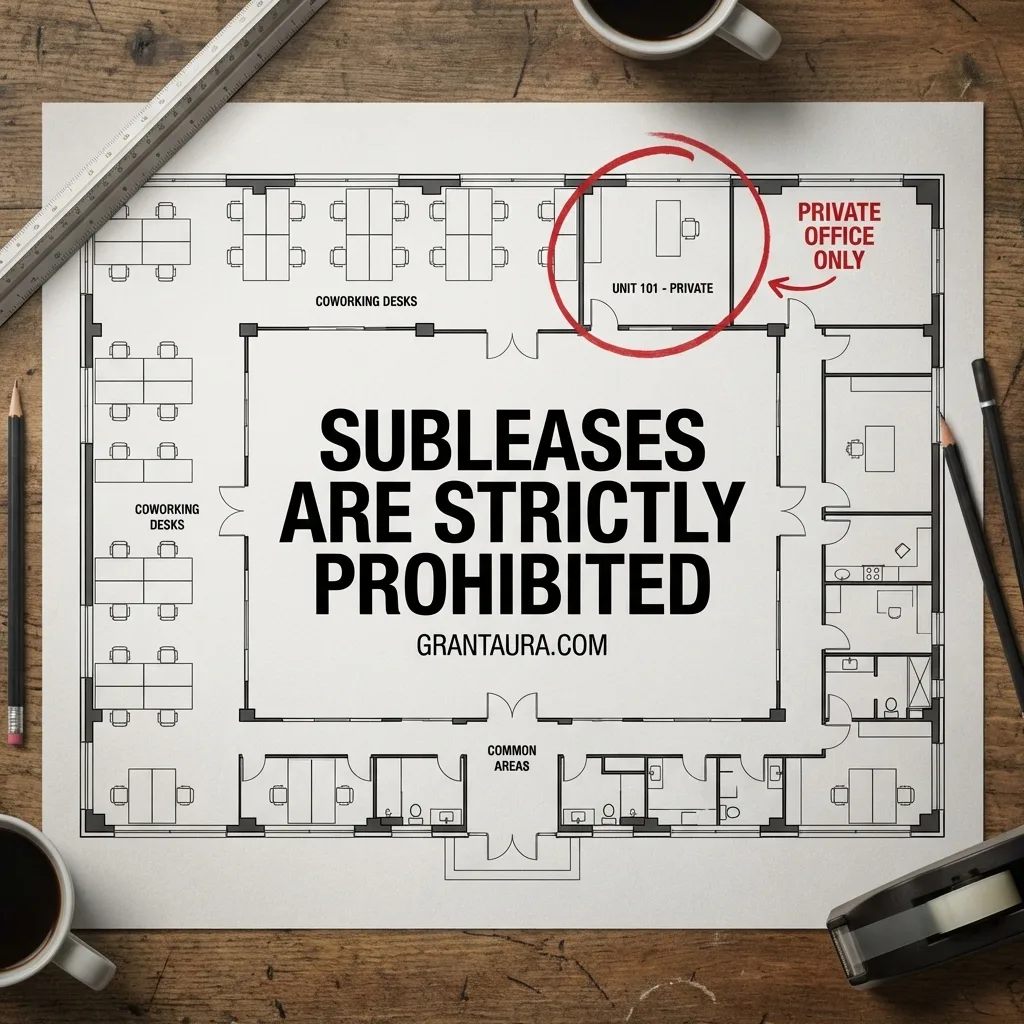
If your space is classified as flex, mixed-use, coworking, or industrial in that database, the county will likely reject your application regardless of how you actually use the space, regardless of what your lease says, and regardless of whether every neighbor in your building runs a professional services firm. The label in the software is what counts. Before you begin gathering documents, check how your building and specific suite are classified in CoStar or the equivalent platform your county contact references. You cannot easily change that classification after the fact. Discovering the problem after submission means starting over -- inside a window that is already running.
Coworking tenants have a specific pathway: the county allows an occupancy permit in place of a traditional signed lease for shared-office arrangements. The office space classification requirement still applies to the underlying building, but the document substitution is explicitly permitted. What does not qualify: floating desks, hot desks, or any arrangement where you do not have a dedicated and fixed private suite. If your coworking agreement does not give you a consistent assigned space for the full term, the county will treat it as a sublease or a non-qualifying arrangement.
The clock starts on the date you and the landlord execute the lease. Not the date you receive the keys. Not the date your furniture arrives. Not the date you notify the county. The execution date on the signature page of your lease is day zero, and you have 180 calendar days from that moment to submit a complete application.
That distinction matters more than it sounds. A business that signs a lease in January and plans a March move-in is already 60 days into its window by the time the space is ready to occupy. Proof of occupancy -- one of the five required documents -- cannot be obtained until you have actually moved in. If buildout or logistics delays push move-in to month five, your window for gathering and submitting all documents may be uncomfortably tight.
The program has no annual program-level deadline -- it is ongoing until appropriated funds are exhausted. Your personal deadline is the only one that matters. First-come, first-served means the completeness of your application and the date it arrives both determine your position in the funding queue. An incomplete application does not hold your place in line -- review only begins once all five required documents are present in the submission portal.
The Five Documents and the One That Stalls Most Applications
Applications go through the county's GovOS portal (formerly SeamlessDocs) at montgomerycountymd.seamlessdocs.com. Five documents are required for a complete submission:
Required Document
What to Know
Articles of Incorporation or equivalent
LLC operating agreements and equivalent company structure documents are accepted
Signed lease or occupancy permit
Must clearly state square footage - shared office tenants submit occupancy permit instead
Original signed lease (expansion applicants only)
Required to document the pre-expansion square footage for net SF calculation
Third-party proof of occupancy
Utility bill or equivalent from a party other than your business or your landlord
Business plan or business proposal
Must identify your business type
The utility bill requirement is where applications most often stall on a technicality. The county requires that the proof of occupancy be "generated by a party other than the Business or landlord for the leased premises." That means: a welcome letter from your landlord does not work. A utility transfer confirmation in your business name does not work if your business is also the account holder. What works: a bill from the local utility company registered to the physical address of your leased space, where the account holder is your business and the document originated from the utility provider -- not from your own records or your landlord's system. Suite number variations between the lease address and the utility bill address can trigger rejection. PO box addresses on utility documents are rejected. The service address must match your lease address specifically.
New businesses face a specific version of this problem: if your LLC was formed recently and you have not yet established utility accounts at your new space, you will not have a utility bill to submit until after move-in. Moving company invoices addressed to the leased space also work. A Certificate of Use and Occupancy from Montgomery County's permitting services is another valid substitute. Plan for this document early, not as an afterthought.
The business plan is the other friction point. The county requires "a complete business plan that clearly identifies the type, purpose, and financial projection of the business." No template is provided. No word count is specified. No format is required. What is clear from the program structure is that the depth of financial projection the county expects to see scales with the award size. A business applying for $40,000 based on a 5,000 SF lease is in a different position than a business applying for $120,000 based on a 10,000 SF expansion. In both cases the plan needs to demonstrate that the business is legitimate, has a defined purpose, and has a credible financial trajectory. In the larger-award case, reviewers are looking at substantially more money -- and the plan needs to reflect that.
After the county reviews and approves your application, disbursement is contingent on a physical site visit. A program manager or Business Center staff member visits your leased space to verify you are physically occupying it. The visit is scheduled after you notify the county that you have taken occupancy. How long that scheduling takes is not publicly specified -- I could not find a published timeline anywhere in county documentation. Plan for a gap between application approval and cash receipt, and do not count on the funds arriving in the same month you submit.
How Rockville Businesses Can Stack Two Programs for More Per Square Foot
The City of Rockville runs its own separate MOVE supplement through Rockville Economic Development Inc (REDI). It adds up to $4 per square foot on top of the county grant. For a Strategic Industry business in Rockville, that combination reaches $19 per square foot from two government sources for the same lease -- up to $190,000 combined. In 2024, Rockville accounted for 55% of all county MOVE grants, with 13 of the 29 awarded to Rockville businesses. The county program and the city program are administered independently and reviewed independently, which means you need to manage two separate applications and two sets of timelines.
The Rockville program has two fixed application deadlines each year: April 30 and September 30. Applications that arrive after each deadline roll into the next review cycle. One thing worth flagging: the Rockville REDI website was written against the pre-2024 county program figures, so some of its published reference information may not reflect the current county terms. Verify directly with Richelle Wilson at Rockville REDI (richelle@rockvilleredi.org, 301-315-8096) before submitting to both programs.
Here is the piece most people miss entirely: the Rockville supplement program explicitly includes retail and restaurant businesses. Those categories are excluded from the county MOVE Grant -- but if your business is retail or restaurant and your space is within Rockville city limits, you may still qualify for the city-level supplement. Two different programs, two different eligibility rules, covering some businesses the county program will not touch. Worth checking if that describes your situation. The Maryland grants archive on Grantaura has other programs worth reviewing alongside this one if you want a fuller picture of what is available in the region.
The 36-Month Commitment and What Happens If You Leave Early
Winning the grant is not the end of the county's involvement. Based on the county code structure and COMCOR 20.76G references, awardees are expected to maintain occupancy of the eligible square footage for 36 consecutive months. If you vacate early or reduce your space below the eligible threshold before that period ends, the county can require pro-rata repayment -- calculated as the number of months remaining in the 36-month window divided by 36, multiplied by the total award amount. Leave at month 18 of a 36-month commitment and you owe back half the grant.
Annual reporting to the county is referenced in the program structure, requiring awardees to update occupancy status and business metrics for the three years following the award. The specific reporting dates and exact certification requirements are not fully detailed in the publicly accessible program documentation -- if this commitment matters to your business planning, ask the Business Center directly about the post-award obligations before submitting your application.
Questions Worth Answering Before You Apply
Q: My lease was signed 90 days ago and I just found out about this program. Am I still in time? A: Yes -- if you are within 180 days of your lease execution date, you are still eligible to apply. Pull out your lease, find the date both parties signed it, and count 180 calendar days forward. That is your personal deadline.
Q: I have seen 90 days listed on another county page. Which is correct? A: 180 days is correct for the current program. Bill 11-24, enacted in July 2024, extended the window from the original 90 days and raised the maximum award from $80,000 to $150,000. The primary program page at montgomerycountymd.gov/business/programs/move-grant.html carries the updated figures. Several other county-adjacent pages have not been updated.
Q: I already expanded my footprint once and received a MOVE Grant. If I expand again, can I apply? A: Each executed lease is its own triggering event, and the program describes each award as tied to a specific qualifying lease. Whether a business can receive multiple awards across separate lease events is not explicitly confirmed or denied in the current public documentation. This is worth a direct question to BusinessCenter@montgomerycountymd.gov before investing time in a second application.
Q: My office is in a coworking building. Can I apply? A: Shared-office tenants can substitute an occupancy permit for a traditional signed lease. The bigger question is whether your specific space is classified as Office Space in the county's third-party real estate data. If your building is classified as flex or coworking rather than office, that creates a disqualification risk regardless of the occupancy permit. Verify the property classification before applying.
Q: Can the county MOVE Grant stack with the Rockville city program? A: Yes -- the two programs are independent and can be pursued simultaneously for the same lease if your space is within Rockville city limits. Combined, they can reach up to $19 per square foot for Strategic Industry businesses.
Q: My business is a nonprofit. Does that disqualify us? A: The county code's definition of "Business" under this program includes nonprofit corporations and firms that are not owned or controlled by a government agency. Based on that language, nonprofits appear eligible. However, the donor page does not explicitly confirm this, and I was not able to verify it from a county official. Email the Business Center to confirm before submitting.
Q: What should my business plan actually contain? A: The county specifies a plan that "clearly identifies the type, purpose, and financial projection of the business." In practice, a solid submission covers what your business does and the industry it operates in, why you chose Montgomery County for this lease, and a financial projection showing revenue trajectory and key expense assumptions. The depth of financial detail matters more for larger awards -- a business applying for $120,000 based on a 10,000 SF lease will benefit from more substantive projections than one applying for a $20,000 award. If you want a second set of eyes on your plan before submitting, start your application submission review and our team will assess it against what county reviewers expect to see.
Q: I am relocating from one Montgomery County address to another, not adding square footage. Does that qualify? A: Yes. Relocating within the county to a new commercial office lease counts as an Inaugural Commercial Lease for MOVE Grant purposes. The program does not require the business to be new to the county -- only that the specific lease is a first lease at that location.
Q: Can someone else submit the application on my behalf? A: The county's policy on third-party submission is not stated in the public program documentation. This is an open question we are working to confirm directly with the Business Center.
Key Terms for the MOVE Grant Application
Inaugural Commercial Lease: The first commercial office lease a business signs in Montgomery County. New-to-county businesses qualify under this definition. Businesses relocating from one county address to another also trigger this category for the new lease.
Expanded Commercial Lease: A new lease or amendment that increases an existing business's Montgomery County office footprint by at least 500 square feet compared to its previous lease. The 2024 update (Bill 11-24) created this pathway for existing county businesses, which did not previously qualify.
Eligible Square Feet: The square footage the county uses to calculate the award. For inaugural leases, this is the total leased office space. For expanded leases, it is the net new square footage added -- new total minus previous total. The precise definition appears in Executive Regulation ER-12-24.
Lease Execution Date: The date the lease was signed and legally executed by all parties. The 180-day application window begins on this date, not the date of physical move-in, not the date the business discovers the program. This is the single most important date in the entire application process.
Third-Party Software: The external real estate classification database -- CoStar is the most widely used -- that the county consults to verify a building and unit are designated as Office Space. If a space is labeled differently in that database, the county will reject the application regardless of actual use.
Strategic Industry: A business category that qualifies for the $15 per square foot award rate, capped at $150,000. The precise qualifying sectors are defined in Executive Regulation ER-12-24, which was not extractable from its public URL at the time of this writing. Based on 2024 award data, Biotechnology, Life Science, and Medical Practice companies appear to be the primary recipients. Contact the Business Center to confirm whether your business type qualifies before submitting.
Executive Regulation ER-12-24: The governing regulation that defines all capitalized terms in the MOVE Grant program, including Eligible Square Feet, Strategic Industry, Inaugural Commercial Lease, and Expanded Commercial Lease. Referenced throughout the donor page. Contact Derese Bikila at the Business Center (240-777-8864) to request a copy if needed.
Third-Party Proof of Occupancy: A utility bill or equivalent document that must be generated by a party other than the applicant business or the landlord, showing the physical address of the leased space. The service address must match the lease address specifically. PO boxes and suite number variations between the utility bill and the lease are known rejection triggers.
Site Visit: A required verification step before grant funds are disbursed. A program manager or Business Center staff member visits the leased space in person to confirm the business is physically occupying it. Disbursement does not occur before this visit. Scheduling timeline is not publicly specified.
First-Come, First-Served: The funding mechanism for the MOVE Grant. Applications are reviewed and funded in the order they are received -- but only once the application is complete. Incomplete submissions do not hold a position in the queue. There is no competitive scoring; the submission timestamp of your completed application determines your place in line.
Make Office Vacancy Extinct: The full name behind the MOVE acronym. The county office vacancy rate stood at 18.1% at the time of the 2024 legislation, up from 12.3% before the pandemic. The program exists because the county is paying businesses to fill that space. Understanding the policy motivation explains why the program is unusually straightforward -- the county wants to move applications through quickly.
Rockville MOVE Supplement: A separate $4 per square foot grant administered by Rockville Economic Development Inc (REDI) for businesses locating within the corporate limits of the City of Rockville. Stackable with the county MOVE Grant for a combined potential of up to $19 per square foot for Strategic Industry businesses. Two application deadlines per year: April 30 and September 30. Contact Richelle Wilson at richelle@rockvilleredi.org or 301-315-8096.
Montgomery County Business Center: The county department that administers the MOVE Grant program. Located at 101 Monroe Street, Rockville MD 20850. Contact: BusinessCenter@montgomerycountymd.gov, response within two business days. Note: the Business Center is a separate department from the county's Office of Grants Management, which runs a different set of programs for nonprofits through the eCivis platform. If you find yourself on the county's nonprofit grant portal, you are in the wrong place for the MOVE Grant.
Bill 11-24: The Montgomery County Council legislation enacted in July 2024 that codified the MOVE Grant program into county law (Section 20-76G of the Montgomery County Code), raised the maximum award from $80,000 to $150,000, extended the application window from 90 to 180 days, and expanded eligibility to include existing county businesses seeking to expand their office footprint.
36-Month Retention Commitment: The post-award obligation to maintain occupancy of the eligible square footage for 36 consecutive months. Failure to maintain occupancy triggers a pro-rata repayment calculated as the remaining months in the commitment period divided by 36, multiplied by the total award. Annual reporting to the county is expected during this period.
More Maryland Grants to Explore
If the MOVE Grant is not the right fit -- whether because your lease category is excluded, you missed the 180-day window, or the office space classification does not work out -- there are other programs worth investigating in Montgomery County and across Maryland. The Maryland grants archive on Grantaura covers state and local programs for businesses at various stages. The full grants directory filters by location, business type, and funding amount if you want to search more broadly.
This Maryland Department of Commerce program provides capital assistance to social equity cannabis licensees, including for commercial space costs. It serves a distinct business sector within Maryland's small business funding landscape and is worth exploring for cannabis operators who may not qualify for the office-specific MOVE Grant structure.
The eligibility rules for the MOVE Grant are clear enough to follow on your own. But two specific points in this process generate most of the problems I see -- and both happen in execution, not in understanding the criteria.
The business plan is the first. The county gives you a requirement ("type, purpose, financial projection") with no format guidance, no template, and no stated expectations for depth. A reviewer approving a $120,000 award based on a 10,000 SF lease is looking for a substantially different level of financial projection than one approving a $20,000 award for 2,500 SF. Getting that calibration wrong does not automatically kill an application -- but it can generate follow-up requests that delay processing in a first-come, first-served program where every day of delay matters. Our team reviews your business plan against what county reviewers have seen in this program and what the award size warrants, not against generic startup writing advice.
The utility bill document is the second. The third-party generation rule -- "generated by a party other than the Business or landlord" -- sounds clear but creates specific failure modes: bills in the business's own name, bills from landlord-managed building services, suite number mismatches between the utility account address and the lease address. These disqualify applications that are otherwise complete. Before the county flags the issue, we check your document package for exactly these gaps.
For businesses locating in Rockville specifically, coordinating both the county and city applications simultaneously requires managing two separate timelines, two document sets, and two review processes. Our team handles that coordination so neither application is submitted incomplete or out of sync with the other.
The complexity tier for this application is complex -- based on five required documents, a custom county portal (GovOS/SeamlessDocs), estimated preparation time of six hours, and the business plan requirement that has no published format guidance. Exact quote details appear in the application submission intake modal before any payment. No upfront commitment to see your options.
About This Grant
I spend a lot of time reading county legislation and cross-referencing program pages to find the gaps between what the official documentation says and what actually trips up real applicants. The outdated $80,000 cap and 90-day window on some official county pages were the first things I wanted to correct here. The Rockville stacking opportunity -- up to $19 per square foot combined from two government programs for the same lease -- was the finding I did not see documented anywhere else. I run Grantaura because that gap between "the program exists" and "your application is actually ready to submit" is where most eligible businesses lose out. If you want to talk through your specific situation, you can reach me at my profile page or book directly with the team at /consultation.
TL;DR
Key Takeaways
1
Office leases earn $8 to $15 per square foot
2
Up to $150000 for qualifying leases
3
180 days from lease signing to apply
4
Business plan is a required document
The Make Office Vacancy Extinct (MOVE) Grant Program from Montgomery County, Maryland pays businesses $8 to $15 per square foot for signing or expanding a commercial office lease. But here is what I found when I dug into the actual program rules: the eligibility conditions are more specific than a one-line summary suggests. Your lease type, your space's third-party software classification, your business category, and the exact date you signed all interact to determine whether you qualify. This checker walks through each condition in sequence. It takes a few minutes and gives you a clear directional answer before you spend time gathering five required documents. Two things worth flagging before you start: the 180-day application window begins on your lease execution date, not your move-in date. And several county-adjacent pages still publish outdated figures ($80,000 cap, 90-day window) - the current program, updated by Bill 11-24 in July 2024, has a $150,000 cap and a 180-day window.
Who This Grant Is Actually For
Two distinct groups can apply, and most secondary coverage still undersells the second one. The first group: businesses signing their very first commercial office lease in Montgomery County. New to the county entirely, or relocating from one county address to another - both qualify on the same terms. The second group, added by the 2024 legislative update: businesses already operating in Montgomery County that are expanding their existing office footprint by at least 500 square feet. If you have been in Rockville for five years and you are signing an expansion lease, this program now covers you too. What does not qualify? A simple lease renewal with no added square footage. The trigger is new square footage committed to, not continued occupancy of what you already had.
The Classification Check Most People Miss
Your lease can say "office" in plain English and your landlord can call it office space. That does not determine your eligibility. What matters is how the space is classified in third-party real estate software - CoStar is the most commonly referenced platform - that the county consults to verify building designations. Flex space, coworking, mixed-use, or industrial classifications in that database create a disqualification risk regardless of how you use the space. I would strongly recommend checking your building's classification before you apply, because you cannot easily change a software label after the fact. If your classification is uncertain, a live 1-on-1 video or phone call with a grant expert can review your specific property details before you commit time to the application.
The Exclusions Worth Knowing Before You Start
Three business categories are explicitly excluded: retail stores, restaurants, and independent financial or insurance agent/broker establishments. Related-party leases - between a business and its own subsidiary - are also disqualified. One exception worth knowing: craft alcohol producers (breweries, cideries, distilleries, wineries) qualify if their primary use of the space is production rather than retail. That exception is in the county code and is often missed by businesses in those sectors. If you fall into an excluded category for the county program but your space is within Rockville city limits, the Rockville MOVE supplement runs separate rules and explicitly includes retail and restaurant businesses.
What Happens After the Checker
If your result comes back clearly eligible, the next practical step is preparing your five-document submission package - and the business plan is where most applications slow down. The county requires it but provides no template, no format guidance, and no stated expectations for financial projection depth. The depth that passes for a $20,000 award looks materially different from what a reviewer wants to see for a $120,000 award. Our team reviews your business plan specifically against what county reviewers have seen at this program, not against generic grant-writing advice. Start your application submission review and we will work through what that preparation looks like for your specific lease size and award tier.
[
  {
    "url": "https://grantaura.com/grant/rockville-move-program/",
    "custom_description": "The Rockville MOVE Program adds up to $4 per square foot on top of the Montgomery County MOVE Grant for businesses locating within Rockville city limits. Unlike the county program, the Rockville supplement explicitly includes retail and restaurant establishments. Businesses leasing in Rockville should pursue both programs simultaneously to maximize their total award."
  },
  {
    "url": "https://grantaura.com/grant/montgomery-county-job-creation-fund/",
    "custom_description": "The Montgomery County Job Creation Fund is the county's complementary economic development program that pays $10,000 to $12,000 per qualifying new job created. While the MOVE Grant rewards office lease commitments, the Job Creation Fund rewards hiring - making them potentially stackable for businesses expanding their workforce alongside their physical footprint."
  },
  {
    "url": "https://grantaura.com/grant/maryland-cannabis-business-assistance/",
    "custom_description": "This Maryland Department of Commerce program provides capital assistance to social equity cannabis licensees, including for commercial space costs. It serves a distinct business sector within Maryland's small business funding landscape and is worth exploring for cannabis operators who may not qualify for the office-specific MOVE Grant structure."
  },
  {
    "url": "https://grantaura.com/grant/maryland-sbir-sttr-matching-grant/",
    "custom_description": "Montgomery County's SBIR/STTR Matching Grant Program provides supplemental funding to county-based companies that have received federal Phase I or Phase II research awards in medicine, biotechnology, or life sciences. Biotech and life science companies that qualify for the MOVE Grant's Strategic Industry tier at $15 per square foot may also qualify for this separate matching program."
  },
  {
    "url": "https://grantaura.com/grant/maryland-small-business-development-grant/",
    "custom_description": "State-level Maryland small business development funding serves businesses at various growth stages across the state. For businesses located or expanding outside Montgomery County's geographic eligibility zone, Maryland's statewide programs offer an alternative path to commercial development support without the office-only restriction of the MOVE Grant."
  },
  {
    "url": "https://grantaura.com/grant/sba-small-business-investment-company/",
    "custom_description": "SBA investment programs serve growing small businesses seeking capital for expansion, including physical space buildout. Businesses using the MOVE Grant to fund lease costs may benefit from pairing it with SBA financing for equipment and operational buildout costs that the county grant does not cover."
  },
  {
    "url": "https://grantaura.com/grant/eda-public-works-economic-adjustment/",
    "custom_description": "The Economic Development Administration's Public Works and Economic Adjustment programs fund infrastructure and economic development projects in distressed regions. For businesses in Montgomery County communities with lower economic activity, EDA programs can complement the MOVE Grant by funding larger-scale facility improvements beyond what a per-square-foot lease subsidy covers."
  },
  {
    "url": "https://grantaura.com/grant/cdfi-fund-new-markets-tax-credit/",
    "custom_description": "The CDFI New Markets Tax Credit program incentivizes investment in low-income communities, including commercial real estate development. Businesses locating in Montgomery County's Community Equity Index disadvantaged areas may find this program strategically aligned with the MOVE Grant as a complementary capital source for buildout costs."
  },
  {
    "url": "https://grantaura.com/grant/maryland-department-of-commerce-choose-maryland/",
    "custom_description": "Maryland's Choose Maryland program provides state-level incentives for business attraction and expansion across the state, including grants and tax credits that can stack with county-level programs. Businesses qualifying for the MOVE Grant may also qualify for Choose Maryland incentives, creating a combined county and state funding package."
  },
  {
    "url": "https://grantaura.com/grant/national-institutes-health-small-business-sbir/",
    "custom_description": "NIH's SBIR program is particularly relevant to Montgomery County's Strategic Industry businesses in life sciences and biotech given the county's proximity to NIH's Bethesda campus. Life science companies qualifying for the MOVE Grant's $15 per square foot Strategic Industry tier often overlap with NIH SBIR eligibility criteria."
  },
  {
    "url": "https://grantaura.com/grant/montgomery-county-technology-innovation-fund/",
    "custom_description": "The Montgomery County Technology Innovation Fund provides commercialization grants to technology companies in the county's priority sectors including advanced manufacturing, AI, biotechnology, cleantech, and cybersecurity. These sectors substantially overlap with the MOVE Grant's Strategic Industry tier, making the Technology Innovation Fund a natural complementary program for the same applicant pool."
  },
  {
    "url": "https://grantaura.com/grant/maryland-biotechnology-investment-tax-credit/",
    "custom_description": "Maryland's Biotechnology Investment Incentive Tax Credit supports investors in early-stage biotech companies based in the state. Biotech companies leasing office space in Montgomery County under the MOVE Grant's Strategic Industry tier may have investor relationships that qualify for this separate state-level incentive, creating value at both the company and investor level."
  }
]
We are your trusted grant application partners. You can navigate the entire grant application process with our expert guidance through this simple 5-step process.
300+ Projects
4.9/5 Rating
Expert Team
Step 1: Application Form
Fill out the "Apply for this grant" form with your information and grant requirements.
Step 2: Eligibility Assessment
Our grant experts will assess your eligibility and notify you via email.
Step 3: Expert Consultation
A dedicated grant expert will be assigned to discuss next steps for your application.
Step 4: Application Submission
Our expert will help you complete and submit your application with all required materials.
Step 5: Final Decision
The grant committee will make their decision and notify successful applicants.
As the founder of Grantaura, I've dedicated myself to demystifying the grant funding process. My goal is simple: to empower entrepreneurs, non-profits, and innovators like you to secure the capital needed to make a real impact. Let's build your funding strategy together.
Profile data is saved in your browser and synced to secure storage when available.
Context
Grants selected0
SLA tierNot selected yet
Billing modelNot selected yet
Due today--
Total project value--
Selection preview
No grants selected yet.
Soft estimate
Estimate only. Final pricing appears in Quote step.
Quote expiry
Quote timer starts after pricing is generated.
Verification
Verification status appears here once quote is confirmed.
Success snapshot
Success milestones appear here after confirmation.
What happens next
After quote confirmation, verify your email and complete secure payment.
ProfileReviewPayment
Choose your service
Select how you want to proceed. You will review pricing before checkout.
Next stepReview pricing, then checkout
Recommended
Full service
Full Application Submission
From USD 41.40
We prepare and submit your grant application on your behalf, with priority or rush handling applied when the deadline makes faster service necessary.
No funding guarantee. If Grantaura cannot complete due to our operational failure, refund policy applies.
Assessment
Quick review
Eligibility Assessment
USD 5.99 one-time
Find out if you qualify. Results typically within 24 hours.
FreeNo card needed
Share & Submit Free
Share this grant with your network. We will assess your application at no cost.
Why does Grantaura charge a fee?
The donor does not charge you. This fee covers Grantaura's hands-on work: expert review time, eligibility checks, application drafting, and submission handling.
You will see the exact quote before checkout. Nothing is charged just for opening this screen.
Keep your post public. Our team will verify the link before processing your assessment. If the post is deleted or made private after submission, your free assessment will be void.