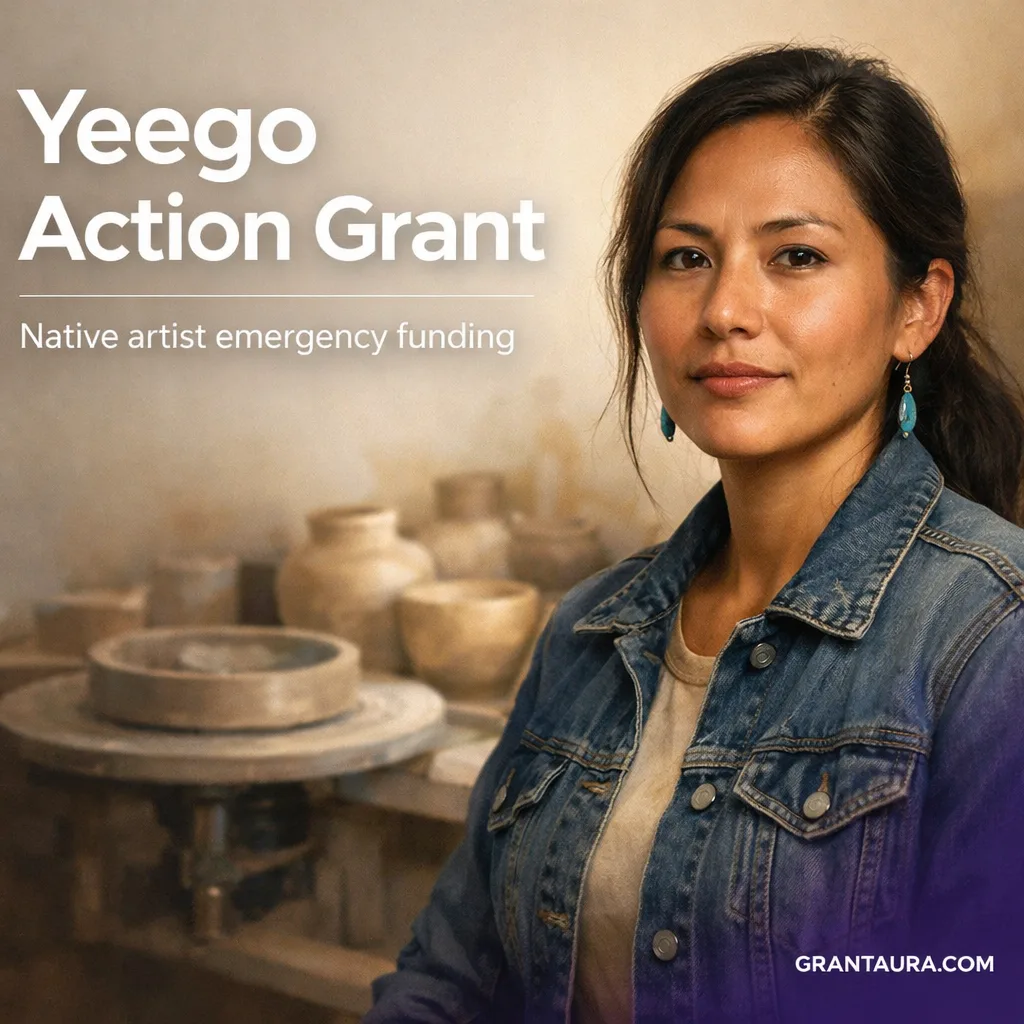
First Peoples Fund's Yéego Action Grant is live every month, and despite what several well-indexed arts directories still show, the cap is $2,500 - not the $5,000 figure that turned up when I checked. The name comes from the Dine word yeego, meaning "keep going" or "don't give up," and the program is as specific as that phrase implies. Not a general arts fund. Not project seed money. A monthly lane of up to $2,500 for a concrete hardship or a real professional opportunity that has landed on a Native artist's practice right now.
The other thing worth knowing before anything else: you can only receive this grant once in your lifetime. Not once per year. Once, ever. That makes the decision of when to apply a different kind of question than most grants ask you to answer.
Individual Native artist or culture bearer, 18 or older
U.S.-based resident
Enrolled tribal member or proof of lineal descent from a U.S. federally or state-recognized tribe
Alaska Natives and Native Hawaiians eligible with proof of ancestry
Practicing artist (verified through three recent artwork samples)
Never previously received a Yéego Action Grant
Not currently enrolled in any degree-seeking academic program
Not a current FPF grantee, fellow, or leader of an FPF grantee organization
Grant Benefits
$100-$2500 per award cycle
Partial funding may be awarded based on available funds
Monthly review and award cycle
Direct deposit after paperwork completion
Six-month impact follow-up from FPF
04
Focus Areas
Yeego Action GrantNative artist emergency grantIndigenous artist grantFirst Peoples Fund grant
Does Your Situation Qualify?
Sorting out whether your specific expense reads as a hardship or as project funding is the part that trips applicants up most - not the eligibility rules themselves, which are clear enough to work through without help. That distinction matters for your score, and getting it wrong on a lifetime-only application has real consequences. Grantaura's eligibility tool runs through the core criteria fast and flags where your situation needs a closer look.
Eligibility Check
Eligibility for Yeego Action Grant $2,500 For Artists USA by First Peoples Fund
Answer a few guided questions. Your responses are matched to this grant's criteria in real time.
Ready to check your eligibility?
We'll guide you through a short, structured flow and instantly evaluate fit for this opportunity.
Eligible
You Appear Eligible
Based on your answers, you meet the core requirements for this grant.
Recommended Next Step
Protect Your Application Before You Submit
You look eligible — but eligibility alone doesn't win grants. Most rejections happen on the application itself: missed language, wrong framing, weak impact statement. A Grantaura Expert Review takes 24–48 hours and flags every gap before the funder sees it.
✓Expert reviews your draft⏱Results in 24–48 h💰Avg. grant value $12,000+
⚠ Grant committees reject 7 in 10 applications that meet eligibility. One overlooked line can cost you thousands.
🔒 Satisfaction-backed — if our review finds nothing actionable, you pay nothing more.
This Grant Isn’t the Right Fit. Your Best One Might Be Two Clicks Away.
Missing one criterion for Yeego Action Grant $2,500 For Artists USA by First Peoples Fund doesn’t mean you’re out of options — it means this grant wasn’t designed for your profile. Our expert research team identifies the grants built specifically for businesses like yours, across 500+ active opportunities.
Basic Match
$125
One-time research
A list of 5 grants only
Basic eligibility matching based on industry & location
Standard funding amount range verification
Primary criteria alignment check
Most Popular
Advanced Match
$145
One-time research
A list of 7 grants only
Advanced eligibility matching with business model analysis
Deep competitive advantage assessment
Innovation & impact potential matching
Market fit & growth trajectory alignment
Premium Match
$175
One-time research
A list of 10 grants only
AI-powered deep-match algorithm analysis
Historical success pattern matching
Priority sector & focus area alignment
Advanced sustainability impact matching
Strategic vision & long-term goals alignment
Preparing secure checkout…
✓
Order Confirmed
Your grant research order is placed. Our team will deliver your personalised report within 3–5 business days. Check your email for confirmation.
Auto-advances after each answer. Use Back to revise.
If the tool confirms you qualify, the next step is a full application submission through Grantaura's intake so our team can review your narrative - specifically the hardship framing and the short-and-long-term impact statement - before anything goes to First Peoples Fund. If your result is unsure, especially around whether your expense qualifies as a hardship versus a professional opportunity versus a project, a live 1-on-1 video or phone call with one of our grant experts is the cleaner path before you commit your one-time eligibility. If the tool shows you do not qualify, scroll down to the related grants section - there are other Native-serving programs worth knowing about, including the NDN Collective Abundance Fund.
The $2,500 Cap - and Why Most Directories Have It Wrong
When the Yéego Action Grant launched in August 2024, First Peoples Fund's original announcement materials listed the range as $100 to $5,000. Several reputable organizations picked that figure up and published it. Arts South Dakota still shows $5,000. California for the Arts listed $1,000 to $5,000. The current official donor page and the live Submittable application portal are both clear: the actual maximum is $2,500. If you found this grant somewhere else first and the number looked different, that is the explanation. I am spelling it out because mistaking the cap affects how you write your request - asking for $3,000 in a program with a $2,500 ceiling is an automatic rejection.
What Yéego Funds
Every allowable use in this program shares one characteristic: it is connected to a specific, documentable event or circumstance. Not general artistic growth. Not an ongoing practice expense. Something concrete enough that you could attach a receipt, a repair quote, an event registration page, or an emergency news article to it. That is the practical test FPF's reviewers are running when they read your request.
Key Points
Market entry fees and booth costs for a specific art opportunity
Workshop registration and application fees
Residency travel including transportation and lodging and meals
Emergency disaster costs from fire or theft or natural disaster
Repair of damaged tools or equipment currently in use
Unanticipated transportation needs for work travel including rideshare
Unanticipated medical expenses that directly affect your ability to create
Sudden unexpected costs on a current project such as replacing damaged supplies or securing a new venue
The Uber and Lyft mention in FPF's official guidelines is worth noting - most grant programs do not name specific rideshare services. But it reflects the real situation they are solving for. An artist whose van breaks down the week of a market needs to get there. That is an eligible transportation emergency, not a request for a new vehicle.
Repair versus replacement is where the confusion tends to concentrate. Your kiln element burns out - replacing that element is a repair of equipment currently in use. Buying a second kiln to expand your capacity is a new equipment purchase. Same general category, opposite eligibility outcomes. The question is whether the expense restores something that was working or adds something new.
How FPF's Reviewers Score Applications
Clarity and specificity are what score, not narrative drama. That is worth sitting with before you write anything, because a lot of applicants approach this as a storytelling exercise when it is actually a precision exercise. The question reviewers are answering is not "is this artist's situation compelling?" It is "can I quickly understand what they need, why they need it, and how it connects to their practice?" That is a different writing task, and it is the one most people stumble on.
First Peoples Fund publishes its four scoring criteria directly in the Submittable application portal - a level of transparency that most grant programs this size do not offer. Here they are with what each criterion actually requires in practice:
Scoring Criterion
What It Requires in Practice
Amount requested is in line with intended use
Match your number to the actual cost. An invoice or repair quote as an optional upload makes this criterion easy for reviewers to evaluate without guessing.
Supporting document or link is relevant if included
Optional materials need to connect directly to your specific request. A market registration page confirms the event exists. A repair quote confirms the cost. A general portfolio link does not move your score.
Applicant expresses a clear need that aligns with grant guidelines
You are describing a hardship or an opportunity cost - not a new project. The reviewer is confirming your situation fits the program's purpose before reading further.
Applicant describes positive impact on art practice in the short and long term
Short term: what happens when you get the money. Long term: what that specific outcome enables for your practice beyond this single event.
That fourth criterion is the one most applications short-change. Describing the immediate need clearly but stopping there is the most common way to lose points when the underlying situation actually qualifies. One sentence connecting the funded outcome to what it opens - the market relationship that builds into regular income, the technique learned at the workshop that feeds your practice for the next year - is all it takes to satisfy the criterion.
Q: Does artistic merit factor into the score? A: No. The three artwork samples you upload verify that you are a practicing artist, but the quality of the work is not a scoring criterion. FPF is evaluating the clarity and fit of your funding request, not your artistic standing.
The Ineligible Side - Where Requests Fail Before They Start
Reimbursement is the first and most absolute rule. If the expense already happened before you applied, FPF will not cover it. No exceptions are documented anywhere in the current guidelines. This is not a gray area.
Do's
Request funds for a specific upcoming cost you have not paid yet
Name the exact event or expense your request is tied to
Include an optional invoice or price quote to support your amount
Show both the short-term and long-term connection to your practice
Apply as an individual artist or culture bearer
Don'ts
Request reimbursement for money already spent
Ask for new supplies materials tools or equipment purchases
Apply for funding toward a new or existing artist project exhibition or programming
Apply while currently enrolled in a degree-seeking program
Submit a group or multiple-artist application
The project-funding line is sharper than it first reads. FPF's guidelines say some hardship requests related to a current project may be eligible - but the grant is explicitly not for funding new or existing artist projects. The difference is whether the hardship is the reason for the request or whether the project is. A damaged installation piece that needs replacement materials before a committed show date - that is a hardship related to a current project, and it likely qualifies. A request for materials to begin a new series does not, even if the artist is currently active and successful. Same person, same practice, different framing outcome.
Q: My studio flooded and I lost equipment. I was also mid-project when it happened. Does the ongoing project complicate my eligibility? A: Not necessarily. Emergency disaster relief and equipment repair are both explicitly allowable uses. What matters is that your request describes the disaster and the specific damaged items, not the project. Frame the need around what was lost and what repair costs, and the project context becomes background rather than the basis of the request. If the line still feels thin for your situation, a live consultation with a grant expert can give you a judgment call before you use your one-time eligibility.
Who Qualifies for the Yéego Action Grant
Practicing Native artists and culture bearers, 18 or older, who live in the United States. The tribal affiliation requirement is broader than many applicants expect. Enrolled tribal members have the clearest path - a tribal enrollment card is typically sufficient. But enrollment is not the only route.
Lineal descent documentation is the alternative for artists who are not enrolled but can show direct ancestral connection to a U.S. federally or state-recognized tribe. That typically means tracing the documentation chain - your parent's or grandparent's enrollment record plus the birth certificates that link you to that enrolled relative. Alaska Natives can use ancestral documentation such as Alaska Native Corporation shareholder records among other accepted forms. Native Hawaiians can verify ancestry through recognized Hawaiian ancestry documentation. FPF applies the same documentation standards across their programs, and their tribal enrollment guidelines document covers what they accept. If you have questions about your specific documentation situation, emailing programs@firstpeoplesfund.org before you apply is the most reliable way to get a direct answer.
Four disqualifiers rarely appear on third-party listings of this grant:
Required Steps
Degree-seeking students are ineligible - the academic program exclusion applies regardless of whether the degree is art-related
Artists who have previously received a Yéego Action Grant are permanently ineligible - receiving the grant once closes the door
Current FPF grantees
fellows
and leaders of FPF grantee organizations are ineligible while that relationship is active - this rule was added after the August 2024 launch and does not appear on older third-party pages
Group or collective applications are not accepted under any circumstances
Q: I applied for Yéego before but was not funded. Am I still eligible? A: Yes. The lifetime ineligibility applies to artists who have received and been awarded the grant, not to everyone who has ever applied. If your previous application was reviewed but not funded, your eligibility is intact. You can apply in any subsequent cycle.
Q: I currently hold a different First Peoples Fund fellowship. Does that affect my Yéego eligibility? A: Yes. Current FPF grantees and fellows are explicitly ineligible to apply for Yéego while that relationship is active. This rule was added after the program's August 2024 launch, and some older third-party pages do not reflect it yet. Wait until your fellowship concludes before applying.
Your One Shot - A Decision Worth Making Deliberately
Most grants do not ask you to think strategically about timing. This one does. Because you can only receive the Yéego grant once, the question is not just whether you qualify - it is whether this specific moment is the right use of your single application.
I am not suggesting you hold out for a hypothetical perfect future situation. That logic is how the grant never gets used. But there is a real difference between applying for $150 in rideshare costs and applying for $1,800 to attend a market that represents a genuine turning point for your practice. The scoring rubric explicitly rewards applicants who can describe both short-term and long-term impact on their art practice, which means the higher the stakes of your specific situation, the more naturally that criterion is satisfied. Partial awards are possible - FPF may fund your request at a lower amount than you requested - so sizing your request to your actual documented cost rather than the ceiling gives reviewers less reason to discount it.
What FPF Says Applications That Score Higher Have in Common
The request was for a specific upcoming professional opportunity, unanticipated expense, or action taken in response to an emergency need. Reviewers were easily able to understand how the requested funds would be used. It was clear how the request connected to the applicant's art practice.
Those three signals from FPF's own published portal are the practical definition of a well-timed application. If your current situation produces all three naturally, the timing is probably right.
Cycle Timing and the Deposit Gap
The payment timeline is slower than the word "quick" implies - FPF's own promotional framing can create a gap in expectations worth correcting. Applications close on the 10th. Notification comes by the last day of that same month. Then paperwork, then payment. Here is the actual sequence:
Stage
Timing
Applications open
Around the 12th of each month
Applications close
April 10, 2026 at 3:00 PM MT
Notification of status
By the last day of the application month
Paperwork completion
Approximately 2 weeks after notification
Funds deposited via direct deposit
6-8 weeks after the application deadline
FPF impact follow-up
Within 6 months of funding
The planning implication is real. If you need money in hand by a specific date, count eight weeks backward from that date to identify the latest cycle you can apply in. A cycle deadline in one month, with approval by month-end, paperwork done two weeks later, and deposit arriving six to eight weeks after the deadline - that math covers an event roughly two months out. It does not cover something happening within weeks of your application.
December cycles carry an explicit caveat in FPF's portal: holiday-season processing may delay both notification and disbursement. If your timing is tight, the November cycle is lower-risk.
Q: The Submittable portal shows no close date under "ends on" - is the program still open? A: Yes. The blank "ends on" field reflects that this is an ongoing monthly program without a fixed termination date, not that applications have stopped. The current cycle deadline is April 10, 2026. A new cycle opens around the 12th of each month.
Q: Can I apply in multiple consecutive cycles before winning? A: Yes. There is no limit on how many monthly cycles you can apply in before receiving the award. Only being funded uses your lifetime eligibility. You can apply every month until you win.
What You Actually Need to Upload
No video pitch. No financial statements. No letters of recommendation. The application is shorter than most Native artist funding opportunities, which is part of why the narrative framing matters so much - reviewers have less text to work with, so weak or vague phrasing stands out faster.
Two uploads are required and cannot be skipped: proof of tribal affiliation and three recent examples of your artwork with brief descriptions for each. The artwork samples are how FPF verifies you are a practicing artist. FPF explicitly notes that not everyone maintains a website or social media presence, and sharing one is optional and does not affect your score. Traditional artists and cultural practitioners whose buyers know them personally rather than through Instagram are not disadvantaged here.
Optional materials that can meaningfully help: an invoice, a repair quote, or a budget document tied to your specific request strengthens the "amount is in line with intended use" scoring criterion. A link to an event page, a workshop registration site, or a news article about a disaster that affected you gives reviewers context for understanding your request quickly. FPF asks applicants not to upload any documents containing private medical records or sensitive personal information.
Q: I do not think of myself as an artist - I teach traditional practices, I steward knowledge, I perform ceremony. Does the "practicing artist" requirement apply to me? A: FPF explicitly includes culture bearers alongside artists throughout the program. Traditional practitioners, knowledge keepers, language stewards, regalia makers, storytellers - these are the people the program was designed for alongside those who identify primarily as artists. The three artwork samples verify active practice, and the label you use for yourself is not part of the scoring.
Q: What is the most reliable way to confirm what tribal affiliation documents FPF accepts? A: FPF maintains tribal enrollment guidelines that apply across their programs, and the most direct path is to email programs@firstpeoplesfund.org with your specific situation before applying. They address documentation questions ahead of the application deadline.
First Peoples Fund - Background and Credibility
Founded in 1995 and headquartered in Rapid City, South Dakota, First Peoples Fund works with American Indian, Alaska Native, and Native Hawaiian artists and culture bearers across the country. The Yéego Action Grant is one of several programs FPF runs, alongside year-long fellowship offerings and the Jennifer Easton Community Spirit Awards - which award $50,000 each to artists selected for their commitment to community cultural practice.
FPF received a $6 million gift in 2021 to expand its grantmaking model, which provides institutional stability relevant to a program launched as recently as August 2024. Past Yéego recipients listed on the official program page include artists from the Cherokee Nation, Oglala Sioux Tribe, Muscogee Creek, Inupiaq, Native Village of White Mountain, Kanaka Maoli, Athabascan and Aleut, and Navajo and Creek and Greek lineages - a national range of tribal nations and practices. Named past grantees include Leilehua Lanzilotti (Kanaka Maoli) and Lehuauakea Fernandez (Native Hawaiian), among others.
Getting the Framing Right Before You Submit
The biggest risk in a Yéego application is not eligibility. It is framing. The form is short and the rules are public. What scores or fails to score is how clearly and specifically the request connects the expense to the art practice - in both the immediate term and the longer term - and whether the request reads as a hardship response or as project development.
Two friction points come up in applications for this program with regularity. The first is the hardship-versus-project line. An artist writing "I am developing a new series and need funding for materials" has written a project request regardless of how active their practice is. An artist writing "My loom broke two weeks before a market I am registered for and I need $650 for the repair" has written a hardship request. Both situations involve real need. Only one fits the program. The second friction point is the short-and-long-term impact criterion - most applicants describe the immediate need clearly and stop there, missing the fourth scoring criterion entirely.
Our team reviews your draft against FPF's four published scoring criteria before anything goes to the funder - specifically the hardship framing, the impact statement, and whether your optional supporting documents are positioned to help rather than sit unused. We also verify that your tribal documentation chain is complete before you submit. These are application-stage tasks that reading this listing cannot do for you. They require someone reading your specific narrative.
Pricing for our application review is confirmed before any commitment is made, inside the submission intake flow.
The consultation is a live 1-on-1 video or phone call with a grant expert - the right move if your situation sits near the hardship-versus-project boundary and you want a real judgment call before committing your one-time eligibility.
Other Native-Serving Funding Worth Knowing
If you have already received the Yéego grant, if you are currently in another FPF program, or if your situation calls for something this program cannot cover, there are other paths worth exploring. The NDN Collective Abundance Fund provides direct cash awards to Indigenous peoples across several states with different eligibility criteria. For Native American and Alaska Native creative practitioners working in film and media, the Vision Maker Media Acquisitions Fund supports completed or near-completed projects. The grants for Native Americans and Alaska Natives category on Grantaura covers the broader landscape of current opportunities.
Grant-Specific Terms
Yéego (also spelled Yéigo in older FPF materials and some third-party sites): A Dine (Navajo) word meaning "keep going" or "don't give up." FPF chose it as this program's name to signal that the grant supports artists in difficult moments rather than funding planned creative projects. Both spellings refer to the same grant. If you are searching and finding inconsistent information across sources, the spelling variation is one reason why.
Culture Bearer: A person who actively practices and transmits cultural knowledge, traditions, and art forms within their Native community. FPF treats this identity as fully equivalent to "artist" throughout the program. Regalia makers, language practitioners, knowledge keepers, and ceremonial leads all fall within this category. The grant does not require you to identify primarily as an artist.
Hardship vs. Project: The most consequential distinction in this program. A hardship is an emergency or unexpected situation that threatens or interrupts an artist's current practice. A project is creating or developing new work. Yéego funds the former, not the latter. The boundary can be genuinely blurry when a hardship occurs mid-project, which is why FPF notes some hardship requests related to current projects may be eligible - but the request must center the hardship, not the project.
Lineal Descent: Proof that you are a direct descendant of an enrolled tribal member, even if you are not enrolled yourself. Documentation for lineal descent typically involves tracing the ancestral connection through records linking you to an enrolled relative - such as that relative's enrollment record plus the birth certificates showing your relationship to them. This path exists specifically for artists whose connection to their tribe is ancestral rather than through current formal enrollment.
Enrolled Tribal Member: A person formally registered with a federally or state-recognized tribe according to that tribe's own enrollment criteria. Criteria vary by tribe and may include blood quantum, lineal descent from a base roll, residency, or other factors. A tribal enrollment card is typically the standard document for FPF applications.
State-Recognized Tribe: A tribal entity recognized by a U.S. state government rather than the federal government. FPF accepts membership or lineal descent from state-recognized tribes as qualifying affiliation, which is a more inclusive standard than many funding programs use.
Alaska Native: A person of Indigenous heritage from Alaska whose ancestral peoples include Inupiaq, Yupik, Aleut, Eyak, Tlingit, Haida, Tsimshian, and others. Alaska Natives are eligible for the Yéego grant through proof of ancestry. Documentation may include Alaska Native Corporation shareholder records among other accepted forms.
Native Hawaiian (Kanaka Maoli): A person descended from the aboriginal peoples of the Hawaiian Islands. Native Hawaiian artists are eligible for the Yéego grant through proof of ancestry. Named past Yéego recipients include Leilehua Lanzilotti (Kanaka Maoli) and Lehuauakea Fernandez (Native Hawaiian), both listed on the official FPF program page.
Practicing Artist: For FPF's purposes, someone actively creating art as a meaningful part of their current life and work. Verified through three recent artwork examples with descriptions. No formal credentials, exhibition history, sales record, or online presence is required. The work itself is the verification.
Partial Award: A grant disbursement for less than the full amount requested. FPF explicitly reserves the right to fund requests at a lower amount based on available funds and request justification. A partial award uses your lifetime eligibility the same way a full award does - you cannot reapply after receiving any amount, partial or full.
Submittable: The online platform FPF uses to accept and review Yéego Action Grant applications. Free to create. A free account is required before you can submit, and the portal closes at 3:00 PM Mountain Time on the 10th of each month regardless of your local time zone - so if you are filing from the East Coast or Pacific time, account for that gap before you start.
Mountain Time (MT): The time zone governing the Yéego application deadline. Convert carefully. FPF is headquartered in Rapid City, South Dakota, and during Mountain Daylight Time (roughly March through November) MT is UTC-6, while during Mountain Standard Time (roughly November through March) it shifts to UTC-7 - and the Submittable portal does not remind you of the difference.
Unanticipated Expense: A cost that was not predictable or budgeted for in advance. The test is whether a reasonable person in your circumstances could have anticipated and planned for the expense ahead of time. This is the standard distinguishing eligible hardship requests from general operating costs or planned expenditures.
FPF Grantee: A current recipient of any First Peoples Fund grant, fellowship, or award program. Current FPF grantees, fellows, and leaders of FPF grantee organizations are ineligible to apply for Yéego while that relationship is active. This rule was added after the program's August 2024 launch and does not appear on older aggregator pages.
Direct Deposit: The payment method FPF uses to disburse approved Yéego grants. Funds are transferred directly to the awardee's bank account after required paperwork is completed, approximately 6-8 weeks after the monthly application deadline.
Q: Is the Yéego grant the same as a First Peoples Fund fellowship? A: No. FPF's fellowships - the Artist in Business Leadership program and the Cultural Capital Fellowship - are year-long programs awarding $10,000 that include professional development, curriculum, and training. The Yéego grant is a quick-response fund for a specific hardship or professional opportunity. They are separate programs with separate eligibility. Receiving a Yéego grant does not prevent future fellowship applications, though holding a fellowship would block Yéego eligibility while that fellowship is active.
About the Author
I research funding opportunities by going to the source - the donor pages, the live application portals, the scoring criteria that rarely make it onto third-party listings. The Yéego grant is a clear example of why that matters: the wrong maximum amount is still circulating on indexed pages from two reputable arts organizations, and the once-only lifetime rule has consequences that most applicants do not see coming. My work at Grantaura starts from the premise that the gap between a qualified applicant and a funded one is almost always a research and writing problem. You can read more at my page, or book a direct conversation at the consultation page.
Eligibility for Yeego Action Grant
The Yeego Action Grant is one of those grants that looks broad until you read the actual gate. I kept finding the same pattern while checking the official page and portal. The real question is not just whether the money sounds useful. It is whether your affiliation path, your current practice, and your application status line up cleanly enough to keep moving. That is why I built this page around the checker first. If the fit is fuzzy, I want the fuzziness to show up early, not after you have already drafted a request around the wrong kind of need. If it is a clean fit, the path is simpler than it looks, and the next step becomes a real decision instead of a guess.
What I check first
The first thing I would sort out is the Native affiliation path, because that is where most readers either feel sure or start second-guessing themselves. Enrolled tribal membership is clear. Lineal descent is clear too, once the documents exist. Alaska Native and Native Hawaiian ancestry sit in the same family of proof, and the portal wants the application to show that connection in a way the reviewers can understand fast.
The one-time rule changes the reading
I would not treat this like a grant you can test casually and circle back to later. The once-per-lifetime rule makes the application feel different, and it should. That is why the question is not only "do I qualify?" but also "is this the right moment for my one shot?" When people rush through that part, they usually write a request that feels loose where it should feel exact.
When the fit is still hazy
If the situation is close but not clean, I would use a live consultation instead of trying to force a yes. The hard parts here are rarely about the existence of the grant. They are about the border between a qualifying hardship, a qualifying opportunity, and a request that starts sounding like project support. That border is where a quick read can turn into the wrong answer, and I would rather slow down there than pretend it is obvious.
The portal asks for more than a yes or no. It asks for proof of affiliation and three recent artwork examples, which means the page is not only about eligibility in the abstract. It is about whether your documents and your practice story match the path you are claiming. That is the part I care about most here, because a strong fit can still get muddy if the evidence is loose.
[
  {
    "url": "https://grantaura.com/grant/jennifer-easton-community-spirit-award/",
    "custom_description": "This is a useful comparison point because it serves Native artists and culture bearers in a related funding lane. It helps a reader see how a recognition-style grant differs from a quick-response action grant."
  },
  {
    "url": "https://grantaura.com/grant/ndn-collective-abundance-fund/",
    "custom_description": "This grant sits in the same Native-serving funding landscape and helps readers compare audience fit. It is useful when the current request needs a different kind of Indigenous support path."
  },
  {
    "url": "https://grantaura.com/grant/vision-maker-media-acquisitions-fund/",
    "custom_description": "This is a related path for Native creative work in a different medium-specific lane. It helps a reader compare whether the need belongs in a practice-support program or a more project-centered opportunity."
  },
  {
    "url": "https://grantaura.com/grant/rauschenberg-emergency-grants-for-artists/",
    "custom_description": "This is a strong comparison when the reader is dealing with an unexpected problem rather than a broad project idea. It gives a practical emergency-relief contrast that can sharpen the decision."
  }
]
We are your trusted grant application partners. You can navigate the entire grant application process with our expert guidance through this simple 5-step process.
300+ Projects
4.9/5 Rating
Expert Team
Step 1: Application Form
Fill out the "Apply for this grant" form with your information and grant requirements.
Step 2: Eligibility Assessment
Our grant experts will assess your eligibility and notify you via email.
Step 3: Expert Consultation
A dedicated grant expert will be assigned to discuss next steps for your application.
Step 4: Application Submission
Our expert will help you complete and submit your application with all required materials.
Step 5: Final Decision
The grant committee will make their decision and notify successful applicants.
As the founder of Grantaura, I've dedicated myself to demystifying the grant funding process. My goal is simple: to empower entrepreneurs, non-profits, and innovators like you to secure the capital needed to make a real impact. Let's build your funding strategy together.
Profile data is saved in your browser and synced to secure storage when available.
Context
Grants selected0
SLA tierNot selected yet
Billing modelNot selected yet
Due today--
Total project value--
Selection preview
No grants selected yet.
Soft estimate
Estimate only. Final pricing appears in Quote step.
Quote expiry
Quote timer starts after pricing is generated.
Verification
Verification status appears here once quote is confirmed.
Success snapshot
Success milestones appear here after confirmation.
What happens next
After quote confirmation, verify your email and complete secure payment.
ProfileReviewPayment
Choose your service
Select how you want to proceed. You will review pricing before checkout.
Next stepReview pricing, then checkout
Recommended
Full service
Full Application Submission
From USD 41.40
We prepare and submit your grant application on your behalf, with priority or rush handling applied when the deadline makes faster service necessary.
No funding guarantee. If Grantaura cannot complete due to our operational failure, refund policy applies.
Assessment
Quick review
Eligibility Assessment
USD 5.99 one-time
Find out if you qualify. Results typically within 24 hours.
FreeNo card needed
Share & Submit Free
Share this grant with your network. We will assess your application at no cost.
Why does Grantaura charge a fee?
The donor does not charge you. This fee covers Grantaura's hands-on work: expert review time, eligibility checks, application drafting, and submission handling.
You will see the exact quote before checkout. Nothing is charged just for opening this screen.
Keep your post public. Our team will verify the link before processing your assessment. If the post is deleted or made private after submission, your free assessment will be void.