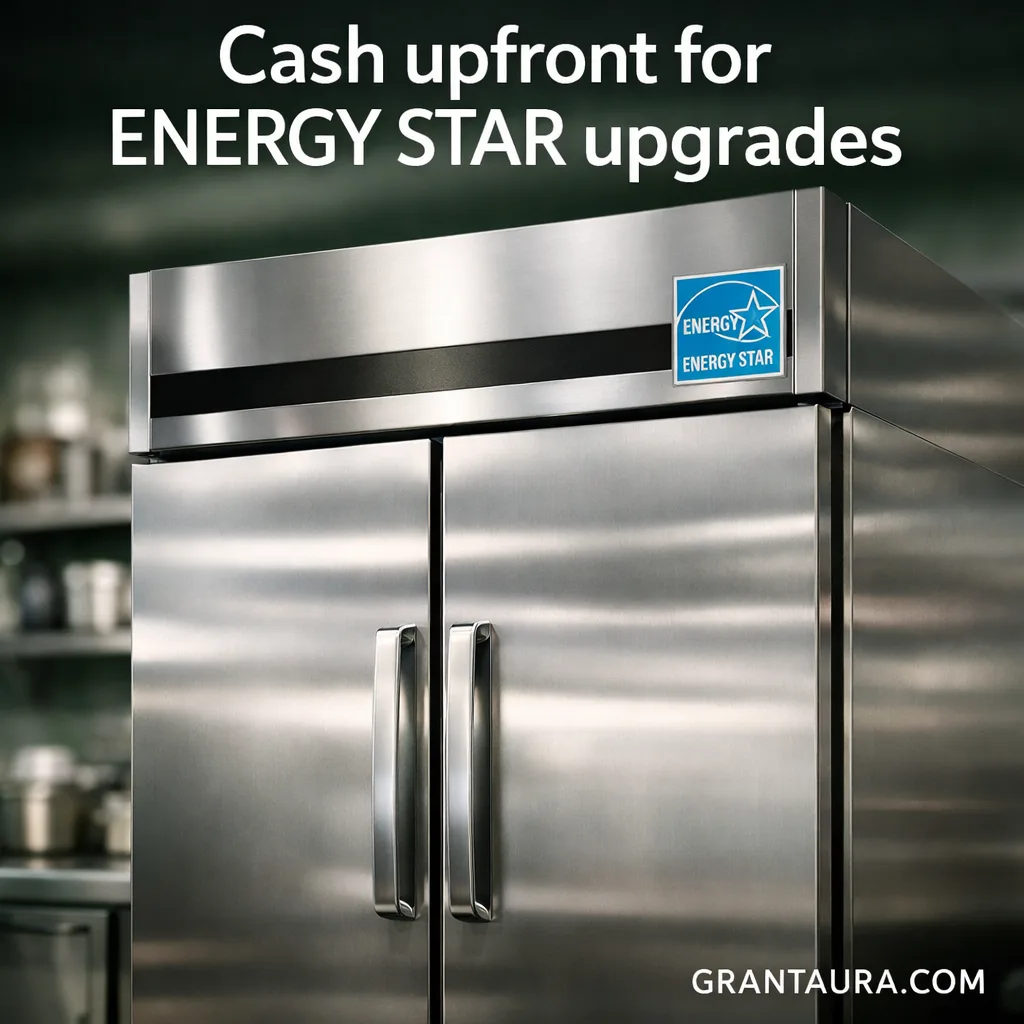
Most small business grants make you spend your own cash first, then wait months to get paid back. Denver's Certifiably Green Mini Grants flip that. They give you the money upfront - up to $10,000 - before you buy a single thing. Kim Le knows the appliance math well. She owns Sesame Sandwich Shop, and when she looked at energy-efficient commercial ovens, the price difference between a standard model and an efficient one was the whole problem - $1,500 versus $7,000 or $8,000. Without capital upfront, that gap is just a number you walk away from. This program exists specifically for that gap. Applications are accepted on a rolling basis until funding runs out, which means your timing strategy matters as much as your project idea. About 30 businesses get funded each cycle.
Sesame Sandwiches used theirs to buy an ENERGY STAR cooler before their old one died. Not because it was broken - because they heard about this program in time. That's the window. More on upfront vs reimbursement grants here.
Brick-and-mortar business or nonprofit within Denver city limits
Active TIN or EIN with Colorado Secretary of State registration
Current Certificate of Good Standing from Colorado Secretary of State
W-9 on file with address matching Secretary of State filing
Project must be completable by end of calendar year 2026
NEST (Neighborhood Equity and Stabilization) neighborhoods receive priority consideration
Home-based businesses and food trucks explicitly ineligible
Grant Benefits
$10000 USD
Upfront funding - cash before purchase, not reimbursement
No matching funds required
Can combine multiple eligible purchases in one application
04
Focus Areas
Certifiably Green Denver Mini GrantsDenver small business sustainability grantDenver green business funding
Not sure if you qualify yet? The eligibility tool below walks through the requirements - takes about 90 seconds. It flags common mismatches like a W-9 address that doesn't line up with your Colorado Secretary of State filing, which is a surprisingly frequent rejection reason.
Eligibility Check
Eligibility for Certifiably Green Denver Mini Grants: Cash Before You Buy
Answer a few guided questions. Your responses are matched to this grant's criteria in real time.
Ready to check your eligibility?
We'll guide you through a short, structured flow and instantly evaluate fit for this opportunity.
Eligible
You Appear Eligible
Based on your answers, you meet the core requirements for this grant.
Recommended Next Step
Protect Your Application Before You Submit
You look eligible — but eligibility alone doesn't win grants. Most rejections happen on the application itself: missed language, wrong framing, weak impact statement. A Grantaura Expert Review takes 24–48 hours and flags every gap before the funder sees it.
✓Expert reviews your draft⏱Results in 24–48 h💰Avg. grant value $12,000+
⚠ Grant committees reject 7 in 10 applications that meet eligibility. One overlooked line can cost you thousands.
🔒 Satisfaction-backed — if our review finds nothing actionable, you pay nothing more.
This Grant Isn’t the Right Fit. Your Best One Might Be Two Clicks Away.
Missing one criterion for Certifiably Green Denver Mini Grants: Cash Before You Buy doesn’t mean you’re out of options — it means this grant wasn’t designed for your profile. Our expert research team identifies the grants built specifically for businesses like yours, across 500+ active opportunities.
Basic Match
$125
One-time research
A list of 5 grants only
Basic eligibility matching based on industry & location
Standard funding amount range verification
Primary criteria alignment check
Most Popular
Advanced Match
$145
One-time research
A list of 7 grants only
Advanced eligibility matching with business model analysis
Deep competitive advantage assessment
Innovation & impact potential matching
Market fit & growth trajectory alignment
Premium Match
$175
One-time research
A list of 10 grants only
AI-powered deep-match algorithm analysis
Historical success pattern matching
Priority sector & focus area alignment
Advanced sustainability impact matching
Strategic vision & long-term goals alignment
Preparing secure checkout…
✓
Order Confirmed
Your grant research order is placed. Our team will deliver your personalised report within 3–5 business days. Check your email for confirmation.
Auto-advances after each answer. Use Back to revise.
If the tool shows you're eligible, the next step is getting your project reviewed before you submit. That's where our experts come in. If you're unsure about something - maybe your W-9 address doesn't match your Secretary of State filing, or you're not certain about your NEST neighborhood status - Book a live 1-on-1 consultation with a grant expert instead. And if you're not eligible? Scroll down to the More Grants section. There are other Denver programs that might fit, or we can point you toward matched grants research based on your profile.
The upfront funding difference
This isn't a reimbursement program. You don't spend your own money, wait months, then beg for a check. The city gives you the cash before you buy anything. You get the award, you purchase the equipment, you submit receipts to prove it happened. That's the whole sequence. It's rare for a city sustainability program to work this way, which is why most people assume the opposite. Don't assume. The upfront structure is the single biggest reason to prioritize this grant over utility rebates that make you front the capital yourself.
What the money actually buys
The city publishes a clear allowable list. ENERGY STAR certified appliances - refrigerators, dishwashers, HVAC equipment. WaterSense fixtures and toilets. Smart irrigation systems and xeriscaping (replacing grass with drought-tolerant landscaping). Reusable to-go ware, dispensers, bags. Bike racks installation. Electric bikes for staff or deliveries. RTD EcoPasses for staff. Upcycling projects. Food waste prevention. Shading systems to reduce summer heat. Water bottle filling stations.
But here's the thing people get wrong. Electric vehicles? Explicitly banned. I double-checked this because it's counterintuitive - a green grant that won't fund EVs. The city prioritizes emissions reductions from buildings and operations, not transportation. E-bikes for deliveries are fine though. Go figure.
The program's five certification criteria categories give you a useful framework for thinking about your project:
CGD Category
What It Covers
Example Projects
Energy
Reducing energy use or improving efficiency
ENERGY STAR commercial refrigerators and dishwashers
Water
Conserving water or upgrading fixtures
WaterSense toilets and low-flow faucets
Waste
Diverting waste from landfill or reducing generation
Composting programs and reusable packaging
Transportation
Reducing fleet emissions or encouraging alternative transit
Bike racks for staff and e-bikes for deliveries
Business Management
Training and process improvements for environmental impact
Sustainability training and green procurement policies
Each purchase needs to be ENERGY STAR or WaterSense certified where those standards exist. You don't need to be a Certifiably Green Denver member already - the application doesn't require it. But the program has certified over 420 Denver businesses, so you'd be in good company.
Who actually qualifies
Let me save you some time. You need a physical brick-and-mortar location inside Denver city limits. Not a home-based business. Not a food truck. Nonprofits qualify alongside small businesses - that's in the official guidelines. You'll need an active TIN or EIN, registration with the Colorado Secretary of State, and a Certificate of Good Standing. Your W-9 address must match what's on file with the state. Mismatches get applications rejected.
If you're in a NEST neighborhood - Denver's Neighborhood Equity and Stabilization zones, basically lower-income areas the city is actively trying to stabilize - your application gets priority. The city doesn't publish the scoring rubric, but the preference is explicit. The NEST Neighborhood Business Fund is another program worth looking at if you're in one of these areas.
The donor page says you need to meet SBA size standards but doesn't specify which ones. Standard small business definition applies - under 500 employees for most industries. Denver Climate Protection Fund rebates are another option if you're working on energy efficiency.
The two-portal dance: Submittable to APTIM
This is where the donor page gets vague. Let me walk through what I found.
First, you submit through Submittable - it's a custom portal, not a simple online form. You'll describe your project and list each purchase with product links or quotes. Then the city reviews applications on a rolling basis. If selected, you don't deal with the city directly after that point. A company called APTIM reaches out. They handle the scope of work document, budget approval, terms and conditions signature, invoice processing, and finally cutting the check.
Default payment method? A physical check mailed to you. Very 1990s but whatever works. You get the cash before you buy anything - that's the key difference from reimbursement grants. Then you make your purchases, submit receipts to APTIM's portal, and you're done.
One more requirement that surprises people: your business needs $1 million in commercial general liability insurance, and the policy must name the City and County of Denver as an additional insured. Most small business policies can add this endorsement, but you need to request it. The ACORD certificate becomes non-negotiable once you win.
One awardee, Alyssa Housh at The Organic Salon, told Denver7: "I felt like the application was easy to understand and navigate. The information requested was not overwhelming." That's a real quote from someone who went through it.
Required documents - and the mismatch that kills applications
The application asks for four things. Your W-9 - use last year's copy if the address still matches. Certificate of Good Standing from the Colorado Secretary of State - here's how to get one if you don't have it. A project description - what you're buying and why it reduces emissions or saves water. And an itemized budget breakdown with product links or quotes.
Address mismatches between your W-9 and your Secretary of State filing are a common disqualifier. Not "close." Not "basically the same." Exact. A minor difference - a suite number formatted differently, an abbreviation versus a spelled-out street type - can stall your application during verification. Check this before you apply. If they don't match, update one or the other first.
The Certificate of Good Standing also needs to be current. Not from six months ago. Not "I think it's still valid." Current. The Colorado Secretary of State portal lets you request one online, usually within a few business days. Factor that timeline into your application planning.
Track record: real businesses, real money
The city has distributed over $650,000 since the program started in 2022. In 2024 alone, 25 businesses got funded. The press release lists names: Sesame Sandwiches, Quince Coffee House, Novel Strand Brewing, The Denver Cat Company, EarthLinks. These are real Denver businesses. The Denver Cat Company used their grant for a new ENERGY STAR cooler. EarthLinks got RTD passes for staff, an ice machine, and faucet installation.
About 30 businesses get funded per cycle, according to program administrator Gerardo Aguilera. That's not a huge number, which means when the money's gone, it's gone.
What I don't know yet (and neither does the city page)
The 2026 open date isn't published yet. The city's page just says "later this month" as of January 2026. I'm checking weekly. The scoring rubric isn't public either - the city just says NEST neighborhoods get preference and projects need to reduce emissions or save water. Whether past awardees can apply again? Not addressed anywhere. If you got funding in 2024, I don't know if you're eligible for 2026. The program contact is certifiablygreendenver@denvergov.org if you want to ask.
But the rolling deadline structure is clear: apply when you're ready, but when the funds exhaust, that's it for the cycle.
Frequently asked questions
Q: Do I need to be a Certifiably Green Denver member to apply?
A: The application doesn't require it. The program has certified over 420 businesses, but membership isn't listed as a prerequisite. That said, being certified probably doesn't hurt.
Q: My W-9 address doesn't match my Secretary of State filing. What do I do?
A: Fix it before you apply. Update one or the other. Address mismatches are a common disqualifier per the application checklist. This is the single most avoidable rejection reason.
Q: Can I apply for multiple projects in one grant?
A: Yes. The itemized budget can include multiple purchases - an ENERGY STAR fridge, bike racks, and xeriscaping all in one application. Just list everything with product links or quotes.
Q: How fast do I get the money after approval?
A: The research doesn't have a specific timeline. APTIM handles payment after scope approval and terms signature. The default is a physical check mailed to you. Plan for weeks, not days.
Q: What if my project scope changes after approval?
A: You work with APTIM on the scope of work document before money changes hands. That's the time to adjust. Once the check is cut, you're locked in.
Q: I'm in a NEST neighborhood. How do I prove it?
A: The city doesn't specify documentation. Use your business address. The NEST map is public on Denver's website - check your address there.
Q: Can a food truck or home-based business apply?
A: No. Both are explicitly excluded in the official guidelines with no exceptions documented. If you have a brick-and-mortar location plus a food truck, email the program to ask whether the stationary business qualifies independently.
Q: Can I reapply if I received a grant in a previous cycle?
A: Not confirmed in publicly available documentation. Email certifiablygreendenver@denvergov.org with your previous award details before investing time in a second application.
Grant terms you'll see in this program
Upfront funding: You receive the grant money before making purchases, then submit receipts afterward. Opposite of reimbursement.
NEST neighborhoods: Neighborhood Equity and Stabilization zones - Denver's equity areas that receive priority for certain city programs.
Certifiably Green Denver: The city's sustainability certification program for businesses. Separate from the mini grant but run by the same office.
APTIM: Third-party program partner that handles scope approval, budget review, and payment processing after the city selects your application.
Submittable: The application portal. Custom online forms, document uploads, and messaging system.
Certificate of Good Standing: Document from Colorado Secretary of State proving your business is registered and compliant.
ENERGY STAR: EPA certification for energy-efficient appliances. Required for appliance purchases through this grant.
WaterSense: EPA certification for water-efficient fixtures. Required for toilets, faucets, irrigation.
Xeriscaping: Landscaping that reduces or eliminates the need for irrigation. Eligible expense.
Additional insured: Your $1M liability policy must name the City and County of Denver as an additional insured. The ACORD certificate is required post-award.
Rolling deadline: Applications accepted continuously until funds are exhausted. No fixed cutoff date.
More Denver funding opportunities
If this grant isn't the right fit - maybe you're home-based, or you need EV charging stations, or you just missed the window - there are other programs. The Colorado Energy Office offers similar funding for energy efficiency projects. Xcel Energy has business rebates for appliances. And Denver's Climate Protection Fund runs rebate programs year-round.
The Breva Thrive Grant offers $5,000 quarterly to small businesses with fewer than 50 employees. It's less strict about project categories, so if your sustainability idea is creative but doesn't fit cleanly into energy/water/waste, try this.
Here's the reality. The eligibility criteria are clear enough - you can read them above. But most rejections in this program happen in the narrative, the budget section, and the paperwork gaps. Specifically, how you describe your project's emissions reduction or water savings. Whether your project maps cleanly to one of the five CGD categories. Whether your W-9 address matches your state filing. Whether your insurance certificate has the correct "additional insured" wording.
What you think is a strong impact statement might not match what reviewers in this program expect. The CGD criteria alignment requirement is not a form field you fill out and move past. It's the core of your application, and it demands project descriptions written to specific sustainability impact language that the city's reviewers recognize as matching the certification framework. A project that is genuinely good but described in generic terms - "we want to reduce our environmental footprint" - reads differently than one that maps explicitly to the energy efficiency category, quantifies the expected reduction, and connects that reduction to the CGD criteria in the language the program actually uses.
Our experts have reviewed dozens of sustainability grant applications. We catch phrasing errors before submission - not what the rule says, but whether your wording triggers a reviewer's "this feels weak" reflex. We also flag document gaps (that W-9 address mismatch thing kills applications, and the insurance requirement trips up winners after selection) and help position your project competitively relative to other applicants in the same cycle.
Do's
Map your project to one or two CGD criteria categories before you write
Get your project scope reviewed before Submittable
Catch W-9 address mismatches before they disqualify you
Check that your insurance policy can name Denver as additional insured
Optimize your impact narrative for measurable outcomes
Don'ts
Submit without a second pair of eyes on your budget
Assume your emissions reduction claim is strong enough
Wait until the money runs out to start your application
Use the same narrative you'd write for a different grant
Ignore the insurance requirement until after selection
Complexity tier for this grant: complex. Why? You need four documents, the portal is custom (Submittable, not a simple online form), and the process is multi-phase (city review then APTIM scope approval then payment). Our pricing reflects that complexity - the exact quote appears in the application submission intake modal before payment, with options for upfront, milestone, or per-submission billing.
If you're serious about applying, here's what I'd do. Let our team review your project description and budget before you touch Submittable. We'll tell you if it fits - not in vague terms, but line by line.
If you're still unsure whether your project qualifies - maybe it's borderline on the allowable list, or you're not certain about your NEST neighborhood status, or the insurance requirement has you confused - Book a live 1-on-1 consultation with a grant expert instead. Video or phone call. We'll walk through your specific situation.
About the author
I've been tracking small business grants since before Grantaura existed. Not because I'm a grant writer by training - I'm not. Because I kept seeing business owners leave money on the table, not because they weren't qualified, but because the donor pages were confusing or buried the key details. This grant's upfront funding model is rare. Most city programs don't work this way. If you're in Denver with a brick-and-mortar location, this is worth your time. I update this listing as the city announces new cycles. Questions? The consultation link above goes to my calendar. You can also read more about my approach on my author page.
I've seen too many Denver business owners spend hours on applications they never should have started. Let me save you that time. The Certifiably Green Denver Mini Grants are for brick‑and‑mortar shops, restaurants, and nonprofits inside Denver city limits - not home‑based operations, not food trucks. The money is upfront, up to $10,000, for real equipment and installations that cut energy use, save water, reduce waste, or improve transportation. The eligibility checker below walks you through every rule the city actually enforces. If you qualify, we'll help you submit an application that reviewers actually want to read. If you don't, we'll point you to funding that fits your situation instead of wasting your time.
Why Denver created this program (and why it matters for your cash flow)
The city knows that most small businesses can't front $10,000 for an energy‑efficient refrigerator or a xeriscaping project and then wait months for reimbursement. So they flipped the model. You get the cash first. Then you buy. Then you prove it happened. That structure alone makes this grant worth checking even if you're not sure your project qualifies. Because if you're tired of watching your utility bills climb and you have a physical address in Denver, you're already in the conversation.
The NEST neighborhood advantage (and why you should check your address)
Denver's NEST neighborhoods - short for Neighborhood Equity and Stabilization - get priority scoring. That doesn't mean you're out if you're not in one. It means if your shop is in a NEST zone, mention it prominently in your application. The city doesn't publish the full scoring rubric, but this preference is explicit. You can look up the NEST map on Denver's website. If your address falls inside, that's a strategic advantage worth highlighting.
The hidden gate: CGD criteria alignment
Most applicants read the allowable list and think "great, my project fits." But the city evaluates your project against the Certifiably Green Denver certification criteria - even though certification itself is not required. That means your project description needs to speak the language of the five categories: energy, water, waste, transportation, and business management. A vague "we want to be more sustainable" won't cut it. You need to say: "This ENERGY STAR refrigerator will reduce our annual electricity consumption by an estimated X kilowatt‑hours." Measurable. Specific. Aligned. That's what reviewers look for.
If you're not sure how to frame your project against those categories, you're not alone. Most applicants get this wrong. and our team will review your project framing before it goes to the city.
What to do if the eligibility tool says you're not eligible
Don't force it. The tool is strict because the city is strict. If you're a home‑based business or a food truck, this program isn't for you. But Denver has other sustainability funding. Scroll down to the related grants section or use our grants research service to find programs that match your actual situation. Wasting time on a grant you can't win is worse than skipping it entirely.
[
  {
    "url": "https://grantaura.com/grant/colorado-energy-office-small-business-grant/",
    "custom_description": "Colorado offers funding for energy efficiency projects across the state. If your business is just outside Denver or you need a different scale of support, this is a strong alternative that doesn't require a Denver-specific address."
  },
  {
    "url": "https://grantaura.com/grant/denver-climate-protection-fund-rebates/",
    "custom_description": "Denver's Climate Protection Fund rebates are another city program for energy and water upgrades. Unlike the mini grant, rebates are reimbursement-based, but they cover some projects this grant does not."
  },
  {
    "url": "https://grantaura.com/grant/xcel-energy-colorado-business-rebates/",
    "custom_description": "Xcel Energy offers prescriptive rebates for ENERGY STAR appliances and lighting retrofits. These can be stacked with the Denver mini grant for larger projects, as they come from a utility, not the city."
  },
  {
    "url": "https://grantaura.com/grant/nest-neighborhood-business-fund/",
    "custom_description": "The NEST Neighborhood Business Fund is a separate Denver program that also prioritizes businesses in equity zones. If you qualify for NEST preference, this is another source of capital for physical improvements."
  },
  {
    "url": "https://grantaura.com/grant/denver-sustainable-transportation-grant/",
    "custom_description": "Denver's Sustainable Transportation Grant focuses on bike infrastructure, e-bikes, and RTD passes. If your project falls into the transportation category, this program may offer additional or complementary funding."
  },
  {
    "url": "https://grantaura.com/grant/epa-energy-star-small-business/",
    "custom_description": "The EPA's ENERGY STAR program provides resources and recognition for small businesses that adopt energy-efficient equipment. While not a direct funding source, certification can strengthen applications to city programs like this one."
  },
  {
    "url": "https://grantaura.com/grant/colorado-water-conservation-rebates/",
    "custom_description": "Colorado's water conservation rebate programs cover WaterSense fixtures, xeriscaping, and smart irrigation. For water-heavy projects, combining this with the Denver mini grant can stretch your budget further."
  },
  {
    "url": "https://grantaura.com/grant/denver-small-business-recovery-grant/",
    "custom_description": "Denver's Small Business Recovery Grant supports operational costs, not just equipment. If your sustainability project is part of a broader business stabilization effort, this program has different eligibility rules worth exploring."
  },
  {
    "url": "https://grantaura.com/grant/colorado-main-street-revitalization-grant/",
    "custom_description": "The Colorado Main Street program funds physical improvements to commercial facades and interiors in designated districts. If your energy upgrade is tied to a larger storefront renovation, this grant can pair well with the mini grant."
  },
  {
    "url": "https://grantaura.com/grant/economic-development-administration-public-works/",
    "custom_description": "EDA Public Works grants are larger and more complex, but they fund infrastructure like shared utility upgrades or district‑wide efficiency projects. For a group of Denver businesses collaborating, this federal program is a different scale entirely."
  },
  {
    "url": "https://grantaura.com/grant/nsf-sbir-phase-i/",
    "custom_description": "For Denver businesses developing novel sustainability technology, the NSF SBIR program funds R&D with grants up to $275,000. It's a very different application process, but the overlap is green innovation."
  },
  {
    "url": "https://grantaura.com/grant/breva-thrive-grant-5000-quarterly/",
    "custom_description": "The Breva Thrive Grant offers $5,000 quarterly to small businesses with fewer than 50 employees. It's less strict about project categories, so if your sustainability idea is creative but doesn't fit cleanly into energy/water/waste, try this."
  }
]
We are your trusted grant application partners. You can navigate the entire grant application process with our expert guidance through this simple 5-step process.
300+ Projects
4.9/5 Rating
Expert Team
Step 1: Application Form
Fill out the "Apply for this grant" form with your information and grant requirements.
Step 2: Eligibility Assessment
Our grant experts will assess your eligibility and notify you via email.
Step 3: Expert Consultation
A dedicated grant expert will be assigned to discuss next steps for your application.
Step 4: Application Submission
Our expert will help you complete and submit your application with all required materials.
Step 5: Final Decision
The grant committee will make their decision and notify successful applicants.
As the founder of Grantaura, I've dedicated myself to demystifying the grant funding process. My goal is simple: to empower entrepreneurs, non-profits, and innovators like you to secure the capital needed to make a real impact. Let's build your funding strategy together.
Profile data is saved in your browser and synced to secure storage when available.
Context
Grants selected0
SLA tierNot selected yet
Billing modelNot selected yet
Due today--
Total project value--
Selection preview
No grants selected yet.
Soft estimate
Estimate only. Final pricing appears in Quote step.
Quote expiry
Quote timer starts after pricing is generated.
Verification
Verification status appears here once quote is confirmed.
Success snapshot
Success milestones appear here after confirmation.
What happens next
After quote confirmation, verify your email and complete secure payment.
ProfileReviewPayment
Choose your service
Select how you want to proceed. You will review pricing before checkout.
Next stepReview pricing, then checkout
Recommended
Full service
Full Application Submission
From USD 41.40
We prepare and submit your grant application on your behalf, with priority or rush handling applied when the deadline makes faster service necessary.
No funding guarantee. If Grantaura cannot complete due to our operational failure, refund policy applies.
Assessment
Quick review
Eligibility Assessment
USD 5.99 one-time
Find out if you qualify. Results typically within 24 hours.
FreeNo card needed
Share & Submit Free
Share this grant with your network. We will assess your application at no cost.
Why does Grantaura charge a fee?
The donor does not charge you. This fee covers Grantaura's hands-on work: expert review time, eligibility checks, application drafting, and submission handling.
You will see the exact quote before checkout. Nothing is charged just for opening this screen.
Keep your post public. Our team will verify the link before processing your assessment. If the post is deleted or made private after submission, your free assessment will be void.