Manufacturing Assistance Program (MAP)
Hawaii MAP reimburses up to 20% of qualified manufacturing costs for NAICS 31-33 businesses, capped at $100K.


Your next step
See what this grant would take before you commit
Review your fit first, then choose the level of help you want. You can start with an eligibility assessment, talk through the opportunity with an expert, or get full application support.
Sign in to pin this grant with deadline alerts, matched-grant context, and a task tracker tied to this opportunity.
Sign in to save this grantGrant Overview
The Manufacturing Assistance Program Hawaii has a documented 50% scoring floor that eliminates applications before the budget is even discussed[1]. HTDC board records show about two thirds of applicants get funded[2], but the third that misses out usually falls on that score threshold or a preventable document mistake.
This page maps the cash-flow reality, the receipt-numbering trap, and the post-award load so you can decide whether the opportunity fits your shop before the next window opens.
Manufacturing Assistance Program (MAP)
- Grant Award
- $100,000
- Application Deadline
- February 13, 2027
- Eligible Region
- Hawaii, United States
- NAICS 31-33 manufacturer
- Must own and operate manufacturing equipment in Hawaii
- Current Hawaii Compliance Express (HCE) status
- Compliant status certificate required before disbursement
- 9-digit DUNS number (not UEI)
- Required before funds are released
- Registered to do business in Hawaii
- Current on state and federal taxes
- Only one MAP application per fiscal year per company
The eligibility tool below checks the baseline requirements HTDC screens first: NAICS classification, HCE compliance status, and DUNS readiness. It is a quick reality check before you invest time in the document stack.
The Reimbursement Math That Changes How You Read “Up to $100K”
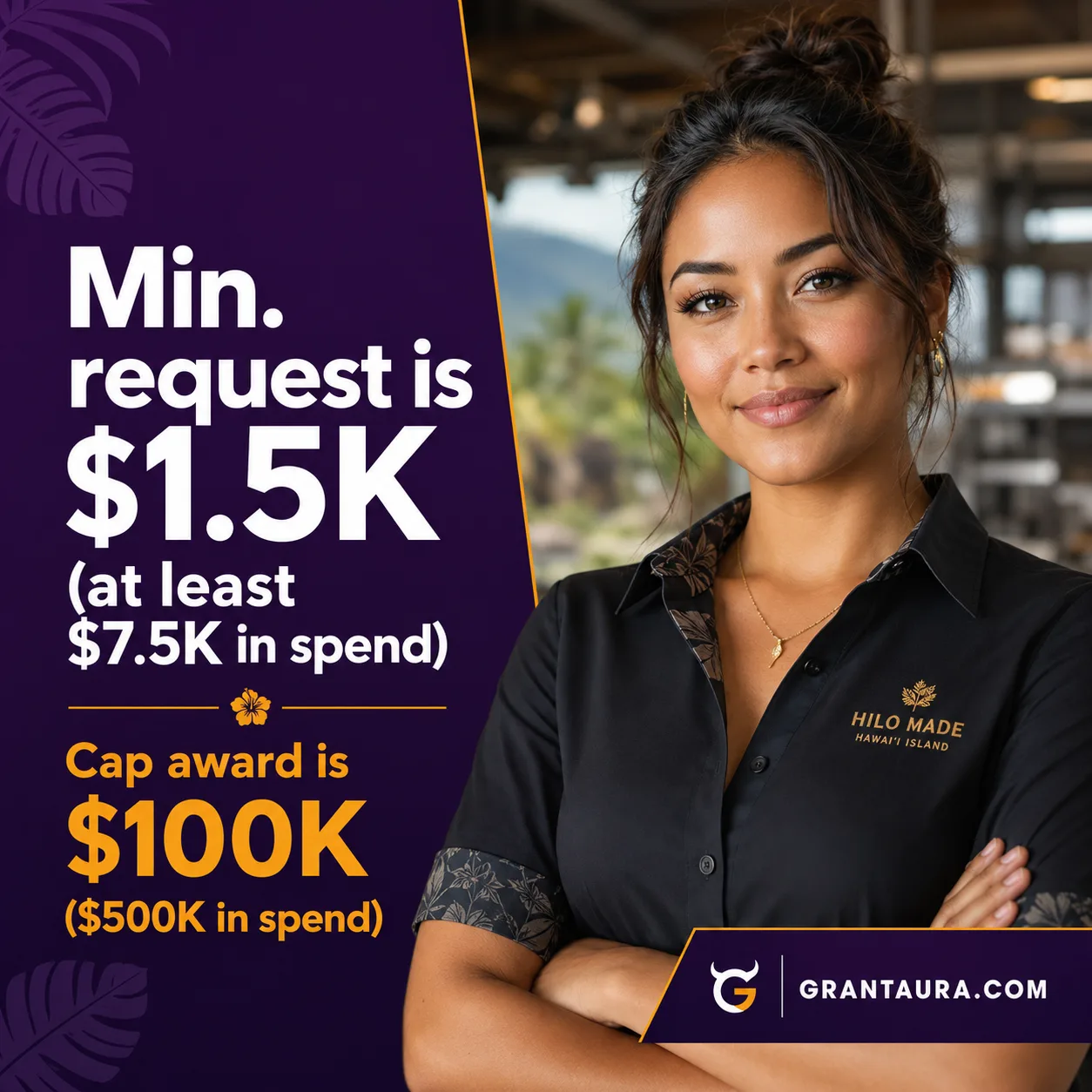
MAP is not a grant where someone writes a check toward your next equipment purchase. You spend your own money first on qualified equipment, training, energy upgrades, or feasibility studies. Then you submit proof of payment and request reimbursement of up to 20% of what you spent. The minimum request is $1,500, which means at least $7,500 in qualifying spend. The cap of $100,000 requires roughly $500,000 in qualified costs.
One detail that most aggregate lists omit: purchases made as far back as July 1, 2020 can still qualify[6]. If you bought eligible manufacturing equipment in 2021 or 2022 and still have the original receipts with the vendor name visible, you may be able to claim those costs retroactively. That changes the calculation for established shops that were not thinking in terms of new spending cycles.
The upfront cash demand is the first real filter. MAP rewards your investment after it happens. If paying now and waiting months for reimbursement would stress your operations, factor that delay into your project timeline before committing to the application.
How the HTDC MAP Review Actually Decides
After the window closes, applications move through HTDC staff screening, then a MAP Review Committee scores and ranks them, and finally the HTDC board approves the recommended awards. This is a multi-phase process, not a single yes-or-no check.
Any application scoring below 50% is not selected for funding, regardless of how much money is left in the pool[1]. That floor is documented in HTDC’s internal allocation memos. The committee then tiers the survivors. Higher-scoring applications receive larger awards relative to their requests; lower-scoring ones may receive nothing if the $1 million pool depletes before reaching them.
HTDC board minutes from late 2025 confirm that about two thirds of MAP applicants get funded[2]. That count applies to applications that cleared the initial screening. MAP is competitive but achievable if the paperwork is tight and the growth forecast is specific.
One scoring factor worth knowing early: neighbor island manufacturers receive preference points in the committee review[7]. If your operation is on Maui, Kauai, or the Big Island, that is a genuine scoring advantage most general Hawaii grant pages never mention.
These recipients were confirmed through official grant program records.Who received this grant
The Document Stack and Labeling Traps
There are eight separate items HTDC expects before you hit submit. The list is public. The failure modes are not. Most rejections at the screening stage come down to one of three things: an expired HCE certificate, a missing or wrong DUNS number, or a receipt that does not match the numbered line on the expense list.
Renew HCE certificate before the window opens Obtain a 9-digit DUNS number not a UEI Download the official HTDC Excel expense template Number every receipt to match its expense line
The numbering rule matters more than it sounds. The MAP Review Committee does not re-number your documents. If the receipt you labeled “3” does not correspond to line item 3 on your HTDC expense list, that discrepancy can move your application out of the eligible pool before anyone reads your growth forecast. The fix is simple but it requires you to build the expense list first and then match every receipt to it before uploading.
Current HCE certificate 9-digit DUNS number Signed IRS W-9 Company financials Numbered expense list on HTDC Excel template Matching payment receipts with vendor names visible 3-year growth projections with salary and job targets Equipment justifications with make and model The 3-year forecast is what most applicants underinvest in. HTDC weights economic impact and financial viability in the scoring. A forecast that lists vague revenue growth without specific hiring numbers or salary targets can drop your total score below the 50% floor even when your equipment purchase is solid. One MAP application per company per fiscal year. Submitting a second application in the same cycle disqualifies both. Confirm you are submitting once and only once before the window closes.Required Steps
Growth Initiative Template
Strategic Asset
Showcase Presentation Guide
What You Agree to After the Money Arrives
MAP is not a one-time check. Grantees must complete two annual surveys for five years and keep the purchased equipment in Hawaii for at least two years[4]. The surveys track employment and sales impacts. If you move the equipment out of state or sell it within that two-year window, the state can recover the funds. Build the reporting calendar into your operations before you sign the award letter, not after.
Cycle Status and FY27 Uncertainty
The FY26 cycle closed on February 13, 2027. HTDC received 67 applications for its $1 million pool. Award notifications are expected in May 2026 after board approval. If you are reading this now, the practical move is to watch who gets funded this cycle and get your documentation ready for the next annual window.
FY27 funding is not confirmed. October 2025 board minutes record that MAP funding was not included in the preliminary outlook[5]. Legislative proposals like HB454 have sought to restore HTDC appropriations, but the final budget outcome remains unresolved. Prepare as if a FY27 cycle will open, but do not make capital commitments that depend on it.
Frequently Asked Questions
Do I need a DUNS number or can I use my UEI?
HTDC still requires a 9-digit DUNS number before funds are paid out[3]. Your federal UEI does not substitute for this state-level requirement. If you do not have a DUNS number, email mfggrant@htdc.org for help before the window opens.
How much cash do I need upfront to reach the maximum award?
Because MAP reimburses 20%, reaching the $100,000 cap requires roughly $500,000 in qualified spend. The minimum request of $1,500 implies $7,500 in qualifying costs. Those are the two ends of the range; your actual reimbursement sits at 20% of whatever you spend on eligible items.
What happens if my application scores below 50%?
It is not selected for funding. The 50% score floor is a hard cutoff. It applies regardless of how much money remains in the pool at the time of review.
Can I apply if I am not on Oahu?
Yes. Neighbor island applicants receive preference points in the committee scoring. That is a genuine scoring advantage for manufacturers on Maui, Kauai, and the Big Island.
What expense types qualify?
Manufacturing equipment integral to your process, training on that equipment, energy efficiency improvements, and facility feasibility studies all qualify. Product components such as bottles and labels, consumables such as lubricants and drill bits, wages, and real estate do not.
What are the post-award obligations?
Two annual surveys for five years, tracking employment and sales impacts. Purchased equipment must stay in Hawaii for at least two years. Moving it out of state or selling it within that window triggers a clawback.
Terms Worth Knowing
HCE means Hawaii Compliance Express, the state compliance check that has to stay current.
Score floor means the minimum score needed to stay in the award pool.
Reimbursement means you spend first and claim part of that spend back later.
DUNS is the 9-digit Dun and Bradstreet identifier HTDC requires for disbursement, distinct from the federal UEI.
How Grantaura Helps With This Grant
The MAP application is technical in ways that experience with other grants does not automatically fix. The expense-list numbering must match your receipts exactly. The DUNS requirement still applies even after the federal shift to UEI. And the 3-year forecast can drop you below the 50% floor if it lacks specific job and revenue data. These are the friction points that separate funded applications from the stack that gets screened out.
If you are uncertain whether your expense records, forecast, and compliance posture would survive HTDC’s screening, a Grantaura expert can walk through your situation before you commit to a full build. We offer a Grant Assessment to check your document readiness and forecast quality, and the assessment fee can be applied toward the Full Application for the same grant.
Your Grant Assessment fee is non-refundable, but the base fee can be deducted once toward the same grant’s Full Application when you select that option at checkout.
Prefer a conversation first? Book a live consultation with a grant expert.
Related Grants for Hawaii Manufacturers
If the cash-flow timing on MAP does not work right now, or your NAICS code sits outside 31-33, there are a few pages worth checking. The Prose 10K AANHPI Entrepreneur Grant targets Pacific Islander founders at the business-building stage. The NJ Small Business Improvement Grant runs a similar reimbursement model if you have operations in New Jersey. For manufacturers looking at larger capital projects, the Strategic Supply Chain Initiative in Connecticut covers a wider award range for expansion work.
How to apply for this grant
We are your trusted grant application partners. You can navigate the entire grant application process with our expert guidance through this simple 5-step process.
Step 1: Application Form
Fill out the “Apply for this grant” form with your information and grant requirements.
Step 2: Eligibility Assessment
Our grant experts will assess your eligibility and notify you via email.
Step 3: Expert Consultation
A dedicated grant expert will be assigned to discuss next steps for your application.
Step 4: Application Submission
Our expert will help you complete and submit your application with all required materials.
Step 5: Final Decision
The grant committee will make their decision and notify successful applicants.