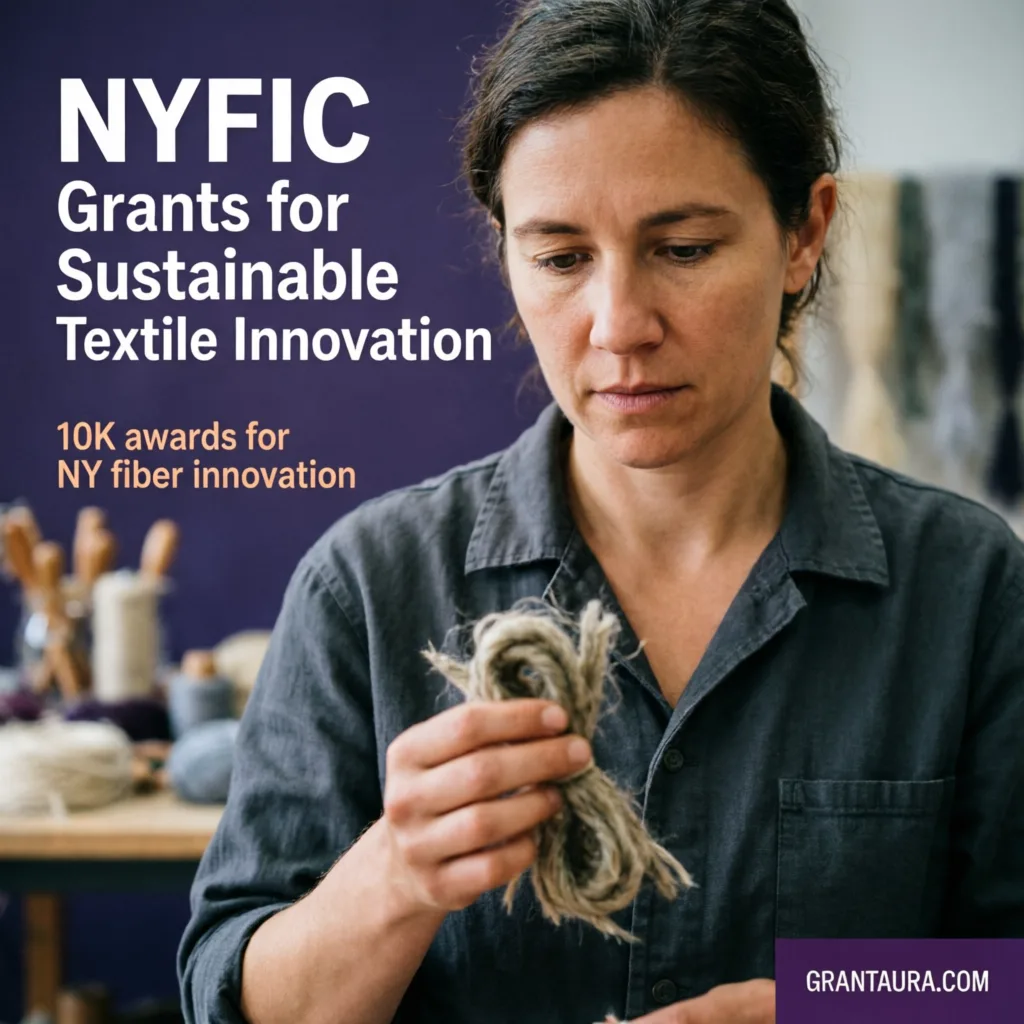
Fixed $10,000 awards for NY textile innovation projects. No cash match. Biannual cycles. Farms, labs, studios, and makers eligible.
$10,000Max Award
New York
Grants For For-Profit Businesses
Grants For Individuals
Grants For Non-Profit Organizations
Grants For Startups
Shahzad Nawaz
Written by
Imran Ahmad
Reviewed by
Your next step
See what this grant would take before you commit
Review your fit first, then choose the level of help you want. You can start with an eligibility assessment, talk through the opportunity with an expert, or get full application support.
Who actually wins here? Farms, labs, makers, and small studios do. NYFIC has already backed wool comforters, circular bioplastic, fiber-processing tools, and wearable tech built with New York materials. That is the useful clue. The program is looking for projects that improve how textile work happens in the state, not just projects that talk about sustainability in broad, glossy terms.
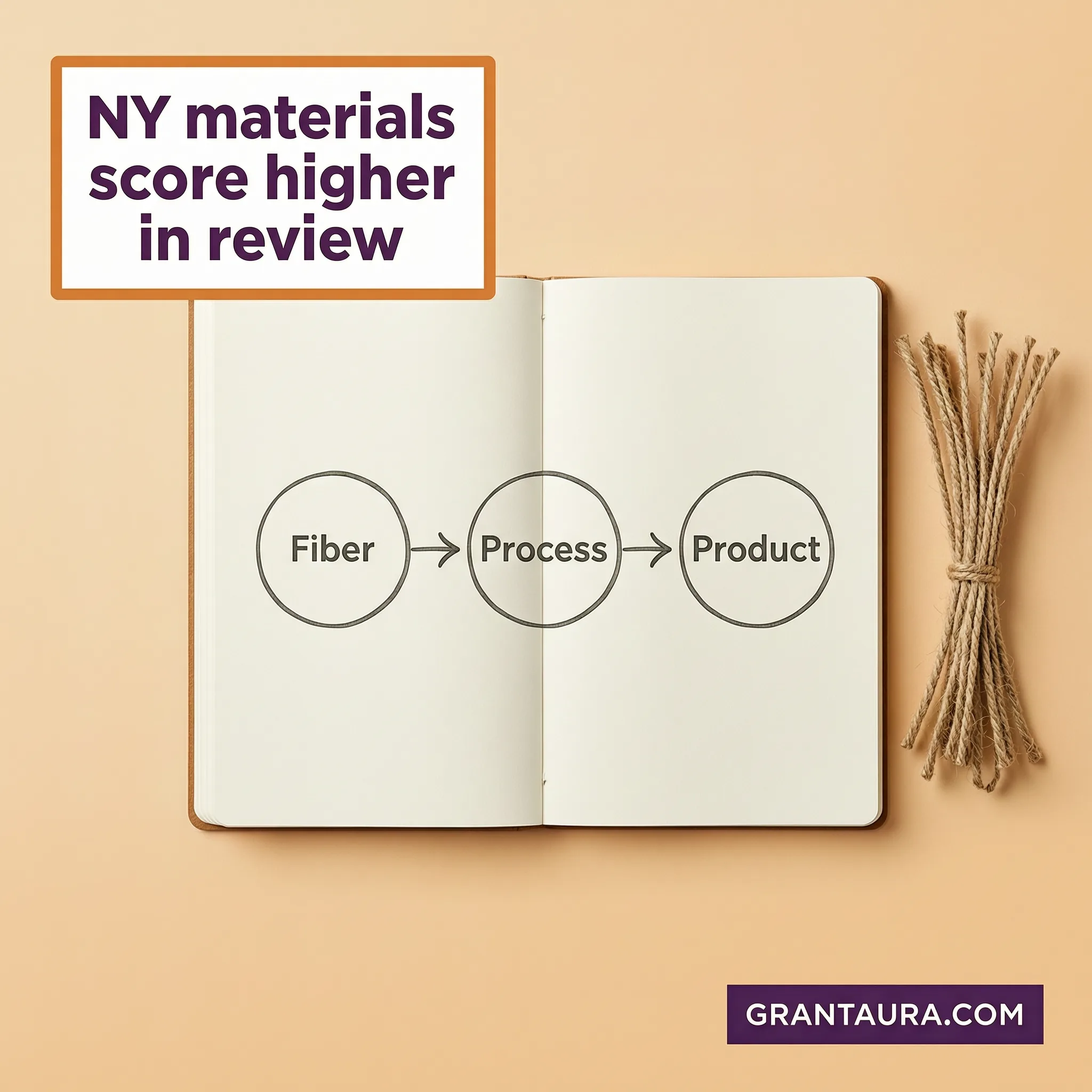
Answer the questions below before drafting anything. The program excludes basic science without a commercial path, and the FAQ is explicit that proposals with New York materials and workforce score better in review. If you’re not sure whether your sourcing counts, the tool will surface that tension early.
Eligibility Check
Eligibility for NYFIC Grants for Sustainable Textile Innovation
Answer a few guided questions. Your responses are matched to this grant’s criteria in real time.
Ready to check your eligibility?
We’ll guide you through a short, structured flow and instantly evaluate fit for this opportunity.
Eligible
You Appear Eligible
Based on your answers, you meet the core requirements for this grant.
Recommended after eligibility
You qualify. Now make sure the application is worth sending.
Eligibility only tells you that you can apply. It does not catch weak answers, missing proof, confusing budget details, or language that makes reviewers hesitate.
This Grant Isn’t the Right Fit. Your Best One Might Be Two Clicks Away.
Missing one criterion for NYFIC Grants for Sustainable Textile Innovation doesn’t mean you’re out of options — it means this grant wasn’t designed for your profile. Our expert research team identifies the grants built specifically for businesses like yours, across 500+ active opportunities.
Basic Match
$125
One-time research
A list of 5 grants only
Basic eligibility matching based on industry & location
Standard funding amount range verification
Primary criteria alignment check
Most Popular
Advanced Match
$145
One-time research
A list of 7 grants only
Advanced eligibility matching with business model analysis
Deep competitive advantage assessment
Innovation & impact potential matching
Market fit & growth trajectory alignment
Premium Match
$175
One-time research
A list of 10 grants only
AI-powered deep-match algorithm analysis
Historical success pattern matching
Priority sector & focus area alignment
Advanced sustainability impact matching
Strategic vision & long-term goals alignment
Preparing secure checkout…
✓
Order Confirmed
Your grant research order is placed. Our team will deliver your personalised report within 3–5 business days. Check your email for confirmation.
Auto-advances after each answer. Use Back to revise.
New York Operations: The Firm Line and the Soft Edge
Physical operations or registration in New York State is the hard gate. No exceptions documented anywhere in the official materials. What happens beyond that gate is where preparation actually matters.
The FAQ puts it plainly: proposals with New York materials or workforce do better in the review process[4]. That phrasing comes directly from NYFIC, not from editorial interpretation. It means a project using out-of-state materials with a NY mailing address is technically eligible but competitively weak. The applicants who treat local sourcing as optional are working against themselves at the scoring stage.
Collaborative applications are allowed. The maximum award per project stays at $10,000 regardless of team size, but listing a New York fiber supplier, a regional manufacturer, or an academic partner strengthens both the Relevance and Team criteria. The trade-off: every collaborator you name requires a short acknowledgment PDF confirming their name, organization if applicable, and proposed role. Simple document, but it needs to be gathered before submission. Solo applicants have no PDF requirement at all.
RPI and NYFIC member organizations must review the Grants Conflict of Interest Policy before applying. Undeclared conflicts are listed as a documented disqualifier.
The Rubric Is Public Now. Use It.
For three rounds, applicants were writing into an opaque review process. The May 2026 Q&A session changed that. Five named criteria, each with a clear framing question[2]. Exact weights remain unpublished, but the descriptions are specific enough to structure a narrative around.
Criterion
What Reviewers Ask
Pattern Seen in Winners
Common Weak Spot
Relevance
Does this address a real NY textile ecosystem need?
Round 1 drew more than 60 applications for 8 awards[1]. That acceptance rate means a passable narrative doesn’t clear the bar. The five-criterion rubric is now the clearest signal available about what separates funded projects from rejected ones.
Which criterion is the weakest point in your current project framing? That’s usually the one worth pressure-testing before you draft.
You can book a 1-on-1 session with a grant expert to map your specific project against these five criteria before committing to the full application. The base assessment fee offsets toward the Full Application service if you proceed.
24 Projects That Won and Why the Range Matters
Three rounds of winners show how far the program actually stretches.
Grant recipients
Who received this grant
These recipients were confirmed through official grant program records.
The full winner archive at nyfic.org/awardees lists all 24 projects. Taken together, farms, biofabrication labs, interior design studios, university partnerships, and individual designers have all received awards. The common thread is not sector. It’s a documented New York supply chain link with a clear project plan behind it.
Applying Through Jotform: What to Prepare
The application lives on a Jotform portal at nyfic.org/apply. Save progress using a free Jotform account. Completion means clicking submit and receiving the confirmation page. If you don’t see the confirmation, NYFIC has no record of your submission.
Required Steps
NYS registration or operations documentation
Project narrative covering focus area alignment and key milestones
Itemized $10k budget with cost justification
Collaborator acknowledgment PDF per listed collaborator
Optional supporting image up to 5 MB
The narrative is where most applications lose ground. NYFIC’s five focus areas have specific vocabulary: circular fashion, sustainable manufacturing, farm-to-fiber, biomaterials, and textile waste reduction. Applicants who describe their work in their own terms instead of mapping it to that vocabulary tend to score lower on Relevance regardless of how strong the underlying project is.
Expert Tip
Draft your narrative against the five rubric criteria as section headers before collapsing it into the Jotform character limits. That structure forces you to address each criterion explicitly rather than hoping reviewers draw the connections.
Do’s
Map project language directly to NYFIC focus area vocabulary
Name NY suppliers or manufacturers even in solo applications
Justify each budget line against a specific project activity
Gather collaborator PDFs before the final week
Don’ts
Describe sustainability benefits without a NY anchor
Lump costs into general categories in the budget
Submit collaborators without acknowledgment PDFs
Rely on the lab being currently operational
What Winning Actually Commits You To
Winners join a cohort. That comes with obligations worth knowing before you apply, not after.
Three virtual meetings: a cohort kickoff, a mid-project check-in, and a closing session with a ten-minute project presentation. A final report of no more than five pages, due within one month of the grant period end. And annual metrics for three years after the grant closes. These are standard for a state-backed program at this level and not burdensome, but they represent a real tracking commitment.
The in-kind benefits are worth listing plainly. A 12-week virtual business coaching program, sourcing connections through the Northeast Fiber Exchange, and access to consortium mentors across NYFIC’s six-member network including FIT, SUNY Morrisville, Hudson Valley Textile Project, Made X Hudson, and Field to Fiber. The NYFIC Lab at RPI is slated to open Summer 2026 and will provide fiber and textile testing infrastructure once operational[3]. At this funding level the cohort package is genuinely unusual.
Frequently Asked Questions
The questions below pull from the official FAQ and the May 2026 Q&A PDF. Where the FAQ and the PDF conflicted with earlier unofficial sources, the official documents win.
How many awards does NYFIC make per round?
Seven to eight per semi-annual cycle, per the official FAQ. Not a guaranteed eight. The program aims for that range through 2027.
Is a cash match required?
No. Collaborative teams can apply but the maximum per project stays at $10,000 regardless of team size.
What counts as a qualifying NY operations footprint?
Physical operations or registration in New York State. A mailing address alone hasn’t been tested publicly, but the program’s clear scoring preference for NY materials and workforce suggests reviewers look for substantive in-state activity, not administrative registration only.
How long does review take?
Two to three months per the official FAQ. Round 4 award notification is expected in Fall 2026.
Can nonprofits apply?
Yes. Nonprofits with NY registration or operations are eligible on the same terms as businesses and individuals.
What’s actually excluded?
Basic science research without a clear commercial path. General operating expenses and debt repayment. Projects without any New York connection. RPI and NYFIC members must declare any conflict of interest.
Do prior NYFIC winners qualify for future rounds?
Not addressed in any official documentation reviewed. Contact NYFICgrants@rpi.edu or call 347-524-5488 to confirm before applying.
Related Programs Worth Knowing
Not every project is the right fit for NYFIC’s narrow NY supply chain framing. Two alternatives with genuine audience overlap:
Key Points
eBay Circular Fashion Fund: $50K project grant for circular fashion with format overlap and no geographic restriction – strong option for applicants whose project extends beyond NY sourcing
Global NY Fund: NY-based business grant backed by Empire State Development with broader sector eligibility and audience overlap for manufacturers and small businesses already in the ESD ecosystem
NYFIC Grant FAQ: New York registration is required and New York materials or workforce improve review positioning. Back
I worked through the official winner archive, the May 2026 Q&A PDF, and corroborating trade press to give an accurate picture of what the review process actually rewards. The rubric being public this round is a real change. Shahzad Nawaz.
We are your trusted grant application partners. You can navigate the entire grant application process with our expert guidance through this simple 5-step process.
300+ Projects
4.9/5 Rating
Expert Team
Step 1: Application Form
Fill out the “Apply for this grant” form with your information and grant requirements.
Step 2: Eligibility Assessment
Our grant experts will assess your eligibility and notify you via email.
Step 3: Expert Consultation
A dedicated grant expert will be assigned to discuss next steps for your application.
Step 4: Application Submission
Our expert will help you complete and submit your application with all required materials.
Step 5: Final Decision
The grant committee will make their decision and notify successful applicants.
My name is Shahzad Nawaz, and I work as a freelancer. Writing for my readers isn’t just something I enjoy it’s central to what I do. I’m constantly exploring new ways to improve my craft, because writing isn’t merely a hobby for me; it’s an essential part of my professional life.
You are on NYFIC Grants for Sustainable Textile Innovation. I can help check fit, explain the December 2, 2026 deadline, compare effort, or decide whether Grantaura application support makes sense for this grant.
No chat history in this browser yet.
You are in queueIAGA
A Grantaura colleague can review this conversation. You can keep chatting with the assistant while you wait.
Tell us about yourself
0/1000
i
The information you add here helps the assistant answer this browser session more clearly. Close this window to continue the chat.
Check your eligibility
Check your saved details, answer the grant questions, and see your next steps.
Grant team review
Saved details where available
Free assessment
Save option
Save this grant application for later
Send yourself a private link so you can return to this grant form with your details ready.
Keep your post public. Our team will verify the link before processing your assessment. If the post is deleted or made private after submission, your free assessment will be void.